Category Archives: Abbie’s column

Abbie’s newspaper columns

Tikorangi Garden Diary number 2, June 3, 2011

A magic run of autumn weather has seen all three of us out in the garden every day. Temperatures remain very mild even though we are now technically in winter. I am nearing the end of my marathon on the Avenue Gardens – another two weeks of reasonable weather and it may be done. We are not big on measuring (and counting plants does not even enter our orbit – we can never believe people who boast that they have 245 roses or 415 rhododendrons. Who can be bothered counting?). But reading a brag book boast by somebody else, I had to pace out the Avenue Gardens to see if I was exaggerating my current task. It measures somewhere over 4300 square metres which I think converts to over an acre of intensive garden. No wonder it is a major task.

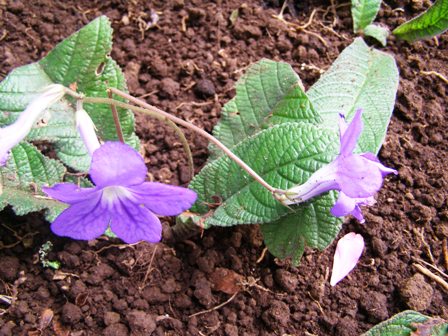
Dividing the streptocarpus

Dividing the streptocarpus

Today has been lifting and dividing streptocarpus – members of the gesneriad family. We are not big on bedding plants here but the streptocarpus survive well in reasonably hard, woodland conditions. They have tiny root systems and seem to muddle on very successfully despite benign neglect so I am hoping they may thrive in freshly tilled soils. They are frost tender and more commonly grown as house plants (like their siblings, gloxinias) but add a touch of the exotic as garden plants.

Mark has been doing a weeding round. He is the Chief Weed Controller here and takes his role very seriously. In a large garden, weed control is the first line of defence against the encroaching wilderness that hovers forever on the boundary, waiting to make inroads. We admit to using glyphosate. There is no way we could maintain the garden without it. The push hoe is fine in summer for the veg garden and for emergency intervention, but glyphosate is indispensable. Mark lives in fear that research may one day rule that it is unsafe, but as long as we can believe that it is not an environmental threat, we will continue its use. The aim here is always to avoid any going to seed. Good weed spraying should be as close to invisible as possible, which means getting the weeds when they have just germinated and never, but never, spraying edges. Various edging tools were designed to get clean, crisp edges, not weedkiller which leaves an unsightly dead fringe.

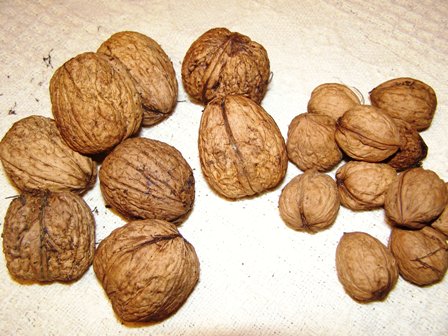
Bigger is better when it comes to walnuts. Standard walnuts to the right, what we think is Freshford Gem to the left

Bigger is better when it comes to walnuts. Standard walnuts to the right, what we think is Freshford Gem to the left

We are drying walnuts and have a good crop from our large walnut this season. As far as we know, it is Freshford Gem, an Australian selection. It is far more rewarding to work with big nuts, rather than the standard size so if you have a choice when it comes to buying trees, chose the ones that boast very large individual nuts.

I was just ever so slightly put out this morning to read the garden pages of our local paper (until last week, I contributed the bulk of copy) and to see that my beloved Plant Collector column has been replaced with indecent haste – by a shopping reporter. Sigh. Gone is the freedom I had to write about any interesting or appealing plant, regardless of whether it was available to purchase or not. Now garish synthetic clogs are the order of the day. It must be a sign of the times. The Philistines have taken over.

The end of an era – but another door will open

The steady flow of posts on this page has been the material I wrote for our local newspaper – the Taranaki Daily News. That all stopped in its tracks this week. After 14 years, I am no longer their garden writer.

While a little surprised at this sudden turn of events, the relief was instant. I realised that I had become bored churning out an endless flow of material to agreed formats. It is time for new challenges. In the short term, this means that there will not be the three new articles every Friday. Without the discipline of a newspaper deadline, posts will be random. But I am a compulsive writer and exploring other outlets, so something will continue, even if I am not yet sure what that will be.

In the meantime, I have had a lovely week in the garden, beavering away on a particularly troublesome border. To be free from deadlines has been liberating. I will not miss trying to come up with fresh ways of reminding people what to do in the garden week in and week out, 52 times a year. Over morning coffee (with home baking here, as a rule) I would pose the question to Mark and Lloyd every week as to what we should be doing and most weeks they would look back at me with blank looks. And I was running out of ideas for Outdoor Classroom.

I will miss doing Plant Collector and my column, particularly Collector which is fun to write so that may well continue. A number of people subscribe to this website and receive new posts direct to their email address. There is no charge to subscribe so if you have been in the habit of visiting each week, you may prefer to sign up, while posts are less predictable. Mind you, it looks better on the website than it does in email format.

Best regards,
Abbie

The Sequel – a second coming for the Tui NZ Fruit Garden

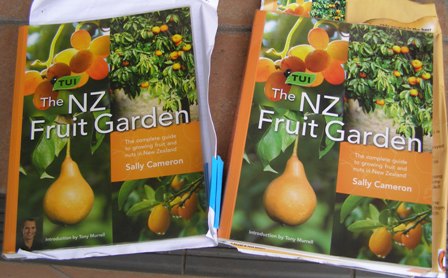
The first version to the left, the revised edition to the right.

The first version to the left, the revised edition to the right.

After due consideration, Mark's verdict was an emphatic thumbs down

After due consideration, Mark's verdict was an emphatic thumbs down

I am married to a patient and kind man but he has been looking ever more exasperated over the last two weeks. I put The Tui NZ Fruit Garden in front of him for comment because his experience with growing fruit and nuts is greater. As he dipped in and out of various chapters, he was finally moved to exclaim that he could not fathom why Tui, Tony Murrell and Rachel Vogan would put their names to this book and give it a credibility that it does not deserve.

If this seems slightly familiar to you, dear Reader, that is not a surprise. This book is the sequel – the revised edition, it tells us on the frontispiece (but not the cover). The first version was the subject of a piece I wrote this time last year, backed up by a lead story on the front page of our newspaper and picked up extensively by national media. There was a little problem with plagiarism by the author, Sally Cameron. Well, quite a big problem really – in fact an enormous one. The publishers, Penguin, pulled the book from sale immediately, mere days after it had been released. Nobody associated with the book ever commented on that withdrawal from sale so the general assumption was it had all died a natural death. No. Little did we know, they were preparing for a second coming. And here it is. It looks the same. The author is the same. The cover has been recycled. So is it the same?

I think the plagiarised sections have gone. I didn’t do an exhaustive analysis but I would guess that they have been quite thorough, given there are legal issues to be considered. But the plagiarism was only half the problem. In reviewing the original version, I was equally critical of the woeful lack of experience and knowledge by the author. And the rewrite has highlighted this even more. At least when the author was cutting and pasting information from the internet, she was generally getting it from credible sources even if they were from overseas. Now that it is in her own words, it often plumbs new depths. “A Chilean guava, pomegranate or feijoa bush can offer hedging that is just as effective as a Buxus.” Really? Shame the pomegranate is deciduous and if you clip your feijoa like you clip your buxus, you will be taking off all next year’s fruiting tips. Or, when writing about grapevines needing support: “This can be shaped or manipulated at leisure to provide a sculptured habitat for the vines to drape from.”

Even worse is the advice on protecting your grapes: “Broad pieces of netting with holes wide enough to let the sun in but keeping, bugs, diseases and birds out help let the fruit ripen nicely on the vine.” Leaving aside the description of broad pieces, since when has any netting kept out diseases and what fine grade of mesh would you need to keep out bugs? Wasps don’t even rate a mention but they are one of the biggest problems, in our experience. The sort of information that the reader needed and deserved to be told is that Albany Surprise is an excellent selection for marginal and humid conditions. Because it has a tougher skin, if you can net the birds out then the wasps can’t pierce the skin and get in to the fruit.

At least lychees, mangoes and pineapples have been consigned to a brief two page spread at the end of the book, under the title of “Fruit not commonly grown in New Zealand owing to climatic restrictions” but it is hard to understand why carambola or star fruit, which is equally marginal, remains with a four page spread of its own in the main body of the text. Maybe the author wanted to show off her recipe for pickled carambola? Proper cranberries (Vaccinium macrocarpum) should have been grouped with the lychees and mangoes too. Equally hard to understand is why tomatoes are included in a book about fruit gardens. Yes, botanically they are a fruit but every home gardener and cook regards them as a vegetable and they are grown in the veg garden, not the orchard. Doing a cut and paste of the tomato chapter from the companion volume, the Tui NZ Vegetable Garden, could be described as having a bob each way but it is unnecessary padding in a book about growing fruit. Some of the other inclusions are odd – the medlar, introduced to this country by the early settlers, is a fairly decorative tree but not worth the space in the orchard as a fruiting tree. Given that you have to wait until the small fruit are nearly rotten before you eat them, why would you bother when we can grow apples and pears so well? Peanuts are a novelty crop grown in the vegetable garden and limited to the hottest and driest parts of the country. But don’t expect too much of that sort of information in this book. In most cases, the author lacks the experience to know what is important and to sift the information accordingly.

Take kiwifruit as an example. For starters, where can you grow them? According to this book, “The kiwifruit is an appropriate crop wherever citrus fruits, peaches and almonds are successful, though the leaves and flowers are more sensitive to cold than those of orange and peach trees.” Right. So this means kiwifruit need more warmth than citrus? But refer to the entry on almonds and it says: “Almonds happily grow in areas with warm summers and cool winters.” So I guess we are talking Hawkes Bay, Marlborough and Central Otago? Refer to peaches and it says: “… a long chilling time ensures a good fruiting crop in summer.” Even we became confused about where you can grow kiwifruit successfully but at least we know that it is a warm temperate to subtropical crop.

If you are a novice and you can deduce whether your area is suitable for growing kiwifruit, what you need to know is that it is a rampant vine and if you don’t prune it thoroughly every year, it will swamp your section and choke out everything else very quickly. The book does at least tell you that kiwifruit are not self fertile so you need both male and female though it fails to mention that only the female vine produces any fruit. I will quote the section on pruning verbatim, so readers can assess for themselves whether they would understand how to prune kiwifruit from this information (including the fact that male kiwifruit vines are pruned differently to female ones). “Pruning: After fruiting has finished, the vines should be pruned in late winter, before the spring warmth. Shoots from summer pruning will not be laden with fruit until the following year after dormancy. Male plants will yield more pollen in the spring if new shoots are pinched out to leave five to seven buds during the summer. Winter pruning renews the fruiting arms, enabling plants to fruit well each year.” Got that, have you? Now you know how to prune your kiwifruit?

Another burning question about kiwifruit which most people want to know is where to buy the new yellow cultivars. The fruit is illustrated but it doesn’t tell you that you can’t buy plants. Hort Research and Zespri, who own all the research on new cultivars, keep very tight control of plants and they are not available to the home gardener. But the book does recommend Cocktail Kiwi, an unproven novelty variety – a rampant grower which is distinctly shy on setting fruit and when it does come it is about half the size of your thumb.
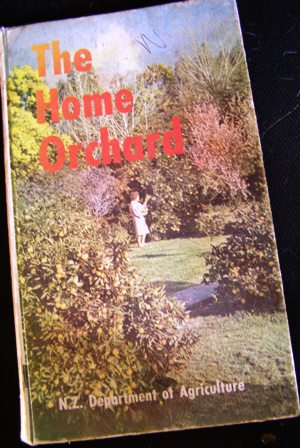
Ever so modest but well thumbed. I can not think that the Tui NZ Fruit Garden will still be around in 40 years time.

Ever so modest but well thumbed. I can not think that the Tui NZ Fruit Garden will still be around in 40 years time.

Kiwifruit is just one example. The book is full of chapters which are similarly inadequate. But according to Penguin, “this book contains all the essential information you need” and “it will become the reference for gardeners of all skill levels….” We wish that were true. Had this been the first release of the Tui NZ Fruit Garden, Sally Cameron and Penguin Publishers might just have got away with it, marginal though it is. To have a second shot at the same book using the same author, it needed to be very good indeed. It isn’t. We will be keeping to our old tried and true modest volume called The Home Orchard, published by the NZ Department of Agriculture in 1973. It is not glossy or trendy but at least it is by people who knew what they were writing about and it only cost us $2.25 to buy at the time.

The Tui NZ Fruit Garden, by Sally Cameron with Rachel Vogan. (Penguin; ISBN: 978 0 14 356536 9).

For the earlier story on mark one of this book, click on The Tui NZ Fruit Garden – dear oh dear.

Breaking the Mould of the Modern New Zealand Garden – the Dreams at Paloma

The combination of foliage and colours brings life to the Bamboo Forest

The combination of foliage and colours brings life to the Bamboo Forest

I wrote in my last column about the brave and grand visions of Bob Cherry in Australia. I recently revisited another garden which never fails to surprise me and it is considerably closer to home. Paloma is Clive and Nicki Higgie’s creation at Fordell, just on the other side of Wanganui. It, too, takes in a sweeping vision on a scale which is not common. It is not a pretty garden in the accepted sense. I can’t recall seeing any roses there. There is a distinct lack of frothing perennials. I think I am on safe ground when I say that there are no clipped buxus hedges defining the spaces. In fact, Paloma has avoided pretty much all of the modern clichés of good gardening. But it is an outstanding garden.
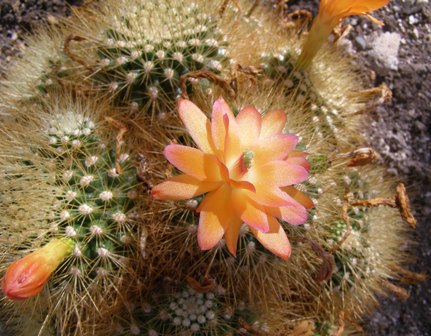
Beginning with a blank canvas but reasonably extensive land with interesting contours (they are farmers), Clive and Nicki started by sourcing pretty much every interesting plant they could find back a decade or three when specialist nurseries still existed. They lean to the exotic plant side from preference. So from the start, palms, cycads, large, tree-like succulents, rare trees and bamboo dominated but the plant collection has gone way beyond those families. They were certainly pushing the boundaries of what could be grown in their climate right from the start but, as plants mature, micro climates change and the tender plant material looks completely at home these days.

The Garden of Death - social history and toxic plants, not a memorial

The Garden of Death - social history and toxic plants, not a memorial

When you are building plant collections from the start, it is natural to group families of plants in the situation that best suits them. With the passage of time, those groupings mature to different themed areas but it takes advanced skills to turn those collections into a garden. The owners in this case describe the garden as having distinct zones which include the well established Palm Garden (a very good collection of palms), the Jardin Exotique (a strong Mediterrranean influence, named for Nicki’s French heritage), the remarkable Bamboo Forests and two arboreta. I am not even going to try and draw a word picture of this expansive garden. It is an ongoing project but, being in distinct zones and project-based, it does not fall into the rambling but-wait-there-is-more trap of some large gardens.

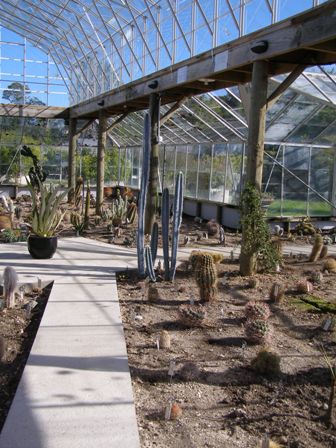
The recent Desert House project

The recent Desert House project

The large desert house is a new installation, made necessary by the gift of a huge collection of well established cacti and succulents. A traditional earth labyrinth (dug by hand) is nearing completion. Clive is having a great deal of fun building the new Garden of Death. This is not to be confused with a pet graveyard. Rather, it is a unique environment for another themed plant collection which is focussed on poisonous plants and their social histories. With a touch of whimsy, they refer to it as the GoD garden.

It is that sense of whimsy which gives Paloma its special character. Those of us who count Clive as a friend tend to be in awe of his productivity and his wide range of practical skills. This is not a garden where money is spent bringing in outside contractors and tradesmen. Clive must be the ultimate D.I.Y. man, the epitome of that New Zealand ethos. But this is not about cobbling together a walkway or putting in a bit of retaining wall. He builds. He welds. He creates. In the early days of making the garden, those creative energies were primarily directed into projects using the plants. These days the bulk of the planting is done, although the arboreta are ongoing projects. An arboretum, by the way, is a deliberate collection of different trees (not to be confused with a forest or a plantation) and, being Latin, the singular is arboretum but only the determined and the fortunate have the plural of arboreta. Garden maintenance is always necessary but it is hardly creative so I would guess that the creative instincts have found new direction in sculptural installations and building. There are neither classical repro statues nor kitset octagonal summerhouses here. Paloma is characterised by one-off originals, at times combined with strong colour, occasionally provocative, often quirky.
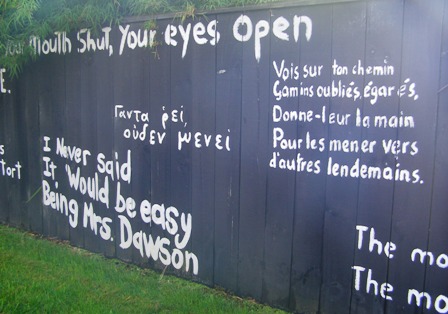
Wit and whimsy on arrival at Paloma

Wit and whimsy on arrival at Paloma

If you only enjoy visiting gardens that look like your own, you may find Paloma disconcerting from the moment of arrival at the simple board fence which has been transformed with whimsical writing. But if you like the challenge of being stimulated rather than soothed on a garden visit, the multiple layers and complexity of this garden environment will be a surprise. I do like a garden where you can’t take it all in on the first visit.

Paloma is not a seasonal garden in the usual manner so there is no single best time to visit. For more information, check out their website (www.paloma.co.nz) , email them (paloma@paloma.co.nz) or phone 06 342 7857.

Turning  plant collections into a garden - Paloma

Turning plant collections into a garden - Paloma

Paradise Found in New South Wales

The quixotic creations of Bob Cherry

The quixotic creations of Bob Cherry

If you ever have any doubts about the quality of service at our local information centres, try going to the tourist information office at The Rocks in Sydney and ask about gardens to visit in the area. If you wandered into our I-sites, it would be reasonable to expect them to come up with maybe six or more options which would include a mix of both private and public gardens. Not so in Sydney. The staffer resorted to Google (which I had already tried at home) and merely pulled up real estate open homes in areas with garden type names. It remains a mystery to us as to whether there are in fact no open garden options beyond the botanic gardens. If there are, we failed to find them.

We did find the Royal Botanic Gardens which are very close to the Sydney Opera House in a magic location. The parking metre fee of about $26 made me wince and the café where we had lunch was downright ordinary. The wonderfully decorative ibis who have clearly adapted to café fare were the best part of lunch. Mark was particularly impressed by the palm collection and chose to linger there, studying mature specimens of varieties he has here to put into his planned Palm Walk but in the end it was the bats which provided the most vivid memory. Many large bats, hanging about in trees. I had been under the misapprehension that bats slept during the day. Not so, at least not these Sydney bats. They merely hang around upside down, bickering, squabbling, fighting and generally making a lot of noise. While the bats are vital for pollinating certain plants in the gardens there, numbers had built up to such a high level that they were also responsible for doing a lot of damage to many trees. I think we were told the current population is estimated to be around 16000, and that was not in a large area. The gardens’ management have permission to try and reduce the population but, this being Australia with a laudable commitment to their indigenous fauna, there is to be no cull. Instead they will attempt to drive the bats out by emitting a particular frequency of sound which only the bats can hear. Lucky neighbours. The bats do not apparently fly very far so upwards of 16000 displaced bats are likely to settle nearby.

We had to drive upstate to find a garden – in this case, one created by leading Australian plantsman, Bob Cherry. The garden he and his wife, Derelie, own is called Paradise and is located in Kulnura. Readers may not know the name Bob Cherry but many will know of Paradise camellias, particularly the Paradise sasanquas which completely dominate the markets both in Australia and New Zealand. However his interests go well beyond camellias and he was working with bidens, amongst many other plants, in search of new garden varieties. What is a bidens, you may ask? Closely related to cosmos and the orange and yellow so-called cosmos that turned up in a packet of pink and white cosmos seed here are in fact bidens. There are also common weeds that are bidens. Beyond bidens, begonias, Camellia sinensis, michelias, polyanthus and many other plant varieties were undergoing the Cherry touch in the quest for better garden plants.

Camellia changii - reputed to flower throughout the better part of the year

Camellia changii - reputed to flower throughout the better part of the year

Bob has made over 40 trips to China since it opened up to the west in the early 1980s and has been responsible for introducing a wide range of new species and plants to the west. We were fascinated to see Camellia changii in flower – in early March. Apparently it flowers all year round and its March flowers were certainly eyecatching, being a true scarlet red with no pink tones at all. Camellia changii is also sometimes referred to as Camellia azalea, although I have failed to find any explanation for that name. In the wild, changii is rated as extremely endangered but it has been distributed around the world and it opens up possibilities for breeding a new race of camellias that flower outside the time when petal blight hits. Of course they don’t have petal blight in Australia. Yet. Bob told us that he point blank refuses to visit New Zealand during camellia season. He thinks it is probably only a matter of time before petal blight reaches Australia but there is no way that he wants anybody to be able to claim that it was first found in his garden or nursery.

Bob and Derelie garden on a pretty grand scale and, typical of most Australasian gardens, they do it themselves with minimal input from outside labour. We didn’t even look at Derelie’s extensive rose gardens, but there is an extraordinary range of woody trees and shrubs, including some of the best foliaged Michelia yunnanensis (syn. Magnolia laevifolia) that we have seen. But the other stand out features of this garden called Paradise were Bob’s structures. I am not sure I can convey the full scale of these. We built a pretty large brick wall here in our garden and it took 16000 bricks. Bob has so far used an estimated half a million bricks on his structures. And that does not include the extensive stonework and ironwork. He gets in a brickie whenever his budget allows but he does all the stonework himself. We are not talking brick paths and dinky little structures here. This is grand vision stuff. The pillared walkway shown in the photograph is as yet unfinished. There are now 50 of these massive brick columns and it is to be an extension of the wisteria walkway. There is something bravely compulsive about some of the constructions – a vision the creator is determined to get well underway, knowing that he may never see completion. His property is on the market and he yearns for retirement to a smaller piece of land in Tasmania. Bob Cherry is one of the gardening world’s modern quixotic gems.

Derelie has published a book on the garden which is available in New Zealand. “Two Dogs and a Garden” is a beautifully produced book, full of pretty photographs (very pink, but how could it be otherwise when camellias play a large role in their lives?) and a personal interpretation of the lives they lead in their own piece of paradise.

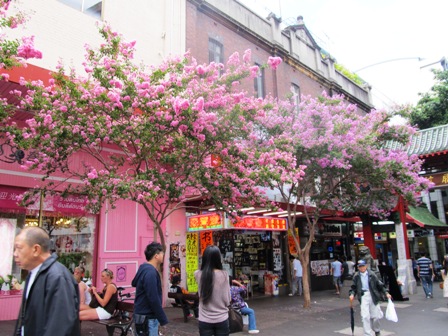
Finally back to Sydney, we were delighted by the crepe myrtles used as street trees and in full flower in Chinatown. The crepe myrtle or lagerstroemia is a small tree, mainly from Asia, with beautiful bark. They can look remarkably dead when they are dormant in winter. We saw some in northern Italy, completely dormant, with bark which resembled piebald ponies. They will grow here, but they rarely flower well. We are just a bit too wet and lush for them. They tend to do better in drier climates with hot summers and more seasonal variation than we can give. Being a small tree with a light structure, they make a well behaved street specimen. In flower, they look a little like trees covered in crepe paper blossoms which seemed entirely appropriate to the ambience of Chinatown.

Crepe myrtles in Sydneys Chinatown

Crepe myrtles in Sydneys Chinatown