Category Archives: Abbie’s column

Abbie’s newspaper columns

A Major Mission in the Rockery

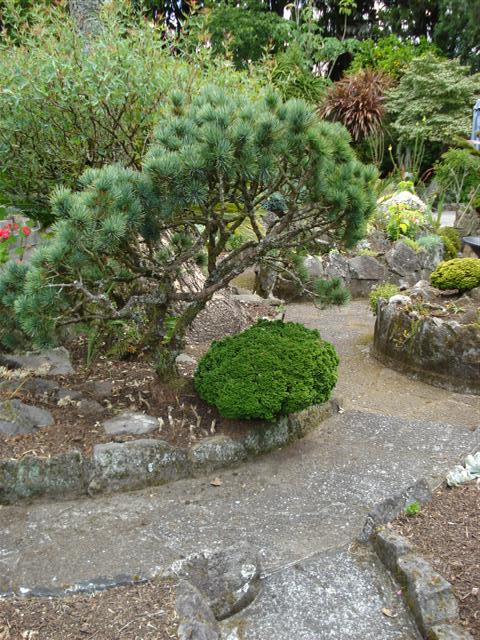
The refurbished rockery looks a little barren in places but below the mulch are many bulbs waiting to spring into fresh growth

The refurbished rockery looks a little barren in places but below the mulch are many bulbs waiting to spring into fresh growth

My current activity started in a very minor way. I must thin out the Cyclamen hederafolium and nerines in the rockery, I thought yet again but this time I had my timing more or less right. The nerines look fantastic in flower in autumn but the clumps had become so large that they had forced themselves up out of the soil and the foliage hangs on right into late spring, swamping treasures around them.

What I did not realise when I started was that the task was going to be so major that I would spend eight hours a day for several weeks, taking apart the contents of the rockery pocket by pocket. It has become a Major Mission.

Cyclamen hederafolium is the autumn flowering species, formerly known as neapolitana. It is a gem which flowers over a period of months in white and, more commonly, cyclamen pink. After many years, decades even, they sure were overdue for thinning out. They grow from flattish, round corms and a large one is about 10cm across. Some of ours were closer to 25cm across and as I gently excavated, I found them up to three deep. In fact, my thinning exercise yielded up around 60 litres of surplus corms with which Mark plans to carpet woodland margins and add to his naturalised bulb hillside in the park. That is six 10 litre pots, in case you are wondering how I arrived at the 60 litre figure.

Having started, I found that the English snowdrops and black mondo grass which share some of the same rockery pockets were also in desperate need of thinning. And while I was about it, I figured the heavily compacted soil could do with aeration and a light dressing of compost. Then the rocks needed some of the lichen and moss scraped off them and some of the pockets had soil levels which overflowed. In fact a complete spruce-up seemed in order. And of course the areas which I did looked so fresh and clean that I felt I had to continue. I am still not finished but I am a driven woman and will not desist until I have done the lot. I have uncovered rocks and divisions in the pocket beds that we did not even know existed.

Rockeries are not in fashion these days, not at all. Ours is a 1950s style rockery using raised beds in island formation. There are a lot of rocks, brick and concrete in it and it must have been a major exercise to build. I had not noticed before that the largest rocks are in the beds closest to the drive. The further you go from the vehicle access, the smaller the rocks get and the more freeform concrete construction there is. I can understand why. Some of the largest rocks must have been very difficult to move.

The basic rockery concept is to emulate the conditions of an alpine meadow. We can’t do alpine, though we have tried. We lack the winter chill and are a great deal too humid with rainfall evenly spread all year. Alpine meadows are cold deserts kept dry in winter by a coat of snow and ice. So our rockery plants are by no means traditional. No gentians or edelweiss here. But what it gives us is a section of garden which is highly detailed, where the pictures are small and individual and baby gems can be admired in close up view. It is entirely different to the big picture style of garden where form, colour and flow are what dominate. Bulbs rule in our rockery, especially those of a miniature or dwarf persuasion. We use cycads, venerable dwarf conifers and some smaller growing perennials so the area is not totally bereft of woody and herbaceous plantings but they are merely the backdrop.

Best guess is that there are well over 500 individual pockets in our rockery. And the skill that has my gardening ability stretched to its absolute limit is the creation of differing combinations in at least some of those pockets. So one may contain nerines for autumn colour, moreas (peacock iris) for early spring and a small perennial such as a prostrate campanula for summer interest. I can not claim that I get triple layering in them all. I wish. Alas some will be bare during parts of the year because they are too small or I Iack the material or skills to plant in layers. But the structure provides the year round interest and does not demand to be filled to capacity twelve months of the year. Some bulbs will only flower for one or two weeks but in that time, they are the daintiest and most ephemeral of delights which would be lost entirely in larger garden beds.

Mark’s parents both loved the rockery. Stepping out from the house, there is always something different to view. Day to day maintenance is relatively easy. We have always worked to keep it weed free, to restrict the occasional invasive bulb (it is why one has separate pockets to keep those with wandering ways in a confined area) and beyond the occasional light mulch and ongoing tidying, it is not generally labour intensive. With most of it being raised, it is not back breaking either. Many bulbs are happy to continue in an environment which is relatively poor. But there comes a time when the soil is so impoverished and compacted that treasures start to go back and thugs multiply so much that the competition is to survive, not necessarily to flower well.

Bulbs are not gross feeders so we like to spread a thin layer of compost on top to mulch and give a light feed only. Not every plant is precious and that realisation has been wonderfully liberating. Some plants are past their use-by date. Some are just in the wrong place. Some have multiplied too well so there are too many of them. Going though centimetre by centimetre has been like a voyage of discovery. I have worked out that I can average about four square metres a day if I stick at it. With about 100 square metres of rockery, it is a mere 25 days work.

Some people like to garden in containers to keep little treasures apart and to be able to give different conditions. Despite my current intensive effort, I think the rockery concept takes less work overall for more aesthetically pleasing results. Maybe the rockery will stage a fashion comeback. If the thought of assembling, placing and securing all those rocks defeats you, there is an alternative in what we call the carpet garden, but for more thoughts on that garden genre you will have to wait.

Crystal ball predictions for the 2010 gardening year

Ah, that wonderful Christmas – New Year hiatus. In the days before the Boxing Day sales and indeed before seven day trading, it used to be more of a coma than a hiatus but even now, in this country, we settle in to holiday mode. Why else would we tolerate the truly appalling offerings on television where there is rarely anything worth watching? Clearly we are all meant to be reading the Christmas books or chatting to family and friends instead. And the print and electronic media, yours truly included, sink into a period of reflection, summarising the year past and bravely making predictions for the year just starting. This is at least one step better than recycling earlier offerings under the headings of “ 2009 Highlights” or “Best of…”. So I shall resist the temptation to recycle a piece from earlier this year (though I will admit to being proud of the series I wrote on English summer gardens which is still on this website) and look into my crystal ball.

I believe we will diversify from vegetables. Veg gardening is not fad or fashion but the all consuming obsession is showing signs of dilution. There is a hint that some would like to read about other types of plants and gardens as well as home food production. I recall an Auckland journo wryly commenting on the $70 lettuce. That is the cost for some of producing their first and sometimes only produce after buying planter boxes, the bagged potting mix and compost, the most basic of tools and punnets of small plants from the garden centre.

Serious vegetable gardening will continue for some, but many of those who follow fashion and trends will be realising by now that to be a successful vegetable gardener requires some expertise and skill and quite a bit of time. You can not just plant the seeds or baby plants and then ignore them. Dilettantes will lose heart and move on. The declaration that one will only plant productive trees and shrubs may be a sign of naivety and not the higher moral ground. It could be argued that the doom and gloom of the recession had us all looking to survival mode. Now that the clouds are lifting, increased optimism allows space for aesthetics and beauty in life as well. And I can assure you that while the walnut tree I see outside my window fruits and we enjoy its harvest, it is but a poor aesthetic specimen compared to the magnolia nearby which is lush and opening its summer flowers. We need to nourish more than just the body and to titillate more than the taste buds. In our eyes, the complete garden goes well beyond just fruit and vegetables, although they are an important element.

The upside of the vegetable craze has been the return to some old fashioned values of seasonal eating, taking pride in home produce and super fresh ingredients given a new twist with some rather more sophisticated international flavours. I reviewed a rather large number of cook books last year for the food pages (Second Daughter was fearfully impressed last week with my shelf of recipe books and I only keep the ones I like) and certainly the current focus is very strongly on eating locally sourced foods in season. The delight in being able to transcend seasonal limitations by buying food which has crossed the hemispheres is a thing of the recent past for many of us. We now care whether the garlic and onions come from China, the grapes and nectarines from USA, the kiwifruit from Italy and the pork from Australia. We would rather it came from Te Kuiti or the Rangitikei, thank you, if we are to move outside our local area. So I would expect we will see farmers’ markets go from strength to strength.

The local focus of the farmers’ markets may well extend to wider gardening practices. Here, we raise our eyebrows at the widespread use of mulches, potting mixes and composts shipped across the country when there are local alternatives with much smaller carbon footprints. Pea straw is the classic. It has a great reputation as garden mulch (though it is a myth that it adds nitrogen to the soil because the nitrogen is in the roots of the pea plant and pea straw by definition, is the dried tops only) but have you ever asked yourself where the nearest commercial production of peas takes place? It is being shipped hundreds of kilometres in a large truck in order to cover your garden when there are local alternatives which will do just the same. Try locally produced granulated bark or compost, pine needles, even barley straw from South Taranaki.

The move away from poisons and sprays is a trend we expect to see escalate. Our tolerance level in this country for the use of some extremely heavy duty toxins is very high indeed, often justified as a lesser of two evils. 1080 is the classic: this mass poisoning on a grand scale with a particularly unpleasant toxin which enters the food chain is government sanctioned but we are seeing the tide of public opinion turn. At least 1080 is tightly controlled, whereas the over the counter poisons that are freely and abundantly sold here are arguably worse. Rats, mice, possums and rabbits – you too can bowl into a shop and buy some nasty poisons. The trouble is that many will enter the food chain, some have no antidotes, some are appallingly slow acting and unpleasant and in this country we are all too cavalier in our use of them. Worry whenever you see the term by-kill. It is the unintended death of other life than the target. A cute little dog named Wilfred, in our case, and the poison that killed him did not originate from our property. While we shoot all our possums here, a common possum poison used by others is very slow acting and can enter the food chain. We are having to review our long held practice of feeding the carcases to our animals. The time when we see a sharp reduction in the usage and availability of such toxins can not come soon enough for us, or indeed for the environment of our country.

Buffy the cat, potential by-kill, even even though Mark shoots all our possums. Slow acting over-the counter poisons may mean the carcase is already toxic.

Buffy the cat, potential by-kill, even even though Mark shoots all our possums. Slow acting over-the counter poisons may mean the carcase is already toxic.

Organics, we predict, will become more mainstream and increasingly widely practiced. It may not be organics as the purists know it. Indeed it is highly likely to be a heavily diluted form and possibly derided by the dedicated converts. But anything which sees gardening move away from practices and habits which rely more on the use of chemicals than on good gardening strategies has to be an improvement. If we follow the European trends, ever tighter government controls will stop home gardeners having access to a range of sprays and artificial fertilisers which have been used to prop up poor gardening practices, poor plant selection or unsustainable habits.

The wheel is turning. After a decade or more of rampant consumerism, conspicuous wealth and people who are time-poor, gardening is on the up again and for that we have the vegetable craze to thank. It all looks a great deal more wholesome and cheerful than a few years ago. Happy New Year and may 2010 be one of good gardening cheer for readers.

Tales of the Christmas Tree

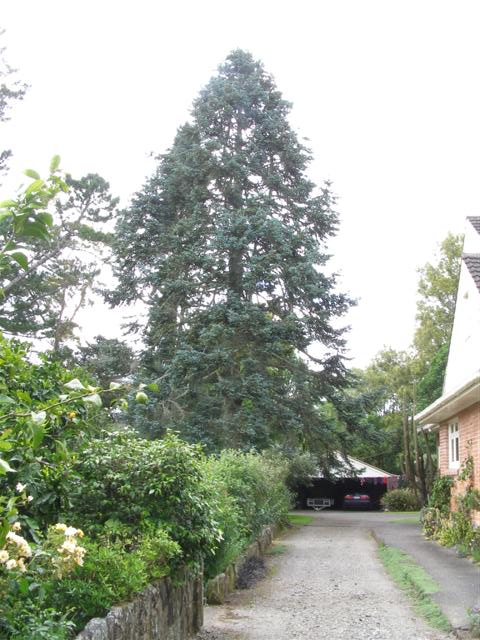
Fortunately this handsome Abies procera beside our house was not cut off in its infancy fifty years ago to act as a Christmas tree for two short weeks

The need for the Christmas tree is starting to weigh upon me. The deadline is December 17, the day when our first returnees arrive home for the traditional family Christmas. We could of course join the throngs who have sacrificed authenticity for convenience and bought an artificial tree. I was listening to a panelist on National Radio last week who mentioned his tree. A man’s tree, he called it. It comes complete with all decorations glued on to the branches so all he has to do is fold it out each year. It just would not do here. I would be pilloried and derided by the returning children who would take such a purchase as a cop-out on every front. They would probably assume that it indicated their mother was entering premature old age.

Alternatively, we could join the throngs who go out and buy a tree. Wash my mouth out with soap. How could I suggest such an action? No, our tree must be harvested at home.
Mind you, if you head out and buy a tree, you will generally buy a nice, dense tree of the correct, prescribed pyramidal shape. In New Zealand this tends to mean a choice of a pine tree, another pine tree, the common pine or pinus radiata. We have made the pine tree (a native of Monterey in California) our own in this country, for Christmas trees as well as timber. In the past Mark has been stung by criticism of his selection of wildling pines and has even resorted to wiring in additional branches to increase the volume in sparse areas. Last year he selected a particular tree which he then trimmed a couple of times to encourage shorter, bushy growth. Alas, in the ten days between checking it for the final time to make sure that there were no feathered friends of the ornithological persuasion resident in the tree and when he went out with the pruning saw to harvest it, a family of chaffinches had moved in. He could not cut it down and we had to make do with an emergency installation of four clipped matai trees in pots.

Over the years we have had a variety of different trees. One year I despaired of the pine needles with which my vacuum cleaner struggled to cope and I tried a tree skeleton, spray painted white. It was not a hit with the children. These days it might be seen as more environmentally friendly because when you think about it, entire forests of conifers are felled each year to furnish the homes of the western world for a few short weeks. I was in London in early December one year when the markets were full of Christmas trees which had been shipped in from Norway and Scotland. These were beautiful, dense trees, mostly Abies nordmanniana or Abies procera (the Noble Fir), and, being horticulturally inclined, I knew that such plants are initially very slow growing. The trees had to be at least eight years old and probably more. My oh my, eight or more years of growth to furnish the front rooms of Londoners for two weeks. Second Daughter was equally struck by these and I recall a blog she posted soon after her first Christmas away from home. Wandering around Maida Vale where she was staying, she took photos of the discarded trees out the front of all the residences where they were awaiting the green collection. Christmas Is Over in London, she entitled this on-line photographic essay.

An American friend is a little scathing about our New Zealand habit of using pinus radiata. The needles, she points out, are too long to allow the decorations to stay on easily. If you look at synthetic Christmas trees, they are certainly not modeled on the pine tree. Most are abies (fir trees) which have tufted growths that are much shorter and easier to work with. But the ideal tree needs a certain amount of horizontal branching from which to hang individual Christmas baubles. If the cone shape is too tight, all you can do is to wreathe it in tinsel and lights. In the US, my friend points out, you have a choice of several different varieties of tree. Internationally, abies are favoured because they don’t shed needles, picea or spruce are common but are less happy about surviving cut off in their prime and show it by shedding needles and there are many different pines to the common radiata which are used overseas. The Norfolk Island pine (Araucaria heterophylla) and its smaller cousin Araucaria columnaris make perfectly shaped trees. If you want to be indigenous, matais and miros could be suitable candidates (totara are a little too prickly, as are rimu). But the bottom line is, which trees are you willing to cut off for a mere two weeks Christmas gratification? Call me a snob, but I worry less about sacrificing the common pine whereas it is distinctly sacrilegious to sever the nobler conifers from their roots. My conscience is soothed even further when we recycle trees or branches that are for the chop anyway, even if this means some rather odd installations. This year it involves the extension ladder and cutting the top out of a mature golden chamaecyparis because its top knot has reverted to a much more open growth. The difficulty for Mark may be getting it down intact from ten metres up but my challenge is greater. See, it is a green and gold variegation and they are devilishly difficult to decorate with any aesthetics at all because they just make tinsel look even tackier than usual.

The final word on the topic has to rest with our dentist who regaled us with the charming story of heading out to buy a Christmas tree one year from the foremost supplier locally and finding that he had managed to bring home a specimen with a nest containing a fledgling thrush. The mother had presumably scarpered at the first sign of disturbance (and we won’t dwell on the mental image of bereft Mother Thrush left behind). Said dentist and wife then spent the two weeks leading up to Christmas hand rearing the thrush with worms dug fresh each morning. After all, how could you have a Christmas tree in the house knowing that you had consigned its now homeless inhabitant to an early death? As the thrush gained in size, they set about teaching it to fly with regular lessons outdoors, tossing it in the air until it caught on to the process. It would be a sentimental lie to say that it flew to freedom on Christmas Day. In fact it spent some time sitting around perched on the washing line (and no doubt pooing indiscriminately on the washing) but let that not detract from what is a charming home grown Christmas story.

Dining al fresco – furniture options

Getting my eye in for outdoor furniture options

I see that summer officially starts on Tuesday but our thoughts turned to the first of the summer wines a few weeks ago. That is to say that I floated the idea of some new outdoor furniture for us to sit in greater comfort with glass in hand. My Mark is a man of many talents but shopping is not one of them. When it comes to larger purchases, I have to do the legwork in advance, narrow it down to a preferred option plus a back up position and then psyche us both up for a joint shopping expedition. So I have been getting my eye in on current options, both in shops and on line.

Wooden furniture largely falls into two camps: Indonesian teak and kwila (hardwoods) or Cape Cod style which is more commonly made in tanalised pine and often painted. We have an existing teak table and eight chairs which are fine but I have another use for them and I want more comfort. I have a twinge of conscience each time I look at the current furniture. I suspect an orang-utan may have been made homeless in order to supply the timber for my patio furniture. Back about eight to ten years ago when we bought it, sustainable logging was not a key selling point. Now it is a huge issue and every purveyor of Indonesian hardwood outdoor furniture from the cheapest to the considerably more upmarket outlets claims that their source is sustainably managed. Call me a cynic, but I wonder if in fact all these offshore buyers were not booked in for consecutive days to visit the one and same model plantation with the claim that it is a fine example of wonderful environmental management and their furniture is being made exclusively from timber milled from this location. The bottom line is that Indonesia’s hard wood forests are disappearing at a completely alarming rate and the timber is going somewhere. It may be optimistic to think that they are not going to supply the decking and outdoor furniture for wealthy Western al fresco living. It is more likely that sustainable logging in heartland Indonesia means cutting out the hardwood forest to replant in high yield palms.

I won’t be buying more furniture made from Indonesian hardwoods at this stage. If you have some (and who hasn’t), you may like to try extending its life by painting it with a mix of about half raw linseed oil and half turpentine. If the mix is a little thick, add more turps. The proportions are not critical. The turps helps the mix get absorbed readily and stops the timber from being sticky. Sadly, I must warn that you can’t put it in a huffer bottle and spray it on (I tried but the mix is too viscous) so you need to brush it or apply it with a rag. It will wreck the brush and if you use a rag, be cautious what you do with it afterwards because it can combust. However it is a great deal cheaper and just as effective as expensive wood preservers sold for the same purpose, though it will darken the wood.

The Cape Cod furniture is allegedly in the American style (fairly loosely speaking, I suspect) favoured on that peninsular of Massachusetts. Personally I think the common style of chair looks as if it were designed for the human equivalent of Jack Russell dogs – long in the upper leg (deep seats) but extremely short in the lower leg (close to the ground) and with a sharply angled back to the chair which looks really bad for posture. They are quite cute to look at in that picket fence sort of genre and it appears to be fashionable to have them painted in alarming garish colours, rather than in gently weathering timber but at least they are made from ethical timber.

Next is that tubular aluminium and nylon look. At its best, it is very stylish in its contemporary appearance with clean lines and it is probably very practical. At its worst, it just looks utility and cheap – and there are very cheap options from some outlets. It is not for me but if I lived in a penthouse apartment with lots of shiny stainless steel and, perspex panels and glass, I would probably feel it was entirely appropriate to the environment but I would only want the more upmarket quality of this style.

So to the French provincial look (sometimes Italian), marketed these days as shabby chic. It is usually cast iron, sometimes wrought iron and I admit I love the look. When we bought our old wooden suite, what I would really have adored was the French provincial dining table and eight chairs which was a mere $6000 close to a decade ago. It wasn’t overly comfortable, it couldn’t accommodate a sun umbrella and it certainly wasn’t practical (the heavy chairs would have been difficult to push in and out on our imperfect, outdoor surface) but it was stylish. These days the price has dropped (the quality too) and alas shabby chic has come to mean chipped paintwork in pastel colours peppered with rust. I don’t want chipped paintwork and rust and I do want comfort. Shabby chic is founded on the real McCoy – weathered by time and of undeniable quality. Repro shabby chic does not do it for me.

Finally we come to the option of African colonial which is outdoor wicker. Proper wicker is a wonderfully organic and aesthetically pleasing material (though it can descend from chic to plain shabby alarmingly quickly) but it is designed for a very dry climate. So what is on offer here is made from synthetic materials. I was surprised to find that if you buy good quality, the guarantee runs to five years which is a lot longer than I expected. African colonial probably takes the prize for all round comfort – clearly the gin drinking representatives of HM Government in that continent knew a thing or two about comfort.
We have yet to make our decision but certainly my forays on the topic have highlighted three points:

1) Like most things in life, you get the quality you pay for.
2) The really, really, really stylish options are found on the internet and are divine but out of our league altogether. I may even rather have the new car I could buy with the money instead.
3) Bringing your outdoor furniture under cover at the end of summer greatly extends the life expectancy of same.

I did not see any of the polyester resin furniture that I have maligned over a period of many years. Maybe it has gone – I wish. I will not even deign to comment on the naff swinging love seats under their own little awnings which look like a floral surrey with a fringe on top. But I would comment that the cantilevered umbrellas that are for sale everywhere this year are desirable. We haven’t owned one yet but we have used one and they completely eliminate the intrusive presence of an umbrella pole in the middle of everything. We are looking forward to being well set up shortly for the summer wines.

Taming the Wilderness – workshop notes

Create space around individual plants to avoid an overgrown, unkempt look

Create space around individual plants to avoid an overgrown, unkempt look

TAMING THE WILDERNESS

Handout notes from the workshop taken here in our garden November 7, 2009 as part of the Taranaki Rhododendron and Garden Festival.

  1. If you are new to the garden, don’t charge straight in immediately and start dropping trees and shrubs. Ideally, give it about nine months to go through the seasons so you can see what is there before you do major felling and removal. In the meantime you can be clearing the lower grade plants – most plants that sucker, clump or seed down can be safely attacked.
  2. Track the path of the sun so you can see where your winter sun and summer shade positions are.
  3. Unless you know what you are doing, seek advice as to which trees are quality, long term trees worth preserving. Somebody at the botanic garden or public park, or an enthusiastic member of a group such as the International Dendrology Society will likely know more than a tree surgeon (whose skills often lie more in safely felling a tree and using chainsaws than in deciding which trees are of value).
  4. Overgrown gardens lose the detail and small treasures, but can give you a framework and maturity to work with. Don’t reduce it all to a blank canvas by clearing everything.
  5. Stand at each window in the house and plan views if possible. Also spend plenty of time looking from every angle in the garden to work out potential view shafts, sun and shade through the seasons.
  6. Make the most of maturity of plants. LIFT AND LIMB. Allow light through underneath and build up layers of garden. Many, if not most, young gardens are badly overplanted to get a quick effect. It is likely that you will need to thin out a number of these plants.
  7. Mature gardens are usually about shade conditions. LEARN TO GARDEN WITH SHADE. Don’t try and turn it all back to sun and a juvenile garden.
  8. CREATE SPACE AROUND PLANTS. The fresh appeal of young gardens is often because each plant stands alone in its own space. As gardens grow, that space gets swallowed up and the plants become entangled. Creating a sense of space again is good for the plant (less competition, more light and more air flow) and creates a more cared for look in the garden. Most gardens need to restrict the size of trees and shrubs.
  9. LEARN ABOUT PRUNING – especially the right times of the year to prune plants and the general rules of pruning. A good pruning saw is worth the expense, as are good loppers. Supervise chainsaw operators carefully – you can not glue branches on later.
  10. Widen paths. Remove anything spiky or prickly beside the path. Creating a sharp edge between a path and garden immediately makes a place look better cared for.
  11. As a general rule, woody trees and shrubs are best left well alone in the root area. Just a feed (preferably in spring) if the plant is looking hungry and pile on the mulch. Herbaceous or clumping plants prefer friable or fluffed soil and in a neglected garden may need to be lifted, divided and rejuvenated.
  12. If you are gardening on a slope or even on a hill, trim the branches and prunings and lay them around the contours of the slope and use them to start building up layers of humus. It is all part of the natural cycle. Bare earth is not a good look.
  13. Be a vigilant weeder from the start. It saves a great deal of time and effort later. Once an area is weeded, lay mulch to suppress fresh young seedlings. You will have many dormant weed seeds in your soil which will spring into life with a bit of light and cultivation.
  14. In our opinions, gardens need some logic to them and this usually means that detailed and tightly maintained areas of the garden are closest to the house, to living areas and entranceways. As you radiate out further, the theme becomes looser and more casual. Most people use outdoor living areas which are close to the house, rather than at the bottom of the garden.
  15. Vegetable gardens need full sun.
  16. As a general rule, water features are best in full sun.