
It would be fair to say this week that I am married to a disappointed man. Some ingrate of a garden visitor has stolen his paris seed. Probably ninety nine out of a hundred visitors wouldn’t even recognise his prized paris polyphylla as a rare delight, let alone think to help themselves to the seed which he had carefully pollinated and was watching ripen. Sadly the one in a hundred who was capable of recognising it was also the one in several thousand who would be mean enough to steal this treasure. Continue reading
Category Archives: Abbie’s column
Music to watch gardens by
We have been pondering entertainment and music in open gardens. This came about because our local Waitara garden trail was held last weekend. A true community venture, run on the goodwill and hard work of the organisers and the garden openers, this not-for-profit event brings out several hundred people to enjoy themselves over the two day period and entertainment is sometimes part of the package.
I must admit we only got to visit one garden ourselves but music played a large part. Being somewhat purist in our approach, we have steered well clear of the entertainment factor in our own garden. Mark is of the view that he would much rather visitors came to enjoy the garden than to treat it more as a venue for entertainment. But we were really interested in the impact of music in the garden we visited. The owners were playing carefully chosen, contemporary instrumental music which was loud enough to create an ambience on arrival but not so intrusive as to dominate. In the spirit of a fun afternoon, it certainly added to the atmosphere and gave a sense of being where something was happening. Continue reading
Of pohutukawa and pineapples
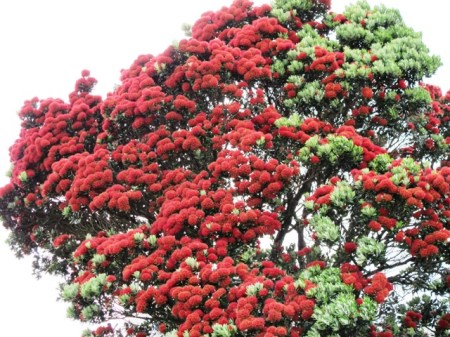
The pohutukawa - often called the NZ Christmas tree
Mark and I drove around looking at the pohuts (as we tend to call them) in Waitara which are well worth a visit at the moment. Waitara would be a bleak little town without these splendid trees. We felt a bit like Mark’s parents reincarnated. For years, Felix and Mimosa would make forays around the pohutukawa plantings and keep records on particularly heavy flowering specimens and good coloured ones. Mark could still recall certain trees – number six along such and such an avenue, or the one outside Mrs So and So’s place. Felix and Mimosa knew them all.
We were not so meticulous, but certainly three aspects made a big impression. The first was what a splendid tree they are for coastal areas and what a joy to behold in flower. The second aspect was a bouquet to the District Council who finally got around to limbing up and cleaning up underneath the trees which line the river. They look hugely better for it.
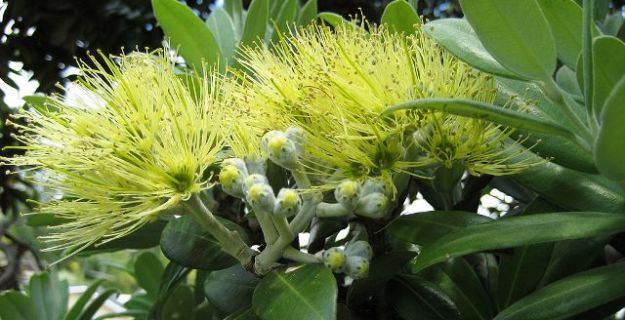
The Waitara riverbanks are also home to the oldest yellow pohutakawa on the mainland
The third aspect was the variation in colour. As landscape trees, not all pohutukawa are born equal. Their flowers may look lovely en masse, close up. But from a distance, rather a lot of them are distinctly brown in tonings. The stand out trees were those with rich red flowers, or those which had an orange tone to them. The orange lifts the colour considerably when viewed from further away. Funnily enough, the dark flowered forms tend to be later flowering.
The moral of this particular story is that if you are going to buy pohutukawa plants, it is worthwhile seeking out either named clones or plants from an identified seed source of good colour. One might as well start with better selections. If you plan on gathering your own seed, identify a good specimen now and return around mid May to collect the seed. Growing selected seed increases your chances of keeping good colour, although there will be variation. Partly as a result of Felix and Mimosa’s study of the Waitara pohutukawa, Duncan and Davies put out a good range of named selections. “Rata Maid” and “Scarlet Pimpernel” are still growing in Waitara. Up north, Graham Platt also selected good forms along with Jack Hobbs, including one called “Brilliance”.
Pohutukawa are tough trees and while they can get wide, they don’t get particularly tall. They can withstand most assaults except for frost when young and vicious attacks with injected weedkiller. If you cut a tree back hard to ground level, it will sprout again. And they will take heavy pruning. Cutting away all the growth from the base exposes their interesting trunk and branch structure and allows views through the tree. They don’t have to be dense, impenetrable visual barriers. They can be a flowering canopy with an interesting structure beneath. And the prunings are brilliant firewood.
We happened to be in Patea over the weekend and their pohutakuwa were also a real feature in the town. Many of them appeared to be of about the same age and are therefore likely to be from the same seed batch so they are not quite as varied as the Waitara plantings. Alas both these small towns suffer from the same problem of overhead power lines. If these were underground, the trees could grow without the heavy mutilation of top pruning some get subjected to on frequent occasions. That pruning does not do much for the appearance of the trees. Bottom pruning is good. Top pruning can be butchery.
On another topic, we had an amusing discussion with London daughter home for a holiday. In her travels around this country visiting friends, she had got into a conversation with somebody about an exciting new red pineapple which is being widely marketed. She just about fell off her chair when we told her that it was none other than the pineapple which grows beside our garage and which has been growing there for about 40 years or more since her grandfather imported it. Or so we understand. A northern nurseryman had visited and bought a plant from us. Sure that he had uncovered treasure which we didn’t appreciate, he put it into tissue culture to multiply it quickly and has been marketing it nationally as an exciting new release which is “cold tolerant, extremely hardy and easy to grow.”
Have we got news for him. It might be easy in Northland (and pineapples are just bromeliads so they are pretty easy in the right conditions) but hardy it ain’t (unless compared with the tropical pineapple) and it sure won’t be that rewarding in less than ideal conditions. I imagine he will get many letters from areas south of the Bombay Hills querying his claims. I can’t think that it will be a great success growing in Christchurch or Invercargill, for example, or indeed anywhere inland. In our books, cold tolerant and extremely hardy means it will grow in Tekapo and Turangi. If you have bought one of these pineapples, it will need the hottest position you can find in full sun. We find its fruit producing capacity is pretty hit and miss and it is an ornamental curiosity rather than the taste treat of the decade.
Pineapples are gross feeders. Our elderly plant is a pretty large clump. It needs thinning, which, because it is spiky and intimidating, does not happen often. You need leather gloves to handle it. The season that Mark thinned the clump and fed it well, it responded beautifully by putting on a splendid crop of fruit which are decidedly ornamental, but in our conditions they tend to rot before ripening properly. As Mark is big fresh pineapple fan, we still buy them from the supermarket.
The New Zealand gardening style
It was straight back to work here as soon as the statutory holidays were over. And by work, Mark and I refer to the nursery. We don’t generally describe gardening as work – that is our leisure and our pleasure (mostly). The nursery is the bread and butter which earns the money to keep the garden and the family going. And it is the time for cuttings. Usually we aim to have all deciduous cuttings in by Christmas (we rarely make that deadline so the over run is early in the new year) but several factors conspired against that this year. Not that it has mattered – the season is so late and so cold so far that we are effectively dealing with cuttings of the same maturity as usual.
But while I have been out in the nursery doing tasks which require little brain power, I have been pondering what makes New Zealand gardens different. At this time of the year, we get a trickle of overseas garden visitors and several of late have come because the British Royal Horticulture Society published an extended article on New Zealand gardens recently. It is with some pride that we note that on their top ten list of NZ gardens, they rate three of us in Taranaki.
Continue reading
The Good, The Bad and the Ugly
We subscribe to Sky TV for three reasons. It was a very expensive means of solving our aerial problems. Mark enjoys the sport (I only like watching cricket when we are winning and am not a rugby fan). But mostly we keep our subscription current for the gardening programmes on the Living Channel. Alas these tend to be in the middle of the afternoon and neither of us ever mastered the video recorder.
Currently Sky have two programmes running which show the very best and the very worst of English
Continue reading
 Tikorangi The Jury Garden