Category Archives: Abbie’s column

Abbie’s newspaper columns

The end of an era

We don’t open the garden to many groups these days but agreed when we were approached to host a visit from “the last Camellia Nationals in their current format”. That is the national conference of the NZ Camellia Society. Competitive show blooms have long been a hallmark of the camellia world, the major focus of the annual conference but a range of garden visits are also included.

A little bit of Taranaki Jury on the honours table of the International Camellia Convention in Dali, China 2016

Mark’s father Felix and his Uncle Les Jury were giants in the camellia scene back in the 1960s and 1970s, earning international reputations and breeding camellias that have become known throughout the world. To this day, Les’s Camellia ‘Jury’s Yellow’ remains a market standard and Felix is probably best remembered for his camellias ‘Dreamboat’ and ‘Waterlily’.

Camellia ‘Waterlily’
Camellia ‘Dreamboat’

When Mark and I returned to Taranaki at the end of 1979, Les was elderly. But before he died in the early 1980s, he was particularly encouraging and generous with advice to Mark, who was taking his own first steps in plant breeding, starting with camellias. Felix didn’t die until 1997 so the camellia influence was strong.

Conferences past. I recently found some homemade posters – I am guessing Mimosa’s work – for a conference that was likely in the 1960s. The flowers have been cut out from magazines and glued on and, unless I am mistaken, the lettering is from Letraset and only oldies will remember the days before accessible printing, let alone photocopy machines!

It was to respect that family connection to camellias that we agreed to the visit last weekend. Times are changing and many horticultural groups are struggling to continue as members die off – literally – and younger generations are not signing up to replace them. That is why this was to be last national camellia show and conference in the current format. I have no idea what new format is planned.

Camellia conferences in days of yore were a little larger and a little different. If the labelling on Mark’s parents’ slides was correct, this seems to be Whakatane 1964.

In times past, the camellia conference was huge. In the heady boom times through until the early 1990s, my recollection is that the conference tours around gardens involved six coaches and countless cars – several hundred people. It was bigger than the rhododendron conference which only required four coaches plus cars. Mark attended several conferences as his parents’ driver and was in awe at the scale of the event and the depth of expertise in the attendees. I went to one – I think it was Whakatane ‘82 and I can date it because I had our first-born with us and she was small. Even back then, Mark and I were a good decade or three younger than most of those who went. We continued to host conference visits here in the times since so last Sunday felt something like the end of an era. Conference attendance was down to 63, so one coach, a minibus and a couple of cars.
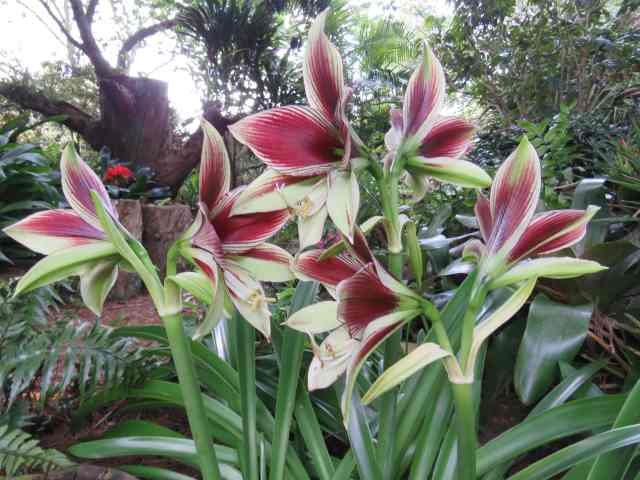
The group arrives last Sunday afternoon.
It rained but the camellia enthusiasts were very enthusiastic and appreciative
In earlier times, pretty much every camellia we grew put on a mass display of blooms. These days it is a rarer sight which makes this little row of Mark’s ‘Pearly Cascade’ more special. But even this would have had many more blooms in the days before petal blight.

Of course, camellias have changed over that time, too. Back in those days, camellias were ranked the second largest-selling product line. Roses were top. And the vast majority of camellias being produced were japonicas and hybrids. Camellia petal blight changed everything. The mass display of flowers all over the bush, the efforts Felix and Les both went to in creating varieties that were self-grooming (dropping spent blooms to avoid the need to pick over the plant), the perfection of formal blooms like ‘Dreamboat’, ‘Mimosa Jury’ or ‘Desire’, the purity of bushes with perfect white blooms, the quest for ever larger blooms – these are but distant memories. Petal blight has largely destroyed the displays that made camellias so loved. It made the Camellia Society shows problematic because the blooms no longer stood up to travel and display over several days. Picked as perfect, they too often became blotched with brown by the next morning and sludge the day after.

Camellia Mimosa Jury’

We still have hundreds of camellias here in our garden and right across our property. I set out to pick one off each bush where I could reach a flower and gave up after covering just a fraction of the garden. A few are named varieties but many are just seedlings from the breeding programme.

I think of camellias like the cast of a stage-show musical. In times gone by, the entire front row of the chorus and some significant soloists were camellias. Nowadays, they play a valuable but less acclaimed role, filling out the back rows of the chorus with a few of them getting to step forward to sing a few solo lines from time to time. They used to be grown primarily for their flowers. Now we value them more for their potential form – we clip and shape key specimens – as well as their obligingly resilient and healthy nature and their adaptability.

We use camellias differently now. The undulating hedge in the foreground is Camellia microphylla. The clipped hedge running across the middle of the photograph is Mark’s Camellia ‘Fairy Blush’. The two white topped lower plants in front of it are Camellia yuhsienensis.
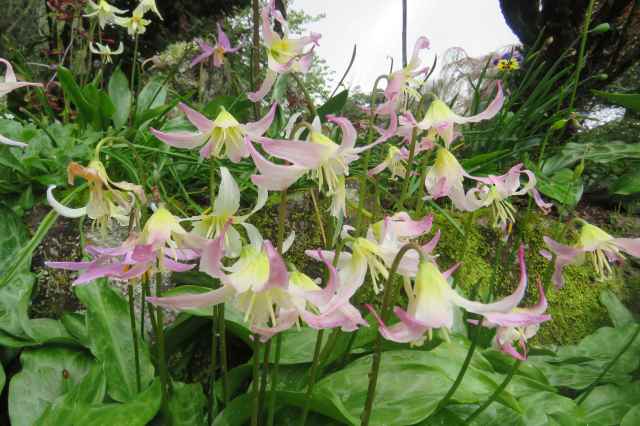

I set up a few sprays of Camellia nitidissima on the table by the visitor loos because I thought the visitors might not be accustomed to seeing them growing outdoors as garden plants – but nobody commented on them, to me at least. At the time when Les and Felix were breeding camellias, nobody in the west even knew about the yellow camellias in China and Vietnam. Les created ‘Jury’s Yellow’ from white camellias.

Preserving a period of time

Can a garden ever be frozen in time?

This train of thought came back to mind as I was sorting through the old slides of our garden dating back in its early days. We first came across the concept of freezing a garden in time when we encountered the Florence Charter being quoted twenty years ago, in the context of what are now referred to as the regional gardens here, particularly Tupare and Hollards.

I see the Florence Charter of 1981 built upon the earlier Venice Charter of 1964 and I can’t quite get my head past the glorious locations of these think-tank conferences on preserving historic monuments. Still, I doubt that the wise heads behind these charters were thinking about preserving gardens from the 1940s and 1950s. Only in colonial New Zealand do we think of 70 to 80 years warranting the descriptor of *historic*.

But how realistic is it to freeze a garden in time? For starters, it is probably limited to bulbs, herbaceous perennials or roses. Trees and shrubs grow. They can’t be lifted, divided, thinned, pruned and replanted in their original configuration. That rules out 99% of all gardens in this country; I cannot recall seeing any gardens here with no trees or shrubs in them.

Topiary at Levens Hall by Peter Jeffery (via Wiki Commons)

What about topiary, I hear somebody ask. Even they evolve over time. Covid robbed us of the opportunity to visit Levens Hall in the Lakes District of the UK. That garden dates back to 1690 and is claimed to be the oldest known topiary garden. Some of the yew topiaries could well be original but I doubt they look the same now as they did in 1700. Even topiary and bonsai grow, mature and evolve over time.

Topiary in the garden at Levens by Simon Palmer (via Wiki Commons). That unbalanced, leaning, cake-plate topiary is an example of serendipity over time, adding quirkiness that would not have been there at the start.

Roses and maybe some other small deciduous shrubs can be kept to the required size and shape. Besides, you could grow on replacement plants out the back somewhere and bring them in as instant substitution when needed.

Herbaceous perennials and bulbs can certainly be lifted, thinned and replanted in exactly the same configuration, although why you would want to do so eludes me.

But, and it is a big but, you can have a perennial, bulb or rose bed and dedicate your gardening life to keeping it static in display but make sure it is in the middle of open space which will stay open. As soon as a bed or border is encircled in hedging, other gardens, trees, orchard or anything else, the time-clock of change starts ticking. The micro-climate you started with will change over time as other plants grow and may no longer be hospitable at all to the initial plant selections.

Mark’s mother’s rose garden in its heyday
And how the area looks today. The line of rimu trees behind were planted in the 1870s and continue to grow with root systems spreading extensively.

We worked this out when our best efforts failed entirely to restore the sunken garden to the glory days when Mimosa had it looking lush, abundant and flowery. In the decades since it was first planted, the rimu trees that bound it on one side have pretty much doubled in size and their fibrous root systems have spread throughout much of the area. The trees and shrubs Felix and Mimosa planted on two other sides have grown like Topsy and the garden in the middle has long since stopped being sunny and open; the area once suitable for roses is now semi-shaded, very sheltered and filled with roots from surrounding trees sucking up all the moisture and fertility. We changed tack entirely.

Freshly planted azaleas on the sunken garden side of the rimu trees, probably in the early to mid 1960s
Looking back towards the sunken garden, these are the surviving azaleas from that original planting today. Now underplanted with Cyclamen coum and hederafolium as it is too shaded for the original narcissi.

All of this begs the question of why anyone would want to freeze a garden in time. Times change and with that, expectations and gardening values change. I was going to add in changing fashions, but long term gardens are about more than fickle fashion. The mark of good gardening, in my book, is the ability to adapt an existing garden, keeping it appropriate, relevant and in tune with current values while accommodating issues of changing microclimates and external conditions. Personally, I don’t see the value of trying to freeze even historic gardens to a particular point in their development.

Stourhead, we think. Our memories are a little hazy now, given we visited in 1996.

Never have Mark and I forgotten our early visit to Stourhead in Wiltshire. The garden at Stourhead was created in the style of Capability Brown – sweeping landscapes and dearie me, is that a village located just where we want to put the lake? Move the peasants out now. So, a statement of wealth, power and privilege. Visiting in spring, the magnificent display of rhododendrons and azaleas delighted the modern hoi polloi amongst the vistas and the garden follies of past grandeur.

But there was a problem. Historically, the garden at Stourhead pre-dated the introduction of rhododendrons to the UK. The original lakeside plantings were, apparently, laurel and mass-planted laurel is never going to delight anybody, really. There was a purist, historical lobby group who wanted to pull out all the glorious rhododendrons and replant with laurels, in the interests of historical accuracy, you understand.

I admit we didn’t think to look closely enough back in 1994 to determine whether this host of golden daffodils were native narcissi species and not more recent hybrids.

I am assuming the historical purists did not win but we haven’t been back to see. It does illustrate the downside of picking an arbitrary time frame to freeze for the long term. You can do it with buildings and monuments but gardens? Gardens, by their very essence, change over time and we gardeners need to adapt to and enhance that change, not constantly try to wind the clock back.

Postscript: Theoretically, a rockery largely given over to bulbs and small perennials could be maintained as a static feature. It is clear that from the very start, Mark’s parents set out to plant in a mixed style.

The house was built around 1949 and 1950 and the rockery must have been the first area of the garden to be created and then planted because this is as early as 1954 and many trees and shrubs are looking remarkably well established. That is a Wheeney Grapefruit which was moved out soon after.

We can date this to 1954 accurately because that is wee Marky at the red arrow on the right. Mark’s mum is above the red arrow on the left but the circle is what I wanted to highlight. You won’t be able to see much on a small screen but the circle is around a very small blue conifer. It was Abies procera glauca and you can read it’s story here.

We felled it in 2019. It had been moved out of the rockery at some point in the later 1960s and by the time we dropped it for safety reasons, it looked like this.

The rockery is the the area where there has been the least change in structure and design. We have carried out a few running repairs but otherwise it is pretty much as constructed by Felix around 1951. The plant material, however, is something else. The turnover of plant material won’t be quite 100% but there is very, very little left that is original.

Freezing a garden in time seems a fruitless folly, really.

The rockery today

The evolution of a garden

One of the privileges of taking over a family garden is being able to trace it down the decades and watching how the garden grows and changes over time. In sorting out Mark’s parents’ slide images, I found snapshots in time that I had not seen before.

We can date this aerial black and white photo of the property to the early to mid 1950s. The house (marked with the red arrow) was built around 1950 to 1951 and key areas of the garden had yet to be laid out. The red rectangle is the area we refer to as ‘the park’ – then a sheep paddock of about 4 acres or 1.6 hectares on a south facing slope. Here, in the antipodes, south facing means it is on the cold side. Mark once studied the original, large format photo with a magnifying glass and declared that he could spot patches where his father had sprayed out the grass in preparation for planting.

This image is undated but is one of the earliest we have after planting started. That is a lot of top quality trees and shrubs going in. I can’t remember who told me that the planting was guided by the principles of the Rhododendron Association at the time; it may even have been Felix. The plants were not grouped but individually placed so that each one could be viewed in solitary splendour from any angle. Plants grow quickly in our mild, warm temperate climate with volcanic soils, regular rainfall and high sunshine hours.

This slide was dated 1962. That is Mark’s older brother on the horse but he was only riding through. Rhododendrons in particular are toxic to stock and so are other ornamental trees like yews. Felix maintained the area by grazing a very small group of sheep in amongst the trees and shrubs. He kept to the same sheep because they learned quickly which plants made them ill and they avoided them from then on.

The park really didn’t change a great deal over the next 30 years, until a somewhat younger Mark unleashed himself in 1995. There was always a problem with flooding in the low-lying areas and rhododendrons hate having wet feet. The evergreen azaleas are more tolerant but it was an ongoing issue. Mark’s tidy grandfather, Felix’s father, Bertrum Jury had straightened the stream to run at right angles on the property to maximise grazing areas. That was around 1900. Every time it rained heavily, the park flooded and there were no natural drainage channels left.

Mark’s efforts were major. That is our bottom road boundary. Grandfather Bertrum’s stream channel was deepened and turned into a flood channel controlled by a simple weir. Before anybody asks, yes he was Bertrum Jury, not Bertram or Bertrand. Flexible spelling is not recent.

The largest flow of water was directed back through the park, opening up the original stream bed. Mark had calculated its likely route and felt vindicated when the digger excavated tree trunks and debris that had been used to fill the old stream bed when it had been closed off.

The resulting clean-up was huge. The amount of silt and clay stacked up by the channel needed to be moved because it would set like concrete and smother the roots of trees that were already deemed precious. It was winter, probably before the days of bob-cat machines and all that gluggy mess had to removed by hand because it was too wet and the spaces too tight to get machinery in. I remember Mark coming in for months on end – dog-tired and covered in mud. He hauled barrow loads to upper slopes to build tracks – one person pushing the barrow and another on a rope pulling because they were too heavy for one person. It was a pretty grim winter activity and only dogged determination got Mark through. To this day, he swears it stuffed his back.

But look! Within just one season, by late spring the scars of the earthworks were already healing and we had flowing water where before there was soggy bog. These are still 1995.

Around this time, we bought our first fancy-pants lawnmower that cost more than our car did but was capable of mowing the varied terrain in the park and maintaining stability while manoeuvring around innumerable plants. Between that and the new weedeater or strimmer, we entered the era when we maintained the area to a standard that would have satisfied even public parks and gardens. Very, very tidy, we were, with neatly mown grass.

Mark then set about turning what had been plants standing in solitary splendour in a glorified paddock into more of a cohesive garden. He also started planting – bulbs and even perennial beds on a shady slope. The bulbs have worked well, especially the narcissi and galanthus. Mark went to some trouble to establish our native microlaena grass in some areas, as a replacement for paddock grass. Its finer foliage and gentler growth is much more compatible with dainty bulbs. 25 years on, we now have swathes of spring bulbs, rather than a few patches.

Around 2010, we started thinking there had to be a better way of managing the park. Keeping it mown and neat was not only labour intensive but we were increasingly concerned by our heavy dependence on petrol-powered motors. Enter the meadow era. We looked closely at meadows, particularly in the UK, and worked out that our situation was very different and we would have to manage it in different ways. Quite a lot of thought and discussion took place before we took the plunge.

We have not regretted it. The mown park may have looked impressive but the meadow is full of soft-edged charm that delights us all the time. I have written before about how we manage it. We mow walking paths through and twice a year we cut the entire area of grass to the ground – in mid summer and again in mid winter. We don’t remove the grass because that would be too big a job. Nor do we have yellow rattle in this country to weaken the growth. We have grass growth all year round; it is why this is good dairy farming country. We had to adjust to a meadow with rampant grass growth. We work to keep out noxious weeds like thistles, tradescantia that washes down the stream from above and onion weed but we have learned to tolerate our buttercups and even the docks. They are part of what makes a meadow in our conditions.

The park continues to develop. The latest two areas are our gardener Zach’s efforts. The upper photo – an area we refer to as The Barricades – was a creative means to deal with waste wood after Cyclone Dovi. Rather than burning it on site, it has been carefully arranged by Zach to create an environment for more planting – mostly orchids and ferns. It will gently moulder away and return to the earth, as indeed we hope to ourselves.

The Accidental Rockery, as Zach calls it, was his solution to retaining a bank that needed some attention by one of the paths down the hill. It wasn’t planned as a new planting area but that was a bonus to moving in rocks to retain the soil. It has filled out a lot since I took this photo soon after it emerged from his efforts.

Back to earlier days, I think this image is mid 1960s and that is Mark’s mother, Mimosa, standing by the azaleas. I looked at this photo and thought, maybe we have just gone full cycle. Is that soft-edged scene with a mown path so very different to where we have ended up now, 65 years on?

From an earlier era

The marquee displays at the 1960 Chelsea Flower Show

I had told myself for decades that one of these days. I will sort through the family slides. Not so much a day, it turned out, as a couple of weeks but I am close to the end.

Both Mark’s parents and Mark himself photographed on slide film in the days before digital cameras. It was always an expensive medium to work in, probably even more so in the days when slide films had to be sent to Australia to be developed. There were boxes and boxes and boxes of slides. Forty years of them.

Labelled ‘Captain and Mrs Ingram, Benenden’. Initially I assumed this must be from Felix’s trip to the UK a decade later, Captain Ingram being none other than renowned plant collector and ornithologist Collingwood “Cherry” Ingram. The photo is more Mimosa in style and Mark says he is pretty sure his mother visited the Ingrams on her tour.

I decided early on that I would scan and keep the historic images of the garden and the property and those of identifiable family members but the close-ups of flowers could all be discarded, as could random landscapes and events that meant something at the time but are of no discernible relevance now.

My task became a lot more interesting when I came to the slides that Mark’s mother, Mimosa, took and now I worry that I may have been too ruthless in my selection of those to scan and keep and those to discard.

Mimosa in front of the Papal Basilica of St Peter in the Vatican, 1960 photograph (not a slide in this case)

Mark’s mother only left the country once that I can see. But that one occasion was a big trip – Le Grand Tour, in fact. Mark has always been a bit vague on her absence, it being ‘quite a long trip’, he thought. I was a fair way through sorting the slides before I realised what a huge experience it must have been for her. She spent about two months voyaging there and back and five months exploring the UK, Italy, France, Austria, Germany, and the Netherlands.

Astilbes in the marquee at Chelsea
Astilbes and lilies
This display of roses was somewhat less than glorious but look at the serious garden visitors behind

It included the Chelsea Flower Show where she was clearly impressed by the marquee displays which were of the very highest standard. She didn’t take many photos of the outdoor gardens. It seems that the showpiece outdoor gardens have evolved quite a bit in the last 65 years. Perhaps they are more fashion-forward these days?

It would seem that the outdoor gardens had more to do glorious floral displays than design

I wanted to date her Chelsea visit and I can now say that it was indeed 1960, as I thought. We also happen to have the menu cards from the trip over and back. We forget how recent long-distance air travel is and how extraordinary it is that we can travel all the way across the world in just over 24 hours in the air. Mimosa sailed out of Aotearoa New Zealand just before Christmas 1959, on board the SS Australia, a long-distance passenger liner operated by the Italian company, Lloyd Triestino, with an Italian crew.

The large format covers for entertainment cards and the menus changed daily, clearly designed as souvenirs – and successful souvenirs in that we still have them!
A very Italian experience

This solved one mystery. I was a little surprised by this somewhat raunchy image until Mark and another both suggested it was related to ‘crossing the line’, ergo, the equator. I found the programme for the event. One wonders what form the 10.15am Discorso di Nettuno e battesimo deo neofiti took (Neptune’s speech and the baptism of the landlubbers) but it all happened on January 12, 1960. Those relatively uninhibited young men in the photo appear to be the Italian crew. The voyage terminated on January 27 at an Italian port, having travelled via the Suez Canal.

Rather more risque than the farm boys from Tikorangi that Mimosa would have known

It must all have been quite the culture shock for a middle-aged woman from Tikorangi but Mark tells me his mother prepared for it all by putting quite a lot of effort into teaching herself Italian. I am not at all sure how one would even plan a trip of that length, in pre-internet days but even more so as a woman travelling on her own with no prior experience. I doubt that she would wing it, as we have done, and she probably travelled with a great deal more luggage than we have ever taken.

The return voyage was likely less exotic, on board the R.M.S. Rangitane, owned by the New Zealand Shipping Company so it likely transited the Panama Canal which, according to my mother, was very dull compared to the Suez. She boarded the Rangitane on or about June 3, 1960 and they docked in NZ on July 6. The menu cards from this return voyage show a diet that was considerably less adventurous than on the Italian liner.

I loved this soft focus image from her visit to a seaside village in Cornwall. We stayed in a very similar fisherman’s cottage in St Mawes when we visited in 2009.

Mimosa was always interested in gardens but she mostly photographed landscapes and architecture. She had a good eye and, 65 years on, it was her people photographs that I found most delightful.  

A random shot, I assume, of Cornish locals, possibly inspired by the blue and red clothing composition. As Mark commented, these photos are all the more remarkable for the fact that with old cameras, the settings all had to be manually adjusted so she would have had to take a light reading with her light meter and then adjust for distance and focus as well. Photography was less spontaneous back then.

When the rainy weather sets in again, I will turn my attention to ordering the garden scenes that I have scanned in. It is interesting to see the earliest plantings and constructions and the various stages they have gone through in close to 75 years. It makes us realise yet again that a garden can never be frozen in time. Gardening is a dynamic response to a changing environment, in the longer term at least. Curated examples may appear here in due course.

From her visit to the Netherlands…. Clogs- dear. They are all wearing clogs.
Nothing to do with Mimosa’s grand tour, but this was probably my favourite of her images. It was labelled ‘Lou and Simon Urenui Domain Gala January ’67’
Or how about “Mr Ashton and his dog raising funds at the Wai-iti Life Saving Carnival”? The expression on the dog’s face is wonderful, if you are viewing on a large screen, as are the men wearing suits and ties at a beach carnival.

Our very own mountain daisy, the celmisia

The three species crosses resulted in broader leaves and silver colour all year round

Celmisias are our very own mountain daisies. They have never been a common garden plant because they aren’t easy in nursery production and rarely thrive in the average home garden. It is likely that their greatest fans are trampers and botanists but that should not blind us to their charm. Many people just don’t know of them. And I suppose, when you think about it, quite a lot of our native plants have white daisy flowers.

I was surprised when I looked them up and found a far greater number of species than I ever knew existed. Some dedicated botanists have clearly spent a lot of time unravelling this genus.

When Mark’s father, Felix, was still alive, he became very interested in seeing whether he could hybridise different species to get plants that would thrive in our lowland, humid conditions. Most celmisias are subalpine to alpine plants. I remember Felix and Mark heading up our maunga, Mount Taranaki, in search of the form which grows there naturally – Celmisia major var. brevis – and being thrilled to find some flower variations into pink. This was about 40 years ago, you understand, when people didn’t feel so bad about collecting plant material in a national park. They collected some plants, including a few of the pinks which they only saw growing in one area.

The first season after their relocation. I have moved them again because the grasses were overhanging them and these plants do not appreciate having to compete for space and light.

Felix set about crossing three species – C. coriacea which comes from Fiordland, C. hookeri  from the Otago area and the aforementioned C. major, in various combinations. Forty years on, we still have some of those hybrids growing and flowering in the garden here. It is the three way cross which gave us the broader leaves in distinctive silver all year round. Over the decades, we lost many of them, including all the pink ones, and have, at times, run close to losing the lot but for a bit of quick intervention. They have never seeded down for us; we have to increase them by division. They do set seed which we could gather and sow in seed trays but, in a busy gardening life, we don’t seem to get around to it. These are plants that need to be lifted and divided every few years or they rot out and fade away so we can never claim that they have naturalised here.

The area we refer to as ‘the grasslands’ when I first planted it in 2022 – one of the few celmisias to the right

When I planted my tawny brown area of two native carex grasses, C buchananii which is specific to our maunga and C. comans, I envisioned a simple breathing area of just those two plants. Mark looked at it and wanted more detail and colour. He suggested moving some of the celmisias which we were in danger of losing, into the newly cultivated area. So I did. There weren’t many left to play with. In the first year, I probably only had half a dozen divisions.  That was in 2022. It was like they breathed a sigh of relief and set about growing with renewed vigour. Last year I divided a few clumps that were large. This year, I divided most of them and I lost count around 58 or 60 plants. Some are small but they are surviving and I have done my best to give them optimal growing conditions. It was enormously satisfying. There aren’t many perennials I am willing to lavish such frequent and individualised care upon but the rewards feel worth it with the celmisias.

The same area in 2025 but now with the addition of 58, or it may be 60, celmisia plants

It is mighty hard to be original in a garden. Pretty much everything has been done before, some time, some place. I always scoff silently to myself when I hear the occasional gardener declare that somebody ‘stole their ideas’ or copied them. “But who influenced you in the first place?” I want to ask (but never do). However, I doubt that the celmisia and carex combination will be replicated soon, at least not locally. It is a successful subalpine planting in coastal, subtropical conditions and I am moderately chuffed by its unexpected nature in that context.

Te maunga, our mountain, Mount Taranaki, as I drove to town on Wednesday. The snow cover is abnormally light for mid-winter. There may be no more skiing days this season.