Category Archives: Abbie’s column

Room for improvement at a major tourist site

On a windy day, the kites were more interesting than the garden

I had never been to the Michael Joseph Savage memorial on Bastion Point in Auckland before but after the somewhat disappointing visit to Auckland Botanic Gardens on Saturday, I wandered down the windy hill from where I was staying and I was somewhat surprised that it had escaped my notice. It was pretty clear that many (many, many) tourists have experienced what had bypassed me as there is a constant flow of tourist buses stopping there.

But let us leave the distinctive obelisk and mausoleum honouring the memory of this country’s first Labour Prime Minister and founder of the welfare state to one side. And also, let us leave aside the chequered history of that particular headland commonly referred to as Bastion Point but also known as Takaparawhau or Whenua Rangatira, while acknowledging the high impact of the recent history that still resonates long and loud for many of us and none more so than the Ngati Whatua community who are the closest residents.
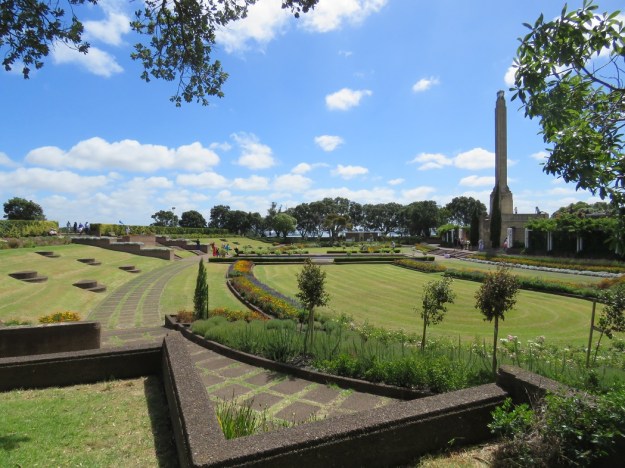
Plenty of room for improvement

Let us talk about the garden. It has an amazing setting, pretty sheltered on the leeward side, astounding views, a rich history, huge significance historically and some pretty interesting aged design features. So why oh why is the garden the most unimaginative, dull, cliched affair possible, dominated by the Victorian bedding plant genre now meeting utility, amenity planting of the dreariest style? What a missed opportunity. Has nobody gone to Council and advocated for a breath of fresh energy and more innovation at a place that is a prime tourist site?

The view  – unconnected to the monument and the gardens

White painted seats, plenty of old concrete, white carpet roses and shaved grass out the front
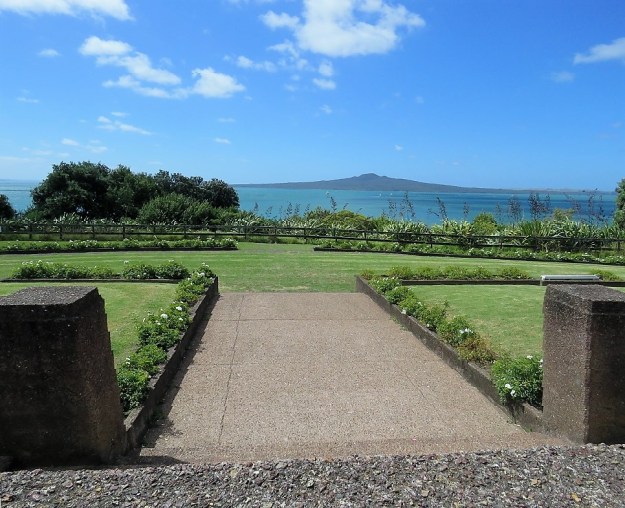
On the seaward side of the monument, there is a breath-taking view. Do garish white painted seats and mingy, narrow borders of a white carpet rose do anything to enhance this area? Well, no, they don’t. And I state that as a fact, not an opinion. I get the formal garden concept for the whole area but surely it could be done more creatively? I would want to use native plants at the front to blend out to the wilder areas at the perimeter and then out to wider seascape. Maybe something like clipped Muehlenbeckia astonii  could be used as a formal planting, as shown at its best at Auckland Botanic Gardens.
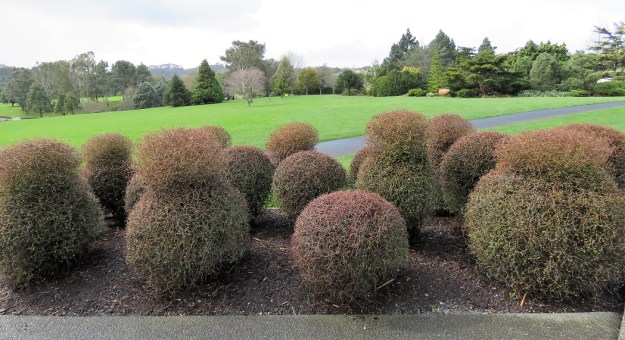
Muehlenbeckia astonii clipped to give formality 

Along with painting the seats a muted shade – anything but stark white or garish bright green. Though, if the front was colour themed to red, black and white to recognise the colours of the Tino rangatiratanga flag and the red of the Labour Party, the white seats might remain. 
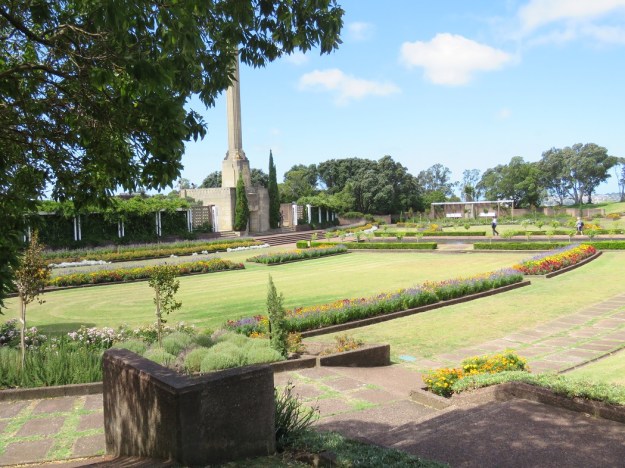
Pretty much a blank slate of austere but unimaginative plantings

On the leeward side, there is a large protected basin with loads of aged concrete construction and a formal pool. They are pretty good bones to start with but standard Iceberg roses and stripes of different bedding plants that are little more than ankle height? I assume it is buxus hedging but I can’t guarantee that because I was so unutterably bored by the plantings that I did not look closely. I am pretty sure I also spotted lavender past its best and cosmos that was over and dead.
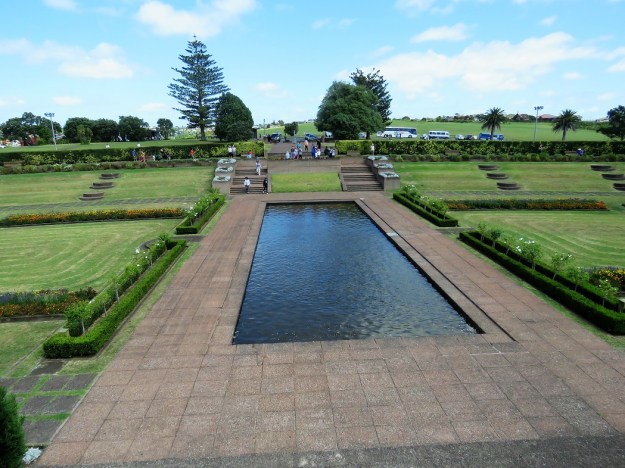
A blank slate, begging for a more ambitious planting

Given the setting and the formal structure, I just wanted to see a very capable designer with good plant knowledge sweep in, gut the plantings and go with something stunning. I have seen really high-quality public planting overseas, particularly in the UK – sustainable, ecologically sound, transitioning through the seasons, hardy but above all, vibrant, inspiring and immersive for the visitor.  Some of the contemporary European and American trends of dry prairie planting, New Perennials or even Pictorial Meadows would transform this area. Keep the old structure but work within it with some contemporary energy and style.
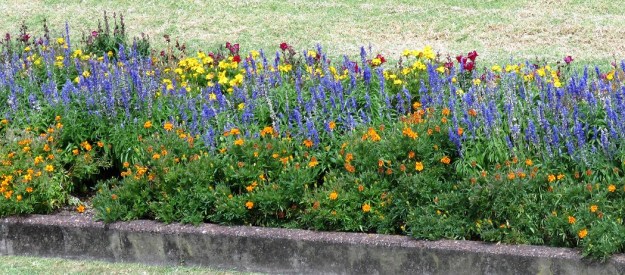
This is the current planting,. Need I say more?

I can not think that either Michael Joseph Savage (1930s era) or Ngati Whatua would ever relate to the oppressive and dated Victorian bedding plant genre. This place could be so much more if somebody, anybody, had some imagination and knowledge. It is not exactly low maintenance now so I don’t accept that as an excuse for the status quo. I suspect that nobody has taken a cold, hard look at it for many a year, let alone considered alternative styles that would honour the history, the location and the existing structure while dragging it into modern times with inspired plantings.
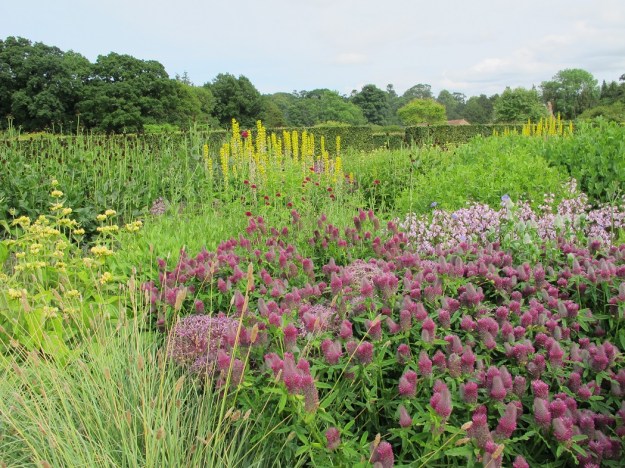
How about some more contemporary, generous, immersive plantings like this Oudolf sweep at Scampston in Yorkshire? 

More Oudolf at Pensthorpe in Norfolk 
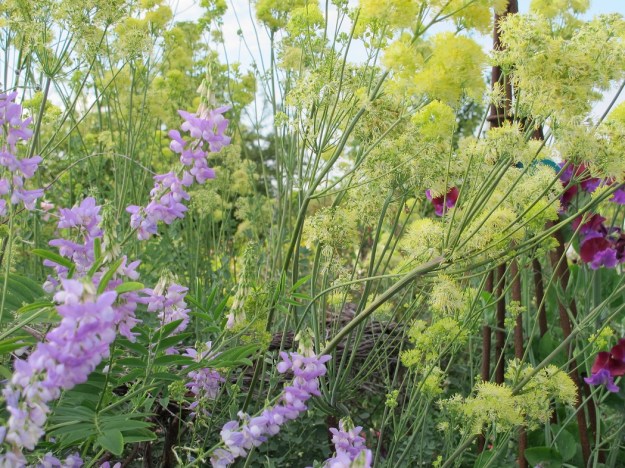
Modern plantings have moved on from Victorian bedding to something altogether more immersive


Lagerfeld Rules – should he ever turn his attention to gardening

The man himself - Karl Lagerfeld (photo: Wikimedia Commons)

The man himself – Karl Lagerfeld (photo: Wikimedia Commons)

In honour of the now late Karl Lagerfeld, I recalled a piece I wrote back in April 2012 when I was still writing for The Waikato Times. I don’t usually republish, but I thought maybe it was acceptable at this time.

I admit I had never really registered Karl Lagerfeld until last week. Sydney daughter sent a little clip of his quotes. “Sweatpants are a sign of defeat. You lost control of your life so you bought some sweatpants.” Ouch. “Florals are for middle aged women with weight problems” and “Having adult children makes you look 100 years old. I don’t want that.”

I started to feel vulnerable until daughter pointed out to me that while I am upon occasion seen in public with one or more of my adult children (and isn’t Lagerfeld so right that it makes one look old?), she could not recall me wearing florals or sweatpants.

In case you are equally ignorant about Lagerfeld, think elderly German fashion designer, made his name with Chanel, now slim, white haired, permanently suntanned and always wears dark glasses. These days, his main claim to fame appears to be his capacity for pithy, outspoken comment. I could find no evidence whatever that Mr Lagerfeld has had anything to say about gardening. But let that not matter. Shamelessly putting words into his mouth, we started a meme: Karl Lagerfeld on gardening. This is what we consider he would be likely to say, should he ever turn his attention to botanical issues.

Only the real thing will do

Only the real thing will do

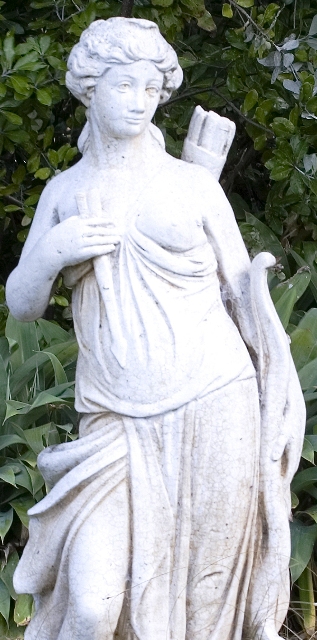
“If you can’t afford the real thing, then it is better to go without.” There would be nothing armless, legless or headless in Karl’s garden, especially nothing white unless he could persuade the British Museum to loan him some of the Elgin marbles. Reproduction classical just wouldn’t do.

“Never plant an avenue of the same tree unless you can afford to replace the lot should one ail. A gap in an avenue is like a toothless smile – engaging in children but an indication of lack of care in an adult.” Karl understands that when an established plant dies, it is almost always an indication of a problem below ground so there is no point in replacing like with like. The incoming plant will succumb to the same problem sooner rather than later. And avenues with gaps look, well, like avenues with gaps or a smile with missing teeth, really.

“Glazed blue pots are so last century. There is nothing aesthetic about a bright, shiny blue pot from Vietnam. Leave them to women who wear floral prints or straw hats adorned with fake flowers.”

“Buxus hedging,” declaims Karl with withering scorn, “is the polar fleece of the garden. Ubiquitous, utility but the comfort refuge of the unimaginative.” Harsh this may seem, but edging garden beds in rows of grassy plants gives rise to even stronger condemnation: “Reminiscent of crimplene trousers with elastic waists.”

Karl would put the not into knot gardens – as in advising not to be seen dead with one in your garden unless you have a European title (minor nobility is fine), live in Europe and can claim direct lineage to the design. Otherwise it is a knock-off copy and Karl does not do knock-off copies. Ever. Accordingly, he rejects chevron gardens, parterres, potagers, rills, canals and the like, unless you have the castle or palace to go with them. At the very least, a stately home is required.

Perhaps better than the toilet bowl recycled as a garden feature, but blue pots are problematic

Perhaps better than the toilet bowl recycled as a garden feature, but blue pots are problematic

“Unspeakable. I will say no more,” is his response to any toilet humour in gardens. He shudders in distaste at the thought that anybody, anybody at all, could ever think it was witty or clever to recycle an old toilet bowl as a plant container. In fact Karl is equally unimpressed with any efforts to recycle old baths, laundry tubs or other accoutrements as garden features. “We don’t have a bathroom in our dining rooms. Some things are best kept discreetly out of view at all times if you want to retain any mystique.”

When faced with the new breed of gardener who will only grow plants that are edible, Karl sniffs. “You might just as well say that you will only wear clothes that can be machine washed and never need ironing. Fashionistas would not be seen dead in polyester. Just as high end fabrics are used for high end clothing, so too are high end plants used for high end gardening. Some things exist because they are beautiful. That is enough. Broccoli is never beautiful.”

Long an advocate of the little black dress, Karl is only too well aware that the same little black dress on one woman will look like a shapeless sack whereas another will carry it off to perfection and on most men it will simply look silly. So too with gardening. “You cannot fake chic,” he says (yes he actually really did say that!) “Some do it with style. Others just follow the rules and it shows.”

“I am a fashion person, and fashion is not only about clothes – it’s about all kinds of change”. Karl is well used to ringing the changes, to leading the way. Not for him to slavishly copy and follow rules.

We will leave the penultimate comment to the man himself: “I’m very down to Earth, I’m just not from this Earth.” If he thought about it, he would be likely to add the advice that you should not think that just because you are working in your garden, trackpants or floral attire are acceptable.

First published in the Waikato Times and reprinted here with their permission.

“The ulmus must go!” Vegetative time bombs

Growing well but just too large for this location – Umus ‘Jacqueline Hillier’

It’s no good. The ulmus must go. Ulmus ‘Jacqueline Hillier’ to be precise. I feel a little sad about this because it is a fine plant. I love it with its detailed bare tracery in winter. I love it with its fresh, bright green growth in spring and its lush summer appearance. I love its elegant and interesting form. It is a good plant in the wrong place.

It was I who planted it at the front of the rockery. At the time, we were still in full nursery production and it was one of the product lines. I see we described it at the time as reaching two metres by two metres, which I assume are the dimensions that were given to us when we first acquired it. That is why I thought it would be fine in the rockery where we could prune as required. It is now around four metres high and more than that in width of canopy and that is despite several major pruning efforts to restrict it over the past decade. The root system is extensive and suckers are popping up many metres away. It is just too big for where it is planted and is now so strong that it is increasingly difficult to grow anything beneath it and it is only a matter of time before the roots fracture the rockery structure.

It will require a chainsaw and we will get some firewood out of it but killing off the extensive root system is going to take poison, something we prefer to avoid.

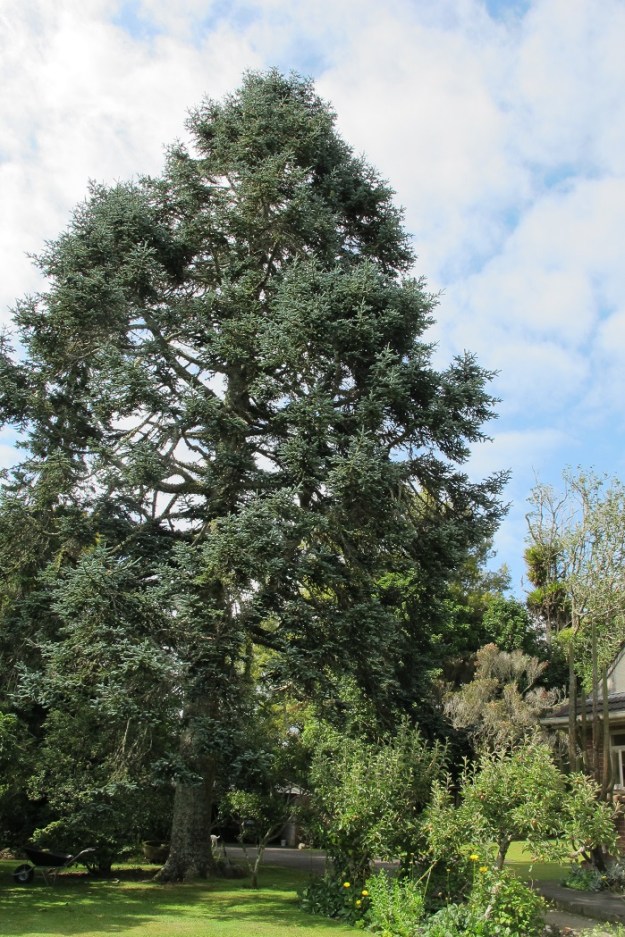
Abies procera ‘Glauca’ – handsome but too close to the house

We are not unfamiliar with vegetative time bombs. We have a few, none more so than our very handsome Abies procera ‘Glauca’.

Oh look, here is a little photo taken earlier. Best guess is that it is early 1960s, when Felix planted it in the rockery. I am reassured that he, too, could plant without doing adequate research on ultimate size. Or maybe he thought it was a dwarf conifer at the time. At least he moved it out of the rockery while he could but it would have been helpful had he moved it more than 8 metres from the house. It is now over 20 metres tall, though not very wide, and we are psyching ourselves up for its removal. Should it fall (and it did have an issue with rot at its base, though that appears to have healed over time), it is likely to take out a good part of the house, starting with our bedroom. It is one of those major and expensive jobs that we know is coming up sooner, rather than later. Beautiful tree. Wrong location.
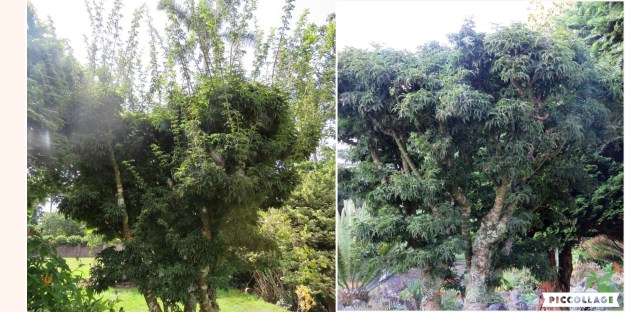
Spring growth on the left, 30 minutes trimming on the right

Some plants are more amenable to being kept in check. This little green maple (species long forgotten) is easy to keep at a controlled size. Once a year, I spend about half an hour trimming off all the long whippy growths and thinning the crown if needed and bob’s your uncle, an attractive vase-shaped plant. If I didn’t trim off the whippy growths, next year the new growth would be made at the tops of those so the plant would become considerably taller and more open over time.

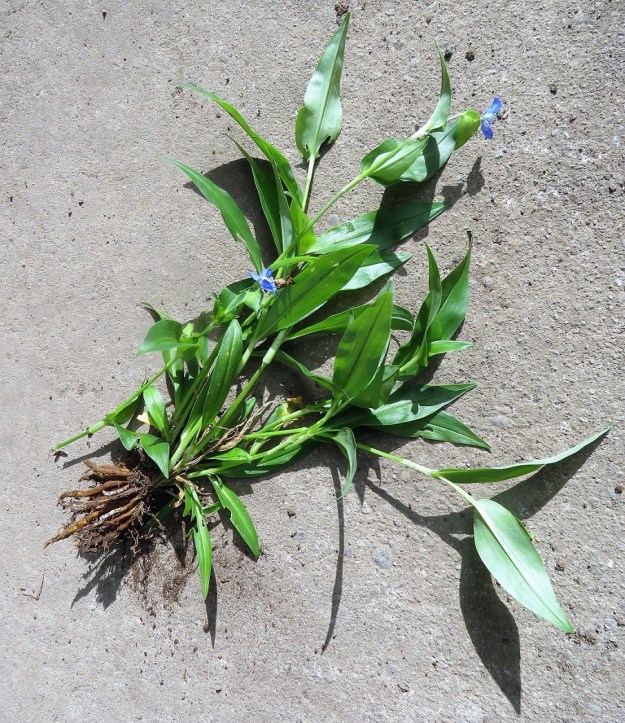
A noxious weed: Commelina “Sleeping Beauty’ does not sleep

And as for vegetative time bombs that should be banned altogether, I give you Commelina coelstris ‘Sleeping Beauty’. I wrote about its bad habits five years ago and still it continues to reappear in the rockery, despite the fact that we are vigilant weeders and nowhere more so than in the rockery. It is worse than the weedy tradescantia.  Not only does it seed, but any piece of root left behind grows again. I nominate it for the banned list but one of our premier seed suppliers continues to sell this noxious weed. Shun it, is my advice.

Along the verges – midsummer on North Taranaki roadsides

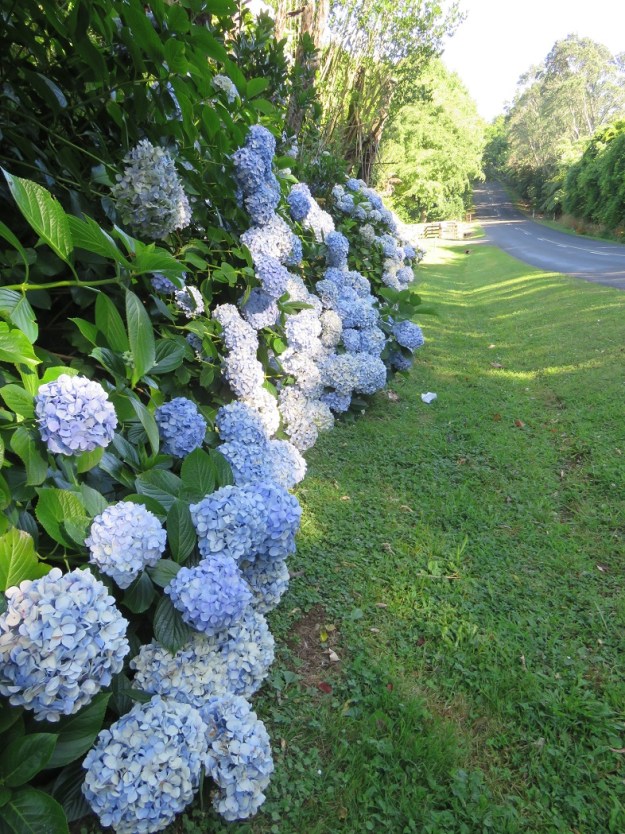
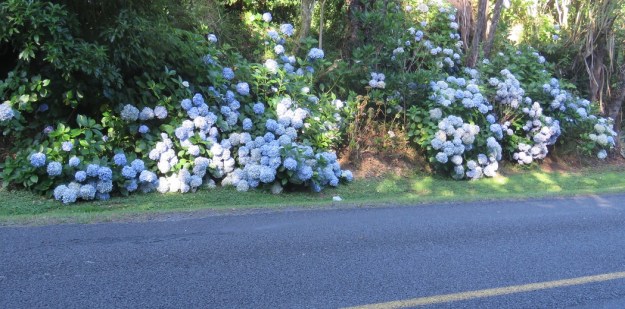
Blue hydrangeas – a common roadside plant

We are very blue along our Taranaki roadsides in midsummer. I meant to get out with my camera a few weeks ago to record the roadside hydrangeas flowering in our area. Many are now passing over so I had to make do with the verge planted by our neighbour across the road. It has been bringing me pleasure for many weeks now.

Basically, hydrangeas are blue in Taranaki. This is to do with available aluminium in our acid soils.  In our warm, temperate climate with adequate summer rain, they can just be planted and left. The many, many roadside hydrangeas will have been planted originally (seeding is minimal) and then left to their own devices. I don’t think anyone ever prunes them. This means that they are generally smothered with smaller flower heads. Pruning controls the size of the shrub and increases the flower size but lessens the number of blooms. Plants can survive quite happily with no pruning at all.

Weed or common wildflower? Agapanthus

It is the season of agapanthus. They are EVERYWHERE in this area, although they generally start from a deliberate planting and they are most often seen as amenity, road verge plantings rather than garden plants. They are controversial here on account of their seeding ways and the fact that they are resistant to the most common weed killer. But our roadsides would be so much the poorer without them.

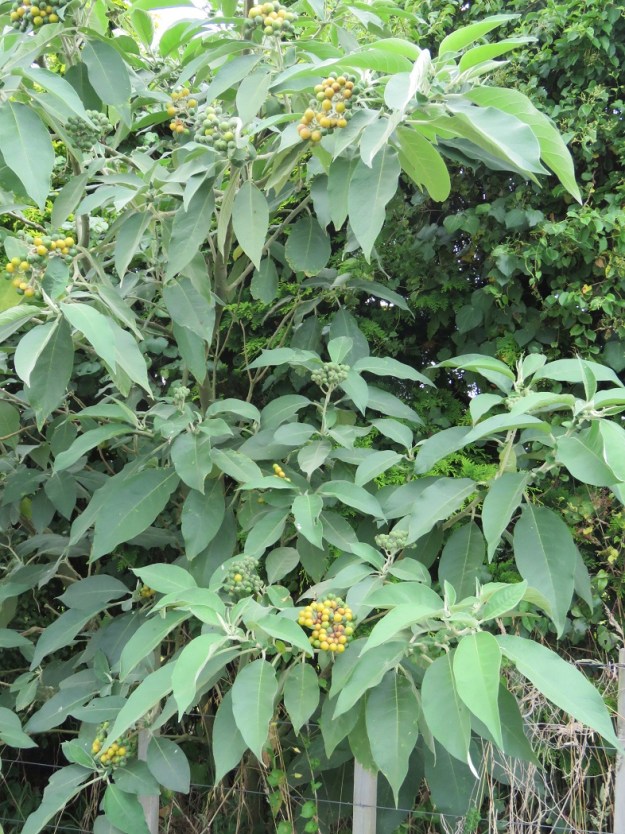
Thumbs down to woolly nightshade

My definition of a noxious weed is a plant that invades and displaces more desirable native plants and I don’t think the roadside agapanthus are displacing anything more desirable. The seed is not spread by birds and generally falls close to the parent plant so is localised. I would be far more worried about woolly nightshade – Solanum mauritianum – than about agapanthus. It has no redeeming features and is highly invasive. Curiously, by this plant, I saw a small plant of Verbena bonariensis on the verge. As it is at least two kilometres from my garden where it is flowering, I don’t think I am responsible for this plant making its way to the wild. Most of our wildflowers start as garden escapes and this verbena is so light and airy in form, while being popular with bees and butterflies, that I am not convinced that it is going to be a problem in the comparative wasteland of road verges.

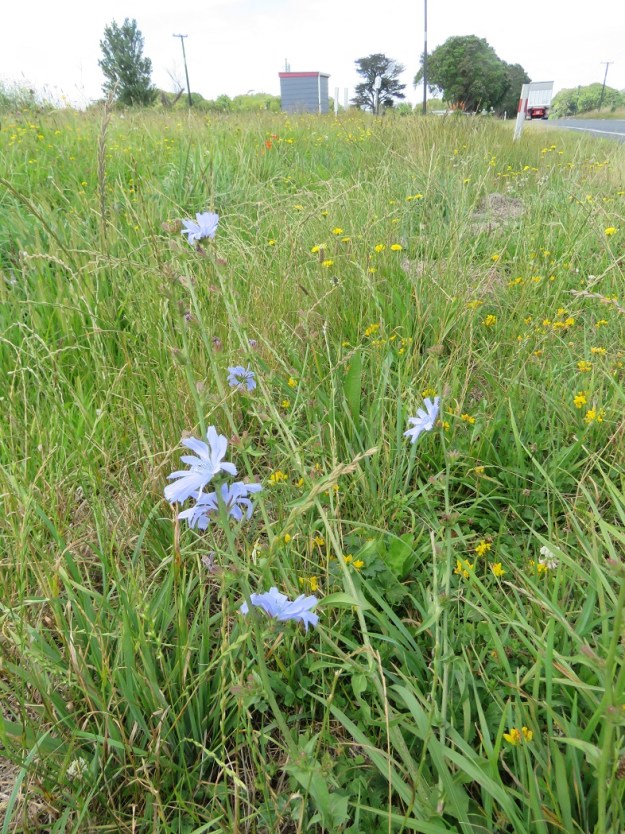
Chicory – not as common as I would like it to be

Chicory is another pretty blue that I wouldn’t mind making its home around here. It is a member of the dandelion family and is also used as stock food overseas so I can’t think it would do much harm here. I found this one growing on railway land when I stopped to photograph the red hot pokers.

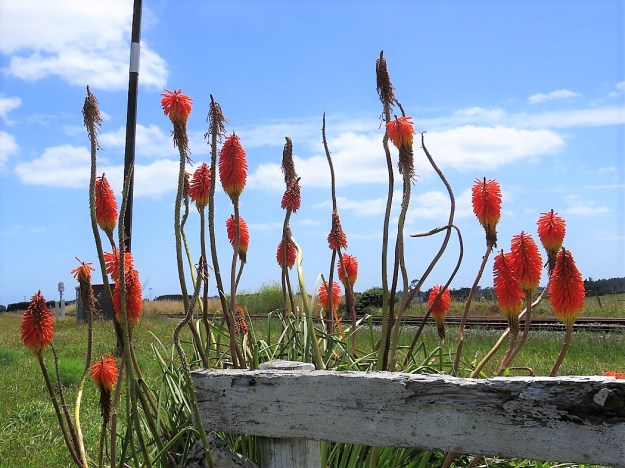
Kniphofia in Lepperton

Like the hydrangeas, kniphofia generally start from a deliberate planting. Though some forms seed more freely than others in a garden situation, I have never seen them as a weed when on road verges. I once wrote about them – if you want to know why Father was a red hot poker and Mother was a blushing violet. I liked this scene of kniphofia and an old gateway between the state highway and the railway line in Lepperton this week.

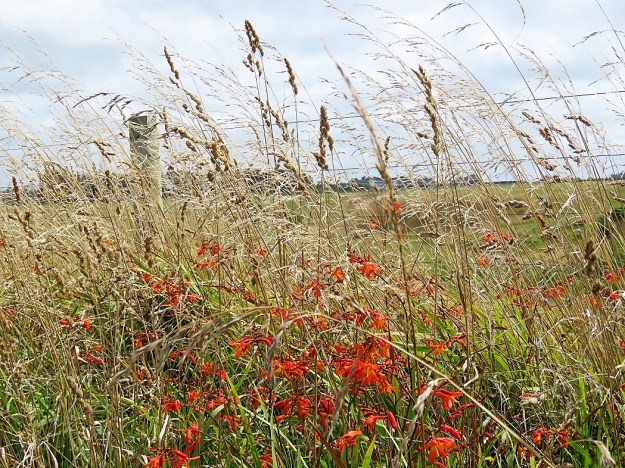
Crocosmia – commonly referred to as montbretia

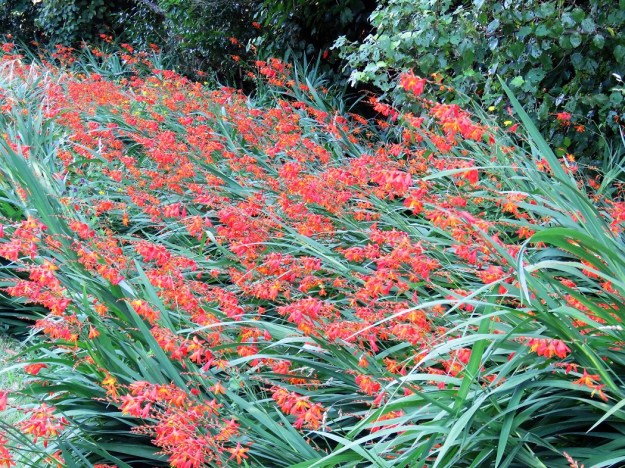
I wrote about crocosmia in my earlier post today. If we are not blue, we are carpets of red around here – or sometimes blue and red. They are just too happy in our conditions though they do look very pretty interspersed with the long grasses on some road verges.

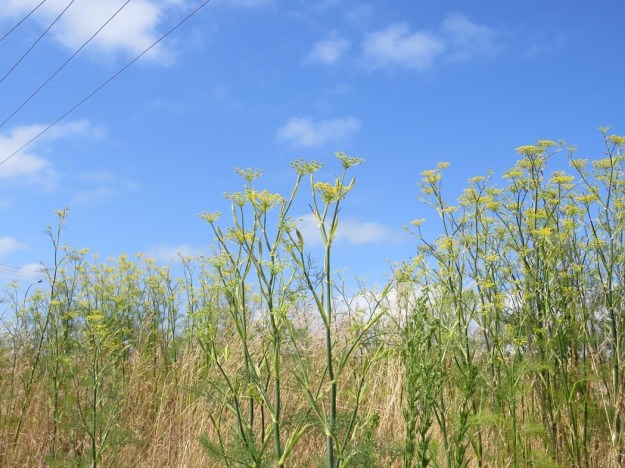
Common fennel

Into the yellows, we have fennel, fennel and more fennel all around the district. I really like it, so much so that I have used it in the summer borders. I like the airy grace of those yellow umbellifers and the fine, ferny foliage. The insects like them too. There is a bronze form more commonly used as an ornamental but I am not willing to spend money buying a fennel and nobody has given it to me yet.

Evening primrose

I am also fond of the wild evening primrose (Oenothera biennis) which is common enough here and certainly common in wilder areas of our property. It doesn’t seem to do any harm and the bees like it.

Thumbs down, also, to convolvulus

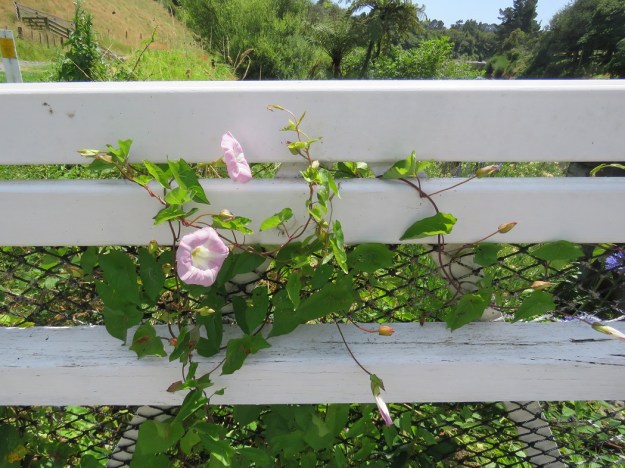
Not all of our wild flowers are desirable. Mark keeps out the convolvulus, be it pink or white, though there is so much of it around, I can only conclude that others are less vigilant. It is a smothering plant, hellishly difficult to eradicate once it gets a foothold. This one is climbing up the Bertram Road swing bridge over the Waitara River but will very soon dominate the whole bank and bridge if not kept under control or taken out.

The wasteland of the sprayed road verge

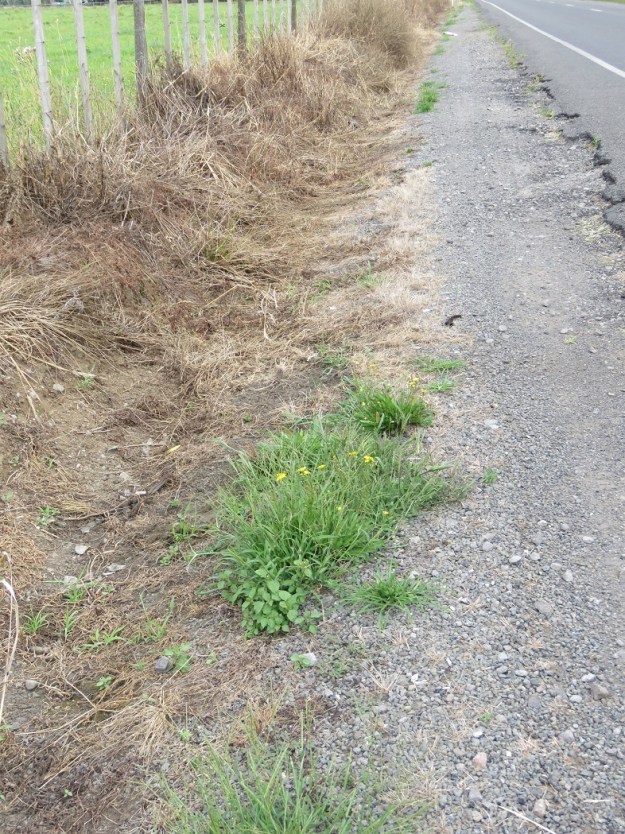
Not all of our wildflowers are noxious weeds. But neither are all of the weeds wildflowers worth tolerating. On the other hand, is there anything much worse than this sprayed wasteland of a road verge? A practice that remains common around here.

Agapanthus a-plenty 

And sometimes agapanthus and crocosmia – one starting from a deliberate planting, the other entirely self-introduced

Summer flowers – tigridias and crocosmias

I started by thinking I would do a comparison of tigridias. And then crocosmias. It was too hot to be out in the garden and I couldn’t go down to the shaded areas of the stream in the park to clear weeds on the banks and free up the water from some of the choking weeds on account of having stuffed my dodgy wrist doing this heavy work the day before.
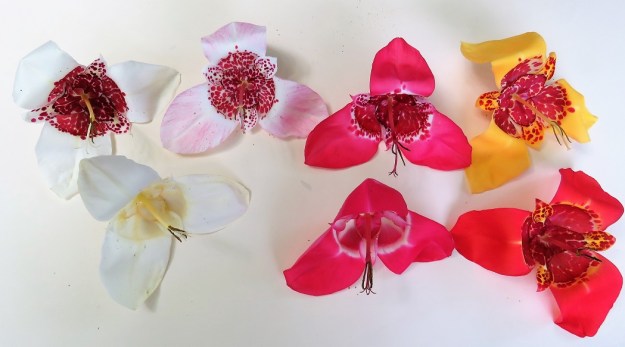
But really, it is that I like making flower boards. If I had my life again, maybe I would consider textile design as a career. I could do lovely floral confections, taking inspiration from flowers from my garden.

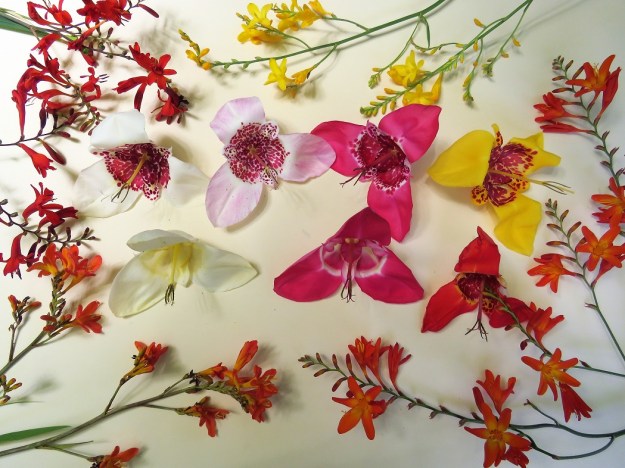
I have spent some time separating the tigridias by colour into separate blocks in two different garden borders. There are many more colours out there but I am not so keen as to want to collect them all. A fair number of them seem to be leaning towards brown hues. This is probably what happens when the pinks cross with the yellows. I am okay with white, all the hues of palest pink through to deepest pink, pure red and bright yellow.
What I would like is forms of the yellow and the red without spots – or freckles as they are often called. It appears that the dominant freckled forms can throw the occasional seedling that lacks them entirely. I have separated off the pure white and mid to dark pinks that hatched sans freckles and last year I found a single bulb with palest pink, freckle-free status. It hasn’t yet flowered this year so I couldn’t include it and, to be honest, it is a bit insipid. But it adds a link to the chain. Over time, I would prefer to mass the freckle-free ones and just add some spotties for variation. I do not know why we have never had a red or a yellow without the spots, but I will continue to watch.

Commonly referred to as montbretia, the weedy crocosmia growing wild all round North Taranaki roadsides

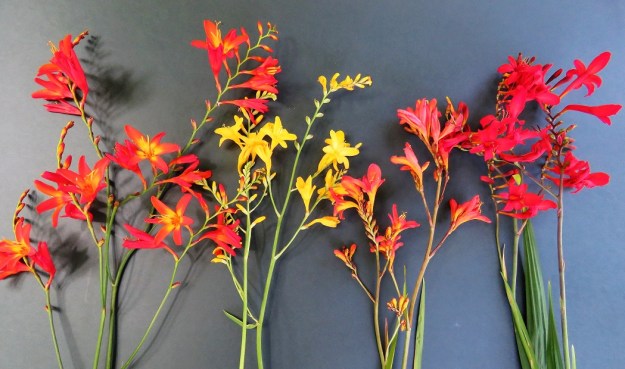
And crocosmias. They turned out to be more interesting than I thought, though we only have four different ones. Crocosmia are better known as montbretia when they are a roadside weed. Or maybe now a wildflower rather than a weed. A weed suggests they can be eliminated but this east African corm has made itself so much at home now that we literally have carpets of them on the road verges around here. We try and keep it out of our park but every time we get heavy rains that cause flooding, more wash down from upstream. They are at least pretty in flower.

Left to right: the roadside weed, a selected yellow form of same, ‘Severn Sunrise’ and ‘Lucifer’

There are about nine species of crocosmia in the wild. The common roadside one is C. crocosmia x C. crocosmiiflora and it increases both from the bulb and from seed. The most common garden form is the larger-flowered, red ‘Lucifer’  which, it turns out, is a different line altogether, being  C. masoniorum × C. paniculata. I deadhead it because it sets prodigious amounts of seed and there is a limit to how many I want in the garden.

The pretty yellow form is simply a variation on the wild roadside one that Mark dug up and moved into the garden because it caught his eye. It has stayed true and also has the advantage of being either sterile or not setting much seed at all. I must take closer note this year, now that I have it well established in the new borders, and see if it is truly sterile. It is a worthwhile addition if it is.

Mark actually bought Crocosmia ‘Severn Sunrise’ from a well-known perennial nursery. All we can say is that it is either not true to the original or it performs much better in the UK, where it has been given an Award of Garden Merit from the RHS. It is so disappointing here that I plan to dig it up and dump it (but not on the roadside). Its foliage is not a good colour, the flowers are small and not displayed well AND it sets seed. I could make better selections from the wild ones along our frontage. I failed to find the species description for ‘Severn Sunrise’ but I wasn’t that interested, to be honest. Some plants just don’t justify their place even if they come with impeccable pedigrees.

The transient pleasure of a colour toned flower board to finish