The first half is now all planted
I have not been shilly-shallying around. The first half of the new court garden is planted and I have started on the second half. This is not light work. Mark has rotary hoed and I follow up with raking the area out and getting clods of roots out, as well as squishing the abundance of grass grubs. It has only just occurred to me that had I transferred all those grubs to a jar instead, we should have had enough for a meal of alternative protein. Whether grass grubs are delicious when tossed in garlic butter in a hot pan will likely remain mystery, however. I am not that intrepid.

Starting on the other half – the pressure is on to get it planted before winter sets in

I describe this as romantic chat between two wheelbarrows (me being a two barrow gardener)
The rush is on because our soils are still warm and temperatures are mild, despite it being late autumn. I am hoping for a few more weeks of grace so the plants can start forming new roots. You would not want to be doing it this late in the season in colder climates or places with heavy soil where the plants would languish in wet, compacting ground. With our excellent drainage and friable, volcanic soils, we have much more leeway.
My plantings are neither complex nor detailed. This is a novel experience here. Most of our garden is highly detailed so going with sweeping plantings of large growing perennials is very different and way easier to put in. Because I am digging and dividing from other areas to get the plant material, it is heavy work but it means I am able to put in sizeable clumps at finished spacings. Had I bought the plants, it would be different. When you are starting with nursery-grown plants in small 10 cm pots, it is really difficult to envisage their mature size and the instinct, always, is to over-plant to get a quicker effect. That of course makes for more work in the future because that over-planting will need thinning sooner, rather than later.

B I G salvias for autumn colour, though I am having to cut back early because of transplanting them
I planted the waves of foundation plants first, using just seven different plant varieties (5 grasses, Astelia chathamica and Elegia capensis), added the blocks of a few additional plants I wanted to use (two black flaxes or phormium, a block of rushes that I have lost the name of already, the giant Albuca nelsonii and a plant of Carmichaelia williamsii which has had a hard life but I hope will survive and thrive) . Finally, I added the flowers. At this stage just the giant inula (likely Inula magnifica), big salvias for autumn flowering, pale foxgloves and Verbascum creticum. I hope I have at last found the right spot for these botanical thugs. The plant selection is fairly typical of the way we garden in that it will end up around 25% native plants integrated with exotics. We have never gone for the deliberate “native garden” but instead select native plants that will work in a mixed situation.
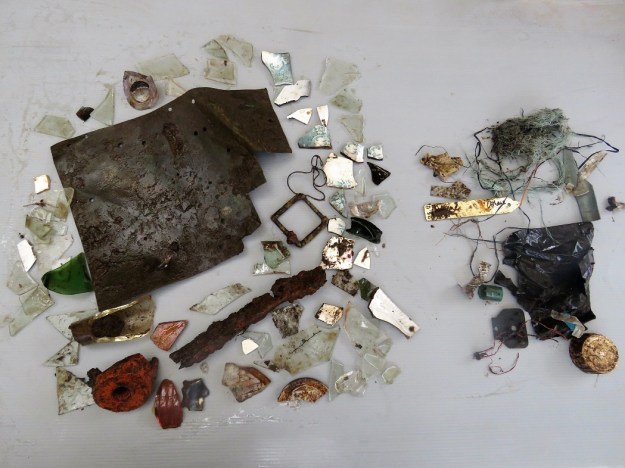
The discards of earlier generations to the left, our plastic generation to the right
There are times when working in the garden here takes on the flavour of an archaeological dig. This used to be a farm and farmers were not exactly renowned for taking their rubbish to the dump. It then became an outlying area of the garden in Mark’s father time, before becoming nursery in our time. I always gather up all the non-biodegradable rubbish as I garden and this haul interested me. Given that our nursery years coincided with the widespread switch to plastics, I was surprised that the volume of modern plastics and synthetics (on the right) was not greater. We must have been tidier than I thought. On the left is the older rubbish. Metal, glass, broken china and some pieces of clay pots, basically. There is quite a lot of broken horticultural glass there. Felix was doing his home propagation back in the days of terracotta pots and wooden seed trays covered with sheets of glass. While the broken glass would have been hazardous in the beginning, time has dulled the edges. Unlike modern plastics, I don’t think there is evidence that glass and shards of pottery enter the food chain and pollute the oceans. In this time when there is growing concern at plastics in the environment, we are relieved to be out of the nursery industry – a business that is now built on extensive use of plastics, some of which may be reused but precious little of it will ever be recycled.
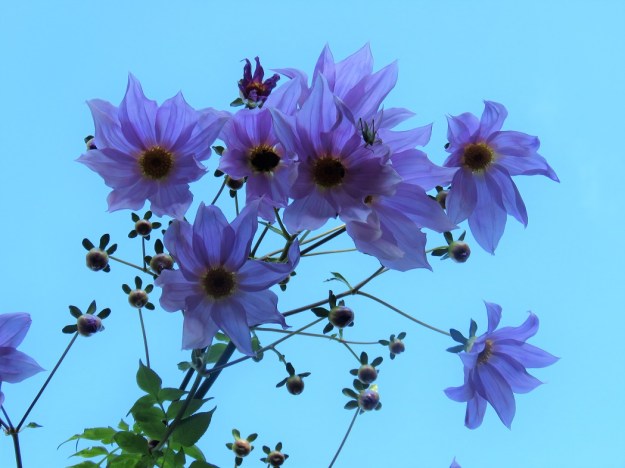
Dahlia imperialis towers some 3 to 4 metres high against the autumn sky
Finally, because I read a brave comment in a southern blog this week boldly declaring, “Even though it’s May, that most dire of months for gardens in the southern hemisphere…” (waving to my friend, Robyn Kilty) , I offer you three flowering plants this week. All are big, rangy, brittle, frost tender and come into their own just as the autumn storms hit. But are they not lovely?
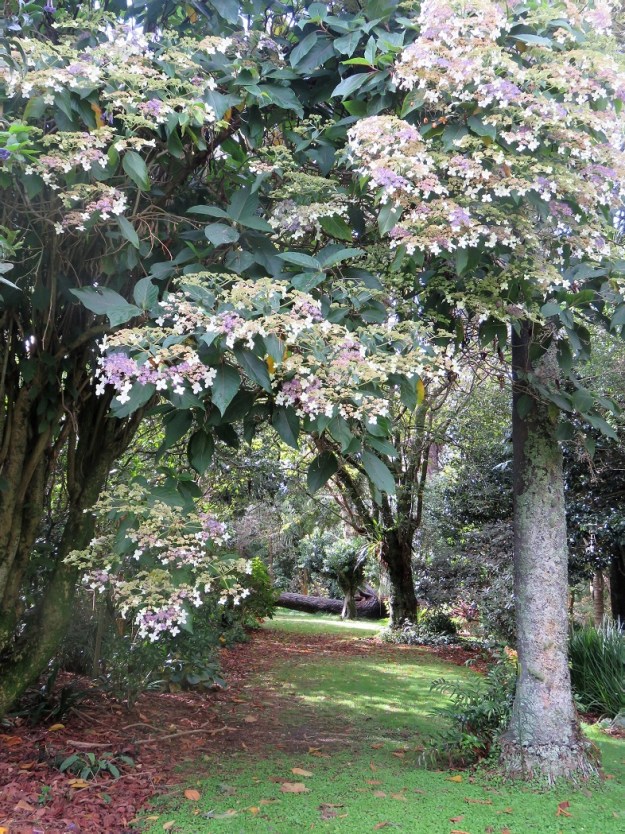
This evergreen tree hydrangea is even larger. Now, I understand classified as a form of H. aspera
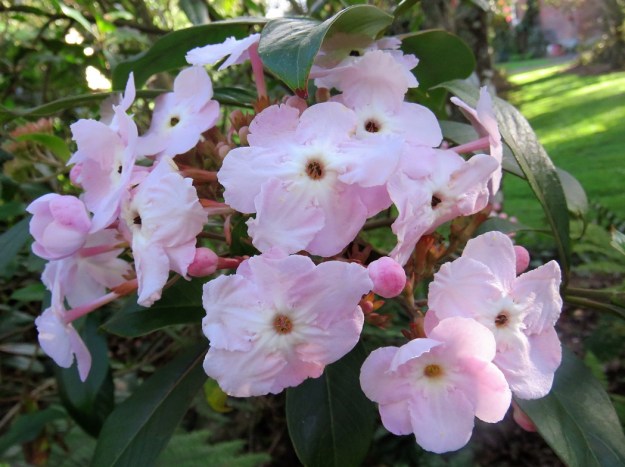
And the luculia season has started, bring us sweet scent. Luculia pinceana ‘Fragrant Cloud’.


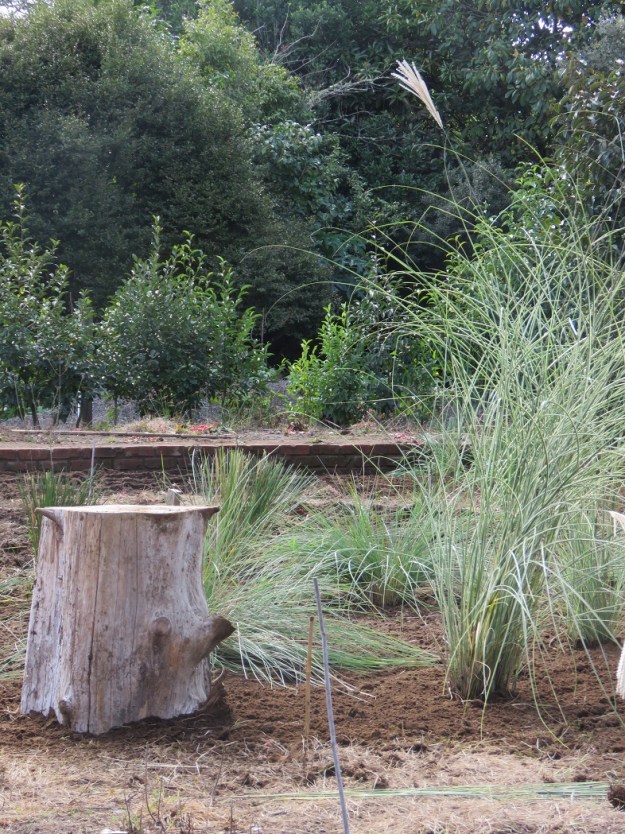 It is a blank canvas, what we refer to as the court garden, on account of it looking like a tennis court when it was just an open space. We have talked about it a lot, stood and looked at the space and mentally envisaged the possibilities – which were pretty much endless – for this open, sunny area. Having narrowed down the plan, I set about refining the plant palette and building up the material to go in. As Mark has observed in the past, ours started as a poor man’s garden. His father could not afford to buy in all the material to plant up the large garden across several acres so applied himself to raising a lot of it. These days, rather than a poor man’s garden, it is an economical couple’s garden. It would cost a lot to buy in all the plants needed to fill over 450 square metres and they would arrive as small specimens. I have been gently building up plants for a few years now so what are going in are reasonable large divisions. Instant effect, Mark calls it.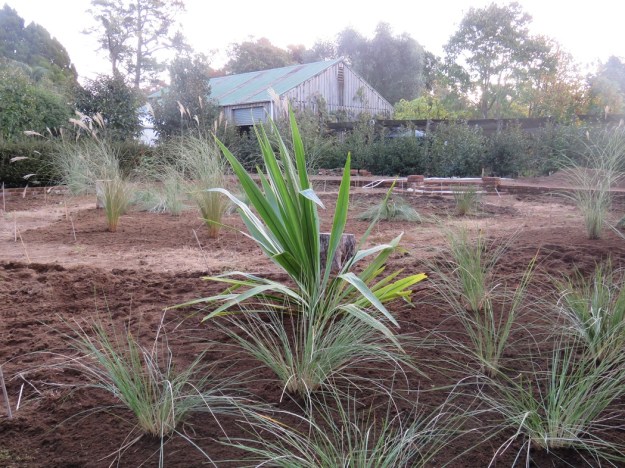

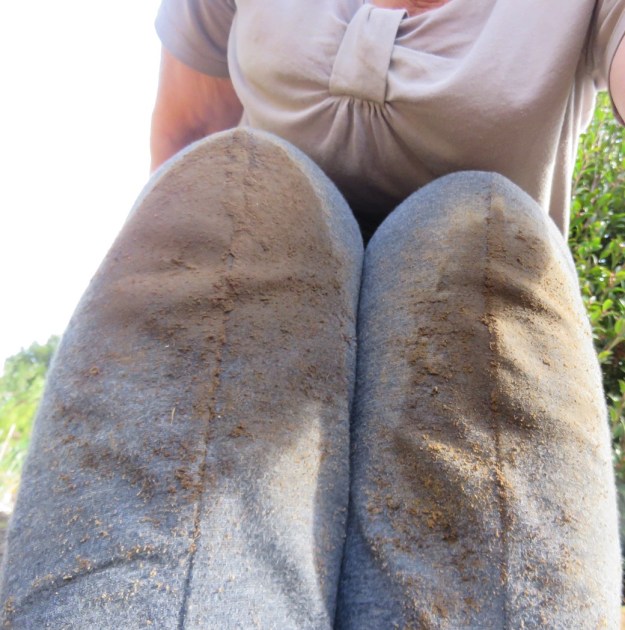 Postscript: I am a dirty-kneed gardener. Mark laughs at me and regularly tells me I should not be allowed indoors. Indeed, I often shed my trousers in the laundry before I enter the house. Don’t tell me about knee pads. I have tried them and they don’t suit me. I have an abundance of kneeling pads but unless it is wet, muddy and cold, I find it easier to wash my clothes than constantly re-position the kneeling pads.
 It is indubitably autumn. Not only do the autumn bulbs tell us this, but the night time temperatures have dropped considerably. It is the time of the year when we have our annual debate about whether it is time to start lighting fires yet.
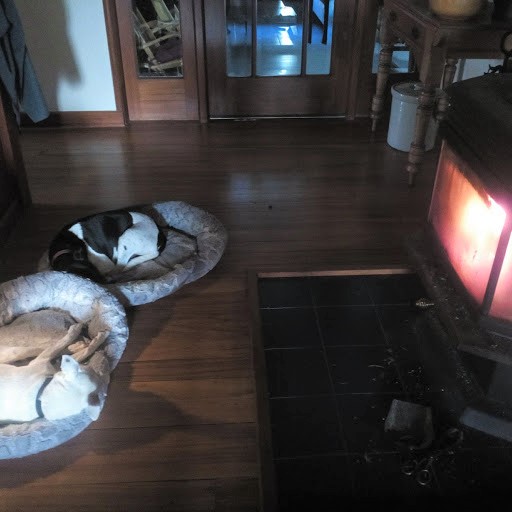
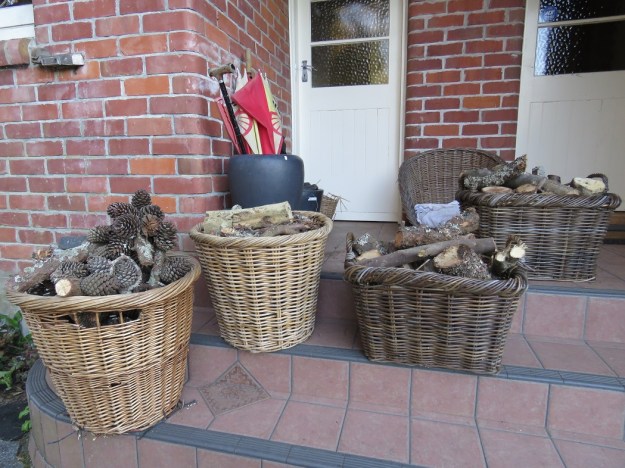
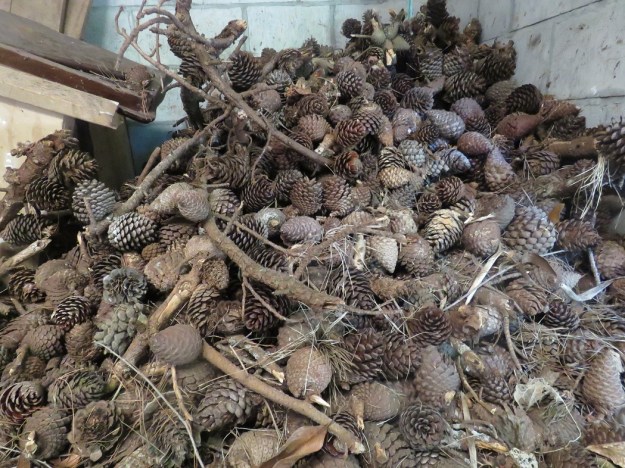 It is the pine cone and faggot time of the fire season. This does not count as burning our way through the winter firewood supplies. It is midway territory. We may be one of the few households with a designated pine cone shed. What we lack in bathrooms, we make up for in sheds here. The volume of pine cones depends on whether one of our massive pine trees has fallen in the year. None have in the past fifteen months so it is just the cones I have picked up from the gardens and lawn but it should be enough to get us through the shoulder season.