Cordyline Burgundy Spire
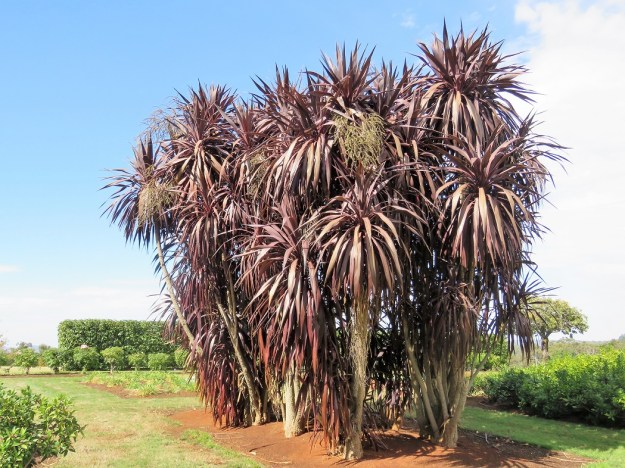
How handsome is Cordyline ‘Burgundy Spire’, seen here in the trial grounds of Anthony Tesselaar Plants in Sylvan, near Melbourne? It isn’t one of ours, though we would be happy if it was. The breeder is fellow New Zealander, Geoff Jewel. It is just a shame they never look like this in New Zealand, on account of our native moth, Epiphryne verriculata. We always have chewed and holey foliage which is the nature of the plant in its homeland; still handsome and eye-catching but as a garden plant, it would be nice to have cleaner foliage.
Mark Jury and Cordyline Red Fountain
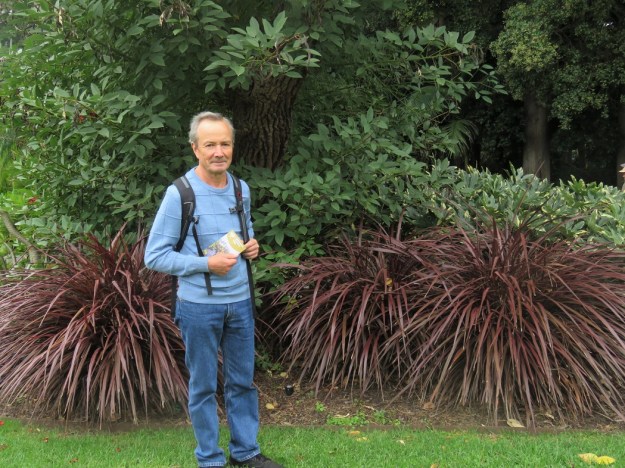
However, I can add to the occasional series of Mark Posing Beside Jury Plants Around the World – this time Cordyline Red Fountain at Melbourne Botanic Gardens. This plant was a joint effort between Mark and his father Felix, and was the first highly successful commercial plant that generated an actual income back to the breeders. Phormium ‘Yellow Wave’ still continues to be grown widely around the world but Felix never received a single cent for that one. Ditto Mark’s Camellia ‘Fairy Blush’. While it is awfully nice to be told by Australian, French and Belgian growers what a wonderful plant that camellia is and how many they sell each year, it would have been nicer had they been paying a royalty.
Muehlenbeckia complexa
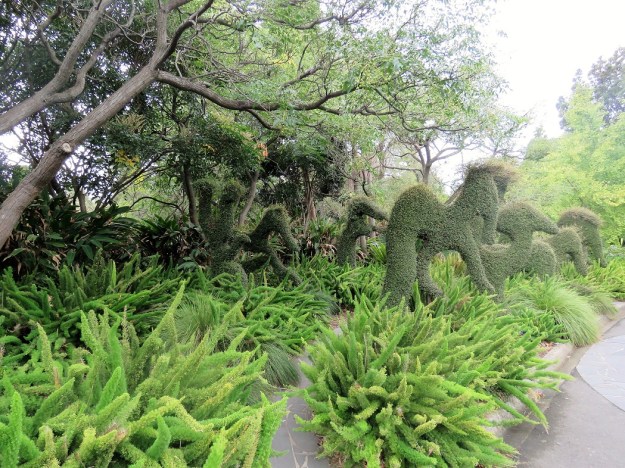
While at the aforementioned Botanic Gardens, we were somewhat charmed by these free-form animal figures created in Muehlenbeckia complexa, another New Zealand native. As the plant is generally a scrambling groundcover, I am guessing they must have trained it up over wire frames. I have forgotten the name of the fern that is used as groundcover. We have it in our garden and usually refer to it as the asparagus fern but I think the common asparagus fern that can be distinctly weedy is something entirely different. This one is rather too slow growing to threaten weed status.

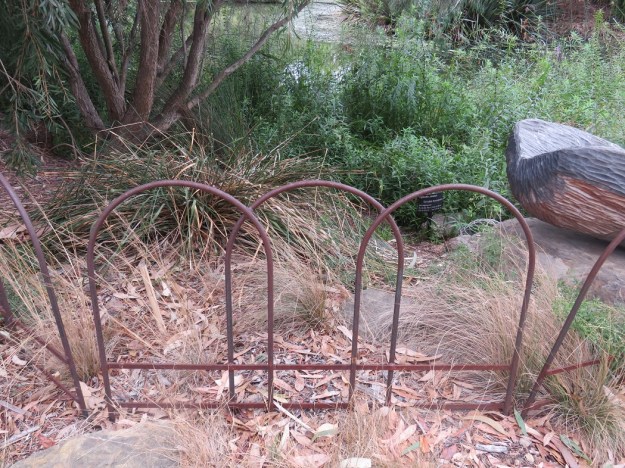
Plant supports from metal
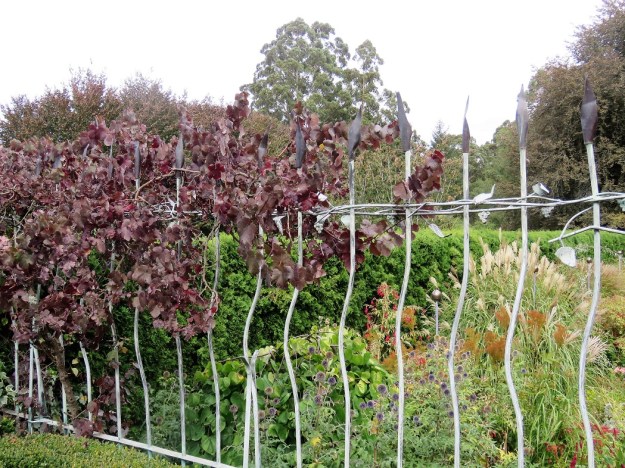
I photographed these permanent metal plant supports to add to my ideas file. In this case, ideas to keep Our Lloyd busy, should he ever run out of work to do here. This scenario seems unlikely, but there are times when some durable, attractive plant supports would be very helpful. I like gently rusting metal because it melds harmoniously with plants. I have always wanted to live in a house with Gothic arched windows. This seems an entirely unlikely event on account of Gothic arched windows never really catching on in New Zealand wooden villas and bungalows of yore and the fact that we have no plans to move house if we can possibly avoid it. But my ambition now is to have some Gothic arched plant supports, at least. As I have become more interested in managing summer perennials, the need for plant supports is becoming more pressing.

Golden bougainvillea
I would be tempted to buy a golden bougainvillea if I ever came across one for sale, though they are such monster plants, with fierce thorns, that they are very difficult to place in the garden. I first saw this colour on the Greek island of Kalymnos many years ago and I can’t recall seeing one since. Purple a-plenty, magenta, pure red, even white but the yellow and orange shades are nowhere near as ubiquitous. I was charmed to find one just down the road from where we were staying in Carlton North.
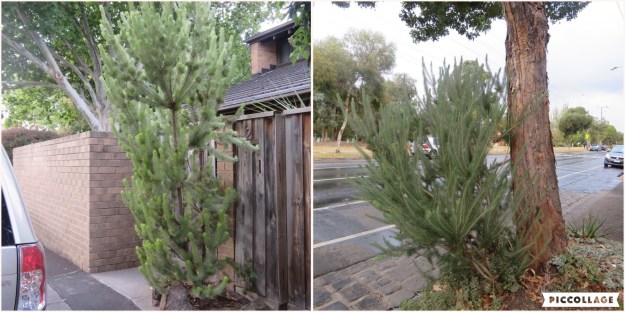
I interpreted these two scenes as what happens when city dwellers plant their Christmas trees on the road verge, although the right hand photo is not a conifer but more likely an Australian native. They amused me, though they have that look of potential vegetable time bombs.
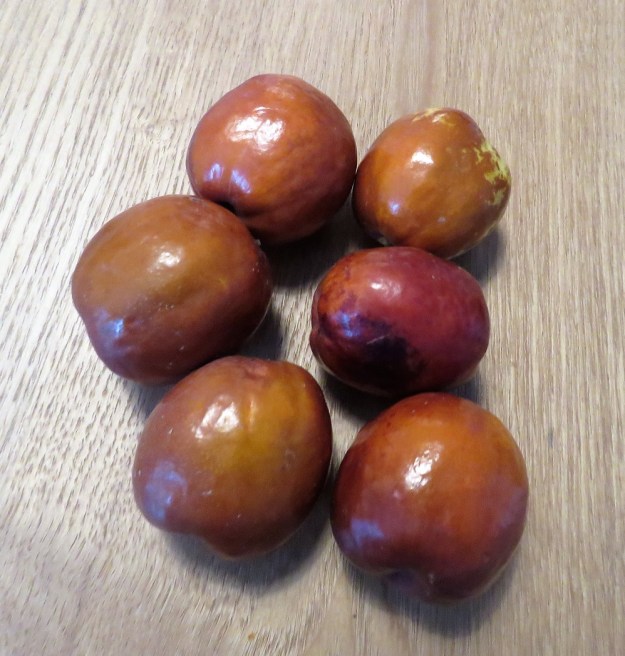
Ziziphus jujuba
Chinese red dates! Botanically Ziziphus jujuba. I have only ever tried these dried and packaged before, and that was many years ago, but our daughter found these at the Sunday markets. They are about the size of a large crabapple and taste like a date-y apple but without the crispness of the latter fruit. I have never seen them sold fresh in New Zealand.
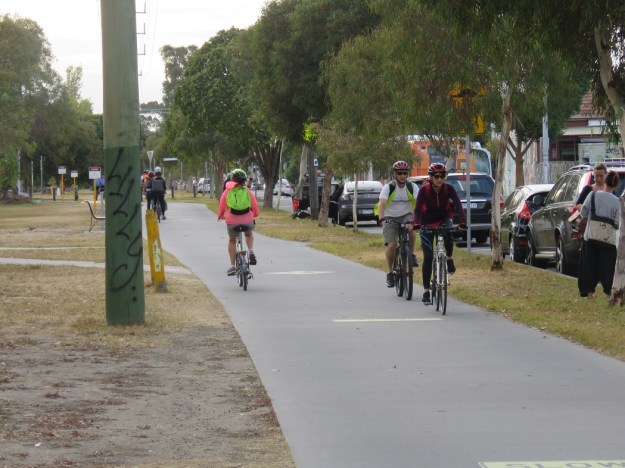
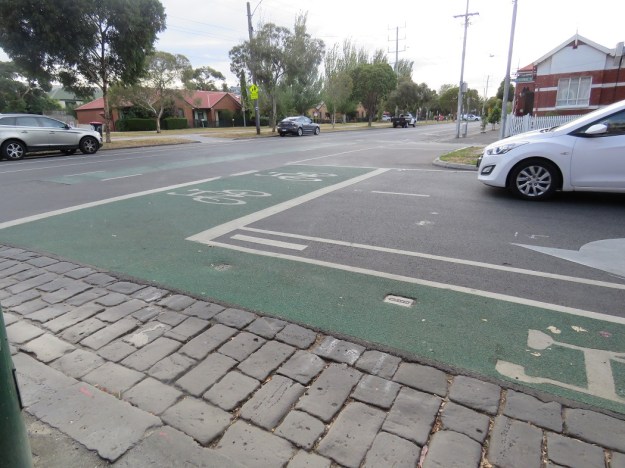
Bicycle friendly
Melbourne is not a city I know, having only been there twice before on brief visits. But we were very taken with the focus on infrastructure and design to make it bicycle friendly. Our son lives there and does not have a car so we were relieved to see that he is living in a city which prioritises safe cycling, even when it may inconvenience car drivers. Our apartment looked out over a protected cycleway and we were amazed at how many people moved along quickly on two wheels. Imagine the alternative of each of those cyclists sitting in a car – often just the one per car. In NZ, cyclists are fighting hard for some rights and accommodation in cities but too often car drivers see them as moving targets and act aggressively towards them on a point of principle. And god forbid that we should put in urban cycleways at the expense of a few carparks. Let alone give cyclists priority at intersections to make it safer for them. In our country with sprawling cities, low population density and poor to non-existent public transport, the private car rules supreme and even there, New Zealanders favour big sports utility vehicles (urban tractors, as they are sometimes called) and people movers with four wheel drive, even when they will never leave the sealed roads. We have much to learn and there are better ways of doing things than forever listening to the howling demands of incensed vehicle owners.
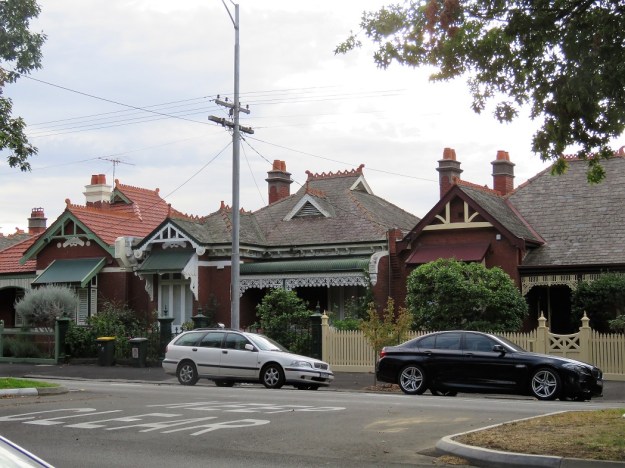
From the start, Melbourne was built with reasonably high density housing and sufficient money to add ornamentation in abundance to its domestic housing. It is very charming that so much of this has been retained. But – and it is a big but – what is with the graffiti, Melbourne? Graffiti everywhere. The only place we have ever seen graffiti to rival it is alongside the rail lines as we left Paris. Our son suggested it is part of the edgy urban feel Melbourne cultivates but we were not convinced. 





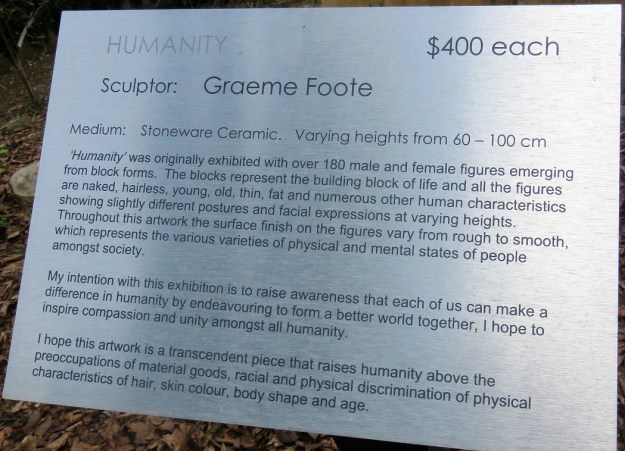
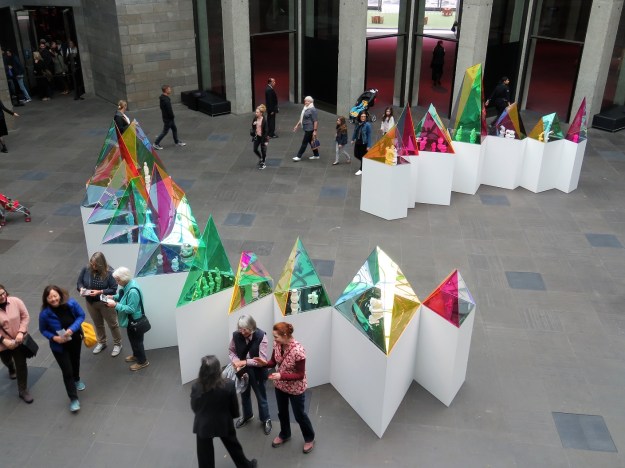 After two hot days in Melbourne last week, the temperature plummeted from 27 degrees to about 10 (Celsius). Fortunately, I had looked at the weather forecast and packed extra layers but I did wonder if I was going to have to buy myself gloves as my poor arthritic fingers complained. It was a day for indoor activities so we went to Melbourne Art Gallery instead.
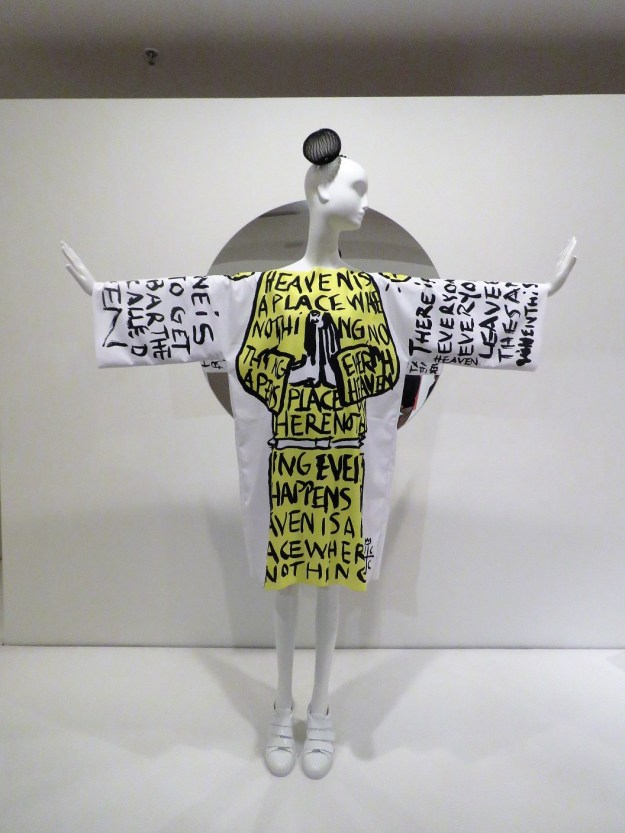 It was the final day for the Escher exhibition and the queues were enormous so we avoided that and went instead to the Krystyna Campbell-Pretty collection of haute couture and Parisian fashion from 1890 to the current day. Now, haute couture does not feature in my life, I admit that. But staging exhibitions has been on my radar from earlier in my life when I worked in an art gallery for close to five years. With over 150 outfits on display, the first rooms were simply staged to feature the gowns.

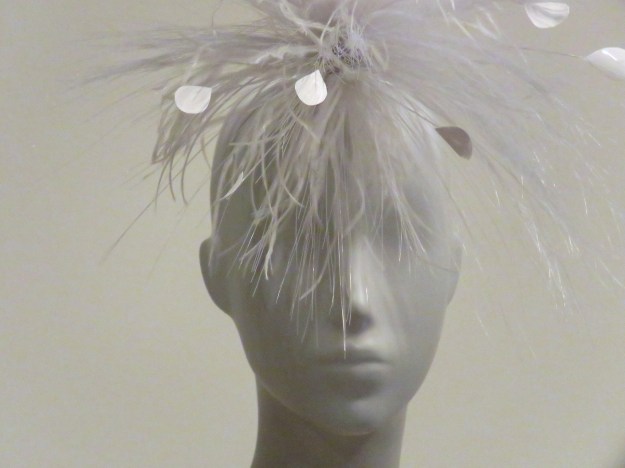 Over 150 gowns is a large number and I guess when I started photographing the models’ heads, my attention was already slipping. But then I noticed another aspect entirely. My guess is that the first gallery rooms were staged initially but then the exhibition designer and hanging assistants also found their attention straying and decided to step everything up several notches.
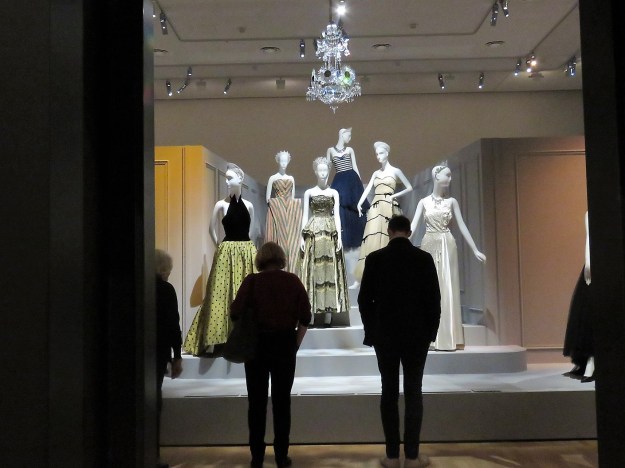 First it became somewhat theatrical in the staging.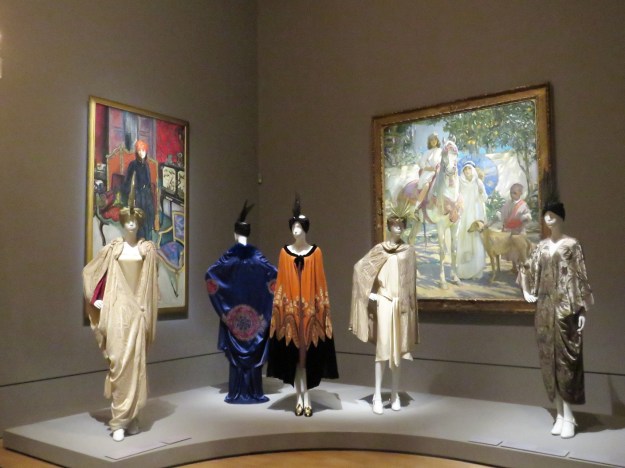
 Then we came across examples where the models and gowns were clearly matched to the paintings on the walls. They were witty but it does mean that one’s eyes naturally focus on the whole scene, rather than on the individual gowns. Which is fine, after 100 or so gowns.
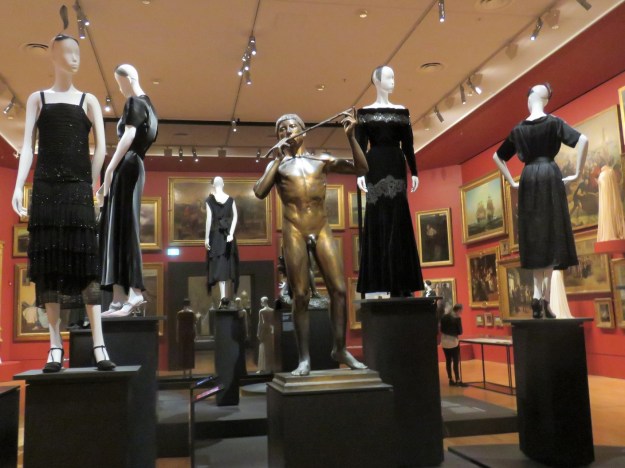 The gallery of the little black dress was Something Else. In the centre of the room, the models were staged with a collection of 3 or 4 smaller, nude men in bronze which was pretty humorous.
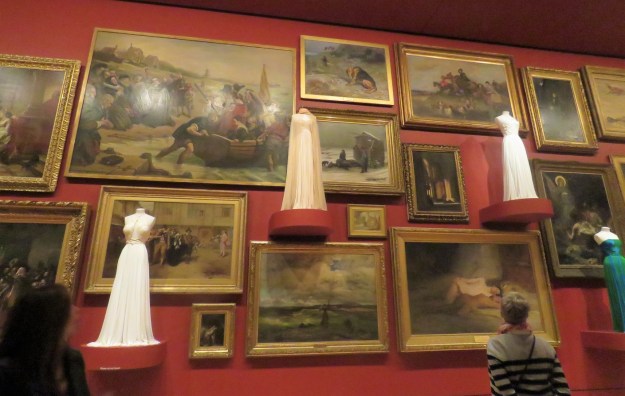 But around the walls, the gowns were arrayed on a series of rising platforms on the wall, and as they rose, the models became not only elevated, but also headless.
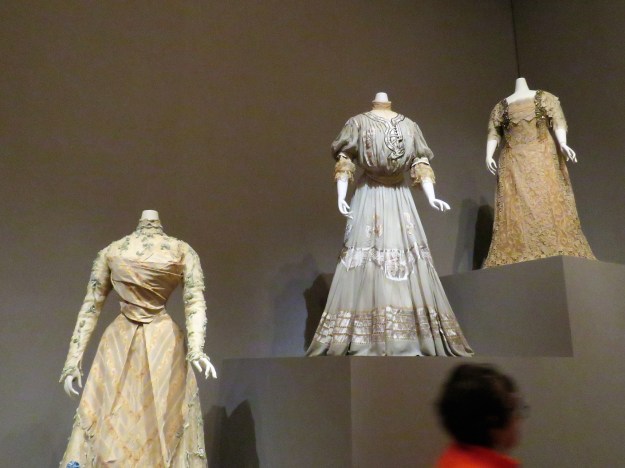 As we exited, I saw this display which had me come home and Google when bras were invented. These three gowns came from around 1890 to 1905 and the first and third gown presumably indicated the use of binding that pre-dated bras. The middle one, it appears from the shape, was for the bra-less – a 1905 afternoon gown from Marie Callot Gerber. And in case you are dying to know when bras appeared, the first models were around this time but they did not come into widespread usage until the 1930s.
 The caterpillar garden has been bringing me much delight this summer.



 I do not think I have a gardening post in me this weekend. Ours is a country in shock but none more so than our Muslim communities and the people of Christchurch. How could this happen in New Zealand? But happen it did and the soul searching going on now reveals that it should not, perhaps, have come as such a shock. The signs were there but nobody took much notice of them. Nobody, that is, except the Muslim communities and other marginalised groups and individuals who face the rising tide of hate in their everyday lives, even in our peaceful land of the long white cloud.