
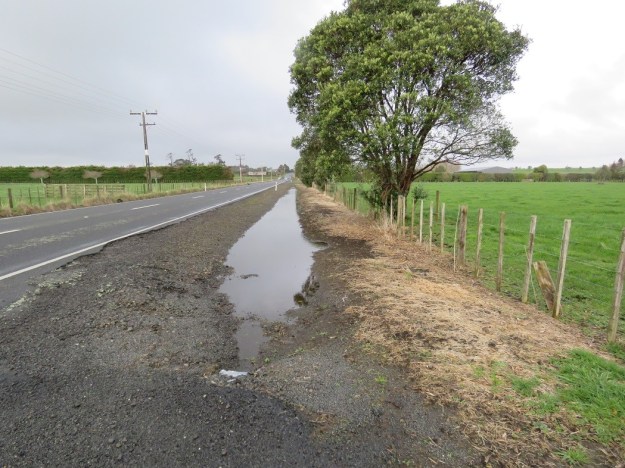
The visual and environmental scourge of the scorched earth roadside
Glyphosate has been much in the news of late and the calls to ban it are increasing in this country. I am no scientist so any opinions we have here are based on experience and observation. Because we ran a plant nursery for about three decades, our experience with sprays is greater than the average home gardener. You don’t think all those brilliant looking plants you buy from the garden centre are grown organically, do you?
Because of my lack of scientific background, I was pleased to find a post on the credible and independent Sciblogs site, written by scientist, Dr Grant Jacobs. If you have any interest in the use of glyphosate, I would urge you to read it in full here.
If you are not going to read it in full, the key points I have taken from it are:
- The original probable (not definitive) link between glyphosate and cancer was made by IARC in 2015 (IARC being the International Agency for Research into Cancer which comes under the World Health Organisation). IARC’s role is to flag areas for further investigation and identify hazards, not to make definitive rulings. Even the term ‘probable link’ is an oversimplification of IARC’s findings.
- The role of risk assessment on those potential hazards falls to regulatory bodies – the Environmental Protection Agency is a key body in NZ. And while IARC made the initial finding, subsequent investigations by scientists in such regulatory bodies around the world have not raised red flags. It appears that all such investigations have cleared it as safe when used according to instructions and with usual safety precautions. The difference between hazard and proven risk is important.
- Any blanket ban on such a product comes down to a political decision and that is what we are seeing happening in Europe. A political decision is not necessarily based on science. It can often be based more in public opinion and political polling.
- The court case in USA which triggered the recent round of debate (the school caretaker who contracted cancer) is based on a judge and jury trial in a courtroom and as such it is subject to the vagaries of a court system where the jury may or may not understand the science and where the directions given by the judge have a huge influence. This will all be tested further in the appeals process but a court case does not constitute rigorous scientific enquiry and risk assessment. While the case is certainly interesting, it is not proof of anything at this stage.
Jacobs also clarifies why we need to be talking ‘glyphosate’, not using the original brand name of Round Up. Indeed Round Up for Lawns contains no glyphosate at all. It is the chemical that is under scrutiny, not the branding. Round Up is a Monsanto product and while there are many concerns about Monsanto across a whole range of issues, the safety or otherwise of glyphosate should not be confused with a battle against Monsanto business ethics (or perceived lack thereof). Let us keep the arguments separate.
I was listening to a discussion on Radio NZ about all this and the host went on and on about the safety of glyphosate. “Is it safe? Can you guarantee it is safe?” he kept asking. Wrong question. How safe is it if used properly? Is the risk within acceptable limits? These might be better questions. Our lives are filled with hazards that we choose to manage. In the 44 years that glyphosate has been in use, it has proven itself to be safer than many other chemical sprays that are, or were, also used. Remember Paraquat? I don’t think there is any dispute that glyphosate is hugely safer than Paraquat but is it safe enough to continue using?
I worry about the nature of public debate that may see political decisions to ban what has so far been a relatively safe agrichemical, while leaving far more dangerous options on the market. Unless we have a change of heart, mind and practice on how we manage weeds and pasture, we run the risk of banning one option, only to have people substitute with another spray that could be way worse. We are a country that accepts a pretty high level of use of chemicals, toxins and sprays. While some are now controlled and you need to be an approved handler to buy them, the home gardener can still buy a fair number of products across the counter that are no longer available to their counterparts in the European Community.
The issue of the possible threat to human health underpins all this debate with IARC, cancer and banning glyphosate. It is separate to the issue of the impact on ecological systems. That is a whole different area to be considered. There are theories that environmental damage may be more to do with the surfactant (the sticking agent) rather than the glyphosate. We have also raised our eyebrows at the quick knockdown glyphosate products – the convenient aerosol or pump sprays that the home gardener can use to kill a plant more or less instantly. But again, that is a separate issue to fundamental matter of the claimed threat to human health.
It is complicated, not black and white. By all means, go organic and shun the use of non-organic sprays in your own garden. But maybe don’t cast glyphosate as the greatest villain of all the sprays and single it out for blanket bans while leaving the others on the market. I think that is called throwing the baby out with the bathwater.
Time will tell if we will face a future without glyphosate and that bears some thinking about for home gardeners, farmers and most landowners as well as the public sector which maintains the parks, reserves, road verges and playing fields. Our attitudes to weeds, to invasive plants, to long grass and to presentation standards which are widely held as desirable will have to change too. On the bright side, the scourge of the scorched earth roadside may disappear which would be hugely beneficial both environmentally and aesthetically, in my opinion at least.


 Finally, an animal story. When we first adopted poor, unloved Spikey dog in 2009, we worried that he felt the cold badly. His coat was very thin – at least compared to the Shetland sheep dog we also had at the time – and he had not one ounce of body fat. Daughter made him a coat of many colours. I put it on him one chilly morn and Mark laughed at the ridiculous sight. Spike then hurtled down the avenue gardens after a rabbit and reappeared without his coat. Suggestions ranged from him being too embarrassed to be seen in the coat to Mark’s idea that he had regifted it to a needy rabbit family. Years passed and we never found the Joseph coat – until this week. It is a little brittle after 8 or 9 years in the open but a triumph to the resilience of yarn blends. One minute – that is how much wear that coat had.
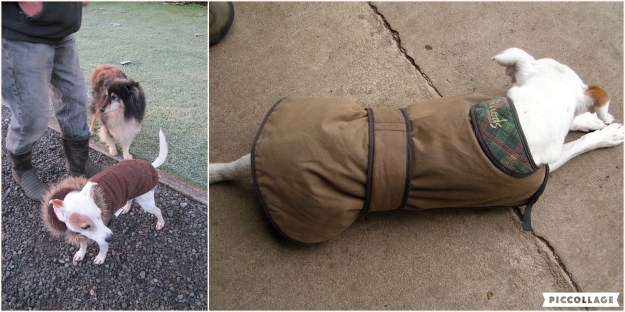 In the meantime, he had been gifted a genuine Harrods coat and I had bought him a little number that made him look like the canine version of Julian Clary. But we always knew that as a bogan, freewheeling dog, he would have preferred a black vinyl number with chrome studs. These days he is over 14, stone deaf with a heart condition and possibly some level of dementia so he has passed the winter days sleeping in his bed by the fire. Yesterday, with spring in the air, he came out of hibernation and could even have been described as frolicking as he accompanied us around the garden with visiting friends. There may be life in the old dog yet, if he doesn’t get taken out by a heart attack.

 You can see how much colder it is by the daughter’s Crassula ovata (commonly called the jade plant or money tree). She forgot to cover it and hopes it will survive. We never have to worry about that sort of thing and
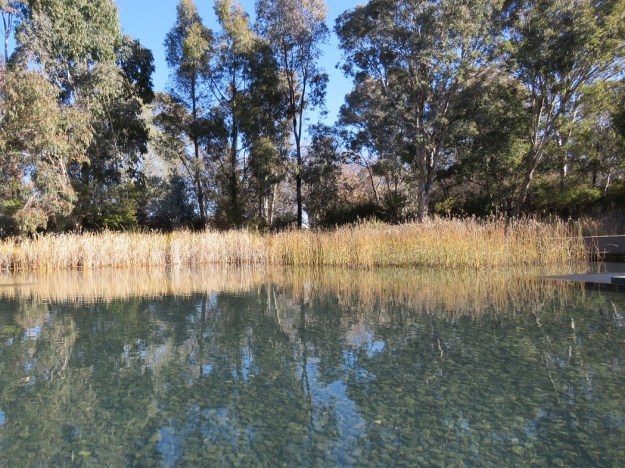 In my mind, I see Canberra as being dominated by muted golden colours. This is largely on account of it being such a dry climate. This is the entry to a major sculptural installation at the National Art Gallery. I never tire going to experience American artist, James Turrell’s Skyspace ‘Within without’ each time I visit and thought I had shared it before but it must have been just on the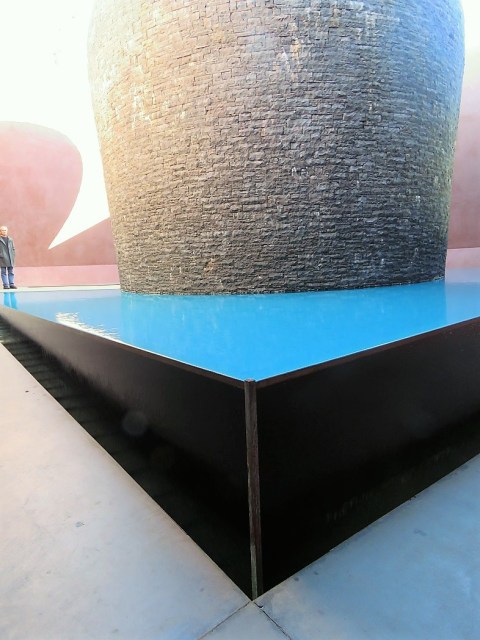
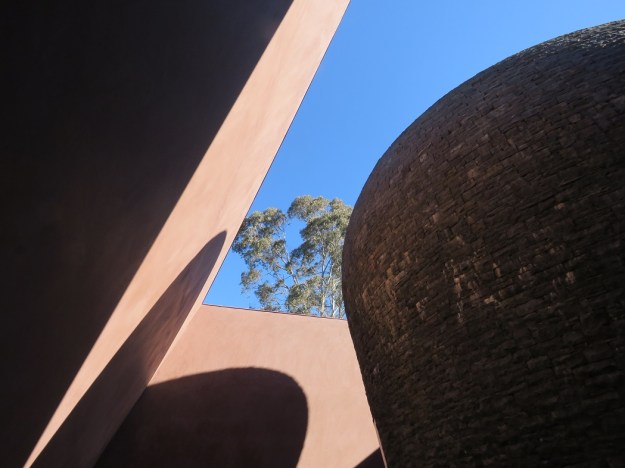
 This is the entry lane to Skyspace and probably as close as you will get to a group shot of the family on this public site. It is minus me as photographer and minus the only representative of the next generation whose second birthday we had gathered to celebrate.
 Public architecture and landscape in Australia is on a more lavish scale than we tend to have in New Zealand – a sign of a larger and wealthier economy. The parliamentary precinct houses many other facilities as well and goes well beyond utility provision of services to enable federal government to operate. I hadn’t see this particular water feature before.
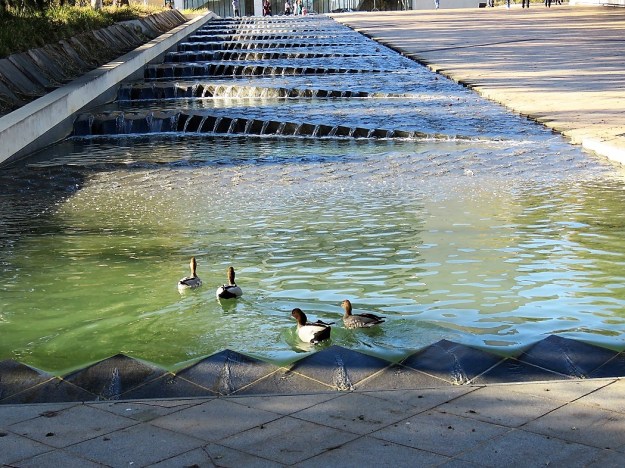 This is the wider context – a staircase waterfall, designed to be safe for the public while capturing light, movement and gentle sound in what is an arid environment.
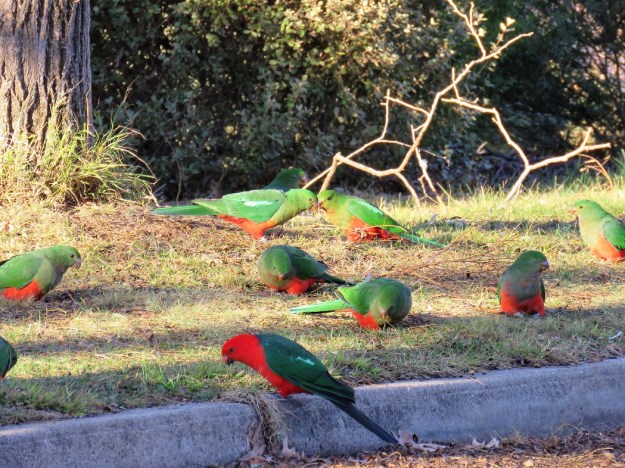 What Canberra may lack in terms of plant appeal in mid winter, it makes up for with its birds. Flocks of birds, in this case a convention of king parrots on the road side in our daughter’s quiet street. Daughter tells us that the red head on the front bird is a sign that it is the only mature male amongst the 20 or 30 juveniles in that group. New Zealand birds are generally restrained in colour whereas Australia has many birds that are bold, brash and colourful.
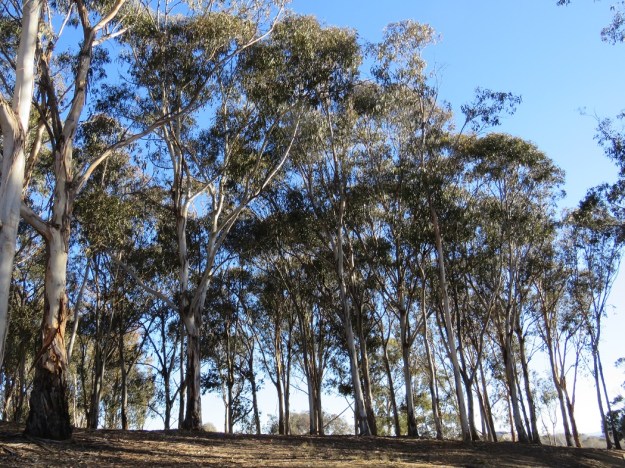
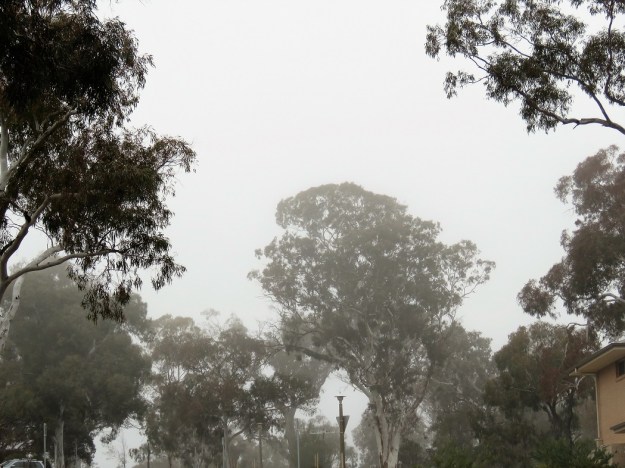 We rarely see the muted, mystical light of a winter morn in Canberra. This may be because we have far more wind – a disturbed westerly air pattern, as Mark refers to it. This is just a suburban street scene – eucalypts, eucalypts and more gum trees. But no koalas on these ones. There are more than 700 different eucalyptus species, most of which are native to Australia. I once offered to buy the daughter a book on them so she could start to learn the different ones but she did not take up my offer.
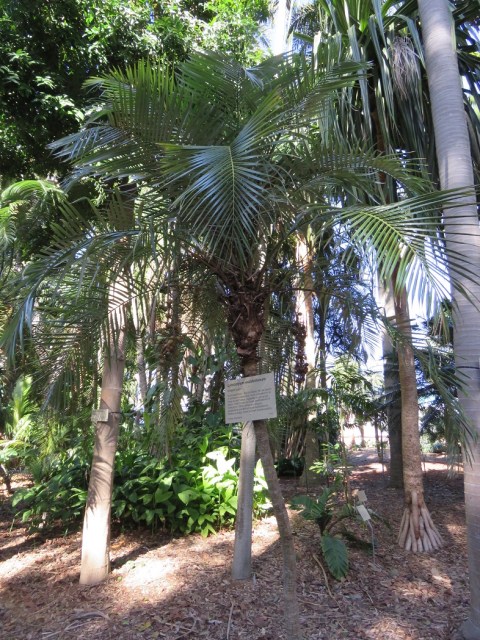

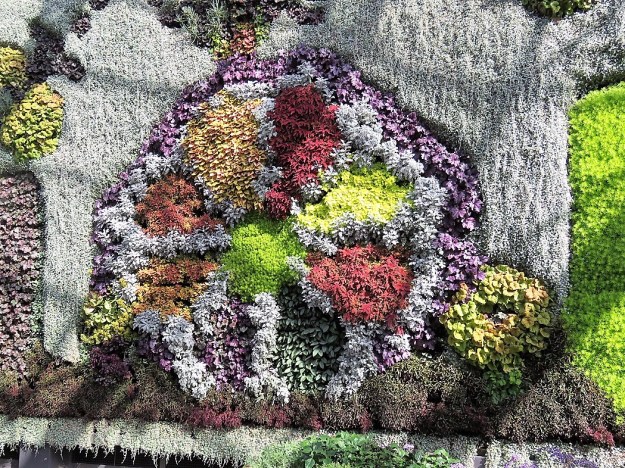

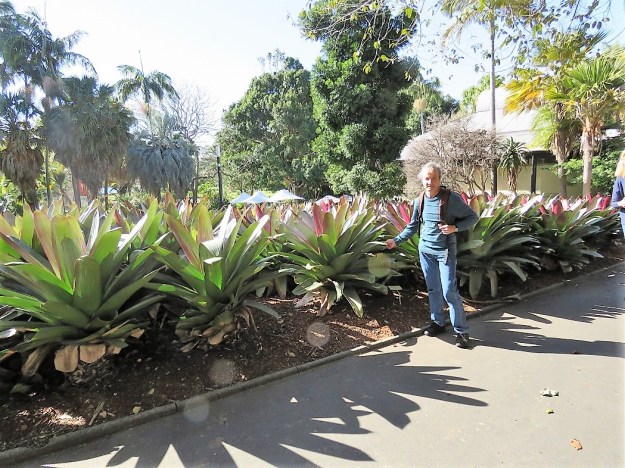


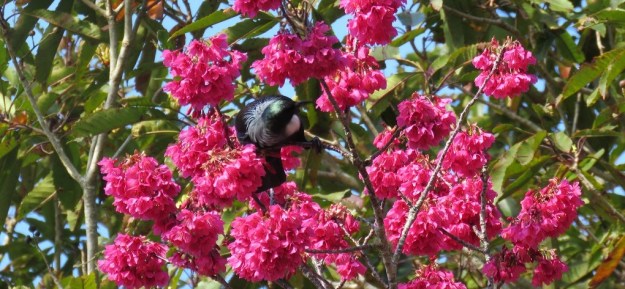
 The stand of flowering cherries in full bloom drew the crowds and proved yet again that humans like colour and blooms, preferably in abundance. It is a locally bred hybrid, a cross between the wild cherry Prunus avium and Prunus campanulata, named ‘Yvonne Matthies’. I have no idea if it is available in NZ and, of more importance, whether it is sterile or not. I imagine with all their bats and birds in Australia, they are not so keen on potential weed cherries that are spread by birds.
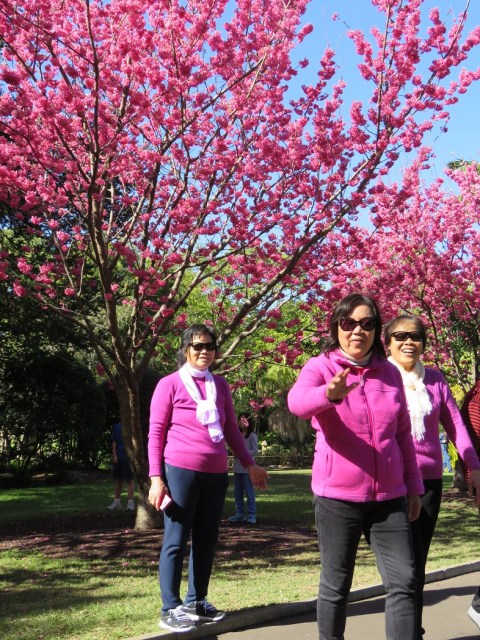 I particularly appreciated the tour group with the three women who, by pure chance, toned so perfectly with the blossom. They were equally delighted and took many (many, many) photos.
 Finally, the sign in each toilet cubicle spoke volumes about the sheer number of overseas visitors these gardens must attract. Toilet etiquette and requirements vary throughout the world. A Twitter friend was more worried by the fact that the roll of toilet paper is depicted round the wrong way. it should be unrolling from the top, not from underneath. That is all I will say on this matter.
 Tikorangi The Jury Garden