Category Archives: Garden book reviews

Fifty Plants that Changed the Course of History, by Bill Laws.

This is a book themed on plants, not to be confused with a gardening book. A collection of fifty chapters on disparate plants (agave, chilli pepper, coconut, olive and forty six others), it is filled with delightfully written random pieces of information. So the chapter on pineapple includes the Wardian case (a vital piece of equipment for transporting plants back alive on very long sea voyages, though it was originally designed for studying moths), a dissertation on the evolution of the glasshouse – and with that, the invention of Bakelite – along with a note about Mr Dole from Hawaii, a name immortalised on the tins of pineapple in our supermarkets. It is full of such curious, eclectic and wide ranging content, ideal for those who like to pick up a book and browse randomly in the hope that some day they may come up with the right answer in a quiz. But more than that, it is underpinned by a little bit of sound botany and wrapped up in a medium format hardback, packed with lovely botanical paintings, historical works of art, imagery and muted, modern photography. The English are masters of understated quality.

(Allen and Unwin; ISBN: 978 1 74237 218 1).
Bromeliads for the Contemporary Garden by Andrew Steens

Beginner gardeners like comprehensive manuals such as the Yates guides or the old Palmers garden guide. Experienced gardeners usually decide that specialist publications on specific topics are more up their street. If you are interested in bromeliads, you will want this book.

The name of the author may be more familiar to readers as one of the vegetable panel in Weekend Gardener magazine, but Andrew Steens experience and knowledge goes well beyond the home orchard and vegetable patch. He is a qualified horticulturist with a particular long term passion for bromeliads, which he has been growing for over 30 years and is now breeding as well. This book is a major rewrite and update of his first book on the topic in 2003, with many additional photos and around 60 new species and hybrids added. Broms are a large family with over 3000 species already known and more being discovered on a regular basis and that does not include the hybrids. Not that this is a comprehensive encyclopedia of broms. Steens has filtered and selected those he includes, grouping them in their larger families. He also gives information on how to care for plants (many are very easy to increase at home) and on growing them in garden conditions and landscaping with them. His style is engaging and he communicates his enthusiasm, tempered by appropriate technical information. I used it to check on the Alcantaera I featured recently in Plant Collector. It is a good reference book from a reputable author with lots of lovely photographs and an appropriate index.
(Godwit; ISBN: 978 1 86962 1780).

Does credibility and reputation count for nothing these days, or does Penguin just think we have short memories?

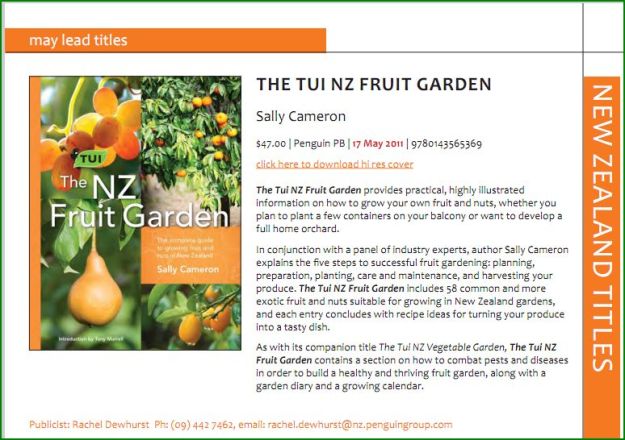
Unbelievable. The second most read entry on this website is the piece on plagiarism I wrote last May which resulted in a lightning quick withdrawal from sale of Penguin’s publication: The Tui New Zealand Fruit Garden by Sally Cameron. Even now, that article attracts several hits most days. But Penguin clearly think the public will have forgotten. Exactly a year later, they will be releasing the new version of the book. To all intents and purposes it looks the same, but apparently this new edition has been written “in conjunction with a panel of industry experts”.  Well that is a relief and shows that some notice may have been taken of the earlier shortcomings, but what on earth made them think that the author, Sally Cameron, has any credibility left?

Are we to see this new edition released with all the usual hype and hollow accolades for the author? I fear it is likely, given the early blurb on Penguin’s website: The Tui NZ Fruit Garden [PDF] It is a good topic, Penguin, and you produce good looking books. You just needed a credible author and a new look. Will you be offering to replace the withdrawn copy with the new edition for those who were unfortunate to waste their money on the first attempt?

The Tui NZ Fruit Garden

Dreamers of the Day: A History of Auckland’s Regional Parks, by Graeme Murdoch.

This weighty, hardback tome is more likely to be a presentation book throughout its life than a best seller. Presumably the new Super City council will be quite happy to continue presenting it, even though it is clearly the legacy of the Auckland Regional Council. One hopes the new council will value these regional parks as much as those who were the original instigators followed by those who kept the dreams alive by protecting and developing these publicly owned areas. There are quite a few such parks ranging from the well developed Auckland Bot Gardens, through reserves at Muriwai and Long Bay to the larger tracts of regional parklands in the Waitakere and Hunua ranges, along with many others in between which are probably largely taken for granted. The author has meticulously documented everything and there are many photographs, both historic and modern, in a book that has spared no expense or detail. The book will be of limited interest outside Auckland but these records are important to have, if only to avoid corporate amnesia and to prevent a repeat of the era in the mid eighties which threatened the future of these valuable and valued open spaces. Open spaces are going to become more important in the future, not less, but possibly even harder to protect from the ravages of development.
(Random House; ISBN: 978 1 86979 332 6)

Book review: A Green Granny’s Garden, by Fionna Hill.

There was a collective groan here when this book arrived for review. Subtitled: A Year of the Good Life in Grey Lynn – The confessions of a novice urban gardener, it immediately placed itself into that genre of self deprecating wit written by somebody with very little gardening experience. That particular genre has been done to death in this country in recent years. And indeed the author owns up to planting the entire garlic bulbs, rather than individual cloves, into heavy, water-logged soil. But as long as you don’t expect it to be a gardening reference book (although it is written as a monthly record, it lacks an index and there is no attempt to organise the information), then it may be fine as a holiday read. Along the way you may pick up some ideas (the author has ranged widely across a whole range of crops) and there are a few recipes interspersed in the text along with some anecdotes of her overseas travels. Generally the book trips along in an entertaining enough fashion, most likely to appeal to a readership of middle aged and middle class women. Though it should be said that her self justifying anecdote of foisting her friend’s unwanted agapanthus on Hollard Gardens plant share and swap simply beggars belief.
(Harper Collins; ISBN: 978 1 86950 847 0).