
Category Archives: Garden lore

Wisdom and hints

Garden Lore

“Once it has a toehold, incongruity has a way of advancing systematically through the garden like quackgrass.”

Des Kennedy, Crazy About Gardening (1994)

A wonderful blue but don't trust this commelina in NZ

A wonderful blue but don’t trust this commelina in NZ

Garden Lore – weed plants

We bought a packet of seed of this pretty Commelina coelstris ‘Sleeping Beauty’ a few years ago and we have been working on eradicating it ever since. Mark decided it was dangerous as soon as he saw the seed set, even before we found that if you fail to remove all the tuberous roots, it can stage a comeback. It has such a pretty blue flower and we are fans of blue. Mind you, it is not as if it flowers in abundance like the common lobelias that seed down here and do no harm at all. I checked an American website and opinion was divided on the invasiveness of this plant but its ability to grow across a huge range of climatic zones, in every soil possible and in both sun and shade is a good indicator of weed potential in the hospitable conditions we have in this country. Pretty wildflowers in harsher climates can be an environmental curse here.

We haven’t complained to the seed company selling the commelina. Last time we mentioned to them about the weediness of a line they were selling (it was so-called strawberry spinach), the response we got was a dismissive: “Nobody else has had a problem with it”. The sub text to this might be: ‘we have no intention of stopping selling this plant and clearly you have no idea what you are talking about’. Since then, we have noticed others complaining about strawberry spinach. It took us years to eradicate it. It wasn’t even particularly appetising. Buy this, or the commelina at your peril. Campanulas are a better option for easy-care blue flowers.

First published in the Waikato Times and reprinted here with their permission.

Garden Lore

“I always think of my sins when I weed. They grow apace in the same way and are harder still to get rid of.”

Helena Rutherford ElyA Woman’s Hardy Garden” (1903)

Sago!

Sago!

Garden Lore: Friday 10 January, 2014

Most of us above a certain age grew up with milk puddings. Semolina, sago and tapioca were the most common thickening agents. Until recently, I had vaguely assumed that they basically derived from the same source of starch and the difference was in the grade of grain. Not at all. Semolina is usually durum wheat-based. After the outside husks and wheat germ have been removed, what remains is the inner part, or middlings. This is what gets ground into flour but before that stage, basically it is semolina. It can also be obtained from rice and maize crops – the latter becomes the dish known in USA as “grits”. Modern times have seen old fashioned semolina give way to the trendier North African couscous, which is essentially very similar in makeup but sold as a quick-cooking product having been steamed and then dehydrated. Israeli couscous (which resembles tapioca or frogs’ eyes) is simply further processed to this larger form.

Sago, on the other hand, is a starch that comes from the pith in the trunks of various palms but particularly Metroxylon sagu and is largely a product from New Guinea and South East Asia. Tapioca has an entirely different origin, being from cassava (Manihot esculenta) which grows as a tuberous root and is a tropical plant which originated in South America but is now a staple food in the Pacific and Asia as well.

These days, I only have sago in the kitchen cupboard. That is because I sometimes use a recipe idea which is vintage Alison Holst. When stewing rhubarb, add sago with the diced fruit (1/4 cup to 4 cups of fruit). It takes a little longer to cook, but the result is somewhat jellied and the acidity of the rhubarb has gone. It is very palatable, even for non-rhubarb fans.

First published in the Waikato Times and reprinted here with their permission.
Garden Lore

“It takes a while to grasp that not all failures are self-imposed, the result of ignorance, carelessness or inexperience. It takes a while to grasp that a garden isn’t a testing ground for character and to stop asking, what did I do wrong? Maybe nothing.”

Eleanor Perenyi, Green Thoughts (1981).

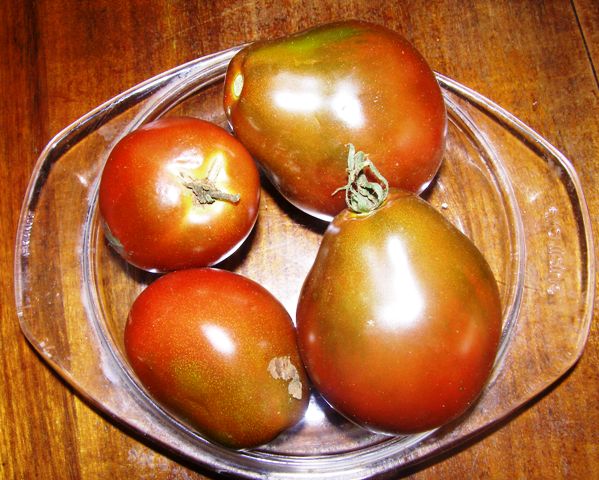
Japanese black trifele tomatoes

Japanese black trifele tomatoes

Heirloom and heritage seed varieties

I see Kings Seeds define “heirloom” seed varieties as being selected strains dating back to pre-1960s. Anything grown from seed will be a selected cultivar from the original species over time and may be very different from wild forms. While, by definition, heirloom varieties are open pollinated (by insects or wind), so too is the vast majority of seed we grow. I tried to work out whether there is an agreed difference between “heirloom” and “heritage” but generally the terms seem to be used loosely and interchangeably.

A number of people and organisations have been working for years to preserve our heirloom varieties in this country but none more so than the Koanga Institute and Kay Baxter in particular. Why does it matter? It is really important to keep genetic diversity in a world where commercial production is driven by other imperatives – particularly high productivity. The kiwifruit industry is a clear example of the perils of depending on a single cultivar of yellow fruit. If disease (PSA, in that case) takes it out, the impact is devastating.

Heirloom is not a synonym for high health. Some will be, some won’t and some will not perform well outside their original area. While most of us like to think it is synonymous with better flavour, that is not always true, either. It has nothing to do with being organic although many organic gardeners will favour heirloom varieties. Essentially, all “heirloom seed” means is that a particular seed strain has shown sufficient merit in some area of performance for people to keep it going for over fifty years. And long may we continue to preserve these different strains of seed.

First published in the Waikato Times and reprinted here with their permission.
Garden Lore

“May I assure the gentleman who writes to me (quite often) from a Priory in Sussex that I am not the armchair, library-fireside gardener he evidently suspects…and that for the last forty years of my life I have broken my back, my fingernails and sometimes my heart, in practical pursuit of my favourite occupation!”

Vita Sackville-West (1892-1962)

Ready to use weed killer

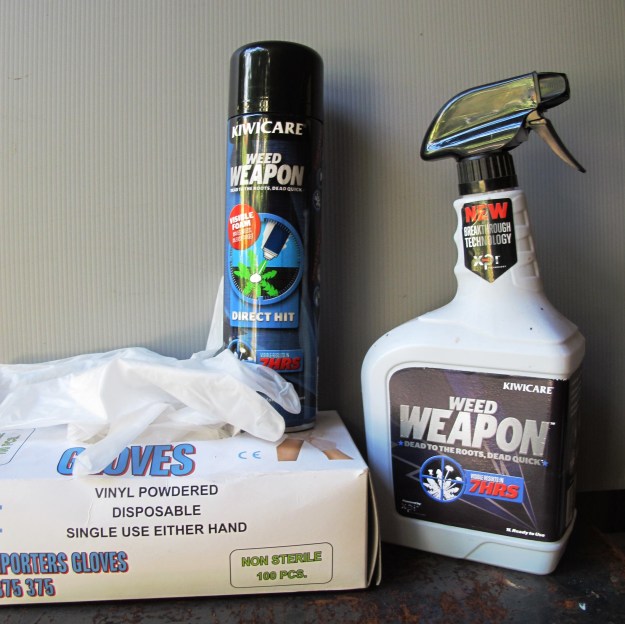
It is so exciting, the rare occasions when I receive a free sample, even if it is weed killer. The garden writer’s lot is not blessed with an abundance of samples. This was Kiwicare’s “Direct Hit” in their Weed Weapon range – aka glyphosate (formerly known by its brand name of Round Up) combined with saflufenacil which gives it a much quicker response in killing vegetation. What makes it different to the earlier “Weed Weapon” (which came in a spray bottle like shower cleaner) is that this is an aerosol foam which means you can see where it has landed.

Does it work? Yes, it will kill most weeds quickly. Is it economical? I doubt it. I didn’t get a price but you will be paying for the convenience of having it packaged in a can like fly spray. Would I recommend it? No. And no again. Being a foam makes it much harder to control the direction of the application than a spray and I suspect the level in the can will drop very quickly. It is also vital to wear protective gloves because I doubt you can use this product without getting foam on your trigger finger. Gardening gloves are not protective gloves. You need disposables or dishwashing gloves.

What was frankly alarming to us (and Mark reeled in horror when I showed him) is that the foam looks like shaving foam or that cream substitute you can squirt from an aerosol. Children would find it simply irresistible. No matter how careful you are, we doubt the wisdom of packaging weed killer that way. If you feel the need of instant weed killer in your life, I would recommend keeping to the earlier “Weed Weapon” in the spray bottle.

First published in the Waikato Times and reprinted here with their permission.
Garden Lore

103
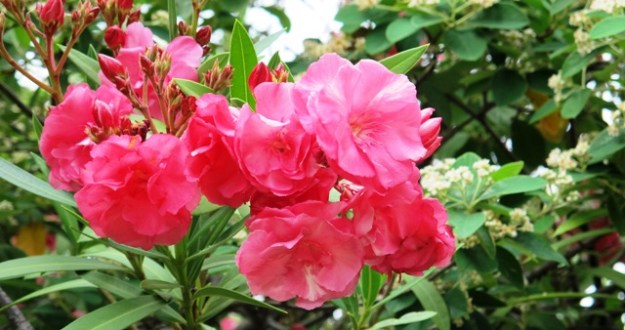
“This morning Thea saw to her delight that the two oleander trees, one white and one red, had been brought up from their winter quarters in the cellar. There is hardly a German family in the most arid parts of Utah, New Mex­ico, Arizona, but has its oleander trees. However loutish the American­-born sons of the family may be, there was never one who refused to give his muscle to the back-­breaking task of getting those tubbed trees down into the cellar in the fall and up into the sunlight in the spring. They may strive to avert the day, but they grapple with the tub at last.”

Willa Cather The Song of the Lark (1915)

Garden Tools

Is it worth buying expensive garden tools? A top of the range garden implement can cost as much as 10 times the price of the cheap alternative. I know this, having bought my Canberra daughter a pruning saw for Christmas. I doubt that it is worth buying the best for beginners. Maybe go a step up from the absolute bottom end price on the display stand, but just as you wouldn’t buy a Porsche or a Volvo for a learner driver, the beginner doesn’t need the top of the range.

For genuinely enthusiastic or experienced gardeners, yes. It is worth every cent to buy the best. Expensive garden tools are generally better designed, better constructed, hold sharp edges for longer and are more efficient to use. A good pair of secateurs will last for many years, beyond a decade even if you don’t lose them, whereas a cheapie pair will deteriorate badly after just a few months. Quality trowels don’t bend out of shape when put under a bit of pressure. Quality spades and shovels don’t bend at the stress point where the shaft is attached. Nor do good quality tools rust.

It should go without saying that if you happen to have some good quality tools in your possession, you should treat them with respect and look after them. After struggling to prune my daughter’s camellias with her cheap and nasty pruning saw, I bought her the very best and it cost about $A120. I have told her that it must be put back in its sheath every single time, even between cuts, to keep it sharp.

First published in the Waikato Times and reprinted here with their permission.