Category Archives: Garden lore

Wisdom and hints

Garden Lore: Friday 17 October, 2014

The red cubes are evergreen azaleasLook! The red cubes are evergreen azaleas. We were driving along and I made Mark stop the car so I could photograph this border from the street because it was eye catching. The azaleas appear to be all the same variety. Each rhododendron in between is a different variety. We decided that what lifted this border above the usual alternating planting – which I have been known to refer as the vaudeville or circus tent look – is the fact that it utilises formality without slavishly trying to make all the plants look identical. Each red cube is actually a different size.

One of the problems of strictly formal plantings is that the symmetry is ruined if a plant fails to thrive or dies. This is a common problem because plants are living organisms and may not conform to your requirement that they obediently stay identical to their neighbours. Here is a practical solution to that conundrum, giving structure, form and unity by overall impression, rather than exact detail. When not flowering, the azaleas will just be green cubes instead. Should one die, it will not ruin the entire length of the border if it is replaced with a younger, smaller plant.

I am not so keen on the sharp contrast of the white fence at the front, but that is entirely personal taste. Notice how the dark fence behind the border makes it recede into the distance rather than drawing attention to the straight lines of the boundary with the neighbour.

First published in the Waikato Times and reprinted here with their permission.
Garden Lore – witches’ broom

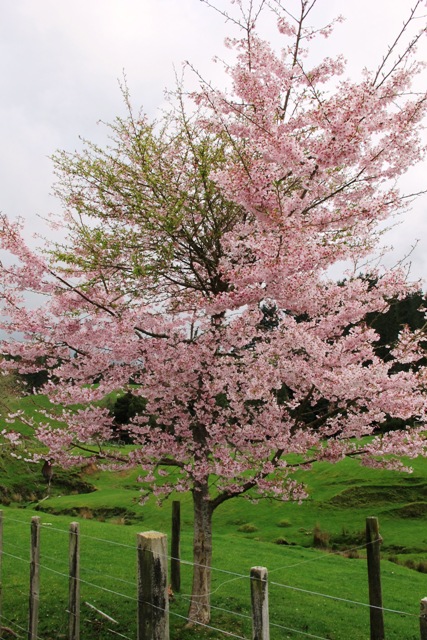
Indubitably witches' broom, not two trees

Indubitably witches’ broom, not two trees

I came across this fine example of witches’ broom in a roadside tree planting of Prunus Awanui. That particular flowering cherry is known to be vulnerable to witches’ broom. It is the green section coming into dense leaf earlier than the rest of the tree and without flowers. Left to its own devices, over time the witches’ broom will take over the tree and you will no longer see much in the way of spring flowering. If you leave it for a few seasons, it also becomes harder to remove the affected sections without destroying the shape and structure of the tree.

Basically, witches’ broom is a mutation within the tree – possibly similar to an immune disorder in humans – which causes dense, twiggy growth in that section. It does not appear to heal itself and it does not grow out of it the following year. There are multiple causes but no general treatment beyond surgery – removal of all affected parts of the plant. Cherry trees are particularly prone to it, although you won’t find them in the campanulatas or Taiwanese cherries. Generally it is seen in the Japanese cherries and the hybrids. If you spot it now, mark it because it is harder to identify later in the summer when all the branches are in leaf. Spray on paint is handy for this, or a tie. Pruning cherry trees in high summer is recommended to reduce disease getting in.

On the bright side, witches’ broom mutations are what have given us many of the dwarf conifers so they are not all bad.

First published in the Waikato Times and reprinted here with their permission.
Garden lore: Friday 26 September

lavender
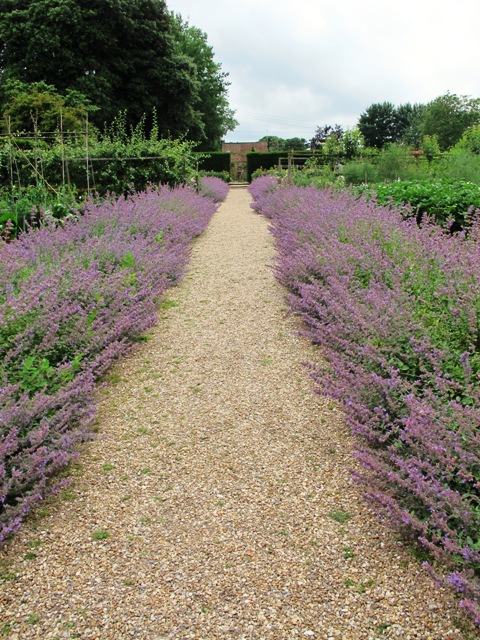
Who doesn’t love lavender? Even I, with my oft-repeated concern about the over-use of edging plants and how that can render any garden depressingly suburban, have to admit that there is something romantic about a sea of lavender. Or a long expanse thereof. But this is not lavender – it is in fact nepeta, or catmint, in early summer.

The problem with lavender is that it is a Mediterranean plant. It needs full sun, brilliant drainage, prefers it not too fertile and needs trimming correctly or it may die. In fact it may die anyway if your conditions are less than ideal. Rich dairy farming conditions with plenty of rainfall are invariably less than ideal. It is also a woody plant so needs to be propagated from cutting which makes it more expensive to buy.

Nepeta, on the other hand, is a lot more forgiving and will take sun or semi shade and still flower. It is not fussy about soil type. Being a clumping perennial which multiplies readily, even the novice gardener will be able to work out how to divide it and spread it. When it has finished flowering, you can just hack it back to a low carpet. Of course it is not lavender. But if you can’t do lavender, it is a viable alternative and the expanse of blue railway tracks into the merry yonder is just as charming visually. There are a number of different nepetas but it appears that many of the garden selections originate from N. fasssenii.

First published in the Waikato Times and reprinted here with their permission.
Garden Lore

A garden is a delight to the eye, and a solace to the soul; it soothes angry passions, and produces that pleasure which is a foretaste of Paradise.

Gulistān (The Rose Garden) by Sa’ Di (1258)

021 - Copy

More on narcissi

It was a full month ago that I wrote about daffodils and showed those varieties that were in bloom at the time. In peak bloom, in fact. We had hosts of golden daffodils in flower. We still have. I headed out to gather samples of the varieties currently blooming.

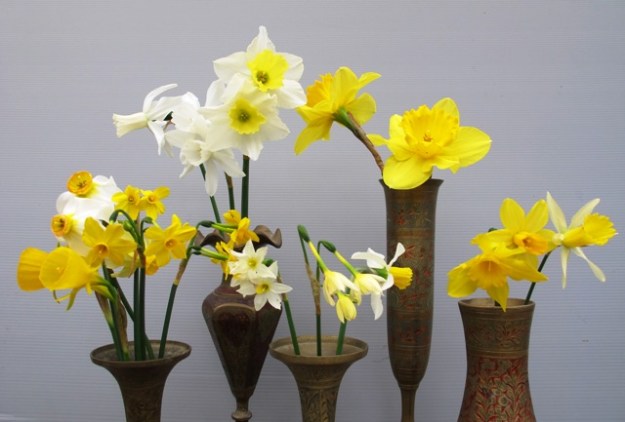
In the vase on front left, we have the three showiest for this time of the season – the bright yellow cups of Narcissus bulbocodium, Narcissus ‘Beryl’ and a dainty little N. jonquilla species which, despite its diminutive size, packs a powerful perfume.

In the centre front vase is a named dwarf variety which we have lost the name of. Mark thought it might be Narcissus ‘Snipe’ (who calls a dainty daff ‘Snipe’?) but the clever internet shows me that the one on the right is more likely to be. The lemon one in the middle is Narcissus ‘Hawera’ which is not growing as strongly as some of the other varieties for us. On the right we have the last blooms of Narcissi x odorus, ‘Tete a Tete’ and ‘Twilight’ – all featured a month ago and only now finishing. These are ones I mentioned don’t set seed. This is why they have such a long flowering season.

In the vases at the back, they will be named varieties on the left but we don’t have their names any longer though one is probably ‘Thalia’. I quite like the white daffodils. To the right, the classic King Alfred type is at its peak for us.

If you love narcissi, you can extend the season past two months by growing a range of different varieties.

First published in the Waikato Times and reprinted here with their permission.
Garden Lore

“Interest in flower arranging has increased in spite of the war. This may be explained by the fact that woman, with her love of beauty, turns to creating it as a way of escape from the cruel knowledge that, every day, beauty is being destroyed.”

The New Zealand Gardener, Vol 1, Issue 1, September 1944.

???????????????????????????????

The New Zealand Gardener then and now

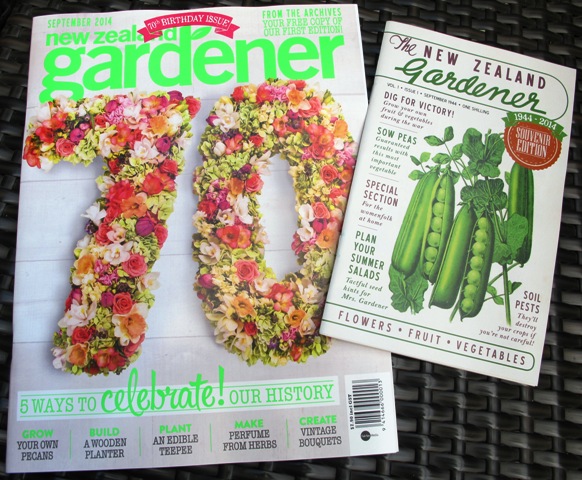
If you are not a regular reader of the New Zealand Gardener magazine, you may want to treat yourself to this month’s issue for nostalgia as much as the current content. It is the seventieth year of publication and to mark the occasion, the very first issue has been reprinted. Okay there is a bit of colour in it though I imagine the original was all black and white but it is both quaint and reassuring at the same time. The old fashioned courtesy and frugality is a reminder of times past. Honorifics are standard practice, with initials instead of christian names. Goodness, letters to the editor are to be paid at a rate of 5/-. By way of comparison, the purchase price of the magazine was only one shilling. That would make a modern letter worth $39.50, had the publisher continued with this largesse. A woman’s place is beyond doubt. It was of course during World War 2 that publication started in 1944 and that is a theme.

I used the word reassuring because quite a bit of the advice is still relevant today. Growing turnips, cape gooseberries or indeed delphiniums is not so very different now. If you are interested in the breakdown, there are seven pages on growing food crops and eight on “Science for the Gardener” (pests, disease, soil management and the like). The ornamental garden has nine pages and I particularly appreciated the column by ‘Silver Birch’ on the joys of importing rare bulbs. Not any longer with our border controls. Then “The Gardener’s Home” has eleven pages of recipes, advice and floral art. That section is by ‘Golden Willow’. Do we think she was married to ‘Silver Birch’?

The original issue comes as a free inclusion with the current September issue.

First published in the Waikato Times and reprinted here with their permission.