Category Archives: Outdoor classroom

A laissez-faire approach to summer care for apple trees

Step by step instructions for pruning apple trees in winter are available here.
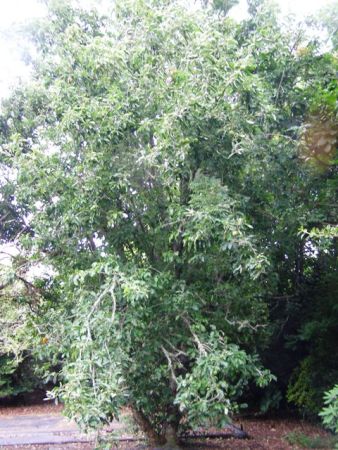
1) Apple trees can survive and continue to crop despite total neglect, but you will get much better results if you give them some attention. This huge old Granny Smith apple tree has not been touched for many, many years and shows why it is better to start with grafted apples on dwarf root stock. This tree is destined to be cut out in favour of our smaller trees which are easier to care for.
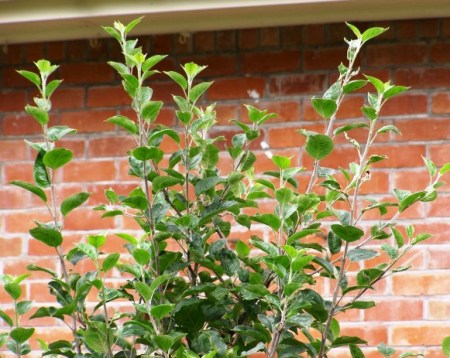
2) Apple trees are currently sporting their new growth which shows as long leafy whips. It is this growth which will give replacement fruiting spurs next summer. Ideally, you should be replacing all fruiting spurs on a two to four year cycle – cutting out old clusters and allowing fresh ones to take their place.
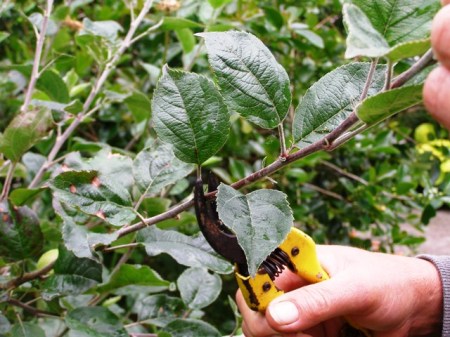
3) Trim the long whips back to about half their length to encourage the fruiting spurs to develop. Surplus whips can be cut right back to a bunch of fruit. You want to keep the tree open and uncluttered to allow the fruit to ripen well.
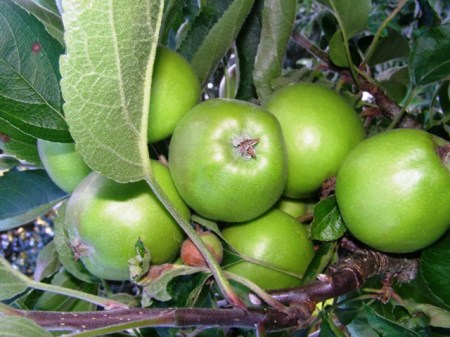
4) If your apples are looking too bunched up, it is best to thin out the fruit so that those that remain will be better quality. The tree will drop some surplus fruit before it is ripe, but thinning ensures that you keep the best specimens and stops the weight from breaking branches. Cut off very small or deformed fruit, reducing bunches to between two and four fruit. Some people recommend taking out the centre apple from a bunch to give those around it room to develop fully.
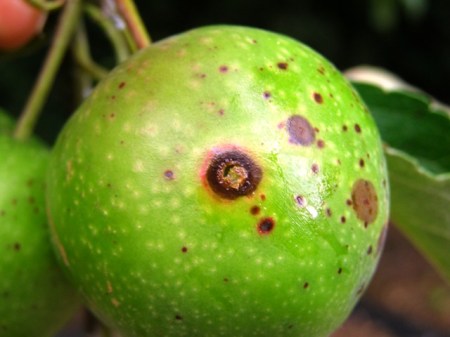
5) Codling moth is the single biggest problem and the caterpillars can take out an entire crop if left unchecked. They burrow into the apple, leaving nasty black tunnels. It is too late this season to try organic controls (pheromone traps and collars on the trunk of the tree). You need to start earlier in spring. We are resorting to insecticide spray this year to try and break the cycle. December to February are the times for spraying. It is recommended that it be done fortnightly but we will only do it once or twice.
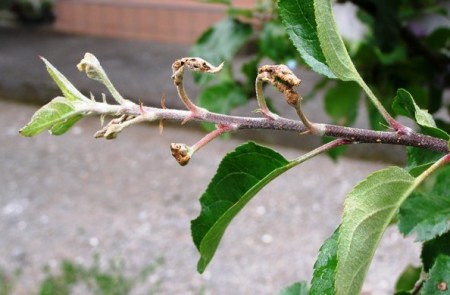
6) We do not carry out a rigorous spray programme so our trees show black spot, mildew, leaf curl and various other afflictions but we still get crops of apples. Traditional practice is to spray with both insecticide and fungicide every 10 to 14 days after the blossom petals have dropped until harvest – ask at your local garden centre for appropriate sprays. Spraying will give heavier crops of more attractive fruit but we are willing to trade that off by having additional trees and not spraying much at all. The leaf curl shown here is caused by a tiny orange midge and is easily dealt with by cutting off the tips of the branches and burning the leaves.
Construct your own Christmas tree (version one)

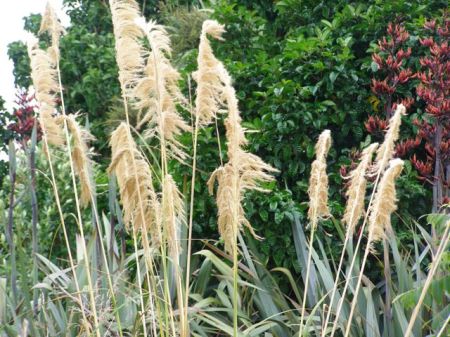
1) Inspired by a tree she saw in London, presumably made with pampas plumes, Camilla fancied trying an alternative to the traditional pine branch or the tacky tinsel alternative. As pampas is now banned in this country, we used toetoe plumes. Gathering the toetoe was the most difficult part of construction, especially with all the recent rain.

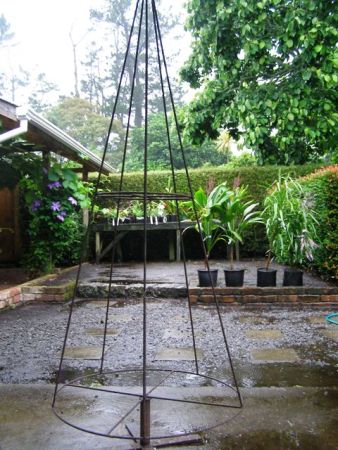
2) We were fortunate to be given a permanent metal base in the shape of a pyramid but you could construct your own from bamboo or a similar material. It needs to be fairly stable to work with easily. You need five or six vertical struts in order to be able to achieve a circular effect. Do not make it too wide if it needs to fit through a conventional door to get it inside when finished.

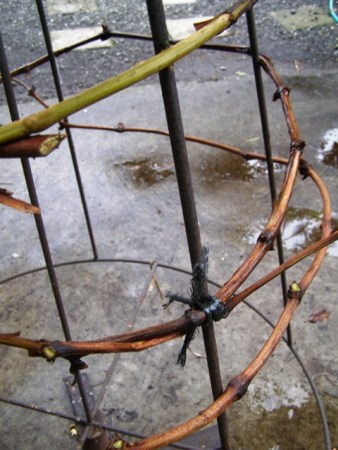
3) We wove additional horizontal supports into the frame at 20cm intervals using flexible lengths of old grape vine prunings.

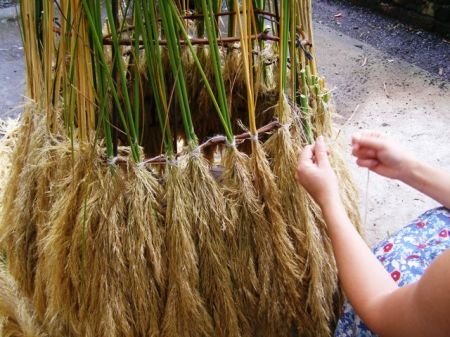
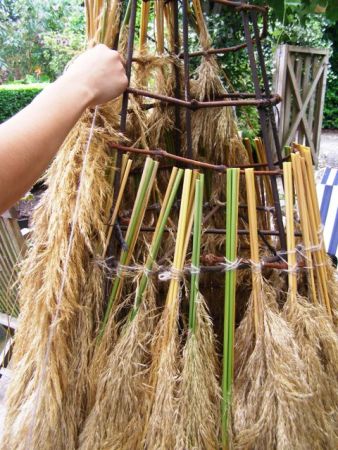
4) Starting from the base, tie groups of about three toetoe plumes at a time, forming the bottom layer of the skirt. It needs to be sufficiently dense not to see through. We tied firmly with neutal coloured wool, securing the plumes to the frame and the rings of grapevine.

5) Layer additional skirts on top. Trim the surplus stems of each layer. It took us four layers to reach the top.

Kevin, Sharon and our Christmas tree

Kevin, Sharon and our Christmas tree

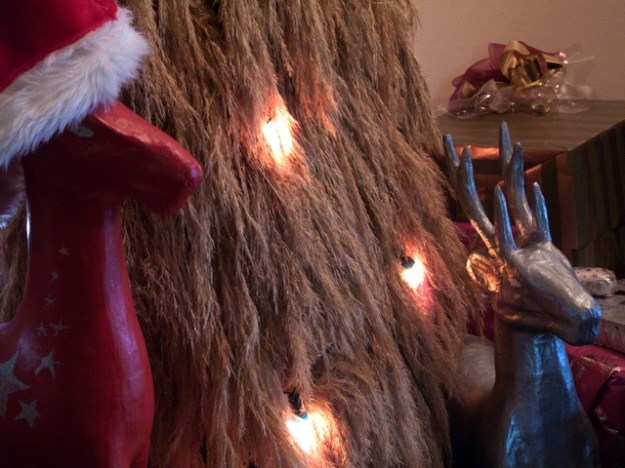
6) When it came to decorations, we decided less was more and just adorned our tree with a Trade Aid angel, the historic Jury family Christmas lights which need rewiring each year to work and the red and silver Spotlight reindeer (known here as Kevin and Sharon) at the base.

Postscript
I recall the “Christmas is over in London” photo blog our daughter Camilla wrote as she wandered the streets of Maida Vale recording the slightly sad sight of Christmas trees put out for green waste collection. I found “Christmas is over in Tikorangi”. Mark said he would dispose of the carbon content of the toetoe Christmas tree. It looked disturbingly like a dead sheep when I came across it.

The second model DIY Christmas tree using the same frame but covered in grape vines is less inclined to moult and lacks the Pacifica charm of the toetoe, but is a more durable option.

Making a bamboo support or obelisk for climbing plants, step-by-step with Abbie and Mark Jury

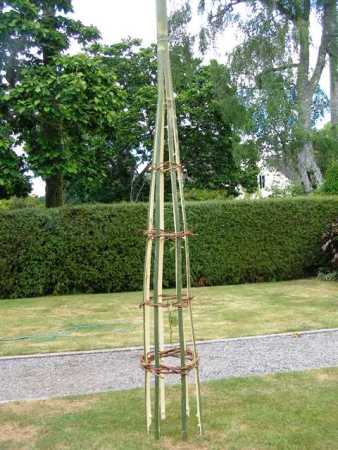
1) If you have access to a stand of giant bamboo, making an obelisk or stylish tepee to act as a frame for climbers such as clematis or runner beans is not difficult. With bamboo’s often wayward habits, owners of such stands may be willing to part with a stem or two. It needs to be freshly cut to split easily.

2) Cut to the required length – two to two and a half metres is about right. Tie a wire about 25cm from the top, just below a node, to prevent the length from splitting right to the end. Use pliers to secure the wire tightly and trim it off neatly.

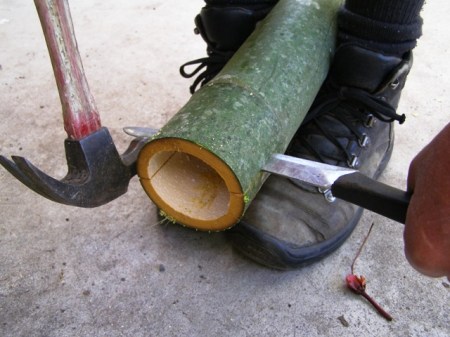
3) Using a hammer and an old knife as a cutter-wedge, make a cut exactly in the centre of the bottom of the pole. Tapping on alternate sides, work the split up to just below the wire. The first cut is the most difficult but once started, you can pull apart the two sides. With bamboo, lift up one side and start splitting. Then turn it over and split from the other side, alternating so that it splits evenly. If you keep lifting from one side only, that side will keep getting narrower.

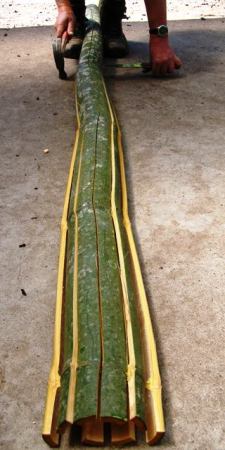
4) Repeat the previous step four times in total, so you have eight separate sections. Our sections are about 3cm wide. The difficult part is splitting the nodes on the length of bamboo which can take some strength.

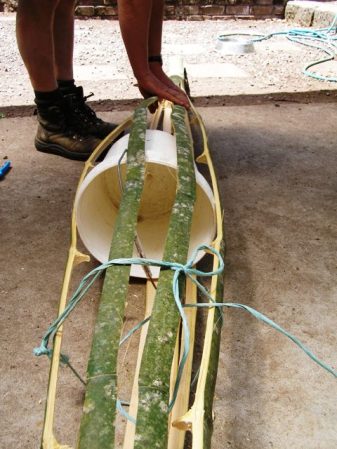
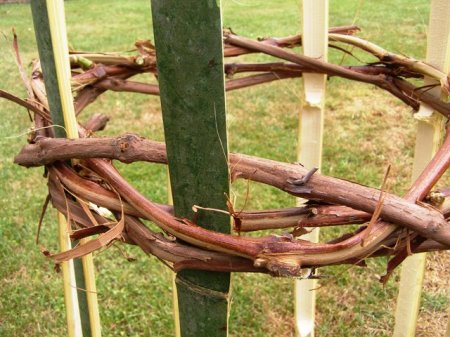
5)Use flexible ties such as grape vine, wisteria or willow to weave between the struts at intervals. Inserting a bucket will hold the shape while you do this, along with a temporary tie of baling twine. It is the ties that will keep the splayed shaped and give the climbing plant something to cling to.

6) The tepee will need to be secured to stop it blowing over. We tie the bases to simple bamboo stakes in the ground. You could use longer lasting pegs but we usually bring our teepees under cover in winter to prolong their life expectancy so old bamboo stakes as pegs are all we need to last for eight months.

A step-by-step guide to staking and tying plants

1) If you can avoid staking a plant, do so. A plant can rely on the stake and not build the strength to hold itself up. If your plant has a small root system and too large a top (referred to as the sail area because it catches the wind) reduce the volume of foliage and branches to cut back the sail area.

2) This is heavy duty staking carried out on landscape grade plants put in to a windy situation on a road verge. Two, sometimes three or even four tanalised batons are used with wide ties. This allows some flexing of the tree without it blowing over and the stakes will last for several years. The flexing of the tree in the wind encourages it to develop a natural taper to its shape which gives it strength. To allow this flexing, the ties should never be more than a third of the way up the tree. All this staking will be removed when the tree has developed the root system and strength to hold itself up.

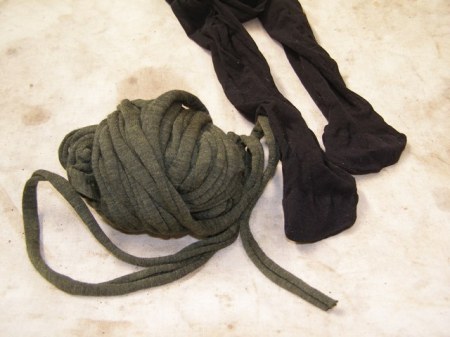
3) Avoid tying with string, rope or wire which will cut in to the bark and cause damage, potentially ring barking the trunk. For the home gardener, old pantyhose or strips of stretch fabric are commonly used or you can buy balls of interlock fabric tie at garden centres which are cheap and easy to use. Black, grey or muted green are less obvious in the garden. Strips cut from old inner tubes are another traditional tie.

4) Commercial growers use tying machines called tapeners which staple a flexible plastic tie in two movements so they are quick to use. However the tape does not break down in the garden situation so we avoid using a tapener except in the nursery because we don’t want little bits of black plastic through the garden.

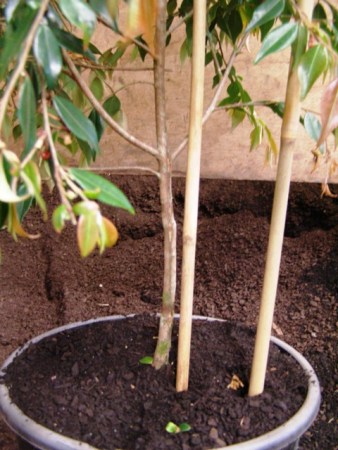
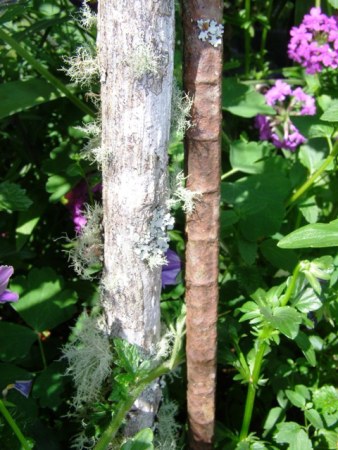
5) Never force a stake hard in by the trunk of the plant, large or small. If you do this, you are damaging all the roots on that area of the plant, usually severing them entirely. If you think of the roots like a piece of pie or an umbrella, you are potentially damaging an entire segment of the root system. How far out you place the stake depends on the root system but even a couple of centimetres can make a big difference on small plants. You can see in the photo how much more damage the stake near to the stem will do compared to the one a little further out.

6) Bamboo stakes will usually last about a year before rotting off at ground level and this is often long enough for a plant to get established. Tanalised batons are a better option for longer term staking such as the trees in step 2 which will need stakes in place for up to 3 years. Where semi permanent staking is required for plants such as standard roses, metal stakes gently rust and become less obvious over time than other options.

Hosta combinations that work: step-by-step

1) The single biggest mistake is buying an assortment of large, fancy hostas and putting them all together. It is the variation in leaf size, plant size and the combination of plainer, single coloured leaves with the fancier and variegated leaves used only as a highlight which makes hostas work together.

2) As a general rule, a variegated hosta needs the foil of single coloured leaves on a ratio of two or three plants to one. Going for size and leaf shape variation adds more drama as in this combination of the little frilly variegation of Kabitan with the large, rounded single coloured foliage of Goldrush.

3) Hostas come in gold, blue and green with variegations in white, cream, blue and gold. A blue and yellow variegated hosta will look better set against plain blue hostas or maybe a plain blue and a plain gold. Green and yellow variegated hostas will look best set alongside plain yellow or plain green hostas. Green hostas with sharp white variegations need lots of plain green to set them off.

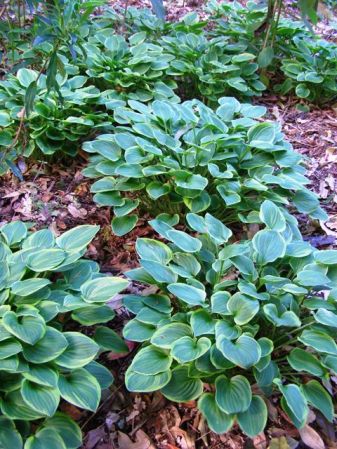
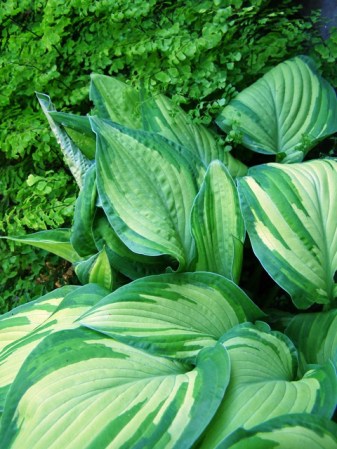
4) Large swathes of hostas look better if they are kept to just one variety. This one on the left is Golden Tiara. We prefer hostas integrated with other plants, rather than only associating them with their own kind. This combination of a variegated hosta on the right with a froth of maiden hair fern adds interest in a narrow border.

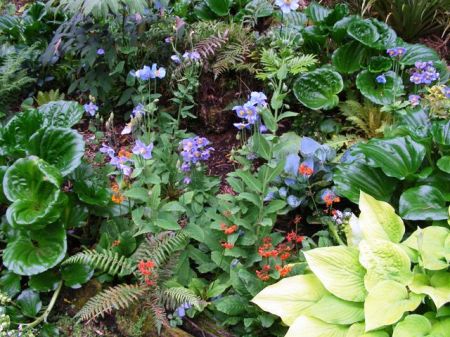
5) In a complex herbaceous planting, the golden hosta adds light and a solid presence amidst Chatham Island forget-me-nots, Inshriach primulas, meconopsis and other plants.

6) Paler variegations – the golds, creams and whites – need more shade. They will be the first to burn in the sun.