Category Archives: Outdoor classroom

Pruning a rampant climber: step-by-step with Abbie and Mark Jury

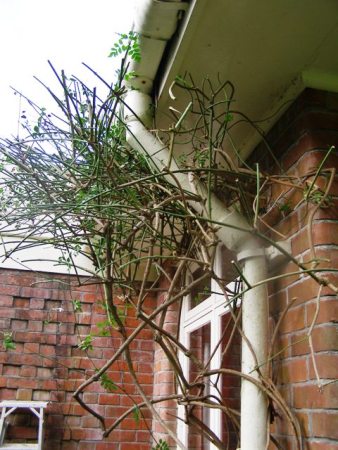
1) This climber has gone well past the point where a light trim will suffice and allow more light in the window behind. However, we don’t want to dig it out and cutting it off at the ground is likely to kill it. This is an ornamental jasmine (not the dangerously rampant variety) and we like the fragrance.
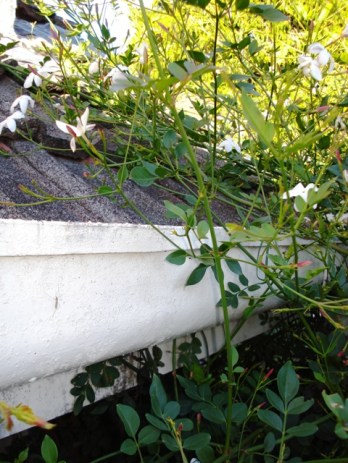
2)The tendrils going over and under the spouting, and even worse, under the roof tiles are a warning that action needs to be taken now. Looking into the mass of vines, you can see that the downpipe is under threat and also that the plant is putting out new growth from the middle and not just on top.
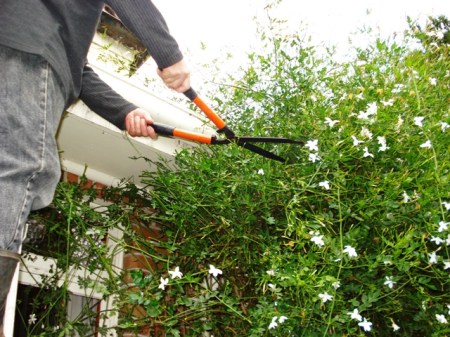
3) Cut back the foliage hard. We are aiming for a curved shape around the corner of the house. It is easier to work out which vines to keep when you can see where each one is headed. You can use a chainsaw for the initial shaping and follow up with clippers and secateurs to tidy up the rough cuts.
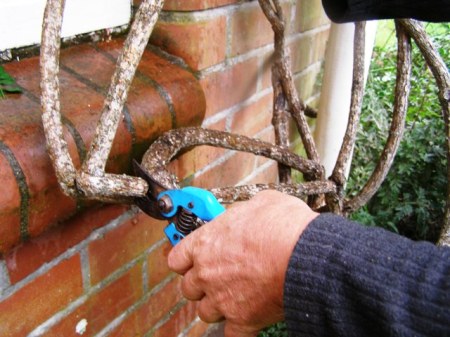
4) Trace the path taken by the vines and remove unwanted stems in sections. If you try and pull it out in long lengths, you run the risk of damaging the growths you want to keep. We are trying to protect the house and to allow the window to be opened so we are thinning extensively. More frequent pruning would have avoided this.

5) Thin out clutter and remove all dead wood.
6) The finished product looks shorn and a shadow of its former self but should grow away strongly. In our mild and soft climate, we can do this type of cutting any time of the year but gardeners in cold, inland areas may wish to wait until late winter or early spring, timed for just before the plant will put on its first flush of new season’s growth.
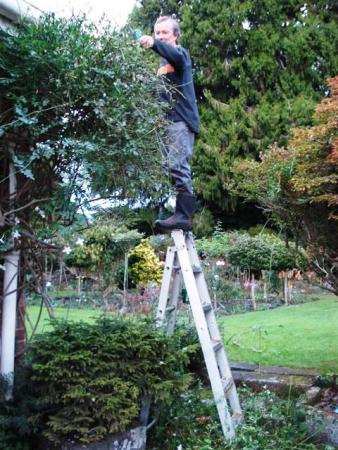
7) This is the photo that we did not use in the newspaper when this feature first ran – not perhaps the best advertisement for safe practice (though Mark asserts that he was holding on tightly with the hand which is out of sight…).
Alternatives to buxus hedging

A step by step guide by Abbie and Mark Jury first published in the Taranaki Daily News and reproduced here with permission as a PDF.

New Outdoor Classrooms are uploaded fortnightly.

Clipping formal hedges – step-by-step with Abbie Jury & Lloyd Sorensen

A step by step guide by Abbie and Mark Jury first published in the Taranaki Daily News and reproduced here with permission as a PDF.

New Outdoor Classrooms are uploaded fortnightly.

Lifting & limbing – the before and after of careful pruning

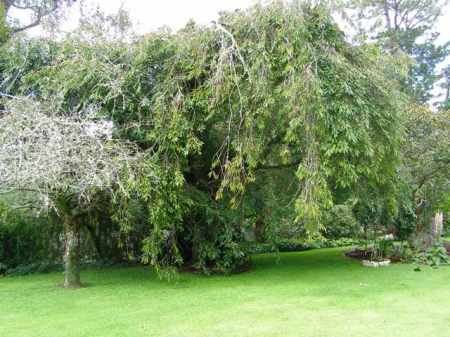
1) This garden aspect is generally all right but you would not look twice at it. The large tree is a weeping cherry, Prunus subhirtella pendula. The fact that the left hand tree, a malus or flowering crabapple, has no leaves on it in high summer is a bit of a giveaway. It is dead.

2) The malus is showing fresh growth at its base but as we knew it was a grafted plant, this is just the root stock growing away.

3) Spend some time working out which branches need to be removed. You can’t glue branches back on and it is surprisingly easy to make a mistake. We are taking off the lower branches and a few higher ones which extend too far over the adjacent gardens. We used a squirt of paint to mark the branches destined for the chop.

4) Make an initial cut underneath the branch. This prevents the branch from ripping off and damaging the bark when you cut from above.

5) Cut close to the trunk or main stems. Don’t leave ugly stumps which resemble protruding coat hooks. There are different schools of thought about whether wounds need to be painted with an antibacterial paint. In this case we have coated the wounds but we don’t usually bother.

6) The dead malus has been removed entirely, even the main stump. If you can get most of the root ball out, it reduces the chance of honey fungus or armillaria getting established on the rotting roots and potentially spreading to surrounding trees. The cherry tree now has a more pleasing shape and it is possible to see beyond the tree and to notice other garden features in the same view. Successful pruning is often discreet – quite a bit of material is removed without it being obvious where it has come from.

Autumn chip budding: step-by-step with Abbie and Mark Jury

A step by step guide by Abbie and Mark Jury first published in the Taranaki Daily News and reproduced here with permission as a PDF.

New Outdoor Classrooms are uploaded fortnightly.