Category Archives: Plant collector

flowering this week, tried and true plants

Plant Collector: Narcissus bulbocodium var. citrinus ‘Pandora’

Narcissus bulbocodium var. citrinus ‘Pandora’

Narcissus bulbocodium var. citrinus ‘Pandora’

Look! The first narcissi of the season – commonly known as daffodils, although the hooped petticoat varieties look somewhat different. These have just the cup with 6 very narrow, spiky petals forming the skirt. It is the pale lemon ones that flower so early. The more common, bright yellow N. bulbocodium come considerably later in the season.

The foliage is narrow, described as grassy. While sometimes recommended as a good option for naturalising in grassy meadows or on banks, we would beg to differ. It is too hard to pick the foliage and emerging flower stems, which makes it difficult to do a late autumn trim on the grass. Without that trim, the narcissi can get swamped by competing growth. We use them in the rockery and along the edges of paths or walls. They are quite happy on the side of the stony drive. Good drainage is the key – they hail from south western France, Portugal and Spain.

These dainty narcissi are like slug magnets, as you may be able to see in the photo. After being somewhat relaxed about the munching varmints in the off-season, it is a call to action before the bulk of the winter and early spring bulbs come into bloom, offering a veritable smorgasbord.

First published in the Waikato Times and reprinted here with their permission.

Plant Collector – sasanqua camellias

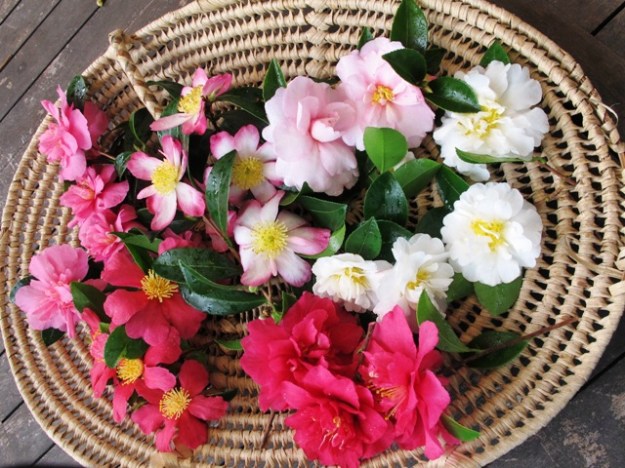
028Gardening is wonderfully cyclic on an annual basis. I know I have written about sasanqua camellias before but each year they flower prettily yet again. These are the Japanese camellias that light up the late autumn and early winter. There is a softness to the blooms which is in contrast to the stiffer japonicas that flower later in winter and early spring.

If you live in Auckland, it is the law to plant only Setsugekka, a big growing white sasanqua. I jest but that is the one you will see there at a ratio of about 20:1. In fact sasanquas come in all shades of pinks, bicolours and even reds as well as the fraightfully restrained whites. Going clockwise from left in the photo are: Elfin Rose, Gay Border, Bettie Patricia, Silver Dollar, Bert Jones and Crimson King. Some may no longer be available on the market but there is usually one that will look very similar.

Sasanquas can be slow to establish but left to their own devices, will make light, airy, large shrubs over time. They also clip very well so are ideal for hedging and topiary. When clipped regularly, the growth is much denser. The foliage is smaller and often darker green than many other types of camellias. Some describe them as fragrant. They have a distinctive mossy, slightly earthy sort of scent – it is one of the defining characteristics of a sasanqua.

First published in the Waikato Times and reprinted here with their permission.
Plant Collector: Medlar (Mespilus germanica)

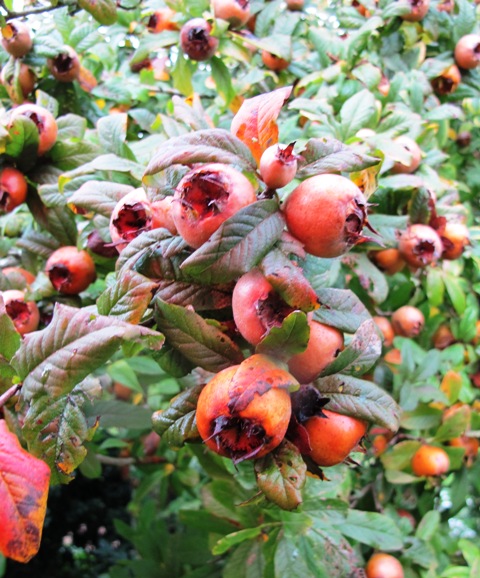
The medlar - probably better as an ornamental than for its harvest

The medlar – probably better as an ornamental than for its harvest

It’s a medlar, and a damn fine specimen at that, which I found in its fruiting glory in the gardens at Wairere Nursery in Gordonton. Medlars are having something of an upsurge in popularity, in the media at least, though they are better seen as a curious ornamental than a fruiting tree for harvest. Medlars were brought to this country by the early settlers but there are good reasons why this fruit tree was quickly superseded by apples and pears. The small fruit are hard, high in tannin and mouth-puckeringly astringent until they are on the cusp of passing from ripe to rotten. Timing is everything, apparently, when it comes to harvesting the medlar crop. In cold climates, when the frosts start, a process called bletting changes the composition of the fruit, making it edible. In milder climates we are never cold enough to allow for bletting so it is a case of waiting until the fruit is soft and the inside flesh has turned brown.

The medlar tree hails from that area of the world where eastern Europe meets western Asia – Turkey, Iran and Bulgaria – and has been cultivated since Roman times. It is a large deciduous shrub, some might say a small, spreading tree and a member of the rosaceae group so a relative of apples, pears and quinces. As with most fruit trees, it will have pretty spring blossom and will even colour in autumn but it is the fruit crop that attracts attention. I wouldn’t bother with it in the orchard but it justifies its place in the ornamental garden.

First published in the Waikato Times and reproduced here with their permission.

Plant Collector: Nerine pudica

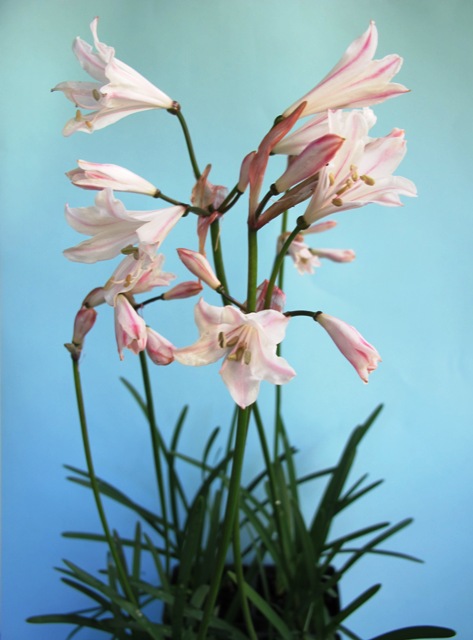
Nerine pudica

Nerine pudica

How pretty is little pudica? This is the first season I have seen it flower and it is a delight. The pointed bells are mainly white with a pink stripe down the centre of each petal and each stem has up to six flowers on it. It is a nerine which makes it a bulb, but it is a much smaller one than the more common sarniensis and bowdenii types. The foliage is also much finer and narrower. It looks more a mondo grass or liriope leaf.

N. pudica is a species, hailing from the western side of South Africa. The ever-useful reference “Bulbs for NZ Gardeners and Collectors” by Terry Hatch and Jack Hobbs tells me that it is one of the original parents of many of the modern hybrids. While showy hybrids have their place, there is often a simple charm in the original species. The ones in the photograph are still in pots. It will take several years before we can comment on how reliable they are as garden plants in the rockery but the requirements are the same as for other nerines – excellent drainage and full sun. I am hoping they will do well because it makes a pretty addition to the autumn bulb display.

First published in the Waikato Times and reprinted here with their permission.

Plant Collector: Hibiscus probably trionum

Hibiscus probably trionum

Hibiscus probably trionum

This plant took a little unravelling. It is a self sown seedling with large, short-lived flowers and serrated foliage which is lying almost flat to the ground. Mark thought it was a native but I think he is wrong. There is no shame in that. Most of the country thinks it is native and it is only recently that it has been separated from a very similar species, now called H. richardsonii, which is truly indigenous and indeed critically endangered in its natural habitat of northern east coast areas.

If I am right, this is actually H. trionum which originated in the Levant area of the Eastern Mediterranean, which more or less stretches from Cyprus to Palestine. It seems that the very dark eye to the flower is what makes it H. trionum rather than H. richardsonii. Well, that and chromosome counts. There are countless references on the internet to H. trionum being native in New Zealand as well as being widespread internationally. It has certainly naturalised here and by the time common usage catches up with the differences, it is likely that what we will have are hybrids between the two. It will fall to the botanists to try and keep a pure strain of the native H. richardsonii.

Both forms of hibiscus are usually short-lived perennials, often behaving as annuals, especially in frosty areas. They are in the mallow family (or malvaceae) and are showy, even if the individual flowers don’t last long. The common name is the unromantic bladder plant, though that is more correctly applied just to H. trionum. We do have one other native hibiscus and that is H. diversifolius.

First published in the Waikato Times and reprinted here with their permission.