Category Archives: Plant collector

flowering this week, tried and true plants

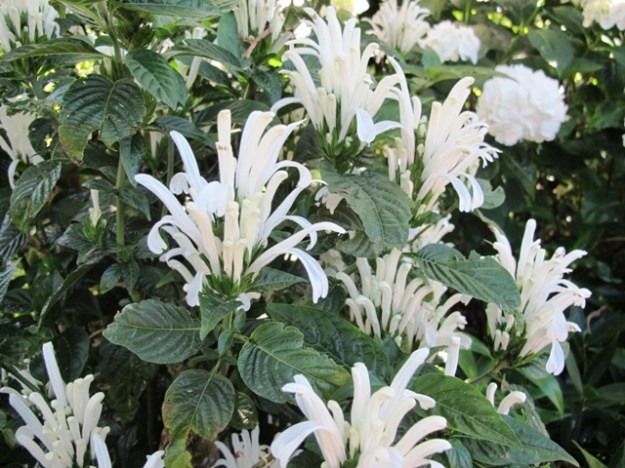
Plant Collector: Justicia carnea alba

The white candles of Justicia carnea alba

The white candles of Justicia carnea alba

Christmas candles? Reminiscent of the tufting of old fashioned candlewick bedspread? It has also the unromantic name overseas of shrimp plant, a reference to the shape of the flowers. The white justicia has been bringing me a great deal of pleasure in recent weeks. We have always had the pink and yellow forms but I thought we had lost the white until I found it looking a little ragged and squashed by surrounding plants. I moved it and it hasn’t looked back. It can be a bit of a straggler so I constructed a discreet little bamboo frame to hold the plant together.

There are over 400 different justicia species, mostly from tropical to warm temperate Central and South America (think Brazil, amongst others) but J. carnea appears to be one of the showiest and is the most common in cultivation in this country. It has a very long flowering season across the summer months. This plant is only a metre tall at this stage but left to its own devices, I expect over time it will reach the 2.5 metres of the pink and yellow ones we have.

There aren’t many plants which will flower profusely in heavy shade. Most plants need sun to bloom. So it makes an ideal larger woodland plant with one proviso. The information online says it will not take below 7 °C. I don’t think it is that sensitive. We can get colder than that here and it has never shown damage but clearly it is quite cold sensitive and is regarded as a glasshouse plant in many areas of the world.

Justicias belong to the acanthaceae family.

First published in the Waikato Times and reprinted here with their permission.
Plant Collector: Pachystegia insignis

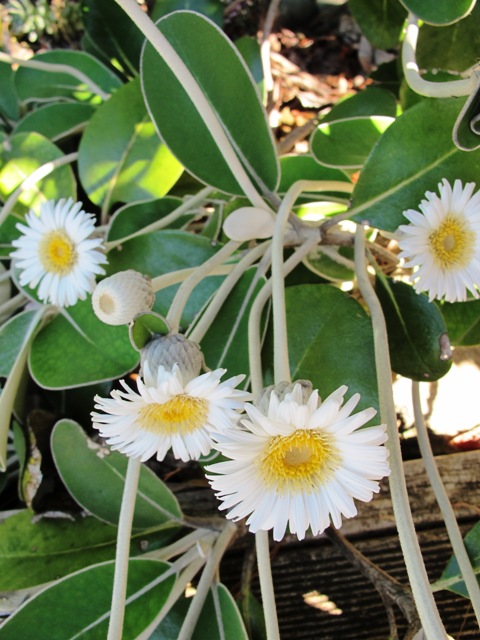
Pachystegia insignis - one of our loveliest native plants

Pachystegia insignis – one of our loveliest native plants

We do a good line in native daisies in this country but few, if any are lovelier than this Marlborough rock daisy. The flowers are pristine white, but even when it is not flowering season, the leaves are big, rounded and heavy textured – glossy green on the upper side and felted white on the under side. That felting is called indumentum (sometimes tomentum).

In the wild, P. insignis grows on the eastern side of Marlborough. Apparently you can see it as you drive down the state highway but the only times I have driven it in recent times, I have been behind the wheel with my eyes fixed firmly on the road. It hangs onto the rocky banks, coping with drought and salt spray. This means it is not the easiest of plants to grow in a lush garden situation. It needs perfect drainage and an open, exposed site. Even then, we find mature plants can keel over and suddenly die from time to time.

To our ongoing embarrassment, our particularly good form here was stolen by my late mother from the Dunedin Botanic Gardens. She died 12 years ago (almost to the day), but her legacy lives on here. Pachystegias are small shrubs belonging to the asteraceae family. The “insignis” seems to mean distinguished or remarkable in this context.

First published in the Waikato Times and reprinted here with their permission.
Plant Collector: Nerium oleander

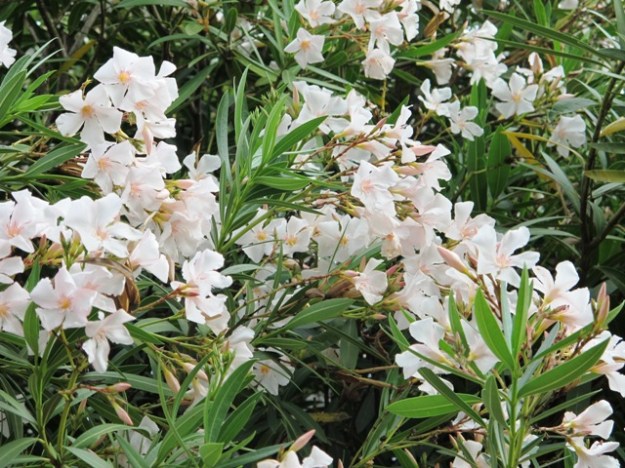
Oleanders - internationally popular for harsh growing conditions

Oleanders – internationally popular for harsh growing conditions

I photographed this oleander in Canberra which rather gives lie to the notion that these are sub tropical plants. Oleanders are so widespread internationally that their original habitat has not been isolated though it falls somewhere in the band stretching from Southern Europe and North Africa through to Central Asia. Some of these areas can get cold winters but what they all share is hot, dry summers. Years ago we saw oleanders used as street trees near the beachside motor camp in Gisborne. Not having been back there for some years, I don’t know if they are still there but similar conditions will apply in the drier, coastal areas of mid to north New Zealand. These plants are tolerant of both drought and salt spray.

Oleanders are evergreen and form large shrubs to small trees, several metres high. They generally grow with multiple stems and can be cut back hard without turning a hair though it may impact flowering the following season. Their tolerance for poor soils, hard conditions and drought means they can be grown in situations where most plants will struggle but it is their ability to flower freely for months on end that makes them a hugely popular plant of choice for many, despite lacking much natural form and elegance. Flowers are whites, pinks and reds, both doubles and singles.

Oleanders are renowned for being poisonous, but so are many plants including daphne. Just don’t ever use it in tisanes, herbal preparations, or anything else that may see you ingesting it. Never use them as kebab sticks. Yes somebody did, with unfortunate results. However, oleander poisoning incidents are generally deliberate rather than accidental. Mind the sap, too when pruning. It can cause skin irritation.

First published in the Waikato Times and reprinted here with their permission.
Plant Collector: Swainsona formosa

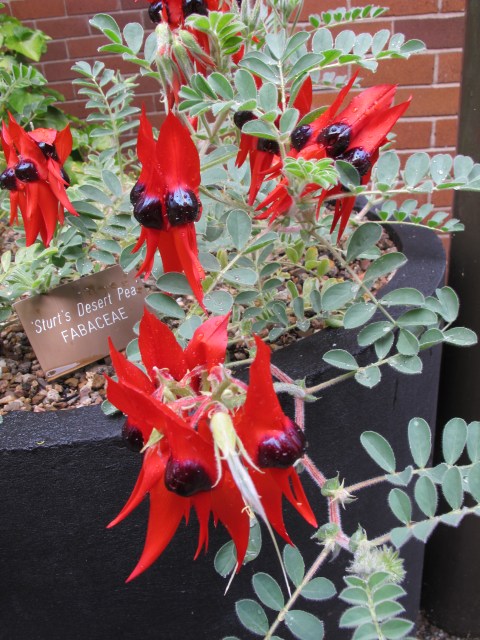
The remarkable Sturt Desert Pea or Swainsona formosa

The remarkable Sturt Desert Pea or Swainsona formosa

Continuing the Australian theme this week, I was very taken by this striking flower, commonly referred to as the Sturt Desert Pea, after Charles Sturt who recorded it flowering extensively in central Australia during his 1840’s explorations. This particular plant was in a tub outside the bookshop at Canberra’s botanic gardens. The scant foliage was visibly leguminous but it was the flowers that were spectacular. They are up to 9cm long and bright scarlet with a showy black boss in the centre, held in clusters. They a little pea-like (as indeed wisterias are) but more distinctive than any pea I have seen before.

It is regarded as one of Australia’s showiest wildflowers. While native to the central and north western areas, it is found throughout much of the country so maybe it is worth a try here in a sunny, dry position. Generally it is a low growing annual, flowering in spring though to early summer before setting seed and dying off.

I bought a packet of seed, unsure on whether I could bring it in to NZ but figuring it was only $4 lost if it was confiscated at the border. There was no problem. It is on the list as being here already so is a permitted import. In fact doing it all properly and declaring it got me through customs faster than had I lined up with everybody else for baggage x-ray. I have seen enough to be a strong supporter of good border control.

First published in the Waikato Times and reprinted here with their permission.

Plant Collector: Rosa Mme Plantier

Scented, healthy and lovely in every way, but only once flowering - Mme Plantier

Scented, healthy and lovely in every way, but only once flowering – Mme Plantier

It has taken years, nay decades, to get a name on this pretty old rose but finally a visiting rosarian sorted it out for us. Mme Plantier is in the oldie but goodie class. It is currently smothered in fragrant white flowers, like soft pompoms measuring about 7cm across. The buds (and there are many more to open) are soft pink but that colour disappears entirely as the flower matures. Add in two more highly desirable characteristics. Basically it is thorn and prickle-free and it is so healthy that it keeps good foliage right through to autumn without ever having seen even the faintest hint of spray.

What is not to like? It is only once flowering and these days the majority of the buying public demand that roses repeat flower. We accept that a rhododendron may only flower for 3 weeks but woe betide any rose that fails to throw up blooms for 6 months. We must get close to 6 weeks from Mme Plantier and her all round performance is so good that we are happy to live with that.

The doyen of English roses, David Austin, has Mme Plantier on his recommended list and notes that it is a cross between an Alba and a Noisette. This may mean more to readers who are better versed in rose species and classifications than I am. All I can say is that it is a top garden variety in our experience.

First published in the Waikato Times and reprinted here with their permission.