Category Archives: Plant collector

flowering this week, tried and true plants

Plant Collector: Rhododendron sino nuttallii

Just beautiful - R. sino nuttallii

Just beautiful – R. sino nuttallii

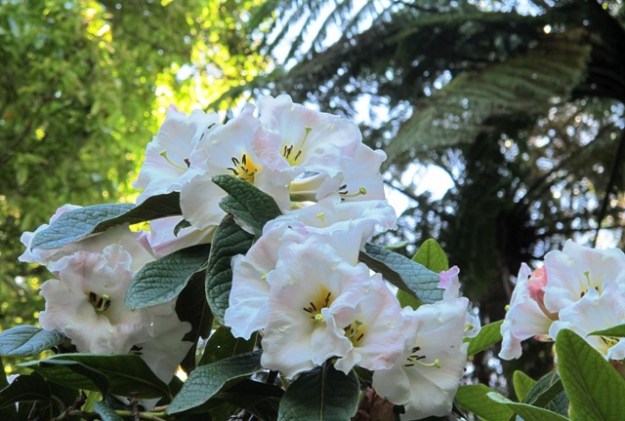
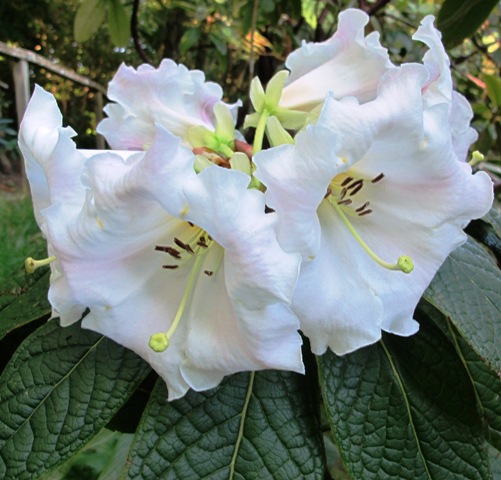
Oh my, but we are besotted with the nuttallii rhododendrons which flower on even as November draws into December. We would rate these in the elite class as far as rhododendrons go. Not only are the heavy, waxy trumpets large and showy, they are also very fragrant. This one is planted on a bank which was a good decision because we can look down on it and the scent wafts up. Some of the others here are several metres above nose and eye level so the scent is a bit academic because they are best viewed from afar.

The foliage is large and heavily textured (bullate for the botanical or like heavy seersucker for those of a sewing disposition) and over time the main stems develop beautiful shiny, peeling bark in a cinnamon colour. These are large and open growing shrubs so do not fit the tight and tidy mould preferred by some.

‘Sino’ just means it is the Chinese form of the species, as opposed to R. nuttallii which is found in Tibet, North Burma and northern India. The Chinese form is bigger and showier and more sensitive to cold temperatures. These plants are rarely offered for sale though you can sometimes find some of the hybrids that have been bred from them.
Rhododendron sino nuttallii

Rhododendron sino nuttallii

First published in the Waikato Times and reprinted here with their permission.
Plant Collector: Tall Bearded Iris “Black Suited”

Iris 'Black Suited'

Iris ‘Black Suited’

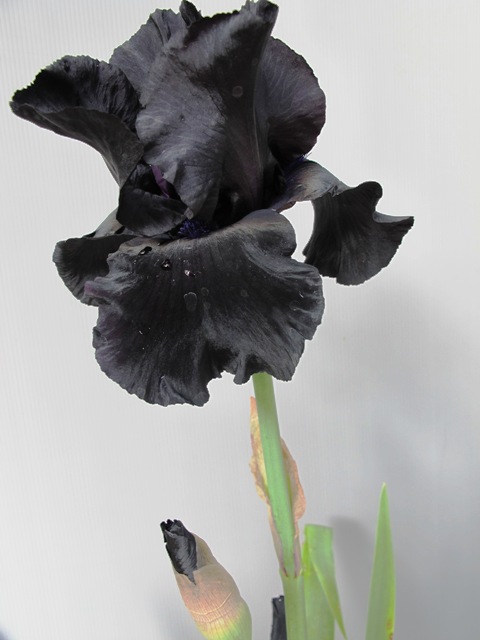
In last week’s column, I included a photo of the black iris called “Anvil of Darkness”. This week it is the turn of the larger “Black Suited” to bloom and for wow factor, it sure has what it takes as a specimen bloom. It opened pure black but both these dark, velvety irises take on very deep purple tints as they age. These are novelty blooms in that black flowers are rare in nature and Mark is a bit suspicious of how well they stand out in the garden. I had been wondering about combining it with some white Siberian irises I have which flower at more or less the same time but he felt that was too obvious and it would look better surrounded by soft pastel colours, probably perennials rather than more irises.

Both these black irises were the work of an American breeder, Sterling Innerst, who was actually a primary school teacher who liked to breed irises in his leisure. He named 213 different new hybrids before his death in 2010 and I guess we might be grateful that the handsome “Black Suited” was not in fact named “Erotic Touch” or “Grobswitched” as two others were. “Black Suited” was first released in 2000 and any debt to original species is a fair way back in the past. He was crossing hybrids so it is a cross of “Before the Storm” with “Black Tie Affair”. The flower spike stands about 50cm.

I wondered whether breeding black irises was a recognised breeding quest but I see that the iris equivalent of the blue rose is in fact a pure red. It has yet to be attained.

First published in the Waikato Times and reprinted here with their permission.
Plant Collector: Ornithogalum arabicum

The lovely Ornithogalum arabicum

The lovely Ornithogalum arabicum

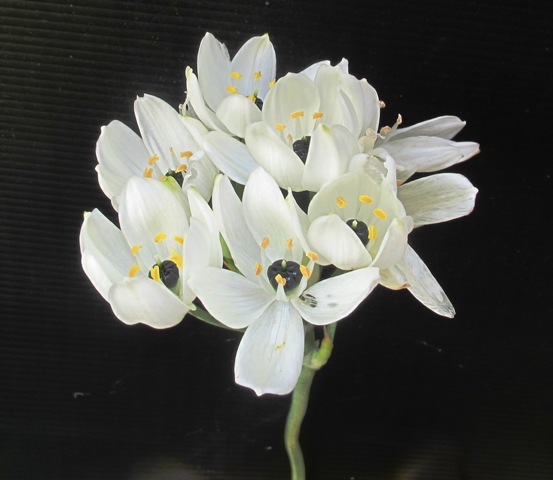
I am so delighted to see several of these in bloom in the rockery this spring. I planted flowering sized bulbs a few years ago and they failed to reappear for probably the last two seasons. I assumed they did not like our conditions but apparently they will, upon occasion, bide their time.

Sometimes known as the Arabian star flower or the Star of Bethlehem flower (this may depend on whether one is Islamic or Jewish, maybe?), I have also seen O. arabicum referred to as a black-eyed Susan although that is more commonly ascribed to rudbeckias. Whichever, each lovely, creamy white flower looks as if it has a black bead in the centre, surrounded by soft yellow stamens. The foliage appears to die off as the flower comes and it sits at about 30cm high, without needing staking – just the right height to sniff the pleasant fragrance. It is reputed to be good for picking but I will need a whole lot more in the garden before I’m willing to cut them.

This particular ornithogalum comes from the Mediterranean area so is going to be happiest in full sun with well drained conditions. Other species come from Europe and South Africa and they all belong to the order of hyacinthaceae. Believe it or not, there is a Facebook page for O. arabicum which has some lovely photographs though only 73 “likes” as one says in Facebook parlance.

First published in the Waikato Times and reprinted here with their permission.
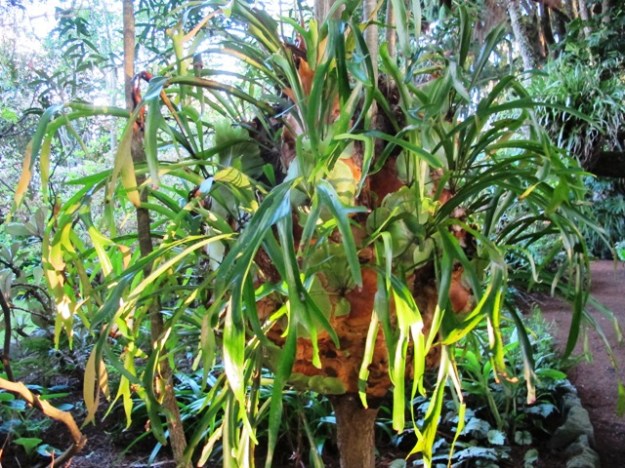
Plant Collector: Staghorn fern or Platycerium

Our giant staghorn fern or platycerium

Our giant staghorn fern or platycerium

In some parts of the world, these are all referred to as elkhorn ferns. I guess we are more familiar with stags than elks in this neck of the woods. The leaves are generally seen as resembling antlers. The general wisdom in NZ is that there are only two varieties – the staghorn and the elkhorn but in fact there appear to be nearer 20 different ones, hailing from the tropics and subtropics in a band around the globe, central to and south of the equator. Best guess is that this one is P. bifurcatum which is native to Java, New Guinea and the east coast of Australia. This tells you that it is frost tender.

The platyceriums are all ephiphytic and are widely grown as houseplants. This particular plant, after decades in our woodland area, measures about a metre across and a metre deep, holding the rather slender host tree in an all-round embrace. It draws all the nutrition and moisture it needs from the air. We give it no attention at all beyond an annual tidy up when I remove the dislodged foliage that has fallen from the trees above. Staghorns are sold from time to time and often grown as house plants in chillier areas. Just wire it to a support of some assortment. Grown as a houseplant, it will need more attention because it won’t be receiving the nutrition and moisture but there are plenty of references on how to care for them in a controlled environment.

First published in the Waikato Times and reprinted here with their permission.
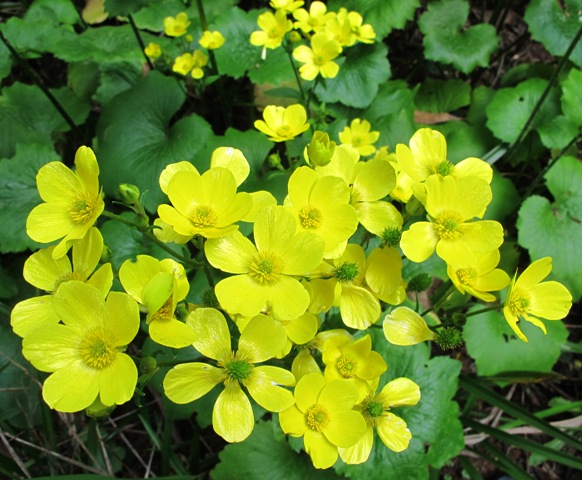
Plant Collector: Ranunculus cortusifolius

Not the ordinary field buttercup, Ranunculus cortusifolius

Not the ordinary field buttercup, Ranunculus cortusifolius

I am guessing that some readers may look at the photo and sniff about common old buttercups. Yes this is a buttercup, but not the nasty, weedy one even if the flowers may look similar. There are hundreds of different ranunculus (or should that be ranunculae?) and quite a few of those are what we call buttercups. This species is highly prized as a garden plant, as long as you aren’t offended by the extremely bright yellow flowers. It hails from the Azores and Canary Islands, sitting in the ocean between North Africa and Western Europe. The online references talk about it being perennial. We would describe it more as biennial, similar to a foxglove. It seeds down gently and in the second year it flowers. The plants are fully deciduous, going dormant and dying off in early summer and returning into growth by early winter. This is usually the pattern of plants triggered into growth by autumn rains.

The foliage is soft and not dissimilar to cineraria, though oft described as maple-like in shape. And yes, you can play the game from childhood of “do you like butter?”

First published in the Waikato Times and reprinted here with their permission.