Category Archives: Plant collector

flowering this week, tried and true plants

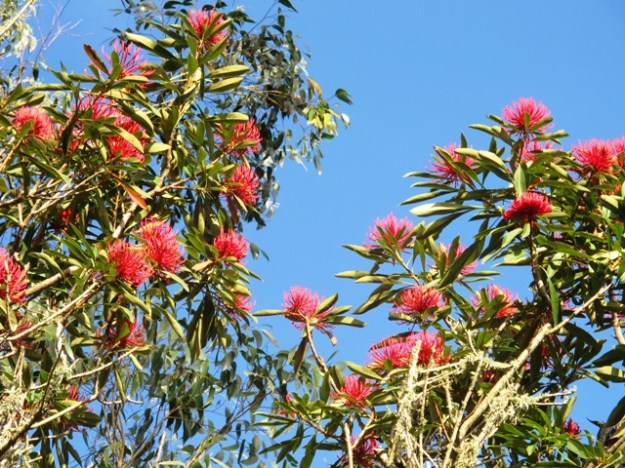
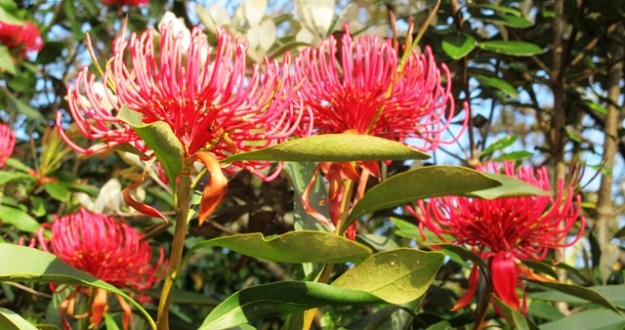
Plant Collector: Telopea (probably speciosissima) or Australian waratah

009
In days when we used to retail plants from here, we would have to keep a straight face when ingénues came in asking what the “lovely red rhododendron at the gate” was. Ahem – commonly known as a waratah, though not to be confused with the fencing waratah. It is the emblem of New South Wales and, like many Australian natives, is not too happy in the fertile, high rainfall conditions of much of this country. It evolved to grow in poorer, harder, drier environments though I see the gardening advice across the ditch is to give these plants semi shade and to water in summer. It has also evolved to survive regular bush fires.

Telopeas are members of the proteaceae family and we struggle growing most of those because of our regular rain all year. They do better in drier, coastal areas. Some years are much better than others for the telopea floral display and this year it may be the dry summer helped. The Australian advice is to cut the plant back very hard after flowering each year. We have never done this and ours tends to undergo a natural die-back process every few years. However, it has still reached the maximum height of 5 metres, owing to the fact that we don’t get bush fires to keep it down. The habit of growth is more shrubby than tree-like and foliage has that Aussie gum tree look. It is apparently a long-lived cut flower.
012
First published in the Waikato Times and reprinted here with their permission.

Plant Collector: Dendrobium Bardo Rose

Dendrobium Bardo Rose

Dendrobium Bardo Rose

Out there in the world are legions of orchid aficionados who are typically possessed of technical knowledge about this plant genus, the most complex and varied of all plant groups. I take one peek in to the details of orchids and get completely lost. But when it comes to orchids suitable for the garden, I can recommend the dendrobiums from Australia. There are many different dendrobium species. Some are tropical and only suitable for glasshouse culture here. But the obliging ‘Aussie dendrobes’, as we refer to them, sit happily in woodland conditions needing no care or attention at all. In early to mid spring, they spark into flower and this pink one has nigh on fifty flower spikes. The flowers are much smaller than cymbidiums and the whole clump only stands 30cm high at the most.

Bardo Rose is the grex name (more or less a collective noun) for all dendrobium hybrids which are falcorostrum x kingianum. We have both those species growing here as well but this pretty pink one is a hybrid between the two. Each flowering spike has 20 or more perfect little orchids which measure about 3cm x 3cm. Other dendrobiums we grow are in pure white (including the aforementioned D. falcorostrum) and shades of yellow.

I do not know if dendrobiums are sold commercially. All ours came from the Orchid Society who are renowned for their generosity. These folk will also be able to advise which ones are fully hardy – and some are. Critical issues in growing these plants include excellent drainage, good light levels but dry in winter so under evergreen trees seems to be a good location.

First published in the Waikato Times and reprinted here with their permission.
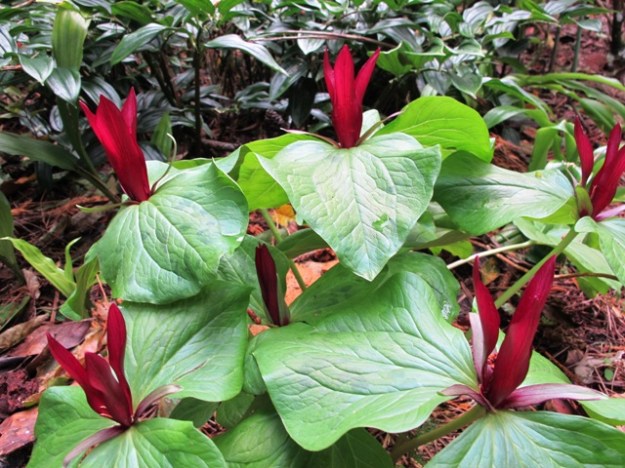
Plant Collector: Trillium sessile

Trilliums! Not common in gardens in our area. T.sessile

Trilliums! Not common in gardens in our area. T.sessile

In the world of status plants for the garden, trilliums are right up close to the top. I am not entirely sure why. They certainly have a quiet charm and are a delightful addition to the spring woodland garden. They are not at all easy for most people to grow and are hard to source, but even that combination of factors does not explain the reverent awe accorded to their presence in a garden.

There are a relatively large number of trillium species (somewhere over 40) and most are native to North America, with just a few from Asia. They are deciduous perennials forming rhizomes below ground. The foliage dies down each autumn, to re-emerge the following spring (one hopes – it is not guaranteed) with fresh leaves and flowers – hence their common name of ‘wakerobin’. At times they are also referred to as ‘tri flower’ on account of their wonderful symmetry of threesomeness. Three heart shaped leaves hold three narrow sepals in the centre which surrounds the three petalled flower which has six stamens. How perfect is that? The dark red trilliums (usually T. sessile or descended from that species) are usually the most highly prized as garden plants, although different species introduce white, pink and yellow to the range.

Being woodland plants, trilliums want ground rich in humus and leaf litter which never dries out. They tend to do better in inland areas with colder winters where the clumps can get more size to them than we see in our coastal conditions. They can be raised successfully from fresh seed if you find a friend with a plant.

First published in the Waikato Times and reprinted here with their permission.
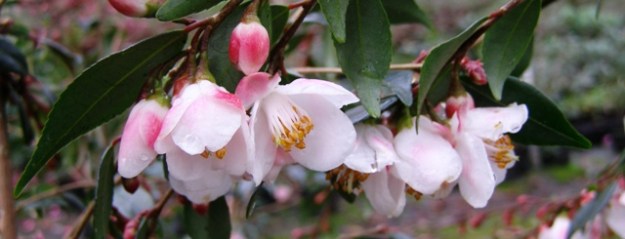
Plant Collector: Camellia minutiflora

Camellia minutiflora

Camellia minutiflora

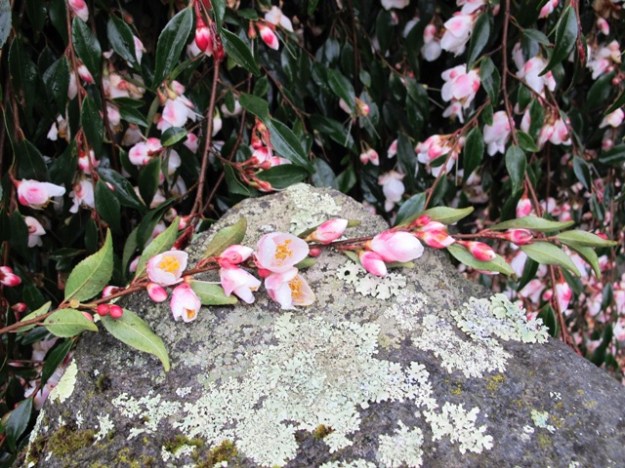
Before we finish camellia season for the year, I would like to introduce one of my absolute favourites. The foliage is small and dark and the branches are long and pendulous so it has a weeping habit. The tiny red buds open to masses of tiny white flowers with a deep pink flush. It is delicate in appearance and so pretty. The original plant came from Camellia Haven in Papakura (now closed) and has only ever reached a metre in height.

We are so taken by this cultivar that we have trained up about a dozen plants to a taller height, ready to plant out in our new garden. Imagine a miniature, evergreen weeping cherry and you may get a mental picture of the effect we are after with these plants.

It appears that the Chinese have reclassified this plant as a variant of another species so its correct name is Camellia lutchuensis var. minutiflora. As it is their plant and they have professional taxonomists, I am happy to accept their decision. C. lutchuensis has similar tiny foliage though much paler in colour and inclined to yellow in the sun, similar flowers though creamy white without the red and it is the most scented camellia of all. I cannot get any scent from C. minutiflora but it is superior as a garden plant.

This is a species. It can be raised from seed. If you can’t find it for sale but know of a plant somewhere, check around its base for seedlings.

After maybe 15 years, the plant is about a metre tall - C.minutiflora

After maybe 15 years, the plant is about a metre tall – C.minutiflora

First published in the Waikato Times and reprinted here with their permission.
Plant Collector: Onixotis triqueta

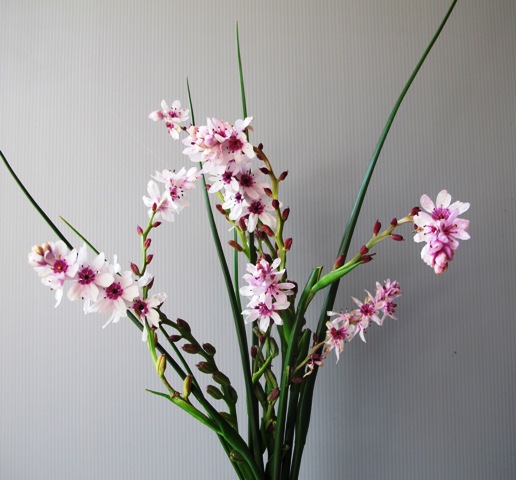
Now Onixotis triquetra, no longer a dipidax

Now Onixotis triquetra, no longer a dipidax

It used to be a Dipidax and is still widely known under this name but I have never heard of a common name in this country. In its native habitat, the bulb wonderland of the Cape Province in South Africa, it is apparently sometimes called the waterflower, on account of its ability to grow in damp ground. In fact it will grow pretty well anywhere as long as there is reasonable sun.

At a quick glance as one passes by, the tall stems of many flowers look almost orchid-like but second glance will show you that they are closer to daisy-like with a dark eye. It flowers from late winter through spring but I see seed is forming already on these heads. The foliage is narrow and tallish, almost like a reed.

Onixotis are really easy bulbs to grow, though we fear they may have slightly invasive tendencies and prefer to keep them in designated areas. Seed is set freely and the bulbs themselves multiply readily so it is probably better not to have them growing through small shrubs or perennials.

Some bulbs have the weird ability to pull themselves down to greater depth in the soil, no matter what level you plant them at (others crowd themselves upwards). Onyxotis are burrowers so you often need to dig quite deeply if you want to lift them. Raised from seed, they reach flowering size in their second season.

First published in the Waikato Times and reprinted here with their permission.