Category Archives: Plant collector

flowering this week, tried and true plants

Plant Collector: Cycas revoluta

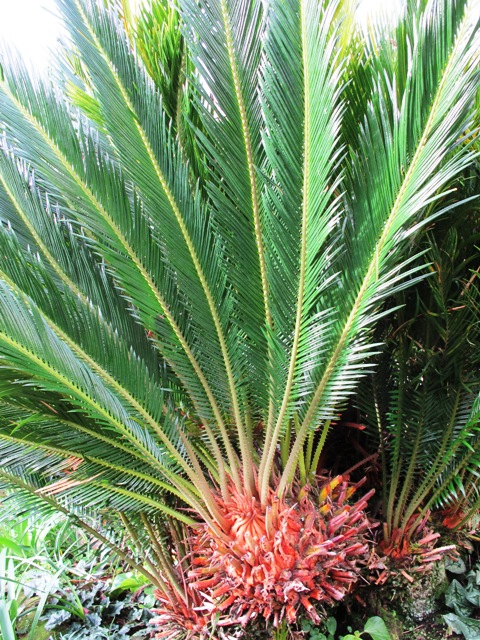
Cycas revoluta - the so-called Japanese sago palm

Cycas revoluta – the so-called Japanese sago palm

It is often referred to as the Japanese sago palm. It is from Japan but it is definitely not a palm. Cycads are different to palms with only a distant botanical connection. Apparently you can extract edible starch to make sago but the plant is so very slow growing that I am sure there are more sustainable and easier food sources should you feel the need for sago in your diet.

There is nothing rare about C. revoluta. It is probably the most widely available variety on the international market, often sold as a house plant. After several decades – five or six – ours is quite large but these are slow growing plants which are generally undemanding. As a house plant, it will want good light levels. In the garden it is one of the hardier cycads, not turning a hair at several degrees of frost but it needs a well drained situation. Ours is in the rockery, too close to a narrow path so I am forever clipping back its very stiff leaves to allow passage. It develops oversized football-like offshoots which can be grown as new plants. Over time a trunk develops – up to 6m, apparently. As the trunk of ours is sitting around 20cm at this point, it won’t be in my time. It has been taller but rotted out some years ago, re-growing from the base.

Like all cycads, C.revoluta is dioecious. Both male and female plants are needed to set seed. This is probably a good thing given that the seeds are toxic and can kill dogs.

First published in the Waikato Times and reprinted here with their permission.

Plant Collector: Daphne bholua

Daphne bholua - oh the fragrance

Daphne bholua – oh the fragrance

It is a rare plant that can stop you in your tracks from several metres out and have you sniffing the air to locate the source of scent. The Himalayan D. bholua is one of those plants. In our experience it is the strongest and sweetest of any of the daphnes and it has a very long flowering season because it sets buds down its stems. It is also very hardy. That is about the sum total of its merits.

As a garden plant, it becomes leggy, scruffy and untidy with age. It seeds down too freely and suckers around the place so when you think you have dug out one plant, it is just as likely that the suckers will pop up all around to confound you. It is semi deciduous. In cold conditions, it will drop all its leaves. In temperate conditions it drops some and of those it retains, only half look healthy while the other half look as if they are dying. Its natural form is upright but twiggy and untidy. Even the named cultivars we have tried are no better.

But we would not be without it. Oh, that scent. It all comes down to placement. Basically, you need to hide the plants behind something more attractive so you enjoy the scent while not expecting to admire the plant. I cut back and try and shape some of our larger plants from time to time, but it does not make a lot of difference to the overall appearance. You can never have too many fragrant daphnes in a garden and the narrow, upright habit of bholua means those plants are not going to hog too much space.

First printed in the Waikato Times and reprinted here with their permission.

Plant Collector: Galanthus S Arnott

What can be prettier than snowdrops in the depths of winter?

What can be prettier than snowdrops in the depths of winter?

Are there any bulbs more charming than proper English snowdrops? Except that they are not English at all, having been introduced from Europe where they have a wide distribution. I had thought they were called ‘snowdrops’ because they often peek through snow (a light covering, I assume because they only grow about 15 to 20cm high) to herald the coming of spring, but I see the botanical name translates from Greek as milk flower. Because we lack the chilly temperatures and snow here, we are limited in the range of galanthus that we can grow well. There is such a word as a “galanthophile” – one who is obsessed with the genus but you would have a hard job earning that epithet here in the mid north. Easily the best performing snowdrop for us is Galanthus S. Arnott which never fails to delight and increases satisfyingly well. We keep gently increasing its spread around the garden and that also staggers the flowering because it will come in later in colder parts.

You don’t get a long flowering season but oh they are so very charming. The proper snowdrop has a little inner trumpet of three petals surrounded by a skirt of three outer petals which look like little wings. Sometimes people refer to the stronger growing snowflake, often seen in paddocks, as a snowdrop. But it is not. It only has the inner trumpet of petals and lacks the delicate charm. It is also a different genus, being a leucojum.

First published in the Waikato Times and reprinted here with their permission.
Plant collector: Nandina domestica ‘Richmond’

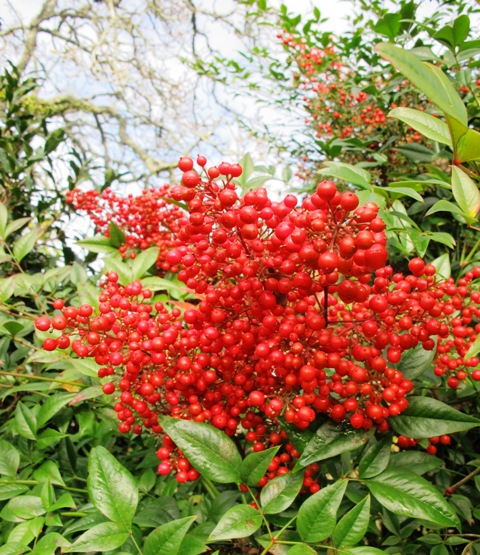
Orange berries all winter on Nandina domestica ‘Richmond’

Orange berries all winter on Nandina domestica ‘Richmond’

There is nothing rare or unusual about Nandina domestica ‘Richmond’ but it gives cheerful colour for many months in the colder season – an orange antidote to the dominant winter pinks. I read an English article which described it as the Far Eastern equivalent of holly berries, for hollies do not berry well in warm or even in mild climates. Clearly it is not attractive to birds. Otherwise they would strip it in a matter of days. It does, however, pick well if you are into flower arranging.

The nandina occurs naturally across much of Asia, from the Himalayas to Japan. It was introduced to the west in 1804 from a plant collection in China. Overseas, it is widely referred to as the heavenly or sacred bamboo, but it is not a bamboo at all. In fact it is related to barberry – but not prickly – and a member of the beriberidaceae family. It is hardy, evergreen and not fussy about growing conditions from full sun to semi shade. Our plants are just over 2 metres high and maybe 1.5 metres wide. We give them the occasional thinning every few years and snap off the spent flowering stems but beyond that, they are genuinely easy-care plants. ‘Richmond’ is a form selected because it berries particularly well and is hermaphrodite. In other words, you don’t need a male and a female plant to get the berries, which nandinas normally require. The flowers are white but tiny and insignificant. It is all about the winter berries.

First published in the Waikato Times and reprinted here with their permission.

Plant Collector: Lachenalia aloides quadricolor

The first lachenalia of the season: L. aloides quadricolor

The first lachenalia of the season: L. aloides quadricolor

The first of our lachenalias has come into bloom. ‘Quadricolor’ refers to the four colours in the blooms of this particular variety – lime green tubes with maroon tips are attached to the stem by a cap of orange and yellow. The commonest lachenalia that is seen in New Zealand is the somewhat garish, strong growing scarlet and orange which looks to me as if it should be sold amongst the plastic flowers in the red sheds. It is not in bloom yet. It used to be sold as ‘Pearsonii’ but that is an incorrect name, peculiar to this country. It is just a different form of L. aloides which is a variable species. We also grow L. aloides tricolor which is much later flowering and lime green with pale yellow and orange and the very different L. aloides var vanzyliae which is a striking pale blue and white with green tips.

Lachenalias are native to South Africa, predominantly the Cape Province. Most are winter flowering and summer dormant. We have different varieties flowering from now until early November in the garden. Many are easy enough to grow in sunny positions with good drainage, as long as you don’t get very heavy frosts. The foliage is not overpowering and doesn’t hang on too long after flowering finishes which makes for a tidier garden bulb. The highly desirable blue species come later in the season and not all are as easy to grow as L. aloides.

First published in the Waikato Times and reprinted here with their permission.