Category Archives: Plant collector

flowering this week, tried and true plants

Plant Collector: zygocactus or Schlumbergera (probably truncata hybrid)

Winter woodland charmer - we refer to it as zygocactus

Winter woodland charmer – we refer to it as zygocactus

We have always referred to this plant as a zygocactus. Others sometimes call it a chain cactus (although that is confusing because there are other cacti referred to by that term also). In the northern hemisphere, it is widely called the Christmas cactus because that is the time it flowers, or sometimes the descriptive term of Crab’s claw cactus. In fact it is a schlumbergera, often referred to as a S. truncata hybrid although it is likely to have S. bridgesii in its parentage too. Not having any expertise in cacti whatsoever, I will wait for somebody more knowledgeable to tell me the dominant species in its makeup.

It is a cactus, but not a desert one and it is not prickly, hailing instead from the rainforests of Brazil, where it is epiphytic – using other plants as its host. It is widely grown throughout the world as a house plant and much favoured in hanging baskets because of its pendulous, arching growth, tolerance of semi shade and prolific flowering in the depths of winter.

If you are frost free, you can grow it outdoors and this is what we do. We have it perching and festooning throughout our woodland area where it is particularly joyous in the depths of winter. We only have the somewhat garish, cerise form which is the most common one around. Hybridists have extended the colour range considerably, even to oranges and yellows, but the different colours have not been as vigorous for us.

Being cacti, these are easy to propagate from the flat, jointed leaves. Just leave them to dry for a few days or longer before putting them into a fine, sandy mix.

First published in the Waikato Times and reprinted here with their permission.
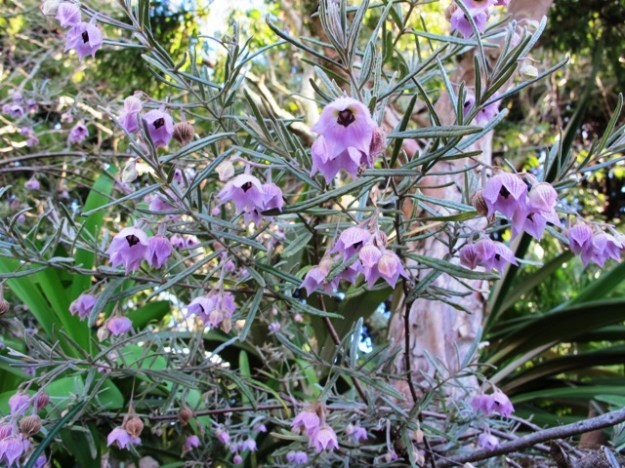
Plant Collector: Guichenotia ledifolia

Guichenotia ledifolia

Guichenotia ledifolia


We learn something new every week, though whether the name of this charming little shrub embeds in the memory banks remains to be seen. It doesn’t seem to have a common name and Guichenotia does not trip off the tongue easily, let alone ledifolia.

But what a little pet this Western Australian shrub is. It has rangy growth and evergreen foliage somewhat like a sparse, grey-toned rosemary (without the aromatic properties). The charming, nodding bells are mauve with little dark centres like a quilted pin cushion.

As with a fair number of Australian native plants, it tolerates a wide temperature range but it needs very good drainage and favours a somewhat drier climate than we have. This specimen is in a raised bed in full sun. It has never exactly romped away to reach its promised 100cm in height, instead arching out and staying low. It is not rare. Nor is it endangered in the wild. It is just one of those lesser known gems that adds a quiet charm to its corner of the garden gently flowering for much of the year. It is the winter flowering now, however, that we value the most.

First published in the Waikato Times and reprinted here with their permission.
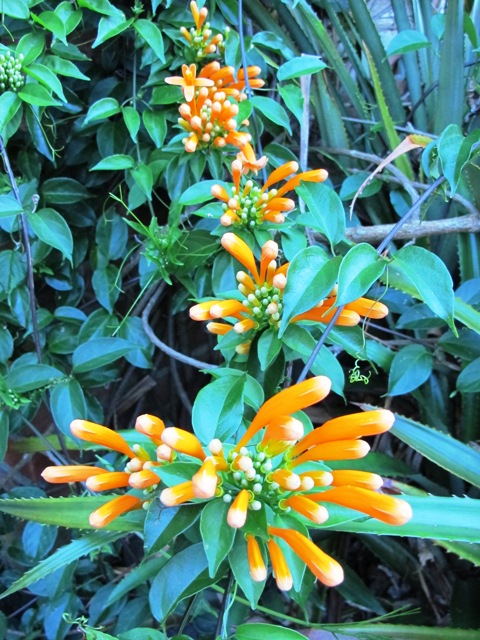
Plant Collector: Pyrostegia venusta

Pyrostegia venusta

Pyrostegia venusta

Like a bright beacon from the tropics on a bleak winter’s day, is this somewhat rampant climber with its common name of the flame vine. It is usually associated with Brazil, probably because that is where it was first collected for the west, but in fact occurs naturally throughout Argentina, Paraguay and Bolivia as well. Unfortunately, it is proving a bit weedy in some parts of the world because it can be invasive but there does not seem to be any record of problems in this country. It is frost tender.

It is a member of the Bignoniaceae family, for the botanically minded, and is evergreen. In the wild, it reportedly flowers in the cool, dry season and is pollinated by humming birds. I have long regretted the absence of exotic little humming birds in my life and the fact ours never sets seed may be due to the lack of a pollinator. Given its rampant growth, this is probably a good thing. Ours is growing outdoors against a warm wall and it is a bit of a miracle that it flowers at all, given that our cooler seasons are invariably wet. Photos on the internet suggest that it may be a great deal more floriferous in drier, warmer climates. It does, however, continually stage a takeover bid for the garage and we regularly hack it back. At this time of the year, its exotic flowers remind me of why it is still in the garden here.

First published in the Waikato Times and reprinted here with their permission.
Plant Collector: Monstera deliciosa

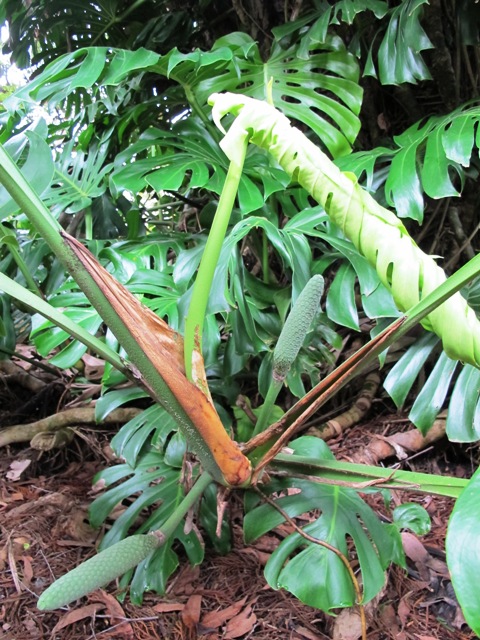
Monstera deliciosa - commonly known as the fruit salad plant

Monstera deliciosa – commonly known as the fruit salad plant

Most people know this as the fruit salad plant, widely grown as an indoor plant though more likely in commercial spaces because they grow quite large. However, it isn’t completely tender and can be grown outdoors as long as it is free of frost or snow. It puts out aerial roots and climbs without doing damage to the host tree. Some of ours are now maybe 10 metres up, giving a luxuriant, tropical effect. Each leaf is about 70cm across and lengthways.

If you look carefully, you can spot the fruit in the photo. There are two green phallic shapes, not to be confused with the unfurling leaf. The fruit is more a curiosity for us than anything else. It takes a year to ripen, at which point the green scales that form the outer casing start to split and peel off, revealing the creamy centre. It is variously described as tasting like a pineapple, jackfruit, mango or banana – in other words, exotic-ish. Because we lack the heat for proper ripening, the natural oxalic acids remain high so the fruit is more akin to eating tropical textured and flavoured fine shards of glass.

Hailing from tropical rain forests of northern South America (Colombia to Mexico), the monstera is a member of the arum family, which is very apparent when you see the hooded creamy flowers. You are most likely to find small monstera plants in the house plant section or if you know of someone with one, a length of stem with some aerial roots will grow away.

First published in the Waikato Times and reprinted here with their permission.
Plant Collector : Persimmons (Diospyros kaki, probably “Hachiya”)

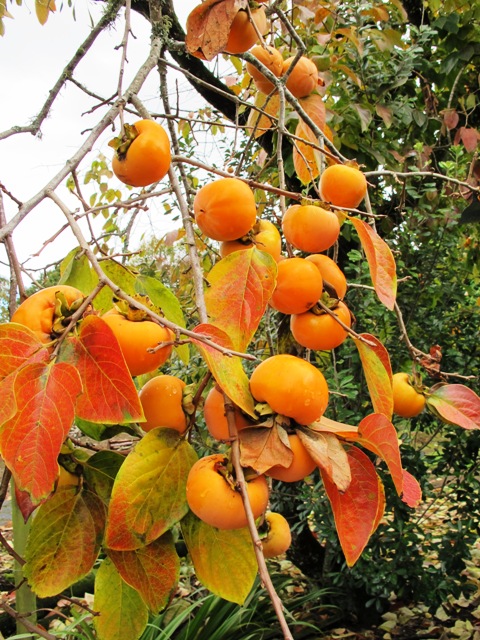
The persimmon - worth growing as an ornamental even if the fruit is not to one's taste

The persimmon – worth growing as an ornamental even if the fruit is not to one’s taste

As autumn draws into winter, our old persimmon tree looks mighty spectacular, even if we aren’t huge fans of the fruit. The large leaves turn golden before falling and the fruit hang on like big orange-gold orbs for a long time. The tree itself is smallish at about 4 metres and never receives any care or attention.

The diospyros family is a large one, best known for giving us both persimmons and the heavy dark timber often called ebony wood. D. kaki is native to China but now grown in many other areas of the world. The commercial cultivars often originate from Japan although Israel has also adopted it as the Sharon fruit.

Being an old tree, ours is an astringent variety. A high tannin content means that any fruit less than very ripe indeed will pucker the mouth. The best parts are the gelatinous segments in the centre. The surrounding flesh can be a bit cloying but no doubt would make an excellent sherbet or sorbet. Nowadays most people plant the modern, non astringent varieties which can be eaten before reaching the soft stage of ripeness. “Fuyu” is the most common non astringent variety here and there is now a small commercial orchard industry. You can buy the fruit in the supermarkets and eat them while still crisp, somewhat like an apple.

Persimmon fruit must be a taste I have yet to acquire despite its international popularity. No matter. The tree fully justifies its place as an ornamental at this time of the year.

First published in the Waikato Times and reprinted here with their permission.