Category Archives: Plant collector

flowering this week, tried and true plants

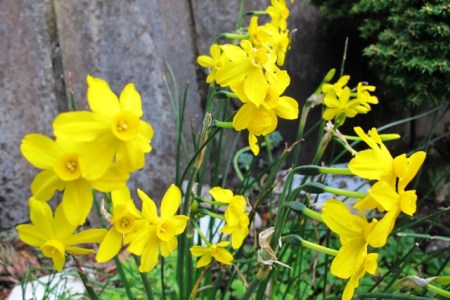
Plant Collector: Narcissus jonquilla and Narcissus bulbocodium

Dainty but with a strong perfume - N. jonquilla

Dainty but with a strong perfume – N. jonquilla

We have been taking a closer look at the narcissi this spring, picking out the ones which flower for longer periods and, latterly, the later flowering varieties. It would be good to have more flowering near the bluebells which are in full flight now. Most daffodils that you see around and buy as bulbs are hybrids. We are back to the original species this week with two which are flowering after most of the others have been, done and gone.

First up is the daintiest, tiniest and most fragrant jonquil species imaginable. It happens to be known as Narcissus jonquilla and is native to Spain and Portugal where it can be found in damp places. There can be up to five flowers per stem, each not much more than 2cm across.
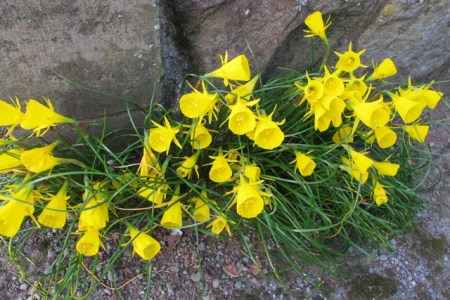
Narcissus bulbocodium - one of the last to flower here

Narcissus bulbocodium – one of the last to flower here

Then there is Narcissus bulbocodium, also known as the hoop petticoat daffodil. It has no scent but if you have a good form of it, it flowers in abundance. It looks as if it only has the corona, which is what the trumpet is called, but it actually has a little frill of six tiny pointed petals making a star near its base. It too comes from the Iberian Peninsula but can be found as far south as Northern Africa. Despite that, it is hardy and sufficiently strong growing to naturalise. Both species have fine, grassy foliage.

First published in the Waikato Times and reprinted here with their permission.
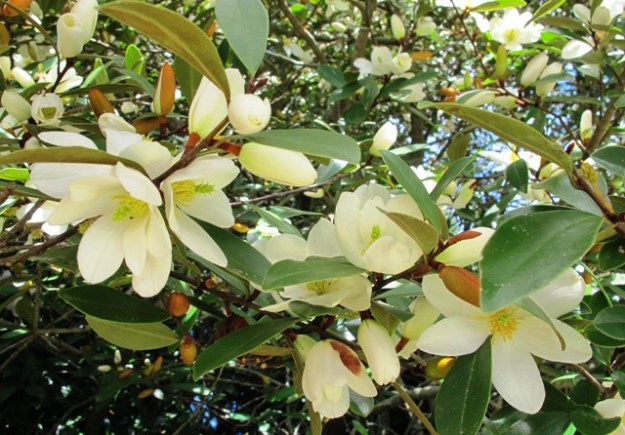
Plant Collector: Magnolia laevifolia “Velvet and Cream”

Now renamed Magnolia laevifolia

Now renamed Magnolia laevifolia

The naming of this plant is a complicated story. It was and still is widely sold as Michelia yunnanensis. It then had a fling with the name Magnolia dianica but is now Magnolia laevifolia. There are sound reasons for the changing name but it makes it confusing. In this country, it is almost a certainty that you will find it sold under its original name of M. yunnanesis. Michelias have now been reclassified as magnolias. Though evergreen, their foliage is much finer than the tough grandiflora types we normally associate with evergreen magnolias.

“Velvet and Cream” is a particularly good flowered form first released by former Cambridge nurseryman, Peter Cave. It has larger flowers in a beautiful cup form. M. laevifolia sets seed so prolifically that every man and their dog has raised seedlings and named them – some are better than others. Grown in open conditions with full sun, plants will stay bushier and more compact but generally these plants are a little slow to get established but eventually make small trees around the 3 metre mark if not trimmed. They are generally sold as fragrant, though I have yet to find one that has more than just a hint of perfume.

First published in the Waikato Times and reprinted here with their permission.

Plant Collector: Erythronium revolutum

The transient delight of dogs tooth violets - Erythronium revolutum

The transient delight of dogs tooth violets – Erythronium revolutum

Of all the fleeting seasonal delights, the dogs tooth violets or erythroniums might take the award for ephemera. They are so pretty and dainty and they are here today and gone pretty soon after. We probably only get ten days out of them in flower and a bad bout of weather can knock the display for the year. But we still get a great deal of pleasure from them. The flowers are like nodding hats while the compact foliage is often gently mottled or marbled in green and maroon.

There are about 20 different species, all in the Liliaceae family, but some of them just won’t perform in our climate. Many prefer cooler conditions and dry summers. As far as we know, what we have are mainly seed raised E. revolutum which is native to the west coast of USA. They thrive in humus rich conditions on woodland margins where the soil stays moist and there are reasonable light levels. The corms are interesting, being long and narrow and alarmingly easy to snap in two when disturbed. They find their own depth, often burrowing down quite deep, out of harm’s way.

First published in the Waikato Times and reprinted here with their permission.
Plant Collector: Magnolia Burgundy Star

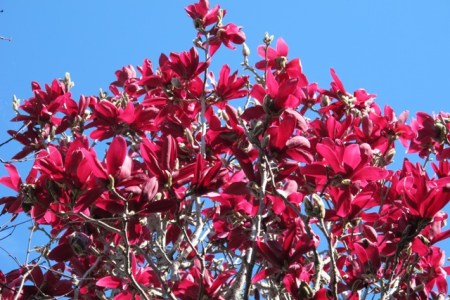
Magnolia Burgundy Star in full glory

Magnolia Burgundy Star in full glory

It is perhaps not widely realised that New Zealand leads the world when it comes to red magnolias, both in terms of breeding them and in the intensity of colour we get. We put this down to a combination of soil conditions and light. What flowers with good rich colour here can look pretty washed out and murky at times in the UK and Europe. New Zealanders tend to take the red colours for granted while magnolia enthusiasts overseas turn green with envy.

This one is Burgundy Star. It forms a narrow pillar shaped tree, not wider than two metres maximum. Because of this shape (described as fastigiate), it makes a splendid feature where space is limited, such as beside driveways. It gives height without much width. The flowers are towards the stellata (or star) magnolias in form but much larger and with firmer petals so they don’t get as floppy. And red. The stellatas are predominantly white, sometimes tinged pink. Because it sets flower buds down the stem, the season is extended. Magnolias which only set buds on the tips have a big display and are then pretty much over for the season.

Any of the deep coloured magnolias look best when planted in a position where the flowers are viewed with the light shining from behind.

First published in the Waikato Times and reprinted here with their permission.

Plant Collector: Corylopsis pauciflora

Corylopsis pauciflora - short flowering season in our climate, but charming

Corylopsis pauciflora – short flowering season in our climate, but charming

This dainty delight is in full bloom now and a good reminder of why I like having a large garden. It is so pretty in flower for a maximum of two weeks in late winter or early spring. For the remaining fifty weeks of the year, it is an anonymous looking shrub. If you only have a small garden, you need plants that work a bit harder than that to justify their space. But for those two weeks when its light, arching branches are clothed in pale lemon witch hazel flowers (it is a member of the witch hazel family, Hamamelidaceae), it has an understated grace and charm. It is also pleasantly scented. When the flowering finishes, saw toothed leaves in dull greeny bronze will take over.

C. pauciflora is one of the more compact species, making maybe 1.5m high by 2m wide. These are hardy, deciduous shrubs from cooler parts of Asia and Japan and are best suited to open woodland areas (in other words, humus rich and semi shaded). We also have C. willmottiae ‘Spring Purple’ which has similar delicate primrose blossom but with purple new growth. It has yet to come into bloom here but it grows to twice the size so it needs a fair bit of space for its 14 days of glory. The flowering period appears to be extended in colder climates.

First published in the Waikato Times and reprinted here with their permission.