Category Archives: Plant collector

flowering this week, tried and true plants

Plant Collector: Narcissus x Odorus

The heady fragrance of Narcissus x odorus

The heady fragrance of Narcissus x odorus

I wish you could smell this lovely daffodil. It has the most divine scent which is commonly found in the fragrant jonquils (or N. jonquilla as they are known botanically). That is because this one is a natural hybrid which was found in the wild in Southern Europe, a cross between a jonquil and N. pseudonarcissus). It is pure bright daffodil yellow (otherwise known as acid yellow) with a very short trumpet surrounded by a skirt of wavy petals in the same colour. While the flower isn’t large, it is held up on relatively tall, wiry stems. The number of blooms to each stem can vary from one to three. They appear to be totally sterile which prolongs the life of the flowers. As the foliage is fine, this is a narcissus that passes over quite gracefully.

If you search out as many different types of daffodils as you can find, you can extend the season from mid winter through to early or mid spring rather than having them all come in a flash over a week or two.

First published in the Waikato Times and reprinted here with their permission.
Plant Collector: Camellia Sweet Jane

Sweet little Sweet Jane

Sweet little Sweet Jane

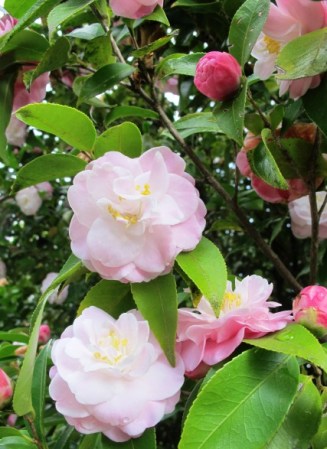
How pretty Camellia Sweet Jane looks at the moment. The flowers are darker pink on the outer petals fading to the faintest blush in the centre with a hint of golden stamens. It is a full flower, described in the camellia world as a peony form and it only measures about 5cm across so it is classified as a miniature. Yes it gets petal blight, but there is such a generous bud set that it still manages a good display over time. It came to this country in the 1990s from Australian breeder Ray Garnett. Readers who know their camellias may be surprised to learn that one of its parents is C. transnokoensis.

In that nineties rage for miniature camellia flowers, many people assumed that the bushes would also stay obligingly small. Few do. Our Sweet Jane, unclipped, is now about 3.5 metres tall and that is true for many of those small flowered varieties like Cinnamon Cindy and Gay Baby. But they do at least have correspondingly small leaves and are easy to clip if you want them kept lower. Camellias only need clipping once a year after flowering, or twice if you are after a tighter form.

We used to grow Sweet Emily Kate commercially. It came from the same breeder and its flower is arguably prettier (and pleasantly scented). Now that we are no longer selling it, I will admit it was a wonderful nursery plant and could look good if well cared for as a container plant but I’ve never seen it looking good planted out in the garden and left to its own devices. Sweet Jane is a much superior plant.

First published in the Waikato Times and reprinted here with their permission.
Plant Collector: Acer Senkaki or A. 'Sango-kaku'

Acer Senkaki, as it is commonly referred to in NZ

Acer Senkaki, as it is commonly referred to in NZ

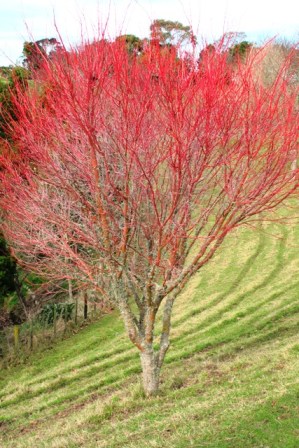
These vibrant red branches belong to what is commonly known as Acer Senkaki, or the coral-bark maple. I will go with Britain’s Royal Horticultural Society’s note that in fact, the correct name is Acer palmatum var. dissectum ‘Sango-kaku’. I wonder if Senkaki is the anglicising of Sango-kaku? The RHS gave it their prestigious Award of Garden Merit.

This is one of the Japanese maples with finely cut leaves (which explains the dissectum bit of the name), in five lobes or fingers (hence palmatum). The leaves are pale green tones throughout most of the season, colouring to gold in autumn. However, mostly one grows it for the glorious winter bark. It is a tree, albeit a smallish one. Over time it will get maybe five metres high by three metres wide.

I photographed this specimen in a country garden, Puketarata, where it stands as a splendid feature all on its own on a hillside, so it is able to viewed in its entirety. It really lit up a bleak winter Sunday afternoon.

Most maples need to be out of the blast of winds because their foliage is soft and relatively fragile. If the roots dry out over summer, the plant shows stress by burnt edges to its leaves. So positions which are well sheltered and moist all year round without getting waterlogged will give the best results. Grown well, the Japanese maples are lush and lacy in appearance and give superb autumn colour.

First published in the Waikato Times and reprinted here with their permission.

Plant collector : Helleborus x sternii

IMG_9684

Helleborus x sternii

There are more hellebores than just the common H. orientalis and sternii is one we appreciate in the winter woodland. It has distinctive green flowers, sometimes flushed purple, and lovely glaucous foliage which is finer in appearance. Glaucous just means it has a blue or grey cast to the colour. It is more upright in growth and does not make as dense a clump as orientalis. In addition to that, it holds its flowers in a cluster above the foliage and many of them are outward facing rather than all nodding (or facing downwards). So it displays its flowers a little better than H. orientalis.

The x sternii means it is a hybrid – in this case a cross between H. argutifolius (from Corsica and Sardinia) and H. lividus (from Majorca). From those origins, you can guess that it is quite happy in hot, dry conditions and the information is often given that it is suited to sunny positions. In our garden, sunny positions are at a premium whereas we have woodland in abundance so we are always after plant candidates for shadier positions. Plants like this hellebore which are not at all fussy, are very handy to add winter interest.

Sternii can be raised from seed or by division. There are named selections of sternii around – the seed from these won’t come true so they need to be divided or increased by cutting if you want to keep their special features. It appears that many of the newer forms are extending the colour range into purer pinks, burgundy, slate and white – akin to the orientalis colour range. We only have the original green flowered forms and have not seen the other colours in this country yet.

First published in the Waikato Times and reprinted here with their permission.
Plant Collector – Pennantia baylisiana (they don't come any more endangered than this ONE was)

Pennantia baylisiana - just the one single plant has ever been found

Pennantia baylisiana – just the one single plant has ever been found

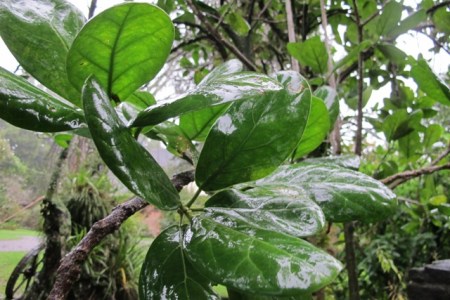
If ever there was a strong argument for putting plants into commercial production in order to save them, it is this rare, native tree. Along with our native climbing Tecomanthe speciosa, only one plant of each has ever been found in the wild. In fact both the tecomanthe and pennantia are from Manawa Tawhi, the Great Island of the Three Kings group, where goats threatened their very survival as a species. Both were found around 1945-6. Duncan and Davies Nurseries succeeded in growing the pennantia from cutting and distributing the plants. Our plant dates back to that – probably in the early 1960s. It is still only a small tree, maybe 4 metres tall, with handsome, large, shiny recurved leaves. Being a subtropical plant from a mild climate, it needs to be largely frost free.

The problem with there being only one known specimen and reproducing it from cutting is that no matter how many plants you distribute, they are all identical clones so lacking any genetic variation. However, the original plant finally set viable seed in 1989 and there are now seedling grown plants in existence which should strengthen the genetic base. Penanntias are dioecious which means there are male plants and female plants. Fortunately the last known plant on the planet was female and occasionally, female dioecious plants can produce a little pollen and therefore self pollinate and produce seed. Our tree has set seed but as there appears to be a plant of Pennantia corymbosa in the neighbourhood, most of the seedlings have proven to be hybrids between the two, which is not what we are after at all. Mark was thrilled to finally get one seedling which seems to be true to P. baylisiana.

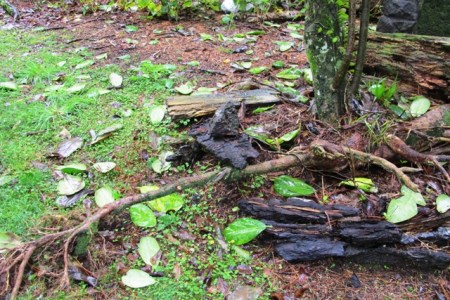
Our pennantia does not appear to be deep rooted - or it didn't appreciate recent strong winds

Our pennantia does not appear to be deep rooted – or it didn’t appreciate recent strong winds

First published in the Waikato Times and reprinted here with their permission.