Category Archives: Plant collector

flowering this week, tried and true plants

Plant Collector: Vireya Rhododendron Satan’s Gift

Satan. I'm afraid it is vireya rhododendron "Satan's Gift", not Santa's Gift

Satan. I’m afraid it is vireya rhododendron “Satan’s Gift”, not Santa’s Gift

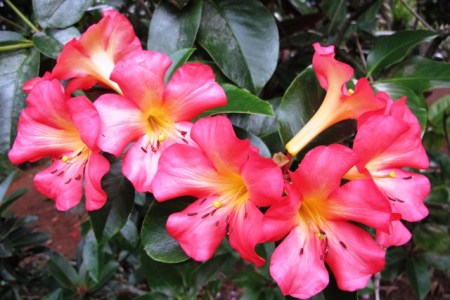
The trouble with vireyas is that they have an aversion to frost so they are really only a garden option for those in mild, coastal areas. Inland (where frosts are much greater), you need to be a careful gardener willing to give them protection and maybe bring them under cover. But they can be such a rewarding plant with their extended flowering habits. This one is Satan’s Gift, one of the best varieties named by the late Felix Jury and certainly the showiest and the most fragrant.

Felix was a complete agnostic so the word Satan merely evoked hot colours to him but over the years, we have seen more religious people struggle with the name. Indeed, we have seen it offered for sale as Satin Gift, Jury’s Gift and the hilarious Santa’s Gift. (Note to such people: it is fine to shun a plant because you don’t like its name, but it is not okay to rename that plant to something you find more acceptable). We were once told that it was the only plant in Eden Gardens in Auckland, a memorial garden, without a name plaque. We just think it is a splendid cultivar to have in the garden.

This is a cross between two different species (konorii x zoelleri) which gives it hybrid vigour. It is particularly bushy and well furnished and flowers more than either of its parents.

Besides not liking the cold, vireya rhododendrons need great drainage. The fastest way to kill one is to keep it with waterlogged roots, whether in a container or the garden. In the wild, most are epiphytes and grow up in the trees.

First published in the Waikato Times and reprinted here with their permission.
Plant Collector: Schefflera septulosa

Schefflera septulosa - frost tender and rather large

Schefflera septulosa – frost tender and rather large

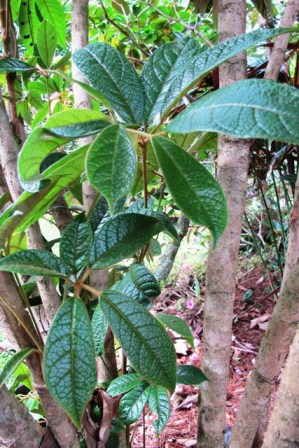
Back in the 1950s, my late father in law, Felix Jury, went on a plant hunting trip in the highlands of New Guinea. In those days, one could still bring new plants into this country and one of those he brought back was this very graceful schefflera which was identified as S. septulosa. After sixty years, it seems that it is still very rare in cultivation.

Schefflera septulosa from New Guinea highlands

Schefflera septulosa from New Guinea highlands

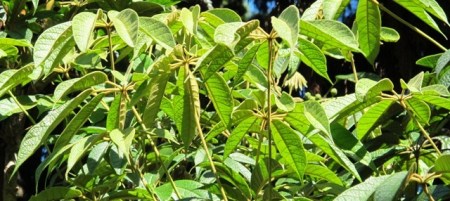
Scheffleras are a huge family belonging to the Araliaceae group (which includes ivy). Most come from tropical and subtropical parts of Asia. Some are widely grown as house plants, while some are relatively hardy to cooler temperatures. S. septulosa is neither. The original plant here is about 5 metres tall and even young plants get large relatively quickly. The surest way to knock it back and to burn off the foliage is to let frost get at it. We grow it on the woodland margins where the canopy from higher trees shelters it. But no other schefflera I have seen is as handsome. It shoots from the base so is more shrubby than tree-like in form and the leaves are large, held in a palm shape and heavily textured, matt dark green. With its brown velvety stems, it is a striking plant.

Scheffleras flower, but I have to be honest and say they are so insignificant on S. septuolosa that I have never noticed them. Mark tells me the bees are the best indicator that there are flowers because they flock in. Generally, they are regarded as foliage plants. The chances of finding S. septulosa for sale are not good, but occasionally you may find the splendid, large leafed “Condor” on offer. It is an unidentified species from Uruguay, so some distance away from New Guinea. It was introduced by Aucklander, Dick Endt of Landsendt. Both make handsome garden additions in warm areas protected from frost.

First published in the Waikato Times and reproduced here with their permission.

Plant Collector: Sasanqua camellia Crimson King

Crimson King - harbinger of autumn

Crimson King - harbinger of autumn


Crimson King forms a graceful, open shrub when mature

Crimson King forms a graceful, open shrub when mature

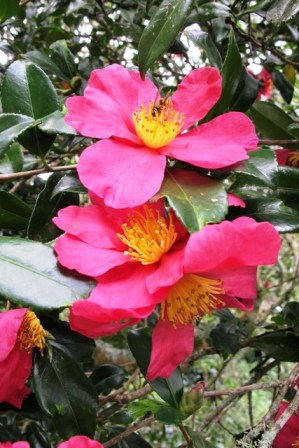
Crimson King heralds the arrival of autumn. It is a sasanqua, one of the autumn flowering camellia family from Japan. Too many people seem to think that sasanqua is synonymous with Setsugekka (how clichéd is the Setsugekka screen planting?) and only comes in white. In fact there are a relatively large number of family members, including Crimson King. It has the usual sasanqua attributes of finer foliage and a graceful, open habit of growth as it matures. In addition to that, the exceptionally long flowering season means it will last well in winter.

Single flowers have just one row of petals and exposed yellow stamens in the centre. The birds and the bees, and indeed the butterflies, need these stamens exposed to be able to feed from the flower. Big full forms or sterile formal flowers are not a source of pollen and nectar. Most sasanquas lack the highly refined flower forms so prized in japonica camellias but single flowers like this shatter and dissipate without ever leaving a sludgy mess below. There is also a simple charm in such a simple flower.

Sasanquas are renowned for being one of the most sun and wind tolerant types of camellias. They also flower early enough in the season to avoid the dreaded camellia petal blight. Overseas reports say that they can suffer from this dreaded fungal ailment but we have never seen it in our sasanquas here. Crimson King has a pleasant scent if you stick your nose right in the flower but I think that the faint waft of fragrance in camellias is rather over-hyped.

First published in the Waikato Times and reproduced here with their permission.

Plant Collector – Oxalis massoniana

Oxalis massoniana

Oxalis massoniana

Envy the gardener who has not had to battle invasive oxalis. Most of us know only too well how difficult it is to eradicate the weedy ones. But there are only a few villains in a very large family and unfortunately, most people shun the lot because of those few. We wouldn’t be without the decorative oxalis and O. massoniana is just one putting on a splendid display at this time.

I think we must have around 30 different oxalis in pots and in the garden here and they are just a drop in the bucket of the many hundreds of different species. Flower colour ranges from white, through the gamut of pinks, lilacs and lavenders, crimson red, yellows and oranges. The foliage is also varied from the clover type leaves to fine and feathery, trailing and even miniature palm leaves. We must have them flowering for six to eight months of the year. I should comment that some have a flowering season lasting a long time, while others are a bit of a flash in the pan.

Some oxalis are garden safe but if in doubt, keep them in pots where they are wonderfully forgiving of benign neglect. The flowers only open in the sun so the pots make a lovely seasonal feature on a sunny doorstep. I have tried massoniana in the garden but it seems to be happier and showier in a big, shallow container.

The apricot and soft yellow two-tone colouring is very pretty and the flowering season lasts a good length of time. As with most of the autumn and early winter flowering oxalis, it is native to the bulb wonderland of South Africa. If you can’t bear the thought of growing oxalis, just call it by its more romantic sounding common name overseas – wood sorrel.

First published in the Waikato Times and reprinted here with their permission.
Brugmansia Noel’s Blush

Brugmansia Noel's Blush

Brugmansia Noel's Blush

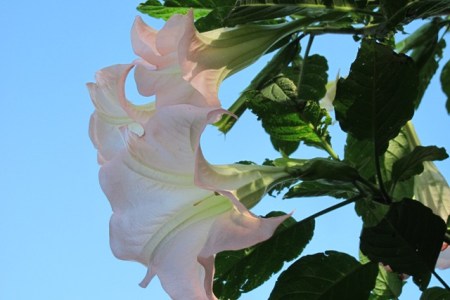
The late summer sight of this brugmansia in full bloom is striking and the trumpets are a pretty peachy pink in colour. Each bloom can measure 25cm long and up to 20cm across which is on the large side. I was reading a description which said strongly scented which I can’t say I have noticed so I rushed out to sniff. No scent in the morning, I am afraid. It appears they are night scented which is an indication that pollination is carried out by night flying insects, usually moths. The plant itself is a big rangy thing of no beauty – you have to work at keeping it more compact and bushy if you want a tidy plant. Otherwise it is just an overgrown solanum which wows when in flower.

This particular one was named for the late Auckland gardener and plantswoman, Noel Scotting and it came into the country about twenty years ago. Brugmansias are all South American and there seems to be quite a bit of shuffling of species, even though there are not many different species to shuffle. I lean towards the likelihood of this being B. suaveolens from south east Brazil. Or it may be a hybrid. All brugmansias are frost tender.

Brugmansias used to be called daturas, to which they are closely related. They are also very toxic. South American tribes have long used them in traditional medicine for purposes as varied as treating dermatitis, arthritis, prophecy, a ritual hallucinogen and, most scary of all, apparently to discipline naughty children by opening them up to the voices of their spirit ancestors. It sounds like scaring them witless to me. All parts of the plants are toxic and fortunately synthetic illegal drugs have replaced their occasional recreational use which was all too often fatal.

The double white brugmansia featured earlier in this series.

First published in the Waikato Times and reprinted here with their permission.