Category Archives: Plant collector

flowering this week, tried and true plants

Plant Collector: Alcantarea regina

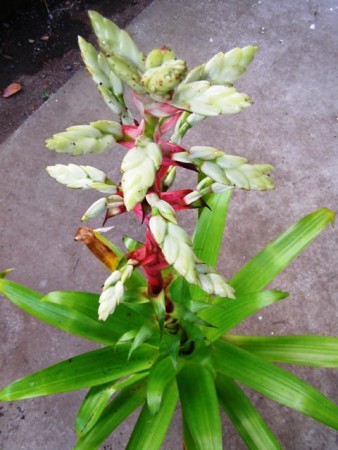
One of the most spectacular bromeliad's when in flower - Alcantarea regina

One of the most spectacular bromeliad's when in flower - Alcantarea regina

A bromeliad, or brom as they are often called, but thankfully the alcantarea family are not prickly and spiny like so many of the other species. There appears to be some debate as to whether this one is A. regina or A. geniculata – it does seem that the experts lean to the latter option but it is widely sold under the former name. Whichever, it is from eastern Brazil, as are all its alcantaera siblings. It has only been in cultivation for a little over a decade but, being easy to propagate, it is now widely grown. In leaf, it is nothing particularly spectacular – just a rosette of reasonably large green leaves. But when it shoots up a metre high, strong flower stem, it is impossible to ignore. The stem is a deep pinky red with bracts for starters, adorned by funny, waxy lemon flowers which are flat and rigid. Being a bromeliad, the flowers last a long time, after which the flowering rosette usually dies (slowly), but not before putting out pups to the side which will take over in due course.

Most bromeliads are on the tender side so we use them as woodland plants because the overhead shelter gives them protection. They have very small root systems for the size of the tops and low nutrient requirements. In other words, they need very little feeding. Most will hold water in the rosettes – which can be a breeding ground for mosquitoes as I found to my cost when working amongst ours recently. The best known bromeliad of all is the pineapple.
Plant Collector: Haemanthus coccineus

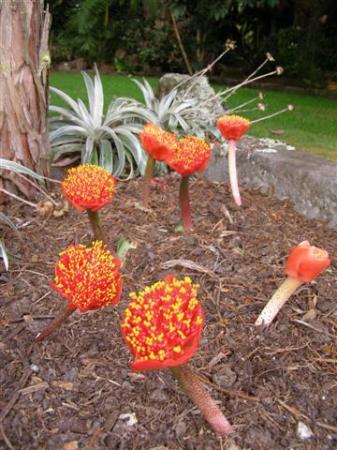
Haemanthus coccineus - usually seen more as a foliage plant than a flowering one

Haemanthus coccineus - usually seen more as a foliage plant than a flowering one

There is nothing particularly rare about Haemanthus coccineus, though if you want a plant, buy it without hesitation when you see it offered for sale. It is one of those oddities which are difficult to source in these days of streamlined plant production and an ever shrinking range. Most readers will know it better from its foliage – typically each bulb puts up two enormous, fleshy leaves which lie flat to the ground throughout winter, resembling elephant’s ears – which is indeed a common name for this plant. Unfortunately, both the young leaves and the flowers can be magnets for slugs and snails so it pays to be vigilant. The red paintbrush flowers on spotted stems which have popped up in the last few days are striking but fairly short-lived. This is a summer dormant bulb from South Africa and the flowering this week will have been triggered by the rains 10 days ago.


The bulbs are enormous fist-sized affairs. If you have a patch which is ready for dividing, you could do it immediately because, as with belladonnas, the plant flowers before it comes into new growth. Otherwise, leave it until the foliage dies off in late spring. Unlike some bulbs, haemanthus roots never die off completely so you have to lift carefully and replant immediately without letting the bulbs dry out. Plants may need some protection from heavy frosts and they don’t want to be in heavy, wet soils.

Haemanthus are another member of the amaryllis family (amaryllidaceae, to be precise) which gives us the showy flowers of belladonnas, crinums and last week’s worsleya, amongst others. Haemanthus albifloss is the reasonably common white flowered form which is largely evergreen but unless we had poor forms of it, it wasn’t much chop as a garden plant and is a mere shadow of its showier cousin, H. coccineus.

As a postscript to the worsleya last week: one kind reader in New Plymouth had a plant blooming and replied to my request. We swapped pollen and can hope for some viable seed.

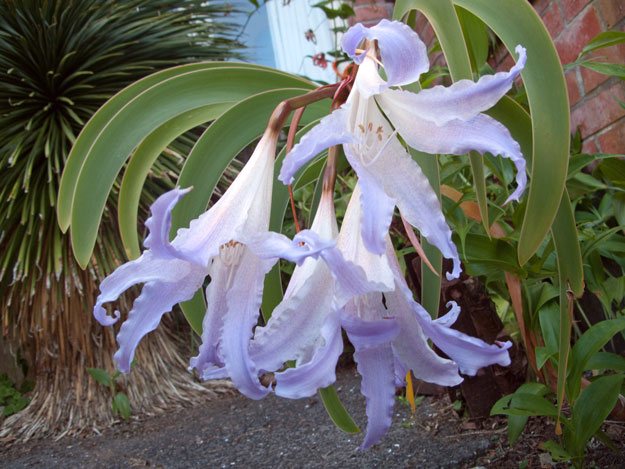
Plant Collector: Worsleya procera

Worsleya procera (syn. W. rayneri)

Worsleya procera (syn. W. rayneri)

The most special plants flowering in our garden this week are the Worsleya procera (syn. W. rayneri) and they are not only special because they have the wonderful common name of Empress of Brazil (which tells you where they come from). They are also extremely rare in cultivation, a very beautiful lilac-blue in colour and generally regarded as almost impossible to grow as garden plants. We have two growing in different positions in the garden where they are just left to their own devices with no special treatment at all. When we had an international tour of clivia enthusiasts through, a number were also bulb aficionados and they were genuinely impressed that we could grow and flower this choice bulb in the garden. They are usually grown as really pernickety container plants. True, our flower spikes do not match the 150cm in height that they are reputed to reach, but the flowers are large and a most unusual colour in the bulb world.

There is only one species of worsleya but if you go back a step to the extended family, they are related to hippeastrums, crinums and amaryllis. Apparently in Brazil, they grow on steep granite cliffs beside waterfalls (where it is hard to imagine a flower spike of 150cm) but our garden conditions in no way resemble the natural habitat. The foliage is really interesting, arching in a semi circular, sickle fashion. These bulbs are not for the impatient gardener. Mark was standing looking at one of ours with Auckland plantsman, Terry Hatch, who originally supplied it to us. They agreed that was a long time ago, maybe as much as eight years. Mark found the label and it was in fact fifteen years. It had taken thirteen years to flower the first time. Time flies, apparently, when you are a gardener. Sadly, both ours are the same clone (one was an offset) and you need two different clones to get viable seed. Pukekura Park’s worsleya in the Fernery is not going to flower this year so if any local readers happen to have one in flower, we would love to swap pollen.

Plant Collector: Amaryllis belladonna

Surprising perfection in the under-rated Amaryllis belladonna

Surprising perfection in the under-rated Amaryllis belladonna

Belladonnas naturalised on a vertical road cutting

Belladonnas naturalised on a vertical road cutting

Looking at the white perfection of the bloom just opening, it is not that easy to pick it as a common old belladonna, but that is what it is and just a random seedling at that. We tend to be a bit sniffy about belladonnas here and see them as roadside wildflowers to be taken for granted. Fortunately they thrive on benign neglect, preferring to be left undisturbed and quite happy to grow in quite difficult conditions. This one is on a vertical bank where Mark broadcast some seed several years ago.

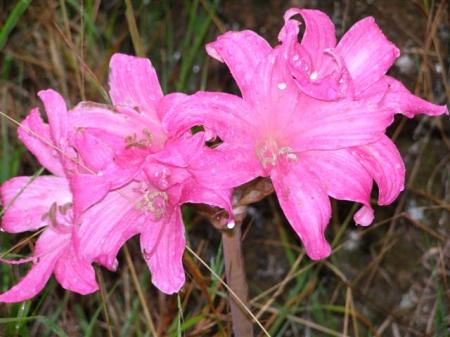
The amaryllis family has only one solitary member and that is the belladonna – which stands for beautiful lady rather than the more common epithet of naked lady. The reference to nakedness comes from the plant’s habit of flowering before any foliage appears. This is another bulb from the Cape Province of South Africa and it is summer dormant. The flower pops up well before it actually comes into growth for the season. The colour range is from pure white through a gamut of pinks – pastel to bright sugar pink to a deep cerise bordering on red.

The more common candy pink of the belladonnas

The more common candy pink of the belladonnas

Apparently there are now some double forms around but I have yet to see them. I found a tray of perfect white ones at the back of the nursery last year and made a spot in the summer garden for them but now I am wondering about revisiting some of the other clumps we have hanging around the place to feature them more as a late summer flower. Their only real downside is that they have rather a lot of foliage for much of the year so they are best planted in a position where they can be left to their own devices and their scruffier times are not intrusive. If you are planting belladonnas, they like to be baked in the summer sun and left with their necks above the ground.

Plant Collector – Helichrysum Silver Cushion

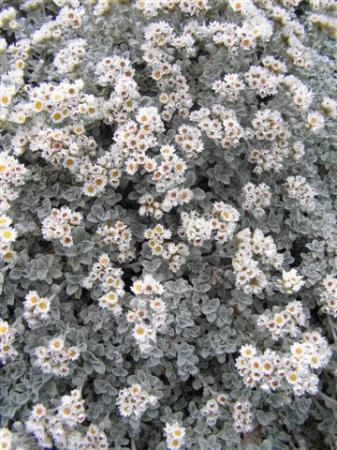
A delightful mound of silver foliage and white daisies

A delightful mound of silver foliage and white daisies

When helichrysum are mentioned, most people think of the everlasting straw flowers, usually orange and yellow, which are fun for children to grow and may have a place decorating a sunhat (preferably somebody else’s) or gathering dust as part of permanent flower displays. However the helichrysum family is much larger than that. Silver Cushion looks like a mounded silver cushion with dense tiny leaves (they are about 4mm across) and a mass of dainty white straw flowers. The flowers are daisies but tiny – under a centimetre across. It is attractive without the flowers but lovely when in full summer bloom.

This is a woody sub-shrub which will gently layer where it touches the ground. The tiny grey foliage and strawflowers give a clue that it will take hot, dry conditions. It thrives in our rockery and can make a good container plant but it did not thrive when I tried it in bone dry conditions with root competition. The plants survived there for a few years but in the end I pulled them out because they were looking pretty hard done by. Silver Cushion has been around for many years, decades even, and is still being produced commercially in NZ. My attempts to unravel its background failed and it may be that a reader can tell me more. As far as we understand, it is a native but what we don’t know is whether it is a species selection or a hybrid. My best guess is that it has at least some H. bellidiodes in its background. To make matters worse, that helichrysum now appears to have been renamed as Anaphalioides bellidioides . While I can live a happy life blissfully ignorant of the finer points of most helichrysum species, it would be interesting to know a little more about the background of Silver Cushion in particular.