Category Archives: Plant collector

flowering this week, tried and true plants

Plant Collector: Lilium regale

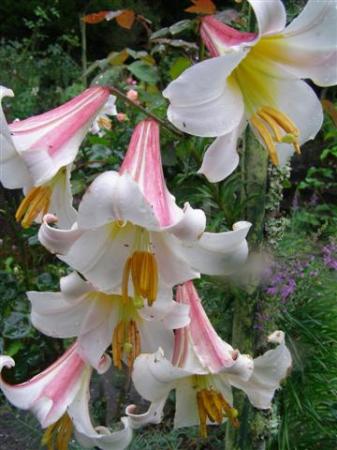
Lilium regale - often called the Christmas lily in New Zealand

Lilium regale - often called the Christmas lily in New Zealand

There seems to be a little confusion as to whether Lilium regale or Lilium longiflorum is the Christmas lily in New Zealand, but I can’t see that it matters. My guess is that florists may refer to the latter as the Christmas lily because it commonly comes with pure white flowers and is a reliable standby for picking, much favoured in floristry. But many gardeners associate the regal lily with this festive time of year. It too has the wonderfully fragrant white trumpets but usually with deep red or purplish markings on the back of the petals. L.regale comes from the Szechuan area of China whereas L.longiflorum is from Japan.

There is nothing too difficult or rare about either. L.regale gets to just over a metre tall and generally we get away without needing to stake it, especially when it is grown in the rose garden and has some taller plants around it to prop it up if it starts to list too far. If you have both sun and good soil, you are fine and it should reward you with eminently pickable flowers to adorn the Christmas table. Like most lilies, the bright pollen falls off rather freely and will probably stain the white damask Christmas tablecloth. Apparently you can brush the pollen off the stamens if you are working in dry conditions. Alternatively, nip the tops off the stamens but leave the anthers in the centre. Don’t harvest the flower stem right back at bulb level. It needs some length left because the stem contains both leaves and flowers and the bulb needs its energy replenished through its foliage or it will waste away.

Plant Collector: Cornus kousa var. chinensis

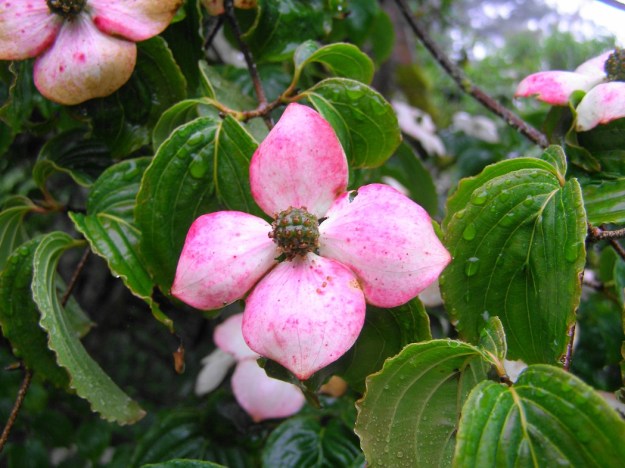
Pink and white all over - Cornus kousa var. chinensis

Pink and white all over – Cornus kousa var. chinensis

The cornus are a big family, commonly referred to as dogwoods. In our climate where we can grow most plants, cornus are not as widely featured as in other areas of the world because we are really too damp and too mild for most of them. They perform much better in a drier, continental climate with hot summers to ripen the wood, sharp seasonal change to trigger the autumn colours for which many are renowned and a good winter chill. Our C. kousa has had its hiccups in life (dieback threatened it a couple of years ago, possibly due to wet roots) but it battles on and in early summer the pink and white flowers are a seasonal delight, albeit a little brief. The welcome rain this week shortened its season.

Curiously, the flower is actually the dull, nubbly bit in the centre. What look like four pink and white petals are actually bracts – in other words specialised leaves which protect the flower buds, so not petals at all. This is common to all the dogwoods and to many other plants as well, including lacecap hydrangeas. Kousa is common in Japan and also found in Korea but Glyn Church tells me the form we grow in New Zealand is actually the one from central China, collected in 1907. After several decades, ours is a narrow, columnar tree about six metres high. When we were last in England, we saw many hybrids between C. kousa and C. nuttallii, some with spectacular, large flowers which were very showy indeed. Kousa shows resistance to anthracnose which has decimated the cornus display overseas and the new hybrids are, in part, an attempt to breed resistance to the disease.

Cornus kousa can age to deep pink

Cornus kousa can age to deep pink

Plant Collector: Dactylorhiza maculata

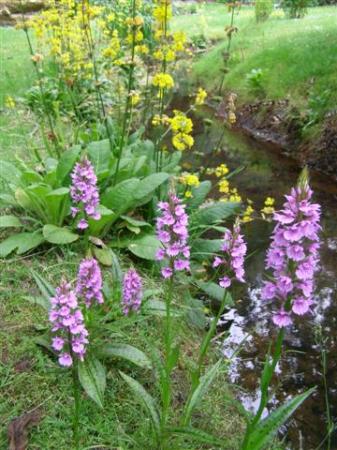
Dactylorhiza - doing better on our stream margins than in the garden

Dactylorhiza - doing better on our stream margins than in the garden

Dactylorhiza are terrestrial orchids – in other words, ground orchids. We have had this purple one for many years. It is likely that Felix Jury imported it here in the early fifties and it has gently increased ever since. It has taken us a long time to realise that it is happier in the cooler, damper conditions of our stream margins where these specimens are growing taller and lusher than those we have in rockery or other garden positions.

The rhiza part of the name refers to the root which is liked a forked tuber, or rhizome and it increases in a similar manner to many bulbs. Dactylorhiza are very widespread in the cooler areas of the northern hemisphere, occurring as far north as Scandinavia and even Alaska. While we have always had this one as D.maculata, otherwise known as the Heath Spotted Orchid, there is a bit of a question mark over that and it may in fact be D. fuchsii, the Common Spotted Orchid or even a hybrid between the two. The differences are subtle – are the markings lines? Is that pointed area in the lower lip like a small middle tooth or is it a lobe? Whichever, the foliage generally has interesting deep maroon spots which are an attractive feature, even without the flowers. Each flower spike is about 20 to 30 cm high (a happy plant will put up a taller spike) and carries masses of individual orchid flowers which open pretty much all at once. The yellow behind the plants in the photograph is the common Primula helodoxa.

Plant Collector: Sarracenia

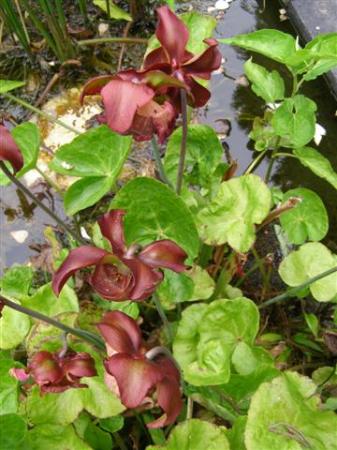
Sarracenia - the flowers come before the insect trapping pitchers

Sarracenia - the flowers come before the insect trapping pitchers

The deep red flower on this plant growing in our goldfish pond is a sarracenia which may not mean a whole lot until I mention pitcher plant – as in the insect eating plant family that traps its little prey in its throat and then digests them. The pitcher part comes later in summer. In spring it puts up eyecatching blooms to encourage pollination by insects and it does not wish to trap and digest the insects that will ensure its survival by pollinating it. Mind you, bees are the common pollinator and few plants can cope with insects as large as the bee.

Most of the sarracenia are native to the south eastern states of USA (think Florida, South Carolina, Mississippi and the likes). As wetland inhabitants, their natural habitats have come under severe threat from development although they are not difficult to grow in suitable conditions and they set seed freely. This plant has its feet in the water and never dries out. It grows from a rhizome. Sarracenias are very cleverly designed as static traps. The insects are attracted by a combination of scent and colour. Once perched on the lip of the pitcher, a slippery secretion can tumble them over the curve to the inside of the funnel where a whole lot of fine, downward facing hairs prevent them making an escape. Some species even have a compound that anaesthetises the prey on the way down. It is a multi pronged attack in this war between plant and insect.

We bought this plant from a garden centre and have long since lost the label so we don’t know if it is a species or a hybrid but apparently they cross readily in the wild. Children find carnivorous plants fascinating and the sarracenia are one of the easier and more spectacular families to grow.

Plant Collector: Manfreda maculosa

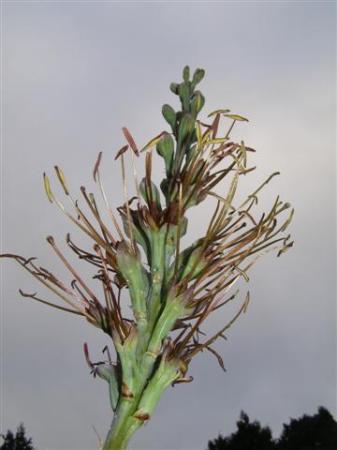
Manfreda maculosa - looking rather more dramatic in the photograph than in reality

Manfreda maculosa - looking rather more dramatic in the photograph than in reality

Manfreda maculosa is a very curious plant, not the least because it has a spectacular flower spike topped with singularly unspectacular flowers. The stem of the bloom can be well over 2 metres tall and is strong enough to hold itself up with staking. It appears in late spring as something of a surprise because the plant itself is low to the ground with just a few fleshy leaves spotted with burgundy. The first time it flowered for us, I waited in anticipation, expecting something showy and exotic. It is neither – browny green tubular flowers with exceptionally long brown stamens, giving a rather ragged appearance. Apparently it is renowned for attracting humming birds to your garden. What a shame we have no humming birds in this country.

This manfreda is also called the Texas tuberose or Spice Lily and it does indeed hail from southern Texas and Mexico so is somewhat tender. It tends to run below ground so when it gets hit hard in a cold winter, it is capable of sending up fresh shoots in spring. I have it planted in a mixed border situation and thin out the surplus runners from time to time. It just sits harmlessly as part of the herbaceous plantings until it gets a rush of blood and sticks out its outrageous flower spike.