Category Archives: Plant collector

flowering this week, tried and true plants

Flowering this week: Cyclamen coum ssp. caucasicum

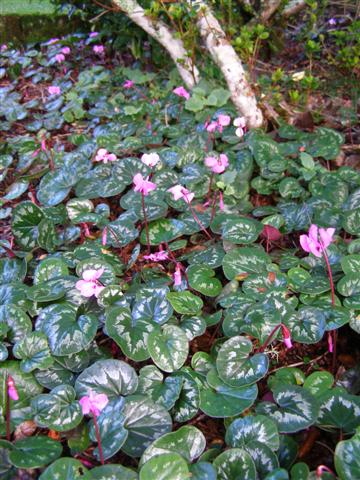
The charm on the winter flowering cyclamen

These winter flowering cyclamen are a delight and over the years we have increased their numbers so that we can use them to carpet beneath the light canopies of large evergreen azaleas (also coming in to flower now) and in open woodland areas. They have a remarkably long flowering season of months but don’t hold on to their foliage very long after flowering and their corms are quite small, so they discreetly disappear amongst the leaf litter when dormant.

Technically these go by the tongue twisting name of Cyclamen coum ssp caucasicum (the ssp stands for sub-species) and the caucasicums are a great deal more successful in our conditions than the straight coum. They hail from a wide area along the western edge of the Black Sea from Georgia southwards through Turkey to Northern Iran, including the Caucasus Ranges, where they can apparently be found growing from sea-level up to 2000 metres. It is the tolerance of sea level which means they will do with us where we don’t get an alpine chill. The Cyclamen Society (based in Britain) have been sending expeditions for years to try and establish the geographic distribution of the different forms of coum but the political instability of the area poses difficulties. The British have a wonderful history, second to none, of intrepid plant hunting and botanical research but they also have a healthy survival instinct. You won’t often see any forms of Cyclamen coum offered for sale, but if you know of somebody with some plants, they are easy to raise from fresh seed.
Tried and True – Camellia Mimosa Jury

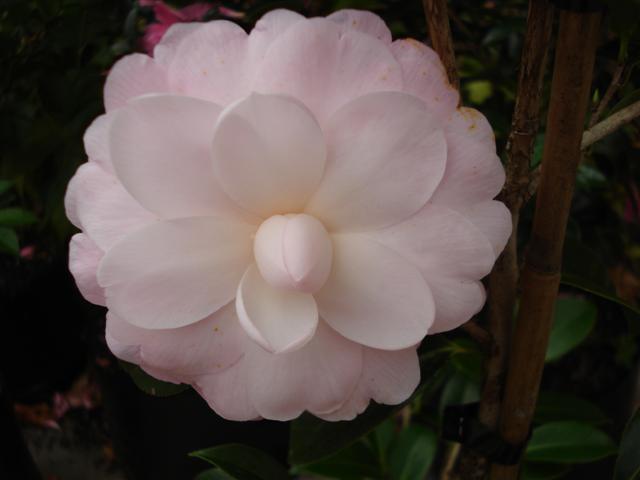
The floral perfection of Camellia Mimosa Jury

The floral perfection of Camellia Mimosa Jury

We have a familial connection here – this camellia was bred by Mark’s father, Felix, and named for his mother – but that is not why it is a tried and true plant. It is the perfection of the bloom which is its appeal, along with a much higher degree of weather hardiness than most pale, formal camellias. The regular arrangement of the petals, in similar lay-out to a water lily with no central stamens visible, is what makes it fall under the classification of formal (these rules are written down, I tell you). The soft pink colouring is particularly pretty. When the blooms are spent, they fall to the ground rather than hanging on as brown mush – a characteristic which is called self grooming.

Mimosa Jury has been around for some years now – there are established specimens locally in New Plymouth in St Mary’s Cathedral grounds. Left to its own devices, as has been the original plant behind our house, it grows tall and columnar, making an excellent hedger or accent plant. It also makes a brilliant clipped specimen. The neighbours have a perfect big lollipop Mimosa Jury as a feature. They have kept it tightly clipped and pinched out so that it is a solid ball of healthy foliage which will hold the perfect blooms out to display. In our opinion, this camellia is probably the best that Felix named and it is no wonder that it has stayed so popular over a period of years. Other formal camellias have bigger blooms but usually sustain much more weather damage and do not have as many flowers over a period of many months.

Flowering this week: Aloe thraskii

Aloe thraskii - quite happy in our marginal conditions

Aloe thraskii - quite happy in our marginal conditions

One of the tree aloes from southern Africa, A. thraskii is putting up its heads of yellow flowers now. I am not a fan of spiky plants in our garden but I am willing to make an exception for some of the handsome aloes. Thraskii is sometimes referred to as the dune aloe (it grows naturally in coastal dune areas) or the palm aloe (on the grounds, perhaps, that if you were nearly blind and galloping past on a runaway horse you may think it resembled a palm?). What is special about thraskii for our purposes is that despite its hot, coastal origins, it is pretty tolerant of higher rainfalls and even the odd light frost. Planting it in free draining soils is even more important if you are growing it in higher rainfall conditions. We have undertaken some reorganisation of the area around our thraskii, which is now about 15 years old and over 2 metres high and I have issued an edict that I would like it moved. Fortunately, aloes can be moved relatively easily but I do notice that nobody has sprung into action yet. This could be because each leaf is thick, heavy and edged in saw-tooth prickles and could make a suitable weapon for guerrilla fighters. Maybe we will just let it flower first. Its yellow tubular blooms hanging from the flower spikes coming from the centre of its top knot are not as spectacular as some of the other aloes, but they are still pleasing on a dreary winter’s day.

Flowering this week: Dombeya burgessiae

Dombeya burgessiae is more autumn flowering in its homelands but here it is blooming in mid winter

Dombeya burgessiae is more autumn flowering in its homelands but here it is blooming in mid winter

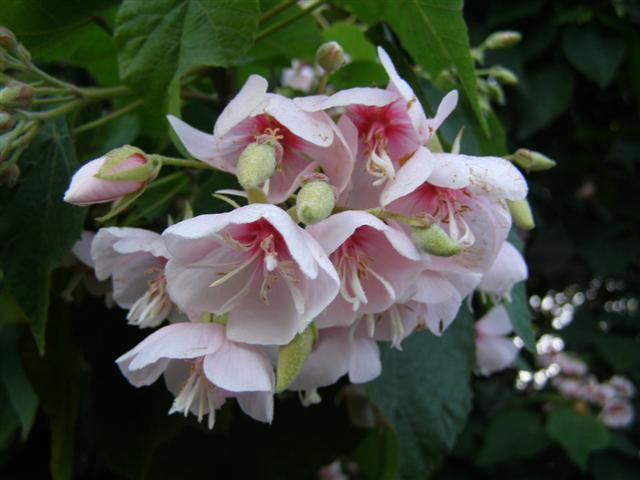
In the mid winter world of June, it is a little difficult to find flowering shrubs in the garden which are not camellias. Mind you, some parts of the gardening world don’t expect any foliage, let alone flowers, in their gardens in winter so we mustn’t complain. But our dombeya is looking very fetching this week. It has full heads of soft pink bells, each with a deep pink starburst in the centre and pure white stamens along with lovely velvety foliage. Apparently the common name for D. burgessiae is the pink wild pear but as we have never seen any fruit or seed pod that resembles a pear, wild or otherwise, this is a slight mystery to us. There are quite few different dombeyas, mostly from Madagascar, but not that many different ones in cultivation. Burgessiae occurs naturally in the Natal area up through Tanzania and is a plant for forest margins, much favoured as a food crop by black rhinos but we have been unable to test this claim in our garden with rhinos, black, white or any other colour.

The origin gives a clue: this genus is generally used to hotter, drier conditions and not suited to frost. We grow our pink dombeya in reasonably open conditions on a warm hillside but the hedge behind gives it some protection. Where frosts are heavier than a few degrees, it would need to be a conservatory plant. While not common in this country, the dombeya is easy enough to strike from cutting for the keen home gardener if you can find somebody with a plant.

Flowering this week: Camellia lutchuensis

Camellia lutchuensis - a triumph of refinement and style rather than bold statement

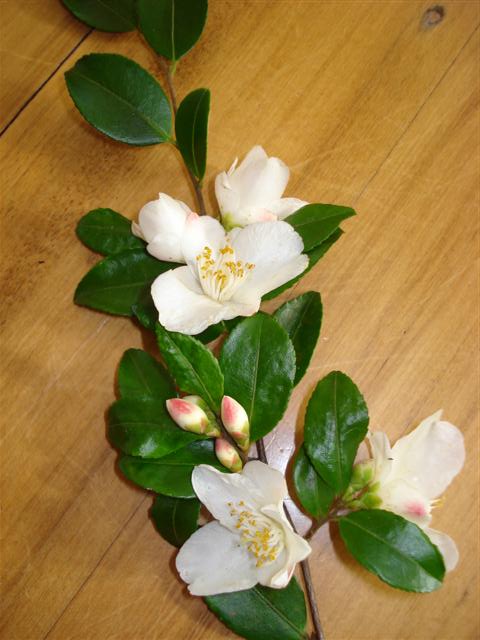
In the crowded class of camellia species with small, white, single flowers, Camellia lutchuensis has a special property which sets it apart – it has the sweetest scent of any camellia. In fact, lutchuensis is the parent of  the scented cultivars (some of which are better scented than others but few are as good as their parent). While not quite into the heady fragrance of daphnes, lutchuensis has a lovely scent which can be detected as you walk past the bush.

There is nothing blowsy or showy about this little camellia but some of us like the simple charm of the creamy white cups which, at only a couple of centimetres across, are never going to shout look at me, look at me. The buds are also very pretty. It is best viewed in close-up as opposed to a landscape statement. Added to that, the foliage (which is smaller than more common japonica camellias) goes a bit yellow in high light levels, so this is a plant for semi shade or open woodland. It is definitely for those of more refined tastes – but what would you expect from a species native to Japan, that country which reveres simplicity in nature and gardening? It also occurs naturally in Taiwan which is another island that has given us some really interesting plants across a range of genus.