Category Archives: Plant collector

flowering this week, tried and true plants

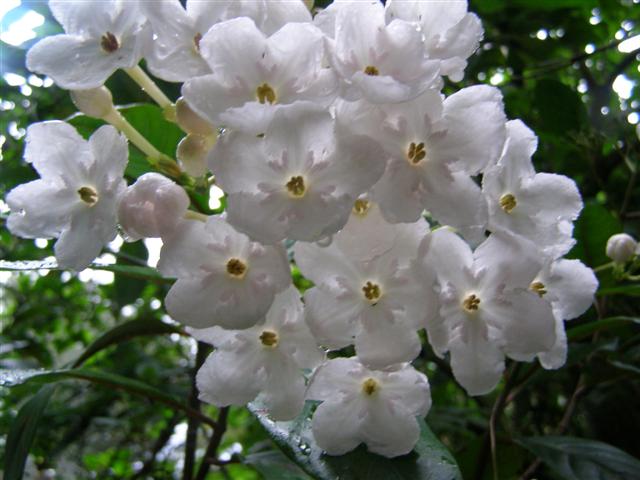
Flowering this week: Luculia pinceana Fragrant Pearl

The sweet fragrance of Luculia Fragrant Pearl through autumn and winter

The sweet fragrance of Luculia Fragrant Pearl through autumn and winter

Fragrant Pearl was a breakthrough in a world of winter pink luculias. The summer flowering white luculia is grandiflora (a different species), the hard candy pink form in flower now is gratissima. The most common form of pinceana is Fragrant Cloud which reaches for the clouds but has beautiful late flowers in soft almond pink with a white eye. Fragrant Pearl is white, very fragrant, has very large individual flowers and if you have a good plant, it will flower from the end of March to the end of June. It does get some size to it if you don’t keep it pruned and pinched out – as in 3m x 3m. Luculias have a wide distribution throughout Asia, including parts of China and northern India but basically they won’t tolerate hard frost and very cold temperatures, they don’t like too much heat but they are happy in moist and friable soils – which is pretty much describes the conditions in much of Taranaki.

We have our colleague, Glyn Church, to thank for introducing the white pinceana luculias here. Some years ago he brought in seed and Fragrant Pearl is a selection which we purchased from him as part of that seed raised batch. It was so good that we started propagating it from cuttings (to keep it true and avoid seedling variation) and put a cultivar name on it. It roots easily from cuttings taken in late spring or early summer and grows rapidly so if you can find a plant in a friend’s garden, you can grow your own.
Flowering this week: Backhousia citriodora

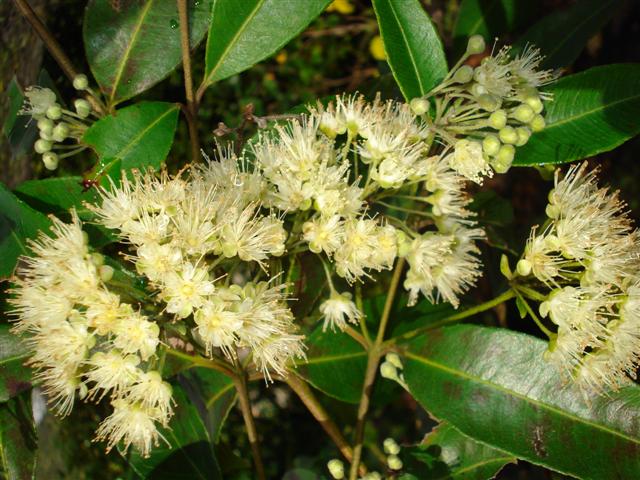
The lemon fragrance from Backhousia citrodora has to be experienced to be believed

I would be the first to admit that the creamy fluffy floral clusters of this small(ish) tree are not showstoppers though they are pretty enough in their own way and make a change for autumn flowering. Nor are the long narrow leaves eye-catching though the red-brown velvety new growth is very tactile. In fact, the visuals of this plant are remarkably modest especially when you consider it is an Australian from the coastal rainforests of Queensland and northern New South Wales. The knock-you-dead aspect is the lemon fragrance when you crush or even brush past a leaf and the flowers also exude wafts of lemon. It has quite the most delicious lemon scent of any plant I know, bar none. This is apparently because Backhousia citriodora, commonly referred to as the lemon myrtle, has higher concentration of citral (lemon oils) than many other plants, including lemon verbena. In fact it is harvested commercially for lemon flavouring. I have to admit that I have not tried it in a culinary context but I will do so. You can apparently use the leaf whole (like a bay leaf) or chopped and it will give a lemon flavour without the problems of curdling, even in milk puddings. So I have read.

While not overly hardy, if given some protection when young, the backhousia should be able to grow throughout most of our area. I have seen it in a protected valley in Canberra Botanic Gardens where apparently it can survive frosts of 8 degrees. It is a member of the myrtle family and it can be clipped. This may be a plant to put alongside a bay tree in the vegetable garden or plant it by a path so you can pluck a leaf to sniff when you pass.

Tried and True – loropetalums

Loropetalums
• Widely available from most garden centres.
• Evergreen shrub.
• Tolerant of a surprisingly wide range of conditions but may need protection from heavy frosts and strong winds.
• Burgundy forms give colour all year round. 

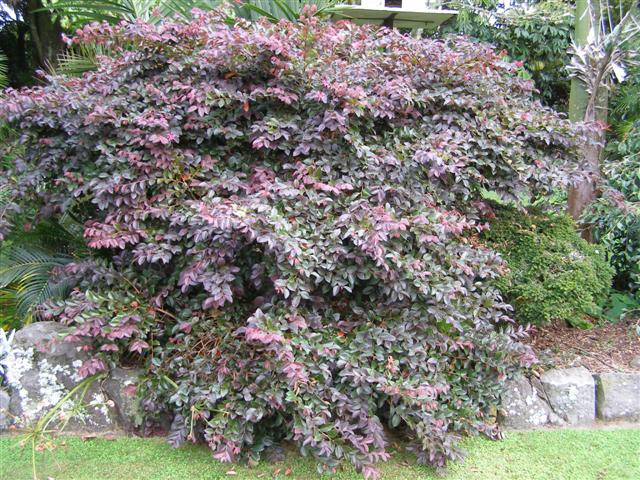
The wine red forms of the loropetalum are a particularly good recent introduction to this country


The wine red form of loropetalum (sometimes called the Fringe Flower) is a relatively recent introduction to this country and a particularly good one at that. It builds in layers and left unclipped it can reach two metres by two metres reasonably quickly. It is easily shaped but is rather brittle so will snap off in wind. We grow China Pink but there is a form called Burgundy and several others – all appear to be very similar and equally good with one exception. Shun Razzleberry if you find it on offer. It starts with good colour in spring but then changes quickly to a murky, dull olive green of no merit that I can see. The flowers on the burgundy forms are interesting clusters of shocking pink spidery petals and stamens but discreet, not showy. If you have a Singapore stopover and go to the Chinese gardens there, you will see all sorts of techniques with bonsai, clipping and hedging of the attractive loropetalum shrub.

Flowering this week: Dichroa versicolor

Flowering this week and pretty much most weeks of the year here - Dichroa versicolor

This plant has the most endearing habit of flowering pretty well all year. The trade-off is that when you get a plant which flowers in random sequence all over the bush, you don’t usually get the wham bang impact of a mass flowering all at once but it is rewarding to be able to see the deep blue dichroa flowers all year. It is an evergreen member of the hydrangea family, hailing from China, and was introduced to this country by our very own Taranaki nurseryman, gardener and garden writer, Glyn Church. Most of the evergreen hydrangeas are sensitive to frost and cold temperatures but the dichroa has shown more hardiness than you would expect with its large leaves and is fine with moderate frosts. Grow it under some overhead tree cover if you are worried about your winter temperatures. It also tolerates a wide range of conditions, sun and shade, wet and dry.

Left unpruned, it will get quite large – around the 3 metres high and 2.5 metres wide mark or even larger over time but I frequently trim long growths back to a point in the stem where I can see twin leaf buds either side. A little pruning often is a better strategy with this plant if you can. It means you can avoid cutting off the flower buds. You can never have too much blue in the garden I feel, and a plant which flowers for the better part of the year and is a true blue certainly justifies its position.

Tried and True – sasanqua camellias

The cheerful face of Camellia sasanqua Gay Border

• Autumn flowering.
• Excellent hedging and good wind tolerance.
• Generally happy in full sun or partial shade.
• Widely available in a range of colours.
• Hardy in all Taranaki conditions.
• Not affected by camellia petal blight.

The first camellias of the season to flower each year are the sasanqua group from Japan. The white sasanqua hedge, Setsugekka in particular, has become a garden cliché in New Zealand but that should not detract from the garden value of this useful and hardy group of evergreen shrubs. When the deciduous trees are changing colour and dropping their foliage, the mass flowering of sasanquas is a cheerful sight. With smaller leaves in a good deep green and a growth habit that is a little lighter and airier than the rather solid japonica camellias which flower later in winter, sasanquas are less chunky as garden plants.

As well as the whites (Early Pearly, Silver Dollar, Mine No Yuki and the like), there is a whole range of pinks from pale to deep shades, a few reds and some attractive bi-colours such as the deep pink and white Gay Border. The flowers are softer and less formal than the japonicas. If you want to clip your sasanqua camellia, the rule of thumb is to do it as flowering ends with a follow-up on wayward growths in spring. It will then hold its tidy form for the rest of the year.