Category Archives: Plant collector

flowering this week, tried and true plants

Flowering this week – Olin and Caroline (rhododendrons of course)

DSC01930 (Small)

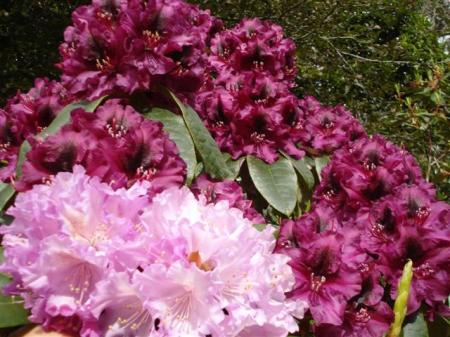
Olin O. Dobbs - a vision in blackberry and Caroline Allbrook - enchanting in lilac

It is only appropriate to keep with rhododendrons as our Rhododendron Festival steams on so it is two half-siblings this week. Olin O. Dobbs is the mysterious and unusual one (they share Purple Splendour as a father) – spectacular conical trusses in the deepest blackberry colour, rivalling Blackberry Nip rose but Olin does not fade out. Unfortunately, despite being much sought after when in flower because of the striking hue, Olin is difficult to propagate (basically needs to be grafted) so is virtually unavailable on the market these days. He also prefers a colder climate and gets infested by thrips here so does not look crash hot as a plant for the other 50 weeks when not in flower. We don’t mind because we will trade all that for two or three weeks of blackberry splendour.

The half sister, Caroline Allbrook, is a pretty, pale lavender which is a reliable performer every year here. Caro also distinguishes herself by holding well when picked which is by no means true of all rhododendrons. Great flower truss, easy to grow and should be reasonably readily available in the marketplace. She does look rather fine planted beside Olin in our carpark area but if you could use the burgundy foliage of loropetalum to contrast, in the absence of Olin.

For devotees, the seed parent of Olin is Mars and for Caro it is the species yakushimanum.

DSC01940 (Small)

We were very taken by the juxtaposition with the purple car parked alongside by a garden visitor

Rhododendron Yvonne Scott

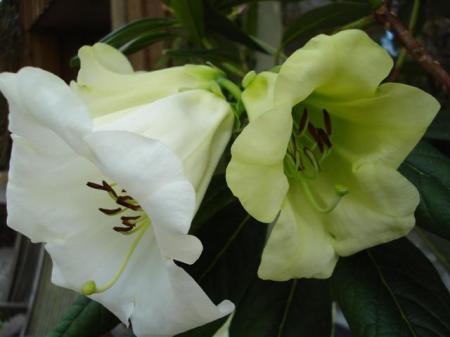
Rhododendron Yvonne Scott - bringing startling lime green into the nuttalliis

Rhododendron Yvonne Scott - bringing startling lime green into the nuttalliis


The late Mrs Yvonne Scott from Inglewood was a fine looking woman and this may in part explain why Sir Victor Davies gave her this seedling rhododendron before it even flowered for the first time. VC, as he was commonly referred to, had a gallant regard for those of the fairer sex. Mrs Scott was shopping at the Westown outlet of Duncan and Davies at the time and, as she was a good customer, VC presumably felt a generous gesture was appropriate. He may not have realised quite what he was giving away because this is a pretty interesting nuttallii.

Rhododendron Yvonne Scott is part nuttallii (the other part has lindleyi and dalhousiae genes) so it has very long trumpets with frilly lobes. What makes it stand out from other nuttalliis is that it opens pure lime green, all over. Within a few days, the lime green bleaches to white but with a lime green throat inside. Not even the most enthusiastic fan could describe the plant as compact, but at least it has lovely peeling bark, rarely gets attacked by thrips and the flowers even have scent. It is remarkably robust as far as the spectacular but often touchy nuttalliis go.

Flowering this week: Rhododendron Bernice

Rhododendron Bernice - very local in origin and name

Rhododendron Bernice - very local in origin and name

Over the past fifty years, the quest here has been to breed rhododendrons better suited to growing in warmer climates and not inclined to the nasty silver leaves caused by thrip (a common leaf sucking insect). In its time, Bernice was an advance in colour and size in the maddenii group of rhododendrons. Its parents are polyandrum (which gave some scent and increased flower size) and Royal Flush Townhill (which contributed the colour genes). It has flat trusses of bell-shaped flowers and can give the impression of a wall of bloom with almost no foliage showing. Over the decades, we have seen many varieties come and go but Bernice has stood the test of time and remains one of our top picks for a brilliant performer right on cue every year.

Pronounced Burniss, not Ber-neice, as I can say with authority because this, arguably the best performing rhododendron Felix Jury selected, was named for his wife’s best friend – Bernice Kelly. Mrs Kelly was an old Waitara identity whom I recall well as a down to earth character who physically made the concrete blocks for the cottage she and her husband built. These days there are pensioner cottages on the site, but the memory of Mrs Kelly lives on in the rhododendron named for her.

Flowering this week – Veltheimia

More likely to be veltheimia bracteata than capensis

More likely to be veltheimia bracteata than capensis

Indubitably veltheimia, but whether bracteata or capensis for the species is a bit open to debate. In fact we may even have hybrids between the two though that does not seem to be widely mentioned as an option. The flowers can look a little like a cross between a red hot poker (kniphofia) and a lachenalia on steroids. The pink form is more common and it is such a robust performer that I am inclined to think it is the easier bracteata. The yellow form with pink blush, called Rosalba, is much rarer and sought after. We had thought that this was the species capensis but it flowers at the wrong time and is such a reliable and strong performer that it is more likely to be predominantly bracteata. We also have a creamy yellow veltheimia which is touchy, difficult, fussy and doesn’t thrive at all which is a shame because the colour is purer than Rosalba.

Whatever, these big bulbs from South Africa (members of the Hyacinthaceae family) are a little tender in constitution for cold areas because they are in growth during winter. For many years, they have been perfectly happy in the narrow dry house border which gets all the morning and midday heat but only occasional rain. In recent times we have found that they can be successful grown in open woodland and indeed bracteata is referred to as a forest lily in South Africa. It is truly remarkable how many wildflowers of that country have come to form the majority of interesting bulb material grown in our gardens here. If you acquire veltheimia seed, it germinates easily but is best sown fresh

Flowering this week – Prunus Pearly Shadows

The flowers on Pearly Shadows are at least two weeks early this season

The flowers on Pearly Shadows are at least two weeks early this season

The disconcerting aspect about the pale pink froth of Prunus Pearly Shadows this week is that it normally happens around Labour Weekend which is still two weeks away. The flowering is early all round the garden this spring. So the drifting pink petals like snow flakes on a breeze may all be over by the time our garden festival starts at the end of the month. At least the new growth is an attractive and distinctive bronze though hardly as pretty as the flowers.

Pearly Shadows is a Japanese cherry with very full, fluffy double flowers. While Felix Jury named it, he did not breed it. The tree is too good just to be a chance seedling so it is a fair bet that it may have a proper Japanese name in Japan but nobody has ever been able to tell us what it is.

Pearly Shadows has a very useful shape as a tree, being like a capital Y which gets the upper branches out of the way. Some other Japanese cherries tend to grow more in the shape of capital T with low, spreading branches. A Y shape makes a better tree to line a driveway than a T shape.

Japanese cherries are pretty as a picture and make a quick growing impact tree but they are rarely long-lived in local Taranaki conditions. We are too damp and they can develop root problems and up and die unexpectedly. They also have a tendency to develop witches broom which can be seen as very dense foliar growth with no flowers. The witches broom will take over the tree if you don’t stay on top of it and cut it out in summer. By that stage, the entire tree is in full leaf and unless you have marked the offending sections, you will probably have forgotten which bits to take out.
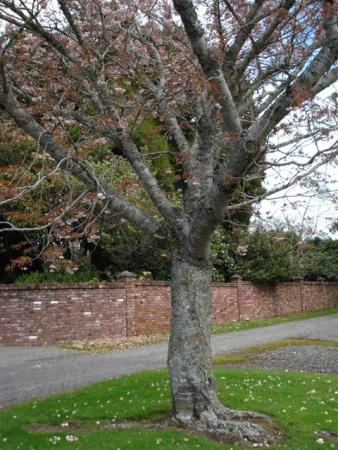
A useful Y shape for a driveway tree

A useful Y shape for a driveway tree