Category Archives: Plant collector

flowering this week, tried and true plants

Flowering this week – bluebells and blue lachenalias

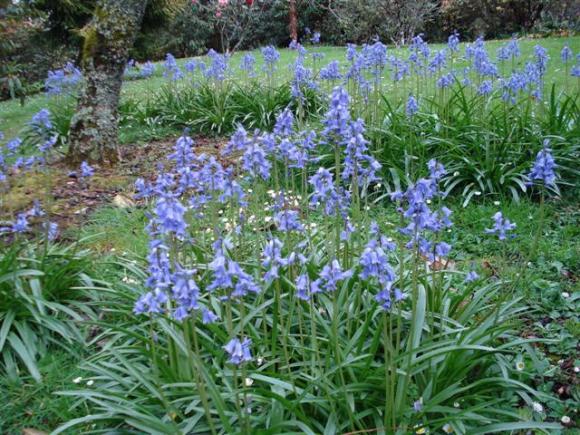
Bluebells (more correctly hyacinthoides, used to be scillas and even endymion)

Bluebells (more correctly hyacinthoides, used to be scillas and even endymion)

Wordsworth waxed lyrical over his sea of golden daffodils (long finished here and hardly a sea) but it is the haze of bluebells that is pleasing us this week. The desirable bluebell is the English one, Hyacinthoides non-scripta, which is scented and less inclined to be as over enthusiastic as the larger growing Spanish one (H. hispanica). But they are reportedly struggling to keep H. non-scripta pure in the UK and odds on what we have here are various Spanglish forms of natural hybrids. Bluebells also come in pink and white although they do not then become Pinkbells or Snowbells. The other colours have some novelty value, but for large scale drifts you can’t beat the beautiful blue. In the UK where their woodland is far more open than our forest, it is hard to surpass the romantic sight of a copse of white barked birches with a blue carpet below. Here we have to naturalise on the margins where there is sufficient light but the bulbs are not competing with full on grass cover which overwhelms everything.

If you really want to sort out the origin of your bluebells, the English ones have cream anthers whereas the Spanish ones always have blue anthers. Apparently. Presumably if you have both blue anthers and cream anthers in your patch, you have Spanglish bluebells. And in case you are too embarrassed to ask what an anther it, it is the pollen bit on the end of the stamen in the centre of the flower.
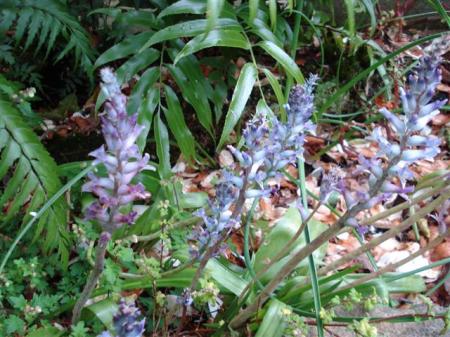
Probably lachenalia orchioides var. glaucina

Probably lachenalia orchioides var. glaucina

Bluebells are easy to naturalise and have a simple charm. Blue lachenalias take considerably more effort to build up and are much fussier about position, but have a great deal more status value. We find mutabilis is the easiest of the blue lachenalias, bur orchioides var. glaucina is showier. Over the years we have collected as many different blue and lilac lachenalias as we can find but they tend to be a little promiscuous and it is likely that we now have the species mixed. We certainly have the labels mixed. The blues flower later, are more frost tender and somewhat fussier than some of easier red, orange and yellow forms (aloides, reflexa, bulbifera and the like).

Kurume azaleas

Undulating rugs of colour from above - our layers of limbed up kurumes from below

Undulating rugs of colour from above - our layers of limbed up kurumes from below

The Kurume azaleas are in flower. Their small flowers are so massed that they make undulating rugs of colour in the garden with no foliage visible at all. These are evergreen azaleas and they hail from Kurume on the southern isle of Kyushu in Japan. Apparently, these are hybrids of two different Japanese species (obtusum and kiusianum) but for local gardeners, their significance is related more to the fact that they are hardier than the southern Indian evergreen azaleas and they are compact growers. Not that ours are compact and they impressed a visitor from Kyushu a couple of years ago. He spoke no English and we speak no Japanese but he managed to convey the message to us that these specimens were of astounding grandeur and they deserved more tender loving care than we were giving them. We felt suitably chastised. We limb up these azaleas to expose their wonderful trunks highlighted in white by lichens, creating another layer in the garden.

Azaleas are members of the rhododendron family but they are considerably easier to strike from cutting. Kurumes have tiny leaves to match their little flowers and can be a viable alternative for buxus hedging as they take clipping and will sprout from bare wood, although they are never as dense as buxus. They are also prized subjects for bonsai. The flowers come in shades of pink, red, white and mauve.

Rhododendron Floral Sun

Floral Sun - frilly, scented and yellow in the nuttallii range

Floral Sun - frilly, scented and yellow in the nuttallii range

Spring continues apace and as camellias and magnolias wane, it is rhododendron time starting. Floral Sun has opened her first flowers. I say her, because being frilly, scented and soft coloured, this plant looks more Venusian than Martian. It is one of ours. When Mark came home and commented that he had crossed sino nuttallii (which has big white scented trumpets) with R. W. Rye (small yellow flowers) in an attempt to get colour into the nuttalliis, I predicted he would end up with a whole lot of plants with very small white flowers and no scent. I was wrong. He ended up with a run of plants with the lovely heavy textured leaves and peeling bark of sino nutt, with frillier trumpets and yellow. Soft yellow tones, not the harder acid yellow of R. W. Rye but Floral Sun also has the more compact habit of her father Rye which is an added advantage. We are still pretty pleased with this rhododendron even if the flowering will be over long before visitors arrive for Rhododendron Festival.

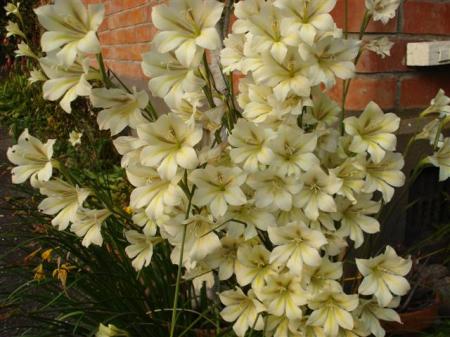
Flowering this week: Gladiolus tristis

Gladiolus tristus - the charm of the species

Gladiolus tristus - the charm of the species

Dame Edna Everidge with her love for gladdies would not agree with me, but I say there are some plants which have not necessarily been improved by hybridising and the gladiolus is one of them. The modern gladdie sits alongside nasty overblown marigolds and over bred cyclamen and chrysanthemums. But go back to some of the species and they are infinitely charming in their purity and simplicity and can easily justify a place in the garden. Gladiolus tristis hails from southern Africa, as do so many of our good garden bulbs here. It grows from a corm and with wiry thin stems, it supports itself without staking. The display of pale lemon flowers is delightful. It is night scented (often a sign that the pollinators are moths but I have no idea if this is true for tristis). Sniff it in the morning and there is no hint of scent but come evening, the fragrance is a divine. Because it also has very thin leaves which are almost anonymous, once flowering has finished for the season, tristis is unobtrusive in the garden while it builds up its strength before going dormant for summer. There are others species gladiolus which are equally charming.

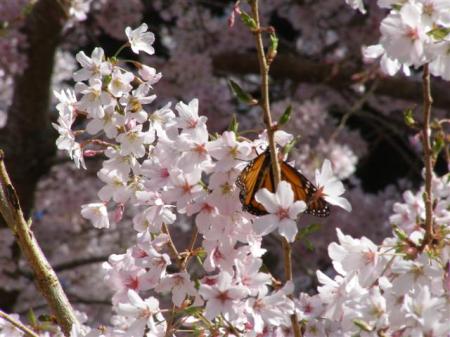
Prunus Awanui

Prunus Awanui feeding the monarch butterflies this week

Prunus Awanui feeding the monarch butterflies this week

Prunus Awanui is pretty as a picture at our place. This flowering cherry looks like fine lace against the sky, a mass of softest, palest pink, small flowers with not a leaf in sight. We have it underplanted with Rhododendron Elsie Frye which is the same colouring but has considerably larger flowers (and fragrant) and when looked at from further away, we have a Magnolia Iolanthe framed in the view too. All tone in together very well. On a sunny day, Awanui is alive with monarch butterflies, honey bees and waxeyes.

It popped up in a garden where eagle-eyed local nurseryman Keith Adams thought it had potential. It has now become a market standard. It roots easily from cutting, remains healthy and is easy and reliable. With our high rainfalls in Taranaki, we are not the best territory for most flowering cherry trees which tend to be short lived as they develop root problems. Awanui does not appear to be so pernickety despite the fact it probably has subhirtella in its parentage. In good growing conditions, it can get quite large. Our tree is maybe nine metres across and six metres high and would have been larger had it been left to its own devices, but it is a light and airy tree and it flowers faithfully every year and looks completely charming. This is a plant that is generally readily available on the market in New Zealand.