Category Archives: Plant collector

flowering this week, tried and true plants

Narcissus cyclamineus

Flowering now - narcissus cyclamineus hybrids

Flowering now - narcissus cyclamineus hybrids

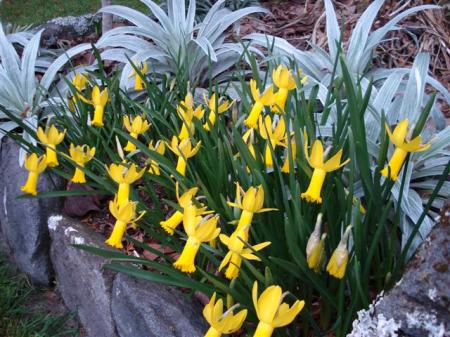
If ever there was a reason to learn how to grow plants from seed, these little charmers are it. You can’t expect to buy these from your local plant shop. In common language, dwarf daffodils or botanically, narcissus cyclamineus. That last word just means that they are part of the group where the skirt of petals is completely reflexed as if the flower is a force 10 gale. In the wild they come from north west Portugal and Spain and are endangered. They are not endangered in our garden where we love them for winter cheer, though many that we grow are hybrids. They are classified as dwarf, not miniature, because they are on stems around 15 to 20cm long. Flowering long before the large, modern daffodils, we find they are nowhere near as susceptible to the nasty narcissi fly which can lay its eggs in the crown of the bulb (so the larvae hatch and eat out the bulb). The silver leafed plants beside are a wide leafed hybrid of our native mountain daisy or celmisia.

Lachenalia bulbifera

Naturalised beneath a pine tree - the rogue flower is a form of aloides

Naturalised beneath a pine tree - the rogue flower is a form of aloides

One country’s wild flowers can be another country’s treasures, or indeed weeds in some cases. Fortunately South Africa’s lachenalias fall into the treasure category. We have a collection of different lachenalias which will flower in sequence from now until mid spring. One group of South African visitors was surprised to see the extent to which we use them as garden plants and commented that we appeared to have a better collection than ever seen at home. But as there are over 100 different lachenalia species in the wild plus a confusion of natural hybrids, our collection is only modest. The most common lachenalia is the garish (or cheerful) orange and yellow aloides. This red one is a form of bulbifera and, being reasonably strong growing and not fussy, it has naturalised well at the base of an old pine tree in a paddock. The really highly prized lachenalias are the blue toned ones but they are much fussier (ain’t that just the way?) and generally more frost tender. We keep the more touchy varieties in the rockery while using the easier ones to naturalise for winter interest. All lachenalias grow from bulbs which will increase naturally in good drainage. If you gather seed, sow it while very fresh for best results.

Vireya rhododendron macgregoriae

R.macgregoiae - the original plant

R.macgregoiae – the original plant

R. macgregoriae is flowering on cue again, as it has for about six decades now. This particular plant is quite historic for us, it being the original vireya rhododendron that Mark’s father, Felix, gathered in the highlands of New Guinea in 1957. In a courageous move, Felix headed over alone, plant hunting in an area where he was apparently the first pale skinned person the indigenous people had seen and a source of great curiosity. We should have asked him more about that trip while he was around to tell us. His thinking was that with altitude in the highlands, the plants may be more tolerant of our temperate conditions. He didn’t bring back a lot that stood the test of time – two beautiful scheffleras, a very odd fig tree (Ficus antiarus) and this resilient vireya rhododendron. This particular plant was used to start his vireya breeding programme and is a parent of ‘Golden Charm’, ‘Orangemaid’ and ‘Buttermaid’. Most gardeners will vouch that vireya rhododendrons tend not to be long lived so this one has achieved a truly venerable age.

Flowering this week: the early snowdrops

The “snowdrop” in NZ – leucojum vernum (left) The proper snowdrop – galanthus S. Arnott (right)

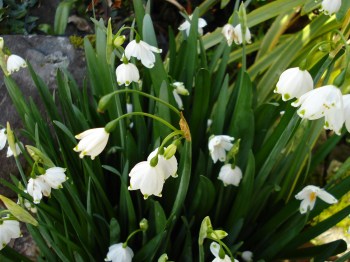
New Zealanders are vague on identifying snowdrops and often confuse the snowflakes that have naturalised in paddocks alongside daffodils with snowdrops. But people of English stock have no doubt at all as to what proper snowdrops are because they grow wild en masse through parts of the countryside, even bravely putting their heads through the snow. Proper snowdrops are galanthus and have three inner petals forming a dainty cup with an outer skirt of three long petals. The pure white flowers often have some green markings on them and they are simply the prettiest and daintiest things imaginable. Lacking snow, our snowdrops flower a little randomly and intermittently all winter but the main display won’t come for another month or so. We have several different forms of galanthus but in an area where we are marginal (they do prefer a much colder winter), galanthus S. Arnott is the most reliable form.

Snowflakes, by the way, are a different bulb altogether, being leucojums. They grow larger, have just the dainty cup flower without the 3 long petals, a remarkably long flowering season in spring, are easy and unfussy and are completely under-rated as a garden plant.

Flowering this week – tree hydrangea of uncertain classification

Evergreen and frost tender but apparently loosely lumped in as Hydrangea aspera

Evergreen and frost tender but apparently loosely lumped in as Hydrangea aspera

This plant is a bit of a mystery but it is a hydrangea even though it is evergreen and of tree-like stature. Mark can not remember where he bought it from years ago, but it appears likely that it came from seed collected by a number of different New Zealand plantspeople at Monkey Bridge in China. At this stage it is loosely lumped into the family of hydrangea aspera even though most asperas are both deciduous and hardy. This is neither.

But it is very striking. It is now multi trunked, about 5 metres tall and 3 metres wide with large leaves and considerably larger lace cap flowers at this time of the year. Each flower can be 40cm across, sometimes more, and in a mix of soft antique colours – lilac, muted green and cream. It is most unusual. Alas it is also more difficult to strike from cutting than most hydrangeas so it is not readily available and you will have to search for it if you really want it. It is just as well that there are not many gardens in Taranaki that have space for a large, brittle, frost tender hydrangea which needs protection from both wind and cold but quickly attains the size of a tree.