Category Archives: Plant collector

flowering this week, tried and true plants

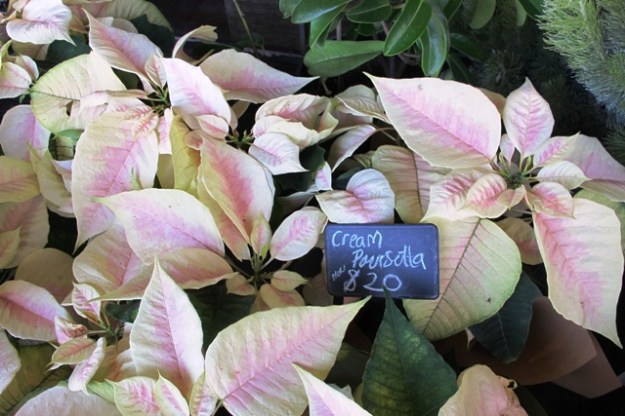
Plant Collector: the cream poinsettia

???????????????????????????????
Christmas is over and my time is running out. But having featured the traditional red Christmas poinsettia in Plant Collector in December, I could not resist sharing this variation. This is the cream poinsettia, spotted outside a Sydney florist. Before you get too excited at this novelty, I must tell you that the photo is flattering. The reality was that the plants appeared somewhat murky in colour and insipid to boot. Not chic.

A net search tells me that this is just another form of Euphorbia pulcherrima from Mexico and is but one of many variations of this species. The poinsettia market may be predominantly – almost solely, even – disposable house plants but it is clearly huge. Any such market has a taste for novelties and new releases. Who knew that there were poinsettias that resembled curly kale? Nasty variegations that could pass for coleus? All manner of colours and combinations are attainable for the poinsettia. To be honest, merely being a somewhat insipid and off-colour cream is the least of the transgressions.

Keep to the red Christmas poinsettia is my advice. While not original and arguably lacking in sophisticated allure, it is at least a handsome plant of merit in its place and time.

First published in the Waikato Times and reprinted here with their permission.

Plant Collector – Brachychiton

Brachychiton - a showy Australian native

Brachychiton – a showy Australian native

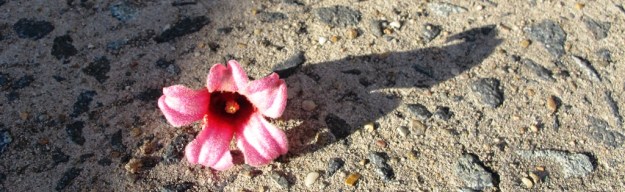
Across the road from our daughter’s Sydney apartment was this eyecatching tree that I had never seen before. Being a better plantsperson than I am, Mark immediately identified it as a brachychiton. Common names are kurrajong and bottletree.

This one is summer deciduous, dropping its leaves before flowering. We are used to magnolias and flowering cherries blooming on bare wood in spring but I can’t think we have any fully summer deciduous trees here. From looking at the internet, I am putting my money on it being B. discolor rather than B. bidwillii. If I am right, it places its natural habitat amongst the eastern rain forests. There are 31 different brachychiton species, 30 from Australia and a solitary specimen from New Guinea. The Illawarra flame tree is perhaps the best known variety (B. acerifolius) but as these are large trees (anything up to 40 metres in their natural habitat although they won’t get that big in less than ideal conditions), these highly ornamental trees are not much favoured in suburban gardens in this country, even in areas where they could be grown. Some can also be very prickly.

The showy brachychiton does at least give lie to the idea that all Australian native trees are either gum trees or something with greyish foliage and bottlebrush flowers.
???????????????????????????????
First published in the Waikato Times and reprinted here with their permission.

Plant Collector – campanula

???????????????????????????????
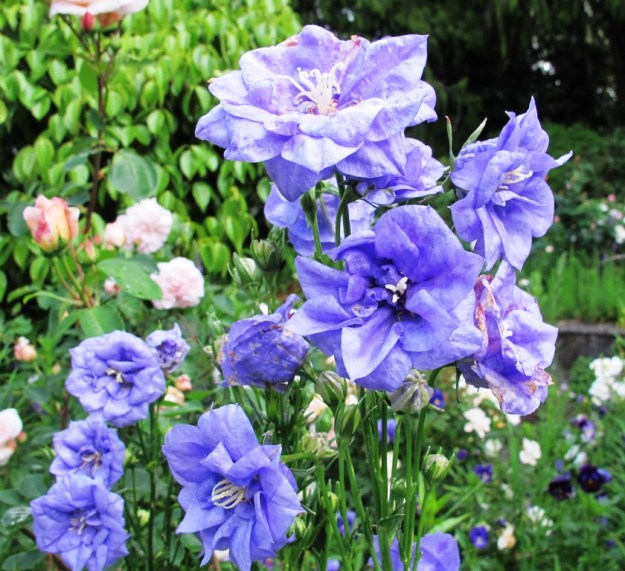
I was given this campanula some years ago and if I ever had a cultivar name for it, I have long since lost it. But is it not pretty? I am particularly fond of blue flowers so this one, combined with pastel roses, has been delighting me. Looking on line, it may be Campanula La Belle but there are quite a few double selections available so it may not be. The flower spikes in late spring to early summer stand maybe 60cm high and don’t need staking. For the rest of the time, it just forms a neat plant, low to the ground with longish, narrow pointed leaves lying nearly flat. I will have only been given one plant but lifting and dividing it from time to time has now given me enough to cover a good area.

There are many different campanulas though I had no idea how many until I looked up the plant family. Some 500 different species count as quite a few, especially when one adds in subspecies, variants and hybrids. We have a charming one that grows in flat mats in the rockery and various different ones in other locations, including the form that is commonly known as Canterbury Bells. Some are annuals, some biennial (in other words they flower in the second year, set seed and die) and some are fully perennial. They are northern hemisphere plants spread across a huge range of conditions from alpine to subtropical. Blue is the most common colour, often with a lilac tinge, but there are pink or white options as well. In the wild, the vast majority will flower single. Double forms such as mine will have been selected out as unusual.

First published in the Waikato Times and reprinted here with their permission.

Plant Collector – Higo Iris and Primula helodoxa

Down by the stream

Down by the stream

The prettiest photo moment in the garden this week has been the meeting of Japan and China in the Higo Iris and Primula helodoxa down by our stream. These are conditions where the plants will never dry out. They get plenty of sun but are in heavy soil on the stream bank.

P. helodoxa is one of the more common primulas in this country. It is a candelabra type – layers of flowers perhaps more akin to a tiered cake stand than a candelabra. The flowers are sweetly scented but rather a bright, sulphurous yellow in colour. In the right conditions, it is so easy to grow that it is borderline weedy because it sets seed freely and increases by clumping. We try and deadhead our plants because they are by running water. Helodoxa is one of the Primula prolifera group and is known in some parts of the world as ‘Glory of the Marsh’, which is rather lovely.

The Higo irises are from Japan and sometimes referred to as Japanese water iris. Higo is not a species. It is a particular strain of iris that originated from the species I. ensata. These are from wild collected seed and are proving quite resilient with us. The named Higo hybrids tend to have been bred for cutting and bringing indoors whereas we want garden performance, not floral perfection. We have Higos by the stream and I am also trying some as garden plants amongst other perennials where they are now into their third year of performing well. I am just a bit worried that they may be multiplying too enthusiastically. The foliage is thin and grass-like. They are deciduous whereas the primula is evergreen.

First published in the Waikato Times and reprinted here with their permission.

Plant Collector: Strelitzia reginae

Strelitzia reginae or the bird of paradise

Strelitzia reginae or the bird of paradise

Is there anything more exotic, more tropical in appearance than the bird of paradise plant? In fact it is native to South Africa which is not the usual “Tropics”, though it is now grown widely throughout the temperate and tropical world and is not as fussy as one might think. In its homeland, it is commonly called the craneflower because of the resemblance to cranes – which are heron-like birds.

It is a very curious bloom, almost two dimensional. The actual petals are the blue centre to the flower and it is this that holds the pollen and the nectar which is what attracts the birds to achieve pollination. The leaves are like paddles with very long stems (technically called petioles) and are heavy textured.

There are about 5 different species of strelitzia but this is by far the most common and therefore probably the most adaptable variety. It is never going to like heavy frosts and wants some warmth but is not too fussy. Looking at photographs, I think it must flower more profusely in hotter, drier climates but it is a pretty low fuss perennial in coastal areas of the North Island and some protection from frost will extend its range inland. For us it reaches about 120cm in height. Mark tells me he has the giant Strelitzia nicolai waiting to be planted out. That apparently reaches closer to 10 metres. If it only flowers on top, we will be wanting to plant it down a slope somewhere if we are to see the blooms.

First published in the Waikato Times and reprinted here with their permission.