
Kevin and Sharon – the reindeer – at the base of the toetoe Christmas tree
December is the month of rituals for us. It is all about countdown and preparation. Will there be new potatoes, fresh peas, strawberries and raspberries ready for Christmas Day? I think we have only ever missed one set of homegrown new potatoes. If my memory serves me right, it was an advanced season and we had eaten all the first crops and hit a lull.

Peas are more problematic and require some precision of timing and management. I adore fresh peas though I lose interest when they are podded and boiled. Browsing from the plant is my preference, followed by raw in salads. Peas generally do better in cooler climates. I admit the ones in the photograph are English. Ours never crop that heavily. In fact they take up quite a bit of space for a meagre to moderate crop here. There are more productive options where space is limited, not the least being beans. But nothing can replace the taste delight of fresh peas. We never have a Christmas turkey here, but we do peas if we can.
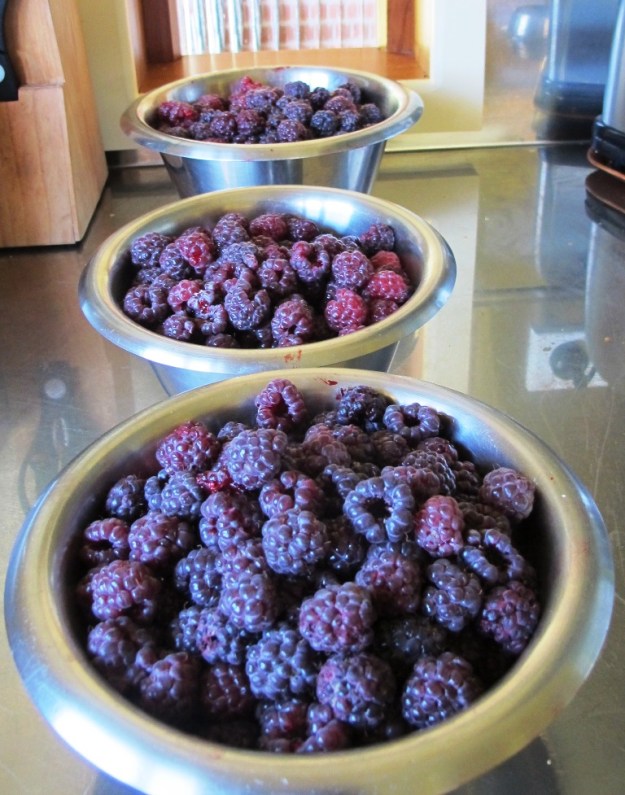
Some years, the raspberrries will ripen in time for Christmas Day. The week or two after Christmas they come on stream at an alarming rate, needing to be picked every day but whether those early ones make the deadline for dessert is entirely beyond our control. Even with our raspberry cage, it is an ongoing battle between humans and birds, mostly blackbirds. The pie seems a fairly good option for the birds, in my opinion. They will scout out the slightest weakness in the cage, squeezing through tiny gaps in their determination to help themselves. The wretches will also breach the cloche defences to take out the strawberries we guard for Christmas breakfast. It is a war out there as Christmas approaches.
Christmas trees, we’ve had a few. The DIY ethos rules unchallenged. We have never bought a tree and never had a tinsel one. Generally we have wildling pines harvested from the property. If we are lucky, Mark has preselected the wildling pine and actually given it a couple of trims to get the growth denser than usual. More often, he resorts to wiring in additional branches in a vain attempt to create something akin to the commercially trimmed pines, or the Northern European abies with their wonderful conical shapes. The thought is there even if the reality is a little different.
By far our most creative tree was the one our second daughter made out of toetoe a few years ago. Home from London, she was inspired by an illustration she had seen of one created from the plumes of pampas grass. No pampas here. It is on the absolutely banned list as a noxious weed. But toe toe (which used to be a cortaderia but has now been reclassified as an austroderia) is our native substitute.
Should you wish to try this at home, be warned. It takes many more toe toe plumes than you think. Many, many more. They will moult through your car boot, even more in the construction area and they will then gently shed in the house all Christmas. But then so do pine needles and they are a more difficult to vacuum up. The toe toe tree was a tour de force. It had a certain Pacifica vibe going, combined with European style. If you want to try it yourself, there are step by step instructions on my website. https://jury.co.nz/2010/12/24/construct-your-own-christmas-tree-with-abbie-camilla-jury/
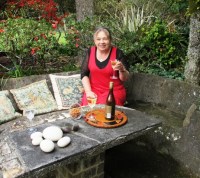
All this is entirely academic for us this year. After more than three decades of building our own family traditions and keeping them the same as assorted offspring migrated home for Christmas, this is the first time we will not be celebrating at home. We are heading over to join the Australian-domiciled daughters and their families this year. I guess it may even be prawns on the barbie. It will be different as the next generation build their traditions for the festive and family season.
First published in The New Zealand Gardener and reprinted here with their permission.

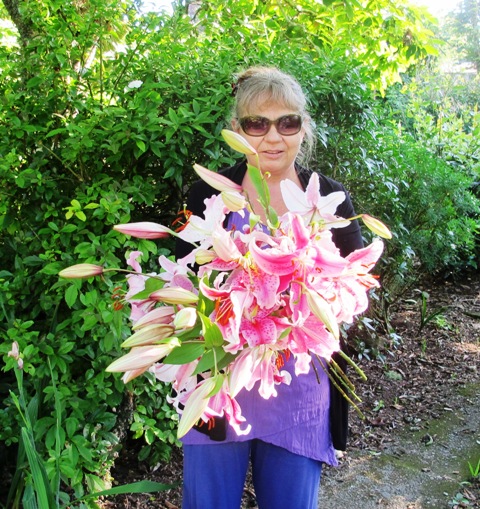 It is time for me to bid farewell to Waikato readers. This will be my last garden page. The new-look garden page will be rolled out next Saturday but I will not be part of it. I have really enjoyed writing for this publication over the past 3 ½ years and would like to thank readers for reading it. Thank you also to those of you who have emailed and even written proper letters and cards.
 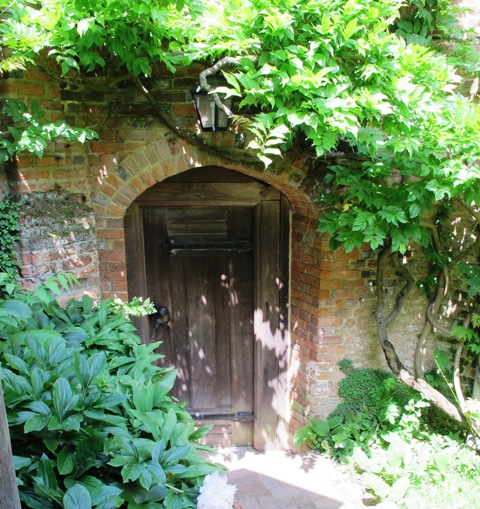 “I shall stop being queer,” he said, “if I go to the garden. There is Magic in there – good Magic, you know, Mary, I am sure there is.”

 First published in the New Zealand Gardener and reprinted here with their permission.
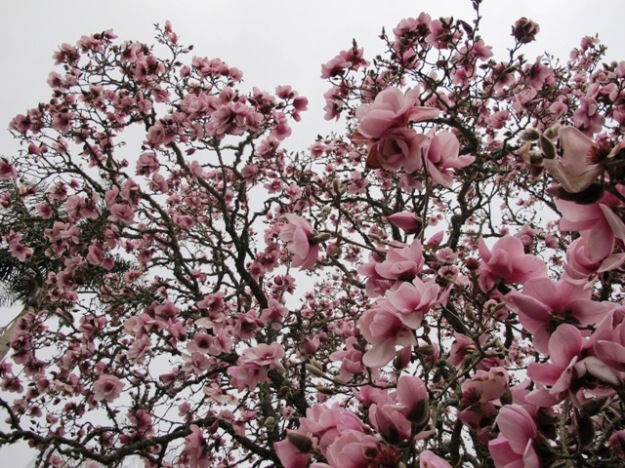
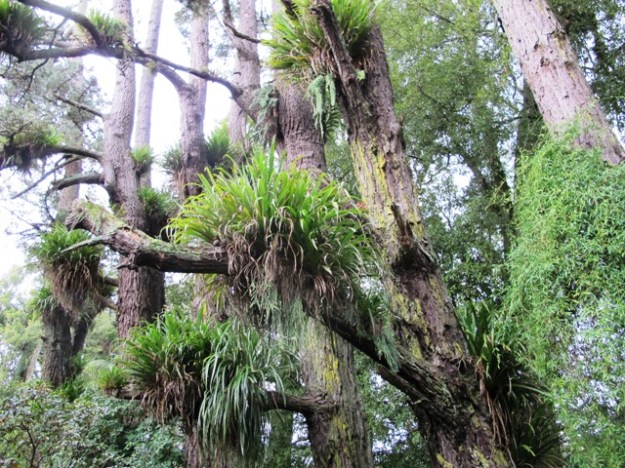 It is both a blessing and a curse to have a garden with very large trees. The pines (mostly Pinus radiata), native rimu trees (Dacrydium cupressinum) and Australian eucalypts all date back to 1870 to early 1880s when Mark’s great grandfather planted them. The rimus are rock solid with a life expectancy of many hundreds of years but from time to time we lose a pine or gum.
 While we can manage most of our tree work ourselves, this one posed a major problem. It broke about 6 metres up where Mark’s grandfather had topped the row in the early 1900s, creating a weak point. But it didn’t break cleanly and the top formed a major swinger. We did the initial cleanup but dealing to the body of the tree required specialist attention.
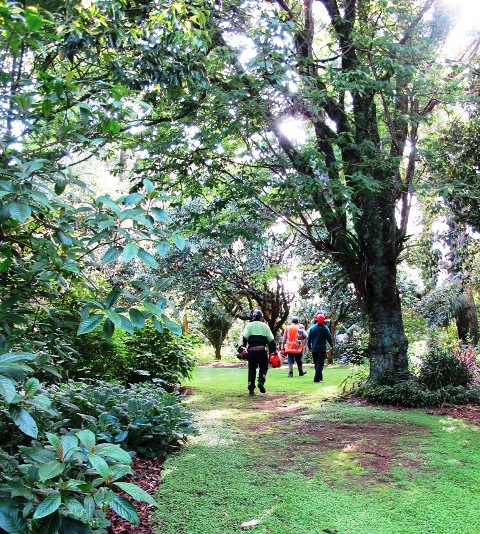 Enter the arborist crew this morning.
 There was a lot of consultation for this was a tricky operation.
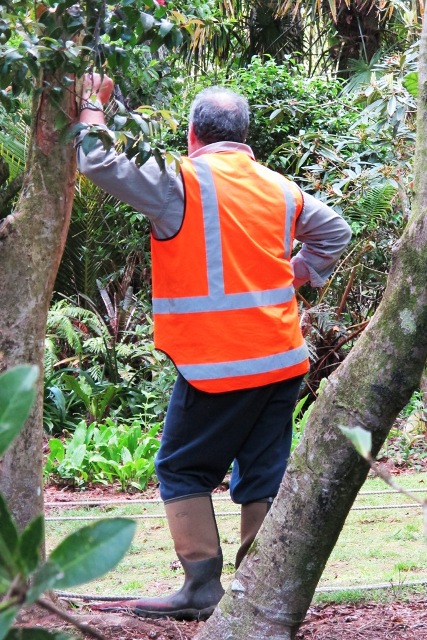 And a lot of supervision.
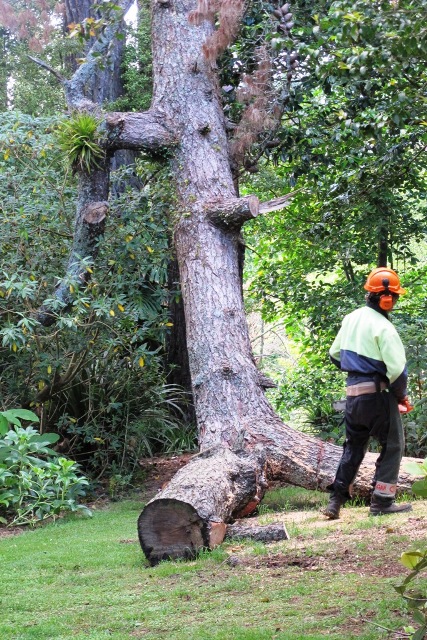 Cuts were made but things did not quite go to plan.
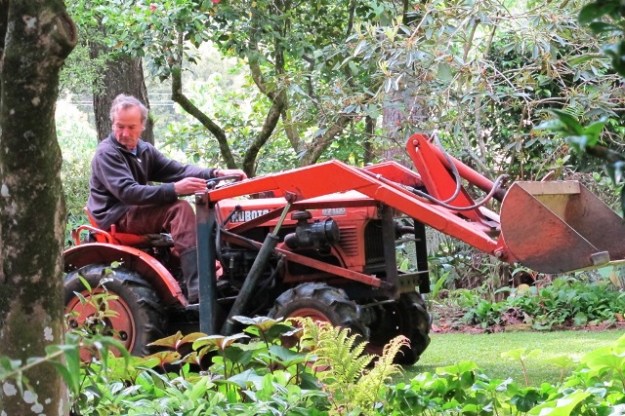 Soon, more equipment was needed. Do not laugh at our baby tractor. It is enormously useful, though not quite equal to this task.
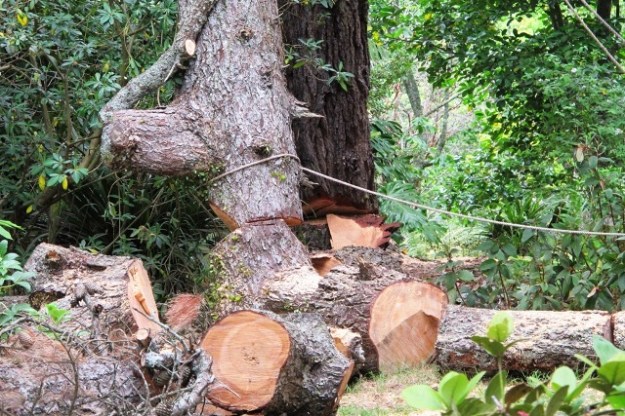 Both ends of the tree were cut through but it remained determinedly in position, defying all attempts to unbalance it.
 There was much manly consultation.
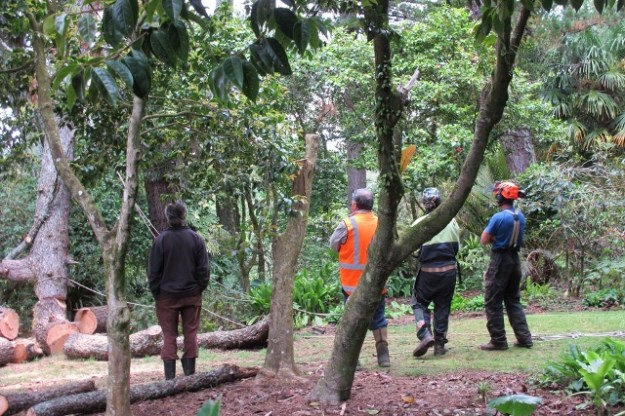 And even more consultation. Lots of consultation. A winch was needed, they decided. The crew departed for more gear.
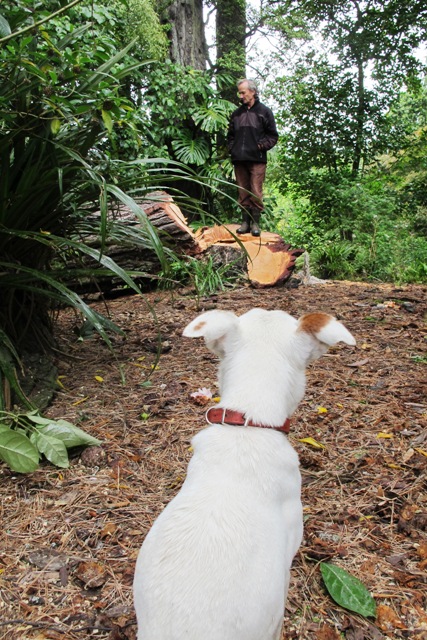 In the end, the crew returned with us not even noticing and both Mark and I missed the final rites when the tree was winched down. We were a little disappointed. It all seemed a bit of an anticlimax but is at least a major problem solved. It is remarkable how a tree some 40 metres high can eventually come down with minimal damage.
 Tikorangi The Jury Garden