Category Archives: Tikorangi notes

The November Garden – rose time

November is peak rose season for us

This is the first spring in twenty seven years that our garden has not been open to the public. It has been something of a revelation. We have so many friends and colleagues who open their private gardens for at least some of the year that it had become normal – an integral part of our lives and how we gardened. We wanted a break but the main driver for the decision to close has been the high impact of the petrochemical industry. From being a sleepy little rural enclave, in a few short years Tikorangi has become Petrochemical Central and this has sent scarily large amounts of heavy and often hazardous transport past our gate. It is not a good fit with an open garden. We take the long view here. Our garden is built around trees originally planted by Mark’s great grandfather from 1870 onwards. The house gardens have been intensively worked since they were first put in by Mark’s parents in 1950. It seems likely that the garden will still be here when the gas has been pumped out from the ground below us and the petrochemical companies have moved on from fossil fuels – to renewables, we hope. In the interim, I don my iPod because I would rather listen to music in the garden than heavy industry. Now we garden for our own pleasure and without having to titivate to open garden standards – or garden grooming we call it.

Cymbeline, on of the David Austen roses

Cymbeline, on of the David Austen roses

November is peak rose season for us. I have a love-hate affair with roses. I am forever debating with myself whether the beauty of the blooms outweighs the foliage and form which are often disappointing – even more so as the poor defoliated things battle through summer and autumn. But is a large, comprehensive garden ever complete without roses? The problem is that we don’t spray our roses. Ever. I never spray anything and Mark point blank refuses to do roses. If they don’t perform without spraying, rip them out and replace them is his view. We do a bit of that and we are trialling some almost thornless pillar roses for a new pergola we have planned.

Mme Plantier, I understand

Mme Plantier, I understand

Mme Plantier, I understand [/caption]Personally, I am not a fan of hybrid teas. They don’t even rank amongst desirable cut flowers for me. I much prefer the informal floribunda types. We have a wonderful white shrub rose which was finally identified for us as Mme Plantier. It keeps excellent foliage without intervention, flowers in abundance and is sweetly scented. But it is only once-flowering and so many gardeners now refuse to grow any rose that doesn’t repeat-flower through the season. We don’t expect other shrubs to flower continually but poor roses are now judged by a different standard. Is six weeks not enough?

Rose Flower Carpet Appleblossom

Rose Flower Carpet Appleblossom

While the Rose Flower Carpet series never attract descriptors such as delicious or exquisite, as high health backbone plants, we have yet to find anything to rival them. Year in and year out, they flourish despite our high humidity and high summer rainfall.  The somewhat vibrant pink form that was the first to be released and the white have particularly long flowering seasons. In fact the white is rarely without blooms. The bright pink looks great when surrounded by large amounts of background green. It took me a few attempts to find the right locations. I prefer the paler apple blossom pink but it doesn’t repeat as well and blooms can ball in heavy rain. While we don’t spray, I am old fashioned and prune by the manual, even though there is research which says that a pass over with hedge clippers is just as effective. We keep roses in open, sunny positions with good air movement. As a point of principle, we do not routinely add fertilisers to our ornamental gardens but we mulch often with homemade compost. That is their feed. If any roses can’t perform well enough with the same regime of care that the rest of the garden gets, then I am afraid they are not for us. But those that do well here are a November delight.

First published in the November issue of NZ Gardener and reprinted here with their permission. 
The October Garden

The glory of the sino nuttallii rhododendrons

The glory of the sino nuttallii rhododendrons

Floral Legacy in bud

Floral Legacy in bud

Rhododendons may no longer be the elite fashion item they were for so many decades, but we still love them.

When we started in the plant business back in the early 80s, rhododendrons were a hot ticket item. We were but one of several rhododendron nurseries in Taranaki and to survive, we needed to find our own niche. To this end, we grew a different range, specialising in varieties that would perform well in warmer climates – like Auckland. After all, even back then, one in four New Zealanders lived in greater Auckland and we figured that if we were going to sell them rhododendrons, we might as well sell them ones that would do better for them. Mark’s father just happened to have done some breeding to find varieties that were more resistant to thrips, didn’t get that burned and crispy edging to their foliage and were predominantly fragrant as well as floriferous. It gave us a good place to start.

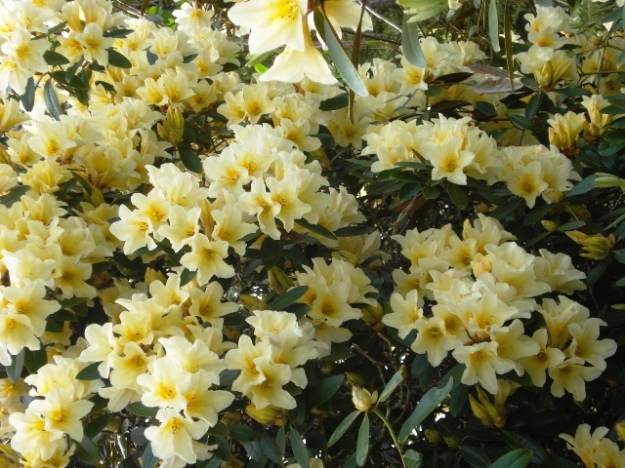
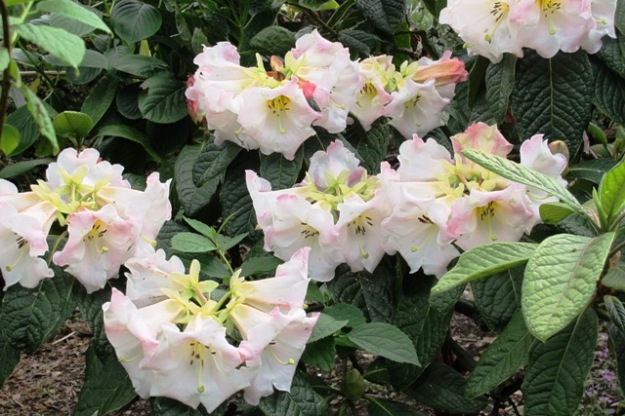
Nowadays there are no specialist rhododendron growers in Taranaki at all and the demand has melted away. I no longer have to try and convince people that not all rhododendrons have a big full truss in the shape of a ball but many have loose trumpets in curtains of bloom instead.

Rhododendrons are one of the backbones of our garden and we wouldn’t have it any other way. While they have a relatively short season in full bloom, the anticipation of fattening buds stretches out the weeks with the promise of delights to come. They are as fine a shrub as any we grow here and a great deal more spectacular than most.

The nuttalliis! Oh the nuttalliis!

The nuttalliis! Oh the nuttalliis!

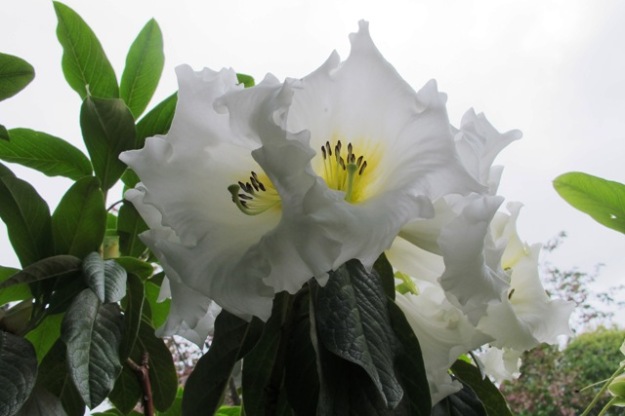
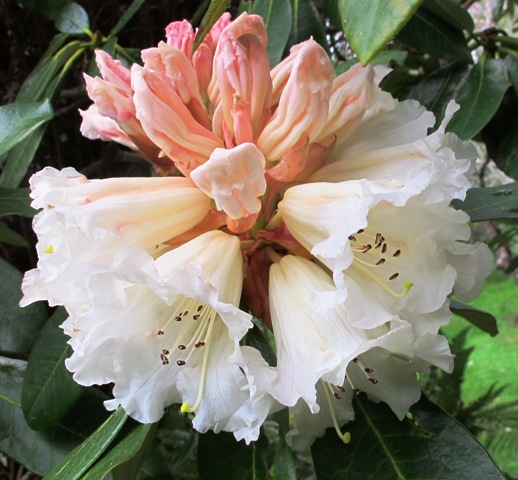
The nuttalliis. Oh the nuttalliis. Peak nuttallii season doesn’t start until closer to the end of the month, taking us into November but some varieties have already done their dash for this year. If we could grow only one type of rhododendron, we’d choose a nuttallii and even more specifically, the sino nuttallii from China. You can keep your big red rhodos (most people’s favourite pick). We love the fragrant, long, white trumpets which look as if they are made from waxed fabric, the lovely peeling bark and the heavy textured foliage. These are rarely offered commercially now so grab one if you ever find it for sale.

Thrips!

Thrips!

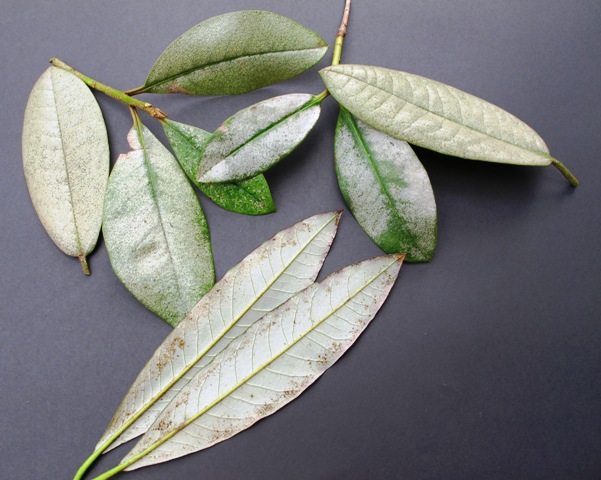
It is, by the way, nasty little leaf-sucking thrips that turn foliage silver and no, you can never turn those silver leaves green again. If you look at the underside of the leaf, you can see dark thread-like marks – these are the critters that do the damage. All you can do is to try and prevent the new season’s growth from getting similarly infested. We are not at all keen on spraying insecticide these days and you need a systemic insecticide that the plant absorbs into its system to get a thorough kill. If you must go down this path, spray in mid November, early January and late February for maximum effect. Others praise Neem oil instead but we haven’t tried it.

We favour choosing more thrip-resistant varieties, keeping them growing strongly and opening up around them to let more air and light in. Thrips prefer shade and shelter. Unless it is really
special, if it is badly thrip-prone, we replace it with a better variety. Not every plant is precious.

In the longer term, plants come and go in the fashion stakes. Goodness, even red hot pokers are having a resurgence of popularity. We don’t worry about the fashion status of the rhododendron and Mark continues hybridising for better performing cultivars. If there is no commercial market for the results, it doesn’t matter. We will continue to enjoy them in our own garden.

First published in the New Zealand Gardener and reprinted here with their permission.
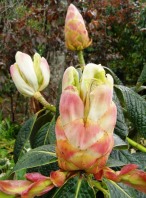
Rhododendron Barbara Jury - one of Felix's  hybrids

Rhododendron Barbara Jury – one of Felix’s hybrids

Japanese simplicity

???????????????????????????????

“I have come to understand the unspeakable loveliness of a solitary spray of blossoms arranged as only a Japanese expert knows how to arrange it…and therefore I cannot think now of what we Occidentals call a ‘bouquet’ as anything but a vulgar murdering of flowers, an outrage upon the color-sense, a brutality, an abomination.”

Glimpses of Unfamilar Japan by Lafcadio Hearn (1894)

Pink bluebells

Pink Hyacinthoides almost certainly hispanica - I picked them because the light conditions were not good enough for the row  multiplying in the old vegtable garden to be photographed

Pink Hyacinthoides almost certainly hispanica – I picked them because the light conditions were not good enough for the row multiplying in the old vegtable garden to be photographed

“Besides all this and spotted by awful white rocks and holed limestone rocks like a great fungus, there was the pink bluebell glade. Miss Anna Rose often remarked to him upon the prolific beauty of the pink bluebells which some aunt of hers had planted here. And he always refrained from expressing his absolute preference for the blue bluebells. Only the very young prefer pink bluebells to blue. Equally, they prefer pink primroses to yellow.”

Molly Keane Treasure Hunt (1952)

Petal carpets, the garden in September

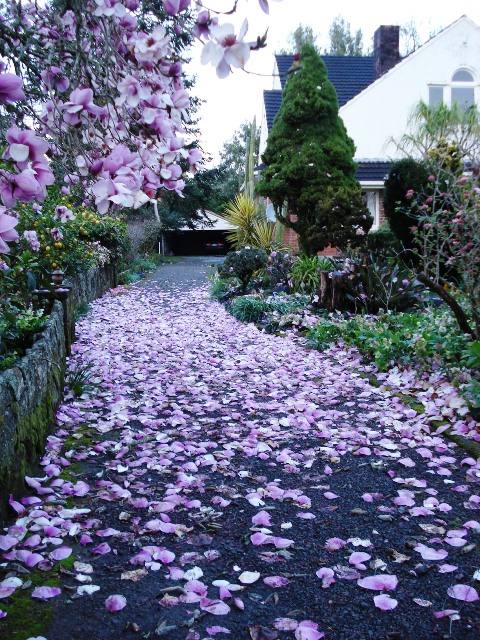
Petal carpets are a second delight

Petal carpets are a second delight

We do good spring gardens in New Zealand. This is just as well in Taranaki, because spring stretches out well past the prescribed three months – from August to early December, I would suggest. The combination of a lack of extremes in temperature, high rainfall and high sunshine hours keeps us in extended flowering mode.

Petal carpets feature large for us. Spring storms may batter plants in bloom but with large trees, the strewn petals offer a second delight, albeit shorter-lived. These used to be more problematic before we discovered a bane of suburban life that is a boon for large gardens – the leaf blower. Once the petals start to discolour and decay, we blow them onto the garden beds where they can quickly rot away to nothing. There is nowhere near the nutritional compost value in fallen petals that there is in leaves, but they are part of the cycle of nature.

Magnolia Iolanthe

Magnolia Iolanthe

The magnolia season continues. The original specimen of Iolanthe is beside our driveway and now measures around 10 metres tall and 7 metres across. In the glory of full bloom, it takes our breath away year after year. If you can give trees the room to grow to maturity, future generations may thank you.

The big-leafed rhododendrons in our park are already passing over. They are showy but flower very early in the season and are vulnerable to frost. They are also difficult to propagate and take up a lot of space so you rarely find them offered for sale. If you are determined, raising them from seed is the best option for the patient gardener. Other rhododendrons are opening however and the season extends right through to Christmas.

Rhododendron 'Eyestopper'

Rhododendron ‘Eyestopper’

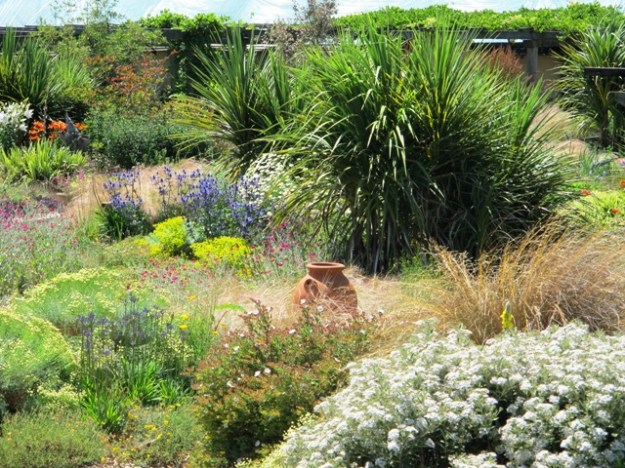
I am madly digging, dividing and reorganising summer perennials. We returned from our trip to see English summer gardens inspired and energised. We were very focussed this time, wanting to see the contemporary gardens rather than the classics like Hidcote, Sissinghurst and Great Dixter. Gardening, after all, moves on and the Arts and Crafts garden style derives from the first decades of last century.

We haven’t heard much in this country about the New Perennials Movement, naturalistic gardening, the Sheffield School and prairie gardening but it has been as big a revolution in garden design and planting as the garden rooms of Arts and Crafts were in their day, or the cottage garden genre that followed. It is a whole lot more than just adding in grasses to perennial plantings, as some sniffily deride.

We were lucky to get into a few private gardens that are not open to the public and we looked at the work of some of the major designer-practioners – Piet Oudolf, Christopher Bradley Hole, Tom Stuart Smith and the late Henk Gerritsen, as well as lesser-known gardeners.

Our conditions are different so it will never work taking the lessons from another country and imposing them here. We need to use different plants in many cases (pampas grass is on our banned list and the lovely Stipa tenuissima is threatening to become a noxious weed according to the Weedbuster’s website). Our management also requires different strategies and some of the gardening practices we saw just won’t work here.

But the underpinning philosophy is relevant and many of the ideas are challenging our preconceived notions. We are serious about the move to more environmentally friendly gardening even though it will push the boundaries of what most New Zealand gardeners regard as acceptable in terms of tolerance for weeds. Our interests also lie in extending our spring flowering well through summer and into autumn and we can’t achieve this without managing perennials much better. No matter. We are inspired. And as gardeners, we take the longer term view.

Wildside in North Devon was the one that excited us most

Wildside in North Devon was the one that excited us most

Of all the gardens we looked at in detail – and there were over 20 of them – the one that really made us buzz with excitement was Wildside in North Devon. This is the garden created by Keith and Ros Wiley. You will have to make do with Googling it or buying Keith’s book because they have now closed to the public. This garden was an inspiration in every way. It brought together vision, energy, determination, sheer hard work and advanced plantsmanship which left us in awe.

First published in the New Zeakland Gardener and reproduced here with their permission.