Category Archives: Tikorangi notes

Tikorangi notes, Friday 24 February, 2012

Summer and Mark's vegetable garden is taking on its meadow garden alter ego as he grows food for the butterflies

Summer and Mark's vegetable garden is taking on its meadow garden alter ego as he grows food for the butterflies

Latest posts:

1) For us, the flowers of summer are lilies but you need to grow a range of different species to get them performing through the season.

2) Lepidozamia peroffskyana in Plant Collector this week – including how a Russian benefactor came to have an Australian plant named after him.

3) Grow your own garlic and keep vampires at bay. This piece also suggests that the conventional wisdom of planting on the shortest day and harvesting on the longest day may not always be the best advice.

4) Quite possibly the last in the short lived garden diary series done for the Weekend Gardener (unless a miracle happens and the magazine rises like a phoenix from the ashes of liquidation.

Tikorangi notes: Friday 24 February, 2012:

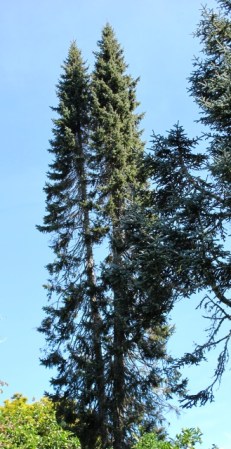
Summer came for three days this week. It was warm enough to entice me into the swimming pool where I looked up at the trees silhouetted against our blue, blue skies and reached for the camera as soon as I got out. I never tire of trees and skyscapes. The elderly pines make a pretty amazing sight even if the one leaning to the right is indeed leaning as much as it appears in the photograph below. One day it may lean beyond the point of balance.
Sadly there is no doubt that a full-on summer is simply not going to happen this year. Yesterday had the unmistakeable hint of autumn. Mark is bringing in grapes every day and muttering about how we had better eat the grapes before the melon harvest starts. Eighty something rock melons, he tells me there are ripening away out in his melon patch. He will have counted them. In the meantime we will not admit defeat and we will eat our way through the grapes. The only crop to rival them here is the green beans, which lack the romance.

The cyclamen are opening which promises an extended delight. The lilies are on their last legs – another torrential rain will spell the end of the auratums but within a few weeks, the autumn bulbs will be starting. That at least is some consolation for a truly disappointing summer.
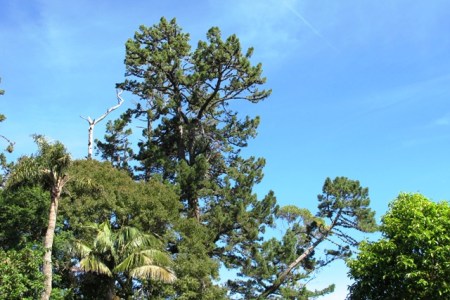
Our old man pines, Pinus radiata, are large trees after 130 years
Our old man pines, Pinus radiata, are large trees after 130 years
Tikorangi Notes: Friday 17 February, 2011

Latest Posts:

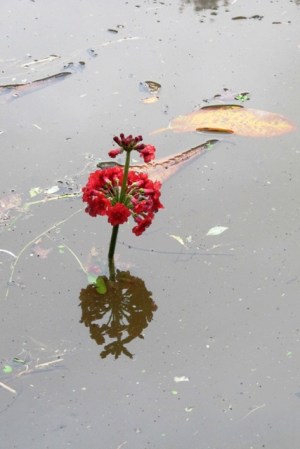
It rained heavily earlier in the week - very heavily

It rained heavily earlier in the week - very heavily

1) Lunacy or of horticultural merit? Planting by the moon – Abbie’s column. I expect some fallout from this one. Back in the days when I used to write for the local paper, we received many more phone calls from locals. One gentleman rang, urging me to write a piece on planting by the moon. He sponsored an African child and he was very confident that if he could just get the entire African village planting by the moon, it would solve all the problems of famine once and for all. When I demurred and suggested I wanted to see some independent, scientific proof, he felt sorry for me, that I was so duped by science. I quickly hung up on the nutter.

2) In for a penny, in for a pound: a review of “Easy Organic Gardening and Moon Planting” by Lyn Bagnall. A little too much smoke and mirrors for my taste.

3) The lovely tropical Tecomanthe venusta is featured in Plant Collector and is flowering here, even though we are far from tropical.

4) Growing oregano and marjoram, what the difference is and the most likely way of intensifying the flavour in GIY.

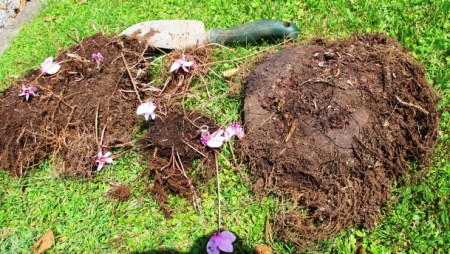
Bet mine are larger than yours - Cyclamen hederafolium tubers

Bet mine are larger than yours - Cyclamen hederafolium tubers


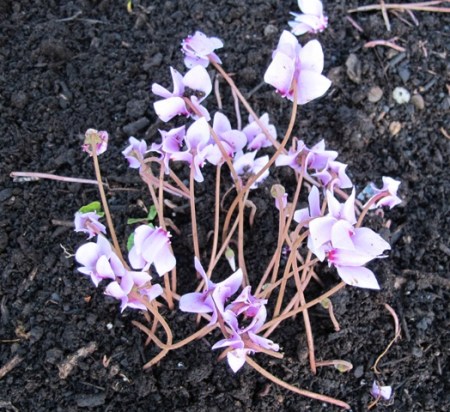
A mere taste of what is to come

A mere taste of what is to come

Tikorangi Notes: Friday 17 February, 2011

The cyclamen photo is because I finally finished rustling up the surplus Cyclamen hederafolium to carpet an area as ground cover. I needed quite a few to cover about 14 square metres but it helps when you find enormous tubers which measure over 20cm across. It takes many years for them to reach that size. They should be looking very pretty in a few weeks time with the first flowers showing already. This is my third attempt to find the perfect groundcover for that particular bed.

It was sad this week to hear that the Weekend Gardener magazine is now in the hands of liquidators – and I don’t say that just because I had a fortnightly writing contract. The gardening media market will be the poorer without it. Fundamentally, I think Weekend Gardener suffered from a split personality. While some aspects remained about as downmarket as they could be (particularly the DIY project using Resene products each fortnight where you too could replicate something astonishingly ghastly), there were an increasing number of interesting stories and features. The just retired editor, Susie Longdell, did much to lift the horticultural status of the magazine and steered clear of the cult of the personality. But in the end, it appears it was not enough to win sufficient subscribers to keep it viable. A pity.

The second most read article on my website is the piece I wrote about plagiarism – The Tui NZ Fruit Garden – dear oh dear. It still gets hits every single day, despite Penguin’s apparent attempt to pretend it never happened. Thanks to a reader, I am now hot on the case of another plagiarised book which may prove to be just as bad. Watch this space.

Tikorangi Diary: Friday 10 February, 2012

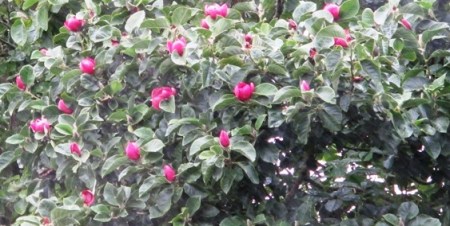
The bonus of summer flowers on Magnolia Black Tulip

The bonus of summer flowers on Magnolia Black Tulip

Latest Posts

1) From big picture gardening to small picture detail – Abbie’s column.

2) On the case with Ulmus “Jacqueline Hillier” in Plant Collector this week. It is not a dwarf grower as we were originally led to believe by somebody or other (probably the person we sourced the original plant from in NZ).

3) Grow it Yourself – spinach this week. Silver beet for refined tastes?

4) In the garden this fortnight – the latest instalment of our garden diary as written for the Weekend Gardener where we reference seeding and spreading plant pests (yes! Campanulata cherries, bangalow palms and Daphne bholua).

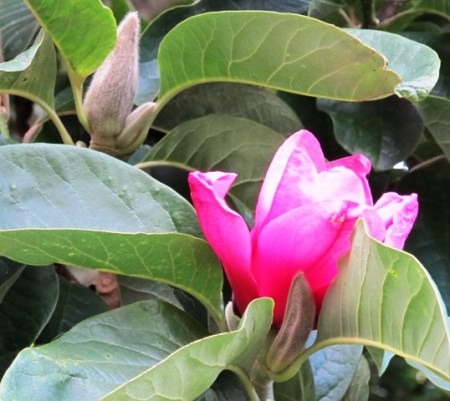
Magnolia Apollo in summer

Magnolia Apollo in summer

Tikorangi Notes:

In days gone by, the Jury name used to be synonymous with camellias. These days it is magnolias and we can chart the year by repeated requests for diagnosis. In late winter and early spring, it is always: “Help. My magnolia buds look fine but then the flower opens all distorted and misshapen.” In this country, the answer is that a possum has developed a taste for the buds and chewed out the centre at an earlier stage. They can do this without it being obvious from below. The solution is to catch the critter – we favour high velocity lead, as Mark says.

In spring and summer, the question is: “Help. The leaves on my magnolia tree are opening all yellow, distorted and sick-looking on one side. What can I do?” The answer is that somebody has used a hormone spray – usually a common lawn spray – at the time when the tree is just breaking dormancy and there is nothing you can do except wait to see if the tree can recover. Oh, and be more careful next year (or ask your neighbour to) because the slightest hint of hormone spray drift at the wrong time does major damage. Don’t spray your lawn in spring if you have magnolias nearby.

Magnolia seed pod, not a sinister growth

Magnolia seed pod, not a sinister growth

This summer, we have had repeated requests for information about alleged abnormal growths and cankers which have appeared. SEED PODS, dear Reader. There is nothing sinister. The plant has set seed and you have just noticed it. Some plants set a fair amount of seed, some none at all (they are sterile) and some only set seed occasionally. And yes, you can grow them but the chances of getting something exciting and better than the parent are extremely remote. And you need space because it may take many, many years before the seedlings get to flowering size – by which time they can be large trees. When the pod eventually turns brown and dry, it starts to crack open and release the red seed. For better germination, we rot that red coating off before planting the inner black kernel.

Out of season summer flowers on magnolias are often mentioned too. There is nothing unusual about this phenomenon. I wrote about it in Magnolia Diary 14. It is in the breeding, basically. And they are bonus flowers, not a major display.

The Tikorangi weather report is better this week – some sunny, warm, summery weather at long last though the lower than average night temperatures and sunshine hours mean the water temperature in our swimming pool remains too low to entice us in. The pool is unheated and would normally be a pleasant 26 degrees celsius by now, maybe more but it is not even close. The only consolation is that the entire country is having a cooler than usual summer. It is always nice to know that one is not alone. At least the auratum lilies don’t mind and flower on beautifully.

Tikorangi Notes: Friday 3 February, 2012

Our pregnant gecko, Glenys, is back in view

Our pregnant gecko, Glenys, is back in view

Latest posts: Friday 3 February, 2012

1) The battle with the water weeds in Abbie’s column this week.

2) One for the dendrologists in Plant Collector this week – Pinus montezumae. It takes a bit to convince most New Zealanders that any pine tree is capable of being special but garden visitors do single our specimen of P.montezumae as being a tree out of the ordinary realm of the common pine.

3) Grow it yourself – silver beet. Some people are even alleged to enjoy eating this iron-rich but utility vegetable.

4) Welcome back Glenys, our highly prized but rather shy resident gecko. We are terribly excited by the evidence that we have a population of gecko in our garden, though that excitement does not appear to have been widely shared by others! But in this country, the small skinks are a common sight whereas our native gecko is nocturnal, elusive and rarely seen.

5) Check out the lily photo album I am building on our Facebook garden page. If you feel inclined to “like” the whole Facebook page, it would be most gratifying. Our popularity on Facebook lags behind the visitor numbers to our websites, and even the subscribers. This may of course just indicate that gardeners are less inclined to use social networks.

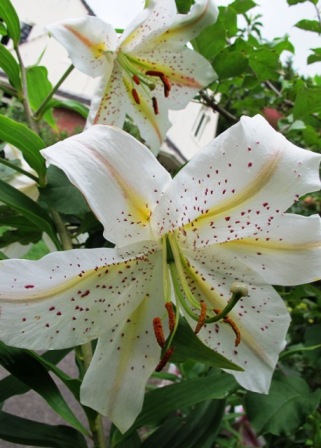
The auratum lily season is late this year, but no less spectacular for its delay

The auratum lily season is late this year, but no less spectacular for its delay

Tikorangi Notes: Friday 3 February, 2012

Oh summer, where art thou? Even the auratum lilies seem to be waiting for some real summer heat before opening fully in all their glory. This may go down in history as one of the coolest summers in recent history. On the bright side, the garden is very lush and green and working conditions are not unpleasantly hot. In fact, for Lloyd and I cleaning out the ponds and stream in our park, working conditions have been very pleasant. I just like a little searing heat to justify the fact we have a swimming pool. It has had precious little use so far this year.

Mark is very excited to see the blandfordia coming into flower. I have tried to photograph it but even by our standards, it is still looking a little too modest to boast about. It may look more notable when additional buds open. The reason for our excitement is that it was planted in the rockery by Felix Jury and as Felix died in 1997, it means it has been there for quite a long time and not doing very much. In fact, in all those years, it has only flowered twice before. Its third flowering is cause to celebrate.

Our Lloyd makes a prettier sight than I do when it comes to weeding the pond

Our Lloyd makes a prettier sight than I do when it comes to weeding the pond

Tikorangi Notes; Friday 27 January, 2012

Crocosmia hybrids

Crocosmia hybrids

Latest posts: Friday 27 January, 2012
1) No amount of wishful thinking can alter the fact that we do not in fact have a Mediterranean climate here and romantic recreations of the glam of Med holidays are likely doomed to disaster. Abbie’s column.
2) A big, beautiful, fragrant rhododendron flowering in mid to late January? R. diaprepes in Plant Collector this week (but don’t expect to find this one offered for sale at your local plant store).
3) Grow it Yourself – broccoli. Personally I prefer not to. I have tried repeatedly over many years to learn to love broccoli and have met with dismal failure but others are more enthusiastic and it is fearfully good for you.
4) The latest instalment of our fortnightly garden diary as published first in the Weekend Gardener – dealing with prickly onehunga weed without resorting to lawn sprays and other garden matters.

The sad state of Camellia chyrsantha

The sad state of Camellia chyrsantha

Tikorangi Notes; Friday 27 January, 2012

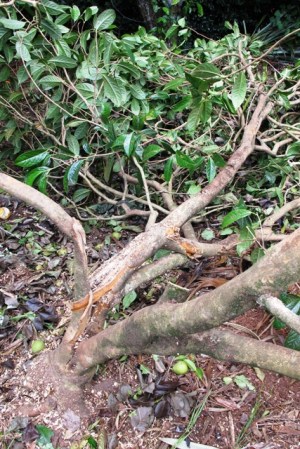
It was only last year that I featured one of the best flowerings we have had on Camellia chyrsantha (it of the butter yellow flowers – bright New Zealand butter at that). It only took a decade or two to start performing well. Alas, it came off second best to the rapid descent of a massive old pear tree last week. The trouble is that it is a grafted plant and the trunk has been split. We are hoping it may still recover and live to bloom again. We can take the long view and wait another decade, if need be.

I have been photographing the different bulbs flowering this month. We were worried we had lost the yellow-orange form of crocosmia but it has leapt into flower and is remarkably showy with very large blooms. The red form (the one above is a hybrid called Lucifer) is such a strong grower that the chances of losing it are negligible, which means we take it completely for granted. Indeed, red crocosmia is a widespread roadside flower regarded as an invasive weed and known as montbretia in our area. The pink vallota is also looking particularly fetching. I would describe it more as peach than pink. There appears to be some debate about whether it is a vallota or a cyrtanthus so the pink vallota may in fact be the peach cyrtanthus. The auratum lilies are still fattening buds and not yet in full stride – just some tasters open so far.

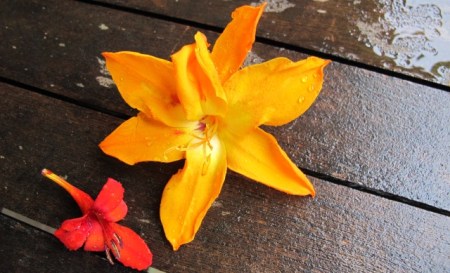
The pink vallota. Or should that be the peach cyrtanthus?

The pink vallota. Or should that be the peach cyrtanthus?