Category Archives: Tikorangi notes

Tikorangi Notes: Friday 16 December, 2011

The DIY Christmas tree

The DIY Christmas tree

Latest posts: December 16, 2011

1) Gardening books that have stood the test of time (or are likely to). Abbie’s column giving recommendations old (some positively vintage) and new.

2) Please do not buy me garden ornaments for Christmas (what we are up to in the garden this fortnight, first published in the Weekend Gardener). Using plants as focal points.

3) The delightful small Chinese tree Tetracentron sinense in Plant Collector this week.

4) Grow it yourself – leeks this week. An easy crop for winter harvest.

5) The DIY Christmas tree for 2011 – step by step instructions. Though this is not exactly a spur of the moment creation this year.
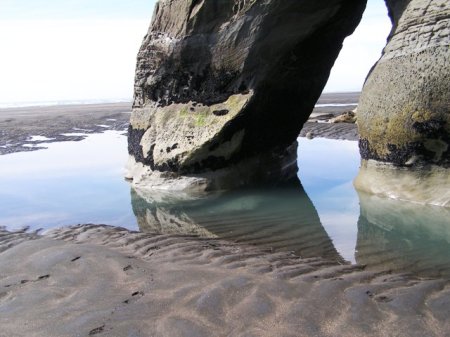
The black sands of a North Taranaki beach

The black sands of a North Taranaki beach

With rain every day this week, there has been little gardening going on here and little of the current flush of blooms will survive. The one consolation is that it could be worse – as it is in other parts of the country. Mark has been busy in the shed sowing seed while I made the Christmas tree but we may start to suffer from cabin fever, unless we get some sunshine soon.

Rather than battling out to try and photograph some sodden plant or garden scene this week, I have turned instead to two beach scenes from last Friday (when the weather was gratifyingly good – sunny, calm and mild) and we headed to the beach at Tongaporutu to gather oysters and mussels for dinner. On the west coast we have very fine black sand beaches. It used to amuse me that despite only ever seeing black sand, the vast majority of young Taranaki children still paint beach scenes showing golden sand. In mid summer, the hot sand can get too hot to walk on with bare feet above the high tide mark, but this early in the season, it is not a problem. Tongaporutu is about 30 minutes up the coast from us and is a wide open beach, often completely empty of people and completely magical. It felt like the essence of New Zealand, captured in a few hours
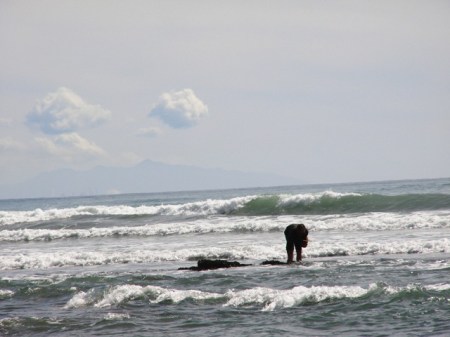
Mark, gathering dinner last Friday
Mark, gathering dinner last Friday
Tikorangi Notes: Friday 9 December, 2011

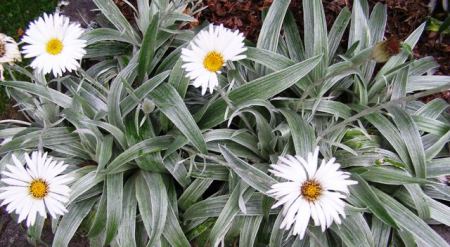
Celmisia - New Zealand's mountain daisy

Celmisia - New Zealand's mountain daisy

Latest Posts: Friday 9 December, 2011
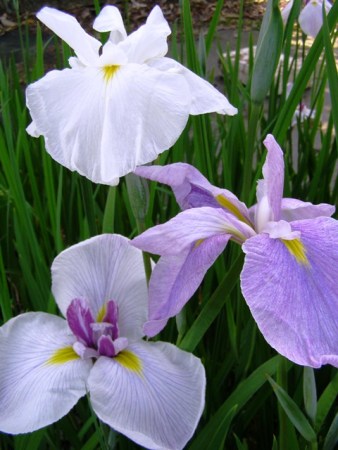
1) No fewer than 700 Higo iris waiting to be planted out in Plant Collector this week.
2) Yet another joint venture infomercial masquerading as a reputable garden reference book – the Tui NZ Flower Garden this time.
3) The current quest for self sufficiency, of sorts at least. More a measure of a high quality of life here than a point of principle – Abbie’s column.
4) Grow it Yourself – rhubarb this week.
5) And absolutely nothing to do with gardening but a link to my other website (www.runningfurs.com) where I publish book reviews of a non gardening nature (mostly cookbooks, children’s literature and a bit of adult fiction) – the latest of which was indeed a cookbook: The Molten Cookbook by Michael Van de Elzen. Food porn, my chef friend calls it.

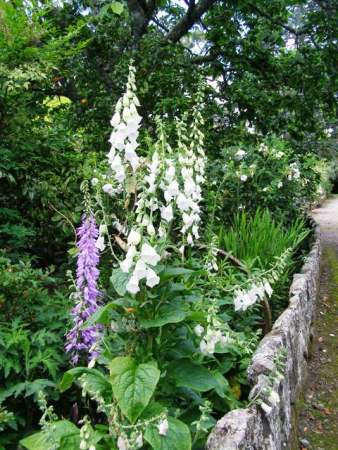
Inspired by Hidcote - the white foxgloves
Inspired by Hidcote – the white foxgloves

At last the temperatures are rising and it feels as if we may be on the cusp of summer after all. The tall white foxgloves have been bringing me much pleasure, simple though they are. We saw these used to great effect at Hidcote Manor in England but, being a biennial, it has taken eighteen months to get them performing here. I am hoping they will seed down as readily as their pink counterparts (most of which are being consigned to the compost to try and keep the white strain pure).

Sparrows in the Queen Palm condo

Sparrows in the Queen Palm condo

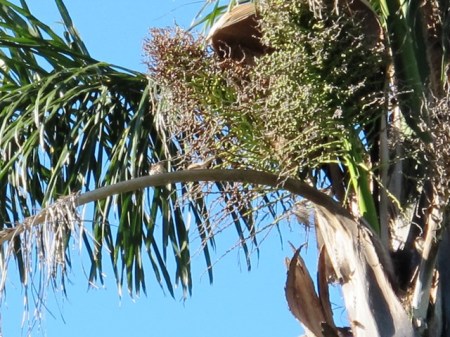
We have been somewhat amazed in recent weeks watching the entire condominium of nesting birds in the crown of the Queen Palm (Syagrus romanzoffiana) – they must be fifteen metres up and it appears that every nesting space is occupied. The dominant population is sparrows with the odd starling having made a move on vacant property. As we sit in our favourite conversation spot, we look out at the many comings and goings, while the tui nesting in the nearby rimu attempts to patrol the entire area and convince all other birds that they are deeply unwelcome.

The celmisia in flower is a reminder to me of the next website project – building the record of native plants we have in the garden. This is of less interest to New Zealanders who tend to fall into one of two camps – the dedicated purist (natives only) and the rather dismissive (“natives are so boring”). In fact, we use many native plants in the garden but interspersed with exotics. I read an opinion recently that the use of native plants is an important way of anchoring a garden into its environment and its country of origin, which seemed to make good sense.

Tikorangi Notes: Friday 2 December, 2011

The next series of Mark's arisaema hybrids is coming into flower

The next series of Mark's arisaema hybrids is coming into flower

Latest Posts:
1) A love/hate relationship with roses – Abbie’s column.
2) My fortnightly garden diary from the latest issue of the Weekend Gardener.
3) Continuing the rose theme, Plant Collector is on Roseraie de l’Hay.
4) Grow it Yourself is on capsicums this week (though apparently we will not be growing them ourselves this year).
5) Fruit by Mark Diacon (British gardeners are apparently sufficiently intelligent or adequately educated and they are allowed an index in a gardening reference book).

Tikorangi Notes: Friday 2 December, 2011
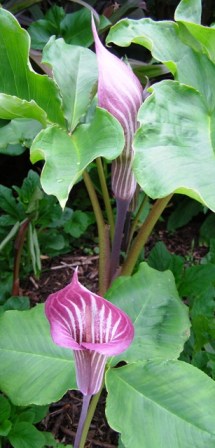
The second wave of Mark’s arisaema hybrids are coming into flower. These are visibly candidissimum hybrids but with colour (and stripes). In our conditions, we struggle with many of the species but hybrids add a new vigour. They may not appeal to the purist and the plant collector, but they will appeal to gardeners! However, the hybrid arisaema have not been offered for sale at all, and at this stage we have no plans to do so.

We have been delighted to see our Cordyline Red Fountain honoured with an award in Japan this week (it was Australia a couple of weeks ago).

And I have been having some fun on the website of our national museum with the DIY Monet facility – turning a photo into a Monet lookalike (of sorts).

The DIY Monet image, courtesy of the Te Papa website

The DIY Monet image, courtesy of the Te Papa website

Coming up next week: the Higo irises

Coming up next week: the Higo irises

Tikorangi Notes: Friday November 25, 2011

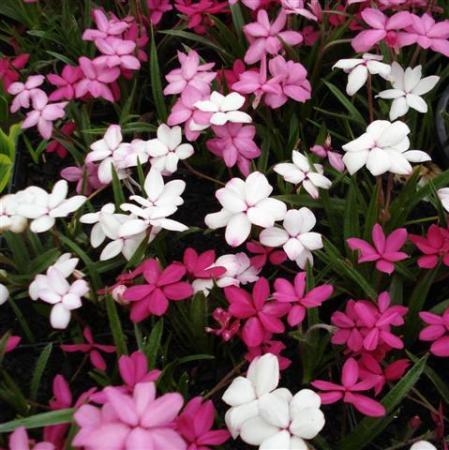
It is rhodohypoxis time

It is rhodohypoxis time

Latest Posts: Friday November 25, 2011
1) Why would gardening be exempt from fashion? Abbie’s column. It never has been before, but in keeping with modern times, the cycles of fashion are moving ever faster.
2) Yet another lightweight NZ gardening book. Even indexes are expendable these days, apparently.
3) Plant Collector this week: Dracophyllum latifolium or neinei, a seriously cool small tree and a native at that.
4) 100 Gardens by Jamie Durie (Australia’s pin-up boy of landscaping). More about ideas for outdoor spaces than gardening as such.
5) Grow it Yourself – melonsthis week. Preferably rock but water will do at a pinch.

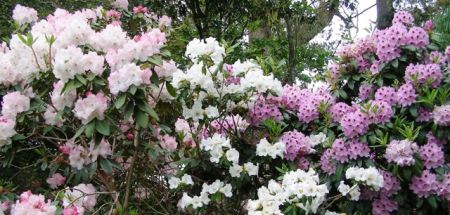
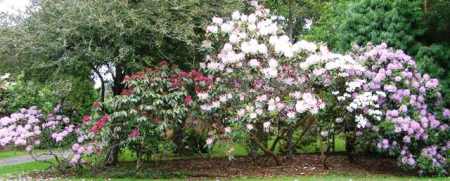
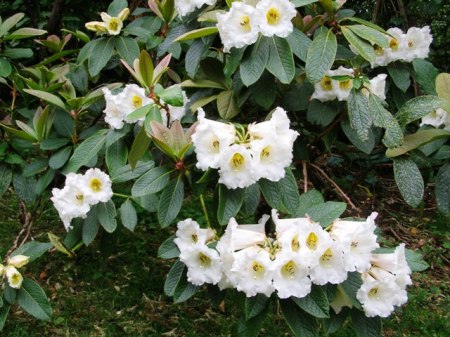
Rhododendron Elizabeth Titcomb to the left, Blue Pacific to the right and R. lindleyi (Ludlow and Sherriff form) caught in their cleavage, as Mark describes it – though nearly strangled might be a better description.
Our unusually cool spring is continuing here, which does at least mean that the spring flowering has been extended way past the usual time. At least the roses have finally opened. We are not the greatest of climates for roses – they don’t appreciate our high humidity – so the first spring blooms are all the more welcome as the bushes are still full of healthy, lush foliage. As the season progresses and black spot strikes, the plants start to look ever more sparse. One can spray roses, of course (and many do) but we choose not to. If a rose plant can not survive and perform without spraying, it ends up in the incinerator.


From left: Caroline Allbrook, Olin O. Dobbs, Elizabeth Titcomb, R. lindleyi and Blue Pacific – a swathe of pink and purple across one side of our carpark.

Tikorangi Notes: Friday 18 November, 2011

The fragrant nuttallii rhododendrons are late season bloomers here

The fragrant nuttallii rhododendrons are late season bloomers here

Latest Posts: Friday 18 November, 2011
1) Plant Collector – the showy Geranium madarense

2) Yet another NZ book best left on the booksellers’s shelves. I call it candyfloss gardening.

3) What’s in a name? Quite a bit, sometimes. Abbie’s column.

4) Grow Your Own – carrots this week

5) In the garden this fortnight

6) Future success predicted for Fairy Magnolia Blush – in Australia.

7) On the case with Grandma’s violets – a step by step guide on digging and dividing congested groundcover.

The area we refer to as "the park"

The area we refer to as "the park"

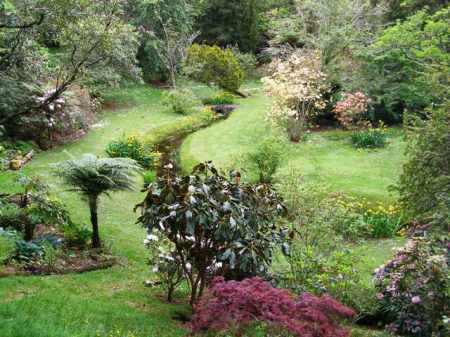
The two most admired areas of our garden are the rimu cathedral walk (“under the rimus” as we call it) and the informal park area in spring time. The park is somewhere over 4 acres in size with the upper waters of the Waiau Stream meandering through. We have deliberately kept the area quite open and informal, featuring specimen trees and an abundance of seasonal colour from magnolias, then prunus, rhododendrons, azaleas and other flowering shrubs. It is that very informality that seems to appeal to garden visitors. Only the very observant pick the detail which underpins such a casual appearance. Bulb meadows don’t just happen of their own accord, at least not in our climate. Nor do clear flowing streams stay that way without some intervention – our torrential rains see flood waters full of suspended silt on a regular basis. But it all seems worthwhile every spring when the park is in bloom and with our unseasonably cool season this year, that flowering has extended by weeks. The nuttallii rhododendrons are in full bloom now, as are the later season maddeniis.

Our garden remains open. If we are not around, we leave an honesty box out. However, plant sales have well and truly finished and we have taken to the end of retail like ducks to water. We would much rather be gardening.

I was, however, disconcerted by the garden visitors earlier this week – an older couple who came out of the garden, making the usual positive comments of how lovely it all was, when he came out with an extraordinary statement: “It must all be such a heavy burden for you.”

I think it said more about him than us!