Category Archives: Tikorangi notes

Tikorangi notes: Friday 18 February, 2011

LATEST POSTS: Friday 18 February, 2011

1) Not, apparently, Worsleya rayneri but Worsleya procera, the Empress of Brazil, in full flower as a garden plant.

2) An update on our prized resident gecko whose photograph gave rise to much interest amongst local herpetologists, we are told.

3) Garden tasks for the week with an acknowledgement that autumn is just around the corner.

4) Step by step instructions on dealing to wasp nests safely – Outdoor Classroom.

5) The ignominious end of the carefully crafted Christmas tree – now resembling a dead sheep in the wild garden.
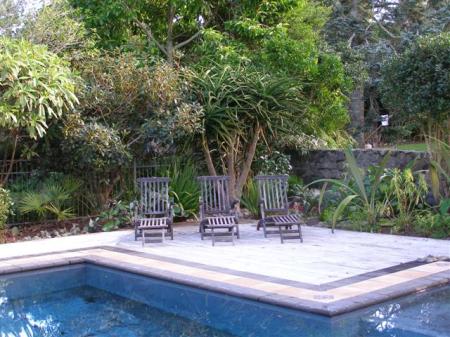
The swimming pool garden

The swimming pool garden


TIKORANGI NOTES: Friday 18 February, 2011
Summer is a time for intensive gardening around here, though not much planting which needs to wait until autumn and winter. We have big plans for substantial new gardens where the nursery has stood in recent decades – good flat areas in full sun. However, before we embark on bringing in yet more garden area, I want to make sure that we can manage the areas we already have to the standard we want. Like most New Zealand gardens, we maintain a large area with a skeleton crew (Mark, me and our ever helpful staffer, Lloyd along with one friend of the garden). The swimming pool garden is not a prominent area and only tends to be noticed during the summer season but as I floated around in the water earlier last month, I realized I could no longer ignore it. We had tackled the massive Curculigo recurvata last winter, but the Cordyline stricta and the Ligularia reniformis were staging takeover bids. Next, it has been on to the subtropical gardens beneath our avenue of enormous rimu trees. Predominantly planted in bromeliads, this means a prickly task which more or less shredded my arms above the elbows where the protective gloves stopped, let alone the legs between ankle and knee. But the garden is looking hugely better for a major thinning effort. Gardens grow but the change can be so gradual that it can escape one’s notice just how much it has changed over time.
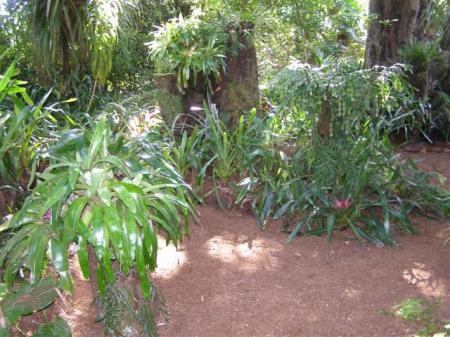
A pleasantly shaded garden to work in during summer
A pleasantly shaded garden to work in during summer
Tikorangi Notes: Friday 11 February, 2011

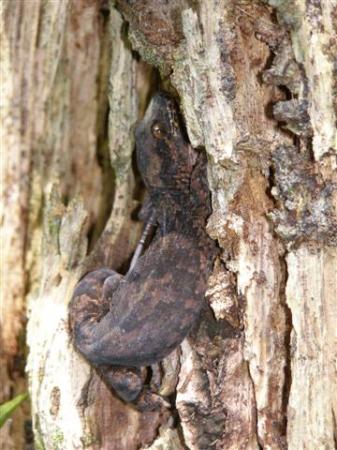
The gecko - a first for us to find a live one in our garden

The gecko - a first for us to find a live one in our garden

LATEST POSTS: Friday 11 February, 2011

1) Gecko (singular but rare), many kereru and a mass of monarch butterflies in Abbie’s column this week. I admit that the photograph of the kereru was staged. It is not easy to get close enough to them and I had lost my one good image. In desperation we got one out of the freezer where Mark stores dead native birds he finds (all from natural causes) to pass on to a local kuia to pluck for use in making korowai or Maori feather cloaks. We had to partially defrost it to mould it, hold it in position and then hastily refreeze it as it was starting to smell rather high.

2) Amaryllis belladonna – often seen as rather coarse and common roadside flowers in this country but worth a second look. Plant Collector.

3) Garden tasks for this week though there is not a whole lot one can do at this time of the year beyond dividing bearded irises, daffodils and bluebells.

4) Not your ordinary everlasting flower – Helichrysum Silver Cushion in Plant Collector last week.

5) A little after the event now – garden tasks for the first week of February in an antipodean summer.

6) The second in our Outdoor Classroom series on making compost – step by step hot compost mixes with an impressive shot of our compost heap resembling an attraction at a thermal reserve.


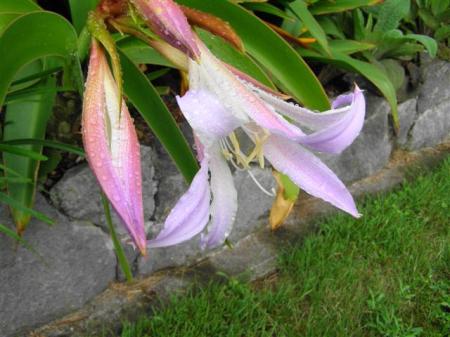
Worsleya rayneri in the garden, just starting to open its blooms

Worsleya rayneri in the garden, just starting to open its blooms

TIKORANGI NOTES: Friday 11 February, 2011There weren’t any Tikorangi Notes last week. I think I was feeling uninspired and having a great deal of trouble focussing my eyes on the computer screen – the result of not seeking help earlier for what turned out to be part of a seed head embedded in one eye. Such are the dangers of gardening. But this week was marked by two events – finding that we have a resident gecko in the garden (the gecko being a rarely sighted native lizard) – written about in Latest Posts 1, and the opening of not one but two Worsleya rayneri blooms in different locations in the garden. The worsleya flowering is not quite as rare as the sighting of a live gecko – it has happened twice before – but to manage this feat with bulbs planted out in the garden rather than kept in controlled conditions in a container is a reasonably significant triumph.

Tikorangi Notes: Friday 28 January, 2010

LATEST POSTS: Friday 28 January

1) Agapanthus – love them or hate them, they are stars of our summer roadsides. Abbie’s column.

2) An exceptionally fierce summer storm last Sunday took out many flowers in the garden but the disa orchids came through unscathed. Plant Collector.

3) Garden tasks for the week from dealing with potato blight to why you may want to think twice before planning to become self sufficient in pine nuts.

Agapanthus blue and white, and montbretia on our roadside

Agapanthus blue and white, and montbretia on our roadside

TIKORANGI NOTES:
Agapanthus or Nile lilies are considerably more highly prized overseas than in New Zealand. Here we tend to see them as indestructible, utility roadside plants or fillers but come summertime, these large clumps of strappy foliage are adorned with a mass of blue or white blooms. They become a real feature of our countryside. But such is the antipathy to these plants, that they are frequently looked down on as garden plants. I think the only one we have in a garden situation (as opposed to our road verges bounding the property) is little variegated Tinkerbell.

Variegated agapanthus - doubly damned in NZ

Variegated agapanthus - doubly damned in NZ

I will have to find a spot for the yellow variegated form shown here, but am not sure yet where it will fit. We have never done anything with this seedling of ours. There is no point in building it up for sale in this country – it is damned on account of being an agapanthus, doubly damned because it is variegated in a country where we do not favour variegated foliage much at all, though it is a good plant with stable colour. The crocosmia (commonly referred to as montbretia) is similarly a borderline weed but it lights up the roadside outside with the agapanthus.

Tikorangi Notes: Friday 21 January, 2011

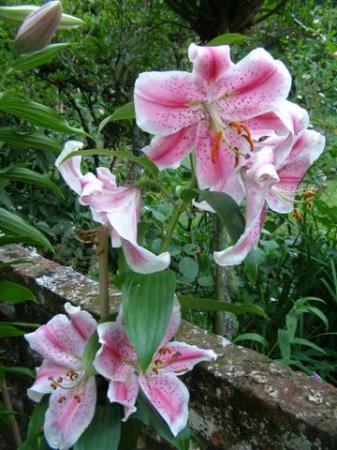
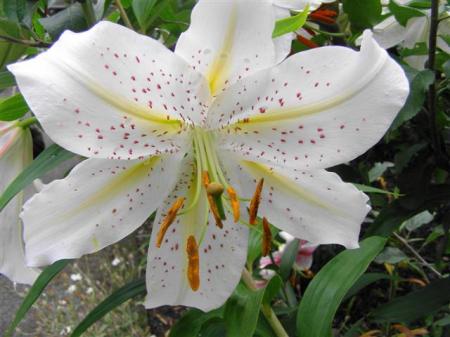
Auratum lilies - a mainstay of our summer garden

Auratum lilies - a mainstay of our summer garden

LATEST POSTS: Friday 21 January, 2010

1) Mid summer is the time for auratum lilies – Plant Collector this week.

2) Garden tasks for the week.

3) In Outdoor Classroom this week, we take the first of a two part look at making compost – simple options.

TIKORANGI NOTES: Friday 21 January, 2010

The auratum lilies are a highlight of summer here. We have yet to master the classic summer herbaceous borders but we can do the auratums well. Divinely scented, big, bold and impossible to ignore, they grow well in both full sun and semi shade. Fortunately, the lily beetle which we saw in English gardens, has not made its way past border control here. That is certainly one pest we can do without.

The glory of the auratum lilies

The glory of the auratum lilies

Tikorangi notes: Friday 14 January, 2011

Too much of a good thing - self sown nikau palms.

Too much of a good thing - self sown nikau palms.

LATEST POSTS: Friday January 14, 2011

1) Is it possible to define the New Zealand garden? I try at least to isolate common threads without necessarily defining a single style. Abbie’s column.

2) I had hoped that the pink form of Schizophragma hydrangeoides would be in bloom this week to photograph but alas it appears as if our large plant is not going oblige with any flowers at all this year. So despite the fact that I used a photograph on Tikorangi Notes last week, I had to resort to using the white form for Plant Collector – but with plant notes as well.

3) Garden tasks for this week of full summer.

TIKORANGI NOTES
By definition, we don’t call self sown seedlings of our native plants weeds here – that derisory term is reserved for introduced plants. But doing battle with runaway native plants has been the order of the week. Ironically, one is the world’s southernmost palm, the nikau (or Rhopalostylis sapida). Handsome though it is, you can have too much of

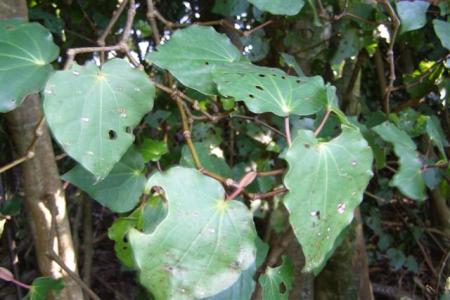
Self sown kawakawa showing typical shot holes in the leaf

Self sown kawakawa showing typical shot holes in the leaf

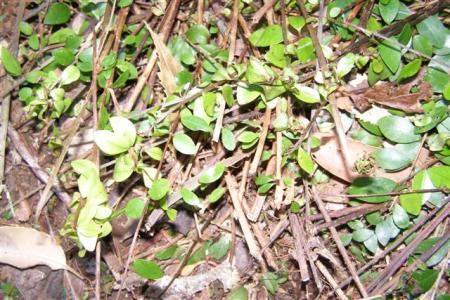
The creeping rata - puts down roots wherever it touches, whether in the ground or clinging to a host tree

The creeping rata - puts down roots wherever it touches, whether in the ground or clinging to a host tree

a good thing and the multiple plants we had let get away in one shaded border were far too numerous, ranging in size from a few centimetres to well established plants of considerable stature. Also seeding everywhere is the tall shrub we call kawakawa or pepper tree (Macropiper excelsum), much prized by traditional Maori for its medicinal and restorative uses and a handy windbreak but not a plant of great beauty. But the most troublesome offender is the rata vine (a metrosideros). It is fine when it scrambles up a tree trunk (though it will eventually kill the host tree which will then cause us a problem when it falls over) but it had spread its tentacles everywhere in an impenetrable mat through the border. It is not as if it flowers down low – a typical climber, it reaches the top of its climb and then flowers. Mark (who largely ignored the clean-up operation) breezily announced that it took twenty years for it become a big problem. As Lloyd and I battled it, we grimly decided that we would stay on top of its wayward habits from now on. If we leave it for another 20 years, we will be way too old and decrepit to curb its spread again.