Category Archives: Tikorangi notes

Tikorangi Notes: June 11, 2010

Latest posts:
1) In the depths of winter, it tends to sap the motivation to get out to the garden but in our hints this week, we discuss why we have never included planting celery in our garden diary and we admire our visiting kereru.
2) Flowering this week is the delightfully scented and somewhat understated Camellia lutchuensis.
3) Outdoor Classroom this week is on pruning raspberries. Our new resident pigeons (of the homing pigeon variety, not the native pigeon) were not overly impressed by the intrusion into their quarters which they are currently sharing with the raspberries.

The gentle ring neck doves are altogether too trusting

Tikorangi Notes
One of the gentle sounds of England for us is the soft cooing of the pigeons. No matter that they may be described as rats on wings, that sound is so completely evocative, that I can pick it immediately, even on television. Our native wood pigeon , the kereru, is a very large bird, cumbersome even, of small brain but highly prized as a garden visitor and completely protected by legislation because of dwindling numbers. But it doesn’t coo like the English ones. We tried ring neck doves which coo beautifully and are pretty little birds. Alas they are completely trusting and spend much time on the ground so are vulnerable to predators. The late Buffy took out quite a few and we have to keep the surviving two in the raspberry coop at night for their own protection. It does not look as if we will ever manage a big flock of ring neck doves, though we would like to.

Mark

In his Jack Duckworth moments, Mark is very fond of his pigeons (I think they are the homing pigeon variety) which we can have flying free. He had to go to the bird show recently and buy another half dozen because even this resilient, quick breeding type fell to the ravages of our rare, endangered and totally protected falcon. We seem to have one falcon which has been around for years and clearly outlived his natural lifespan, possibly because of the raiding parties he makes regularly on Mark’s pigeons. Our dog, Zephyr, actually recognises the silhouette of the falcon circling above and barks a warning, which is a pretty impressive party trick for a dog.
Tikorangi Notes – June 4, 2010

Latest posts:
1) Friday June 4, 2010 The sweet fragrance of Luculia Fragrant Pearl – a white pinceana form, no less.
2) Friday June 4, 2010 It may be Arbor Day tomorrow but we don’t have a proud history in this country of valuing our trees in the landscape – Abbie’s column.
3) Friday June 4, 2010 Garden hints for this week as we enter winter.

The Theatre of the Banana

Tikorangi Notes
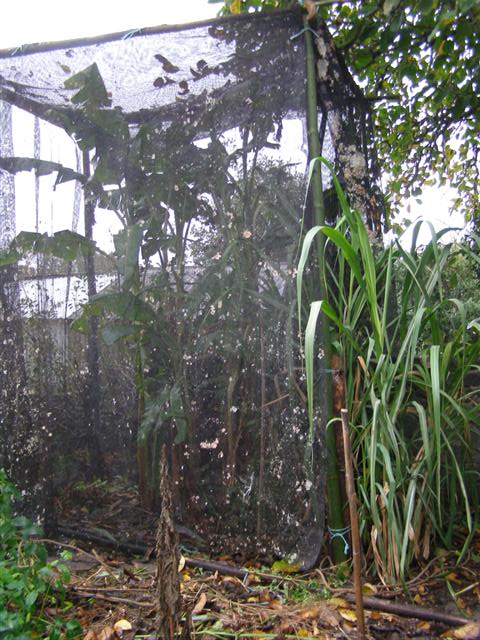
June 1 heralds the official first day of winter here but as a general rule, the worst of the weather doesn’t come until after the shortest day later in the month. July is the worst month, by August we are warming up again. So either it has been bad this week or we are just getting older because it has felt cold, bleak and miserable. Fortunately Mark has his bananas tucked up for winter in an edifice that I style as his Theatre of the Banana.

We can report that the dried michelia wood we are burning in our fire, cut down last year from what Mark has taken to calling his sustainable woodlot (aka reject seedlings from his breeding programme) is proving excellent. It neither splits nor splinters which is an interesting characteristic. Mark is now wondering if it has a future in cricket bats.

Tikorangi Notes: 28 May, 2010

Latest posts:
1) 28 May, 2010: The banana crop of 2010 revealed but really about our recommended tasks in the garden this week.
2) 28 May, 2010: The wonderful lemon fragrance of Backhousia citriodora.
3) 28 May, 2010: More about bananas – our Outdoor Classroom on thinning to get better crops.
4) 28 May 2010: The burgundy coloured loropetalums, China Pink in our case, are a splendid additon to our gardens here.
5) 26 May, 2010: The story of Cordyline Red Fountain.

The persimmon in autumn is more about looks than taste, for us at least

The persimmon in autumn is more about looks than taste, for us at least

As autumn morphs into winter here (to paraphrase our inimitable television weather presenter), we seem to be doing the Squirrel Nutkin impersonation and following a food theme. We aim to be self sufficient in vegetables and most fruit – I say aim, some years we get closer than others. But with only two of us left at home these days, I don’t have to resort to buying much fresh produce at all.

One of the edible crops we grow which we rarely eat ourselves is the highly ornamental persimmon which looks fantastically decorative in the autumn. This is an elderly astringent variety which means one needs to wait until it so ripe it is nearly rotting before it becomes palatable. Even at that stage, I only like the jelly-like segments at the very centre and find the outer flesh rather clarty and sticky. I am sure it would make an excellent gelato, icecream or granita but none of these appeal in the chill of late autumn. It is possible to buy non-astringent fruit and plants which can apparently be eaten crisp, like an apple, but I have yet to bring myself to buy one when we have all these going to waste at home. Except that they are not really going to waste because they bring us a great deal of pleasure over many weeks just adorning the bare branches of the tree.

Tikorangi Notes: May 21, 2010

Latest posts:
1) 21 May: A Worm’s Tale (subtitled: best not display your ignorance on National Radio).
2) 21 May: The perils of monochromatic garden colour schemes (subtitled: we were disappointed in Sissinghurst’s white garden and much preferred the blue and purple border).
3) 21 May: An evergreen member of the hydrangea family that flowers nigh on twelve months of the year: Dichroa versicolor.
4) 21 May: Counting down to our annual spring garden festival – a district round-up.
5) 21 May: Garden hints and recommended tasks for the upcoming week in our autumn conditions.
6) 21 May Autumn flowering sasanqua camellias are tried and true favourites in our climate.


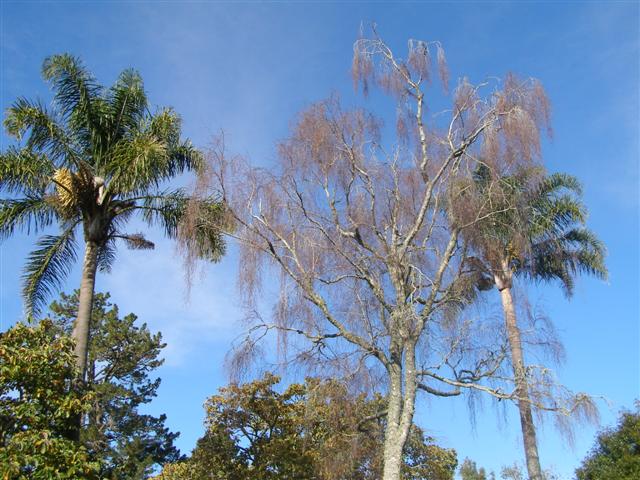
We are not great territory for silver birches. They tend to defoliate long before the summer’s end. Their prodigious quantity of pollen causes hay fever, they seed down far too freely and they are messy darned plants, shedding twigs constantly in our winds. From time to time, we wonder about a death sentence on this betula near our entranceway. But when it is bare, the delicate tracery against the skies is a never ending source of delight. I can’t think of any deciduous tree that brings me such delight in silhouette and as it lacks much foliage for about eight months of the year, that is the dominant picture.

Flagging it on either side are large Queen palms (Syagrus romanzoffiana) now over 50 years old and probably up to 20 metres high. Felix Jury grew these from seed sourced from the Sydney Botanic Gardens. It is a bit of a meeting of two continents, Europe and Brazil – the betula and the palms side by side.

Tikorangi Notes: May 14, 2010

Maybe best not to follow Mark's example
Latest posts:
1) May 14, 2010: The lovely blue of autumn flowering Moraea polystachya keep continuing over a long period.

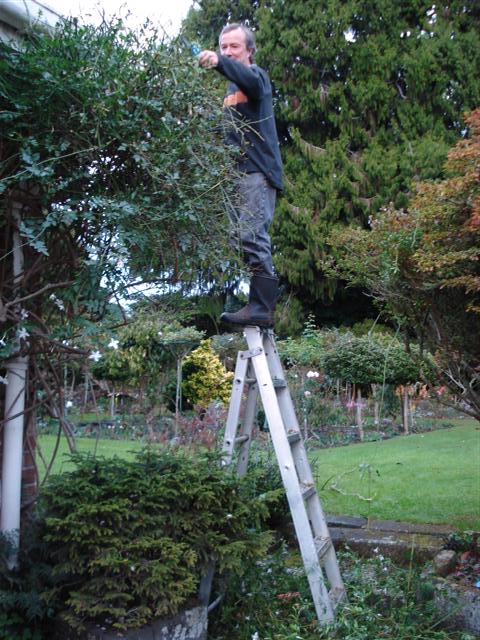
2)May 14, 2010: Outdoor Classroom – our fortnightly step by step guide. This time it is pruning a rampant climbing jasmine which is blocking most light in a window as well as threatening the downpipe, roof spouting and even the roof tiles. We used to have a member of staff who refused to use any of our ladders on the grounds they were unsafe. Mark has no such qualms as can be seen in this photo which we did not dare to use in this Outdoor Classroom instalment which gets published in our local paper. We could see an onslaught of outraged letters to the editor about unsafe practices and that would be from people who didn’t even know that the ladder in question lacks even a bracing cross bar. Mark credits regular yoga for his good sense of balance.

3) May 14, 2010: As our unusually calm, dry and sunny autumn continues, there is plenty to do in the garden this week. Advice on lawn care, harvests, green crops (yet again) and more.

The colours of the autumn flowering oxalis

4) May 14, 2010: After the breathtaking inadequacies of the Tui NZ Fruit Garden, it was a relief this week to be reviewing a NZ publication of merit. Threatened Plants of New Zealand deserves a place on the shelf of anybody interested in our native flora, botany or conservation. Apparently 1 in 13 of our native plants are currently under threat of extinction.

5) May 14, 2010: The first of a new series of notes about plants which are tried and true in our garden – this week the smaller flowered vireya rhododendron hybrids.

6) Camellia Diary instalment number 2. It appears to have been a busy week for me with new posts!

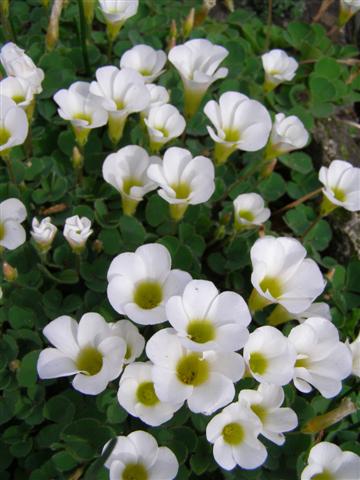
Oxalis purpurea alba - one of the very best garden varieties.

Last week certainly ended on an exciting note with my review of the new Tui NZ Fruit Garden Book by Sally Cameron (published by Penguin) even making the metropolitan daily papers and being picked up by radio as well as other publications. The speed with which the internet disseminates information is amazing, nearly matched by the speed at which Penguin ordered a total recall of a book they had only released days earlier!

This week it is back into the garden. Mark has been continuing his autumn harvesting routines though he had the grace to laugh at his banana harvest which will be revealed in detail in due course. I have to say we are more than marginal for growing bananas and he has to work hard to get a crop from his outdoor plants. In the garden, the ornamental oxalis are making a very pretty picture indeed. I think we must have somewhere around 30 different varieties now across a range of colours. These are surely an under-rated autumn bulb in our New Zealand gardens.