
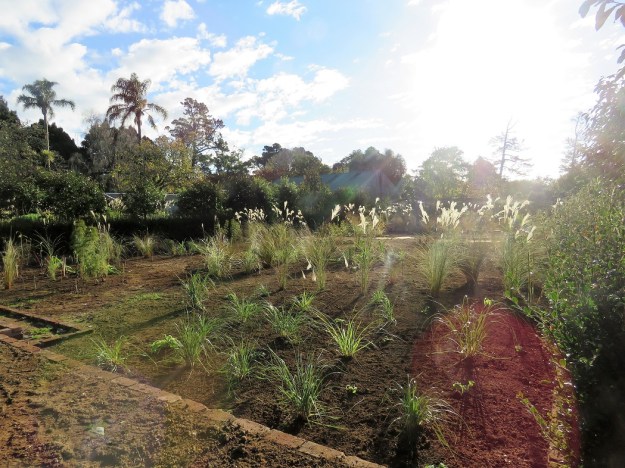
Two weeks and the foundation plants are all in the new Court Garden
“Now you can add the glitter,” Mark said when I proudly announced that I had finished planting the new Court Garden. It has been something of a marathon effort on my part. “What glitter?” I replied defensively, telling him I had put in assorted flowering plants. “Flowers like echinaceas and narcissi,” he said. After all it is to have a prairie look (albeit a prairie on steroids, somewhat styled into waves).
This was food for thought. I rejected the idea of echinacea. The Court Garden is flanked on one side by the twin, herbaceous borders and on the other by the lily border and the unromantically- named caterpillar garden. Over a glass of wine last Friday, Mark declared: “We don’t have garden rooms. We have galleries.” He was taking the mickey, of course. We certainly don’t have garden rooms but I wrote down the galleries because I feared the wine may dull our memories. It seemed a good description of this new garden – a main area with side galleries.
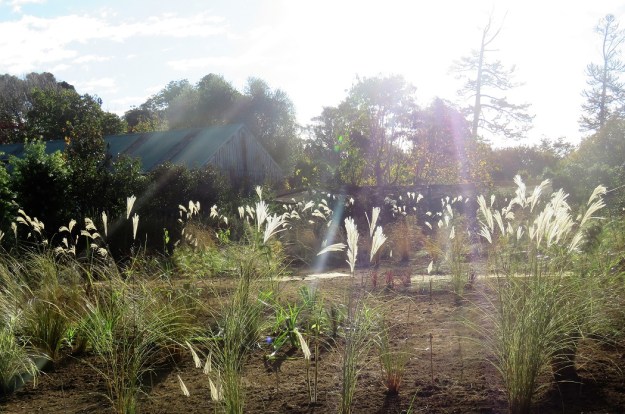
Lots of miscanthus – magical in autumn when back-lit. All our miscanthus descend from a single specimen which used to live in the Iolanthe garden.
In planning the new plantings, one of my ruling principles has been to use different plants in the different areas so they don’t all look the same over time. And echinaceas are a big feature in the twin borders so I didn’t want to repeat them. At this stage, there are only two plants that feature in both the borders and the Court Garden (miscanthus and the giant Albuca nelsonii) and I want to keep it that way. Nor did I plan to plant bulbs through the Court Garden. My vision is big, bold, immersive and generally low maintenance.
My restraint and resolve lasted precisely the two weeks it took to plant the Court Garden. Keeping to about 26 different plants may not seem restrained by some modern landscapers’ standards but it is extremely restrained by ours. In this we are not alone. Mark pointed out that Piet Oudolf’s planting plans can be astonishingly complex when you see his plant lists.
I am figuring that the Court Garden will be looking well furnished by next summer and autumn and starting to hit its peak by the following summer. Having looked at the grass garden at Bury Court, I also expect that over time, the grasses will dominate and crowd out the flowering plants. And I am fine with that. It will be survival of the strongest which means that at least some of the flowering options are short term only. This is not an area for choice treasures that need nurturing and attention to keep them going.
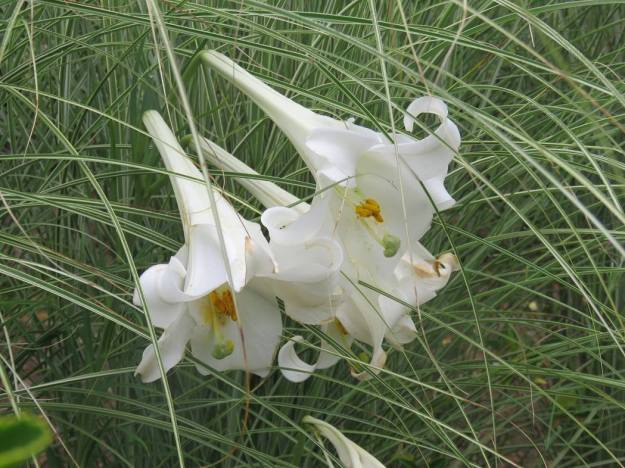
After all, what is lovelier than Lilium formasanum with a backdrop of miscanthus?
But in the interim, I decided that there is no reason why I can’t add plants that will perform and delight even if it is only for a few years. Yesterday, I added some of the autumn flowering Lilium formasanum because it looks so lovely flowering against miscanthus. And a daisy that I am told came from Bev McConnell’s meadow. Now I am wondering about adding dwarf narcissi. We have some trays of bulbs that are already well represented in the wider garden so these surplus are meant to be going down into the park meadow where they may, or may not, thrive. Maybe they could flesh out the Court Garden in its early years instead. They can be the glitter Mark was envisaging.
I used to feel a bit defensive about loving ornamental plants. First we saw the native purist wave – “I will only plant natives. That is not a native, is it?” (said sniffily). Then there was the edibles wave. “Everything in my garden has to be edible or medicinal.” Or worse – and this is what I actually heard proclaimed by a doomsday prepper in Egmont Village – “In this day and age, anybody who plants a tree that is neither fruit or nut or plants that are not edible is a fool.” Apparently hard times and food wars are coming sooner rather than later. But what about feeding the soul with the beauty of a magnolia in full bloom, I wanted to say.
Now we know that the ornamentals are what feed the bees that we need to pollinate food crops. We understand far more about the need to maintain healthy eco-systems. A row of brassicas and a mandarin tree may feed the stomach but their contribution to the health of the environment is minimal. It is not just aesthetics – although a dwarf apple tree is never likely to ever take your breath away with its beauty. It is about working with nature, furnishing the environment, feeding not just the birds and the bees but all other lesser appreciated insects and animals of a healthy eco-system. And it is about feeding the soul.
Good gardening is about a whole lot more than just feeding the human body, creating pretty pictures or improving real estate investments. It always has been but it has probably never been more important than it is now.
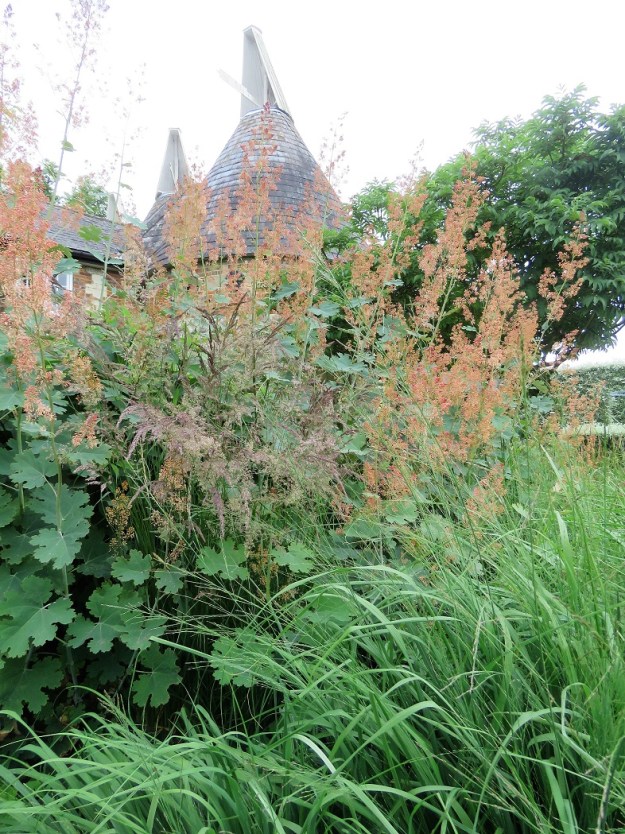
We have plenty of Macleaya cordata but my best photos of it are from Bury Court. Sadly, we lack oast houses here at Tikorangi.
For any readers who like plant lists, below is the initial planting from the Court Garden.
Key grasses and others planted in waves:
Miscanthus ‘Morning Light’
Chionochloa rubra
Calamgrostris ‘Karl Foerster’
Stipa gigantea
Elegia capensis
Astelia chathamica
Chionochloa flavicans
Albuca nelsonii
Other foundation plants:
Curculigo recurvata
Doryanthes palmeri
Austroderia fulvida (North Island toe toe – the only plants I needed to buy in)
5 different phormiums in red and black (‘coloured flaxes’ as we call them in NZ) Only two still had labels on them – ‘Black Rage’ (who named that one?) and ‘Pink Delight’ though all will be named forms.
A random large growing reed
Flowering perennials
Not so much glitter as flowering thugs difficult to accommodate elsewhere but worth a place where they can compete on more or less equal terms
Foxgloves in white and pale apricot
Nicotiania (sylvestris, I think it is)
Verbascum creticum
Fennel
Verbena bonariensis
Salvia confertiflora, and two other very large salvias that I have yet to find the correct names for
Macleaya cordata (plume poppy)

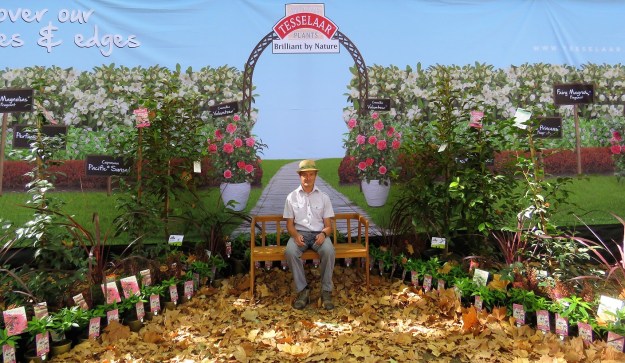 We were not above some pride in what I called the Mark Jury Wall of Fame on the outside of the Media Centre. And Mark was sufficiently gratified to pose for my photos. All the plants except the coprosma are his breeding. Admittedly the Media Centre is organised and run by our agents, Anthony Tesselaar Plants, but it did feel a bit like having a prime position at the show. Sometimes, it is easy to lose sight of the bigger picture when we are immersed in our garden at home and New Zealanders rarely like to hail one of their own, lest that person get a swollen head, so it was pretty interesting to find his standing in Australia is greater than at home.


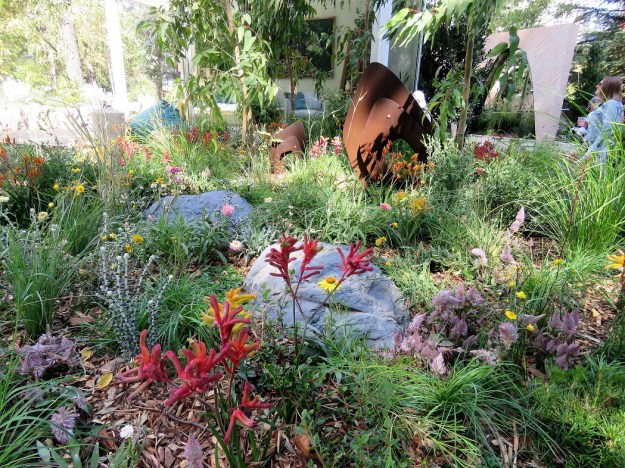
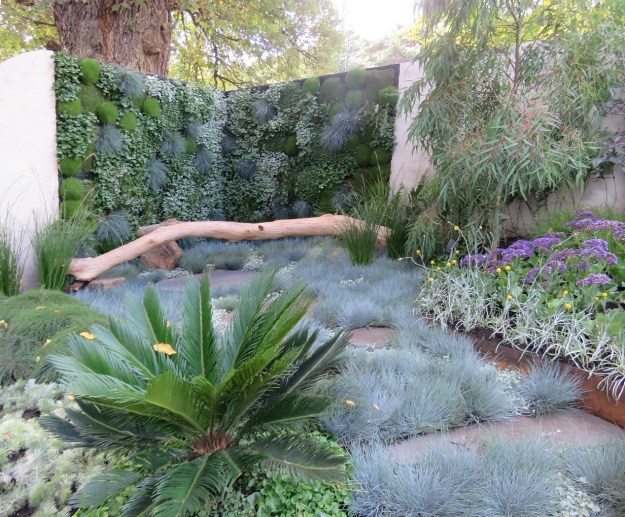
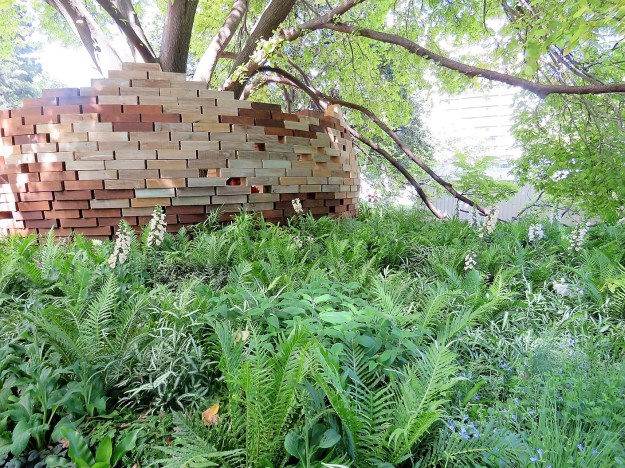
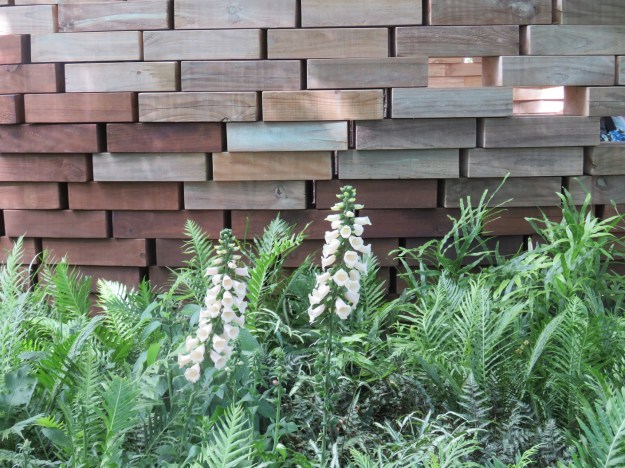


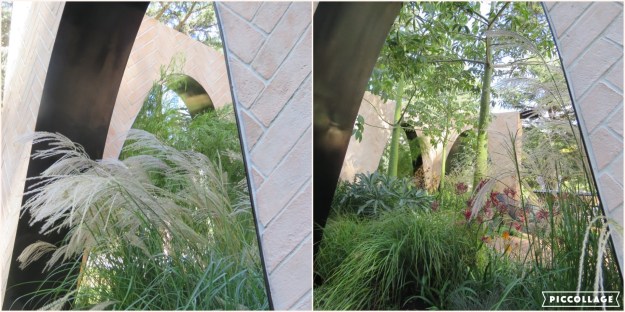
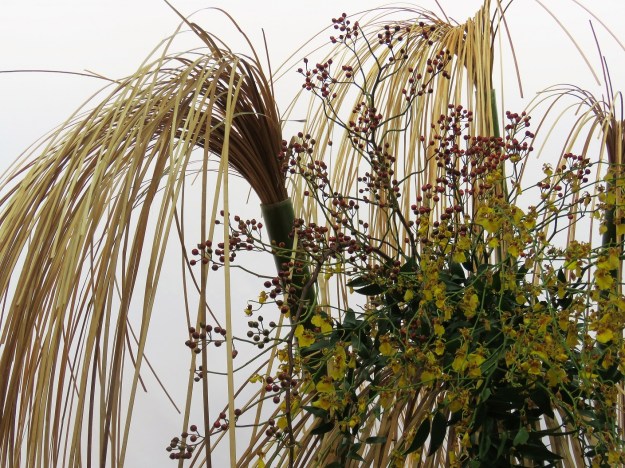

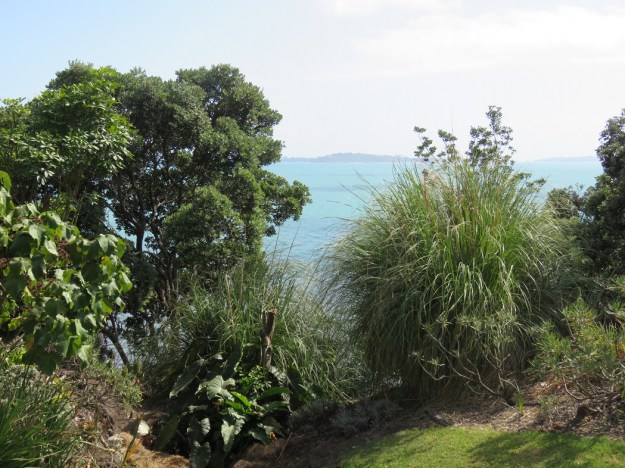 We visited a Mellons Bay garden which had a location and view to die for. It is still very much in development and the owners are making the most of creating a garden space that maximises its remarkable location. It was there that I encountered a grass I had not seen before.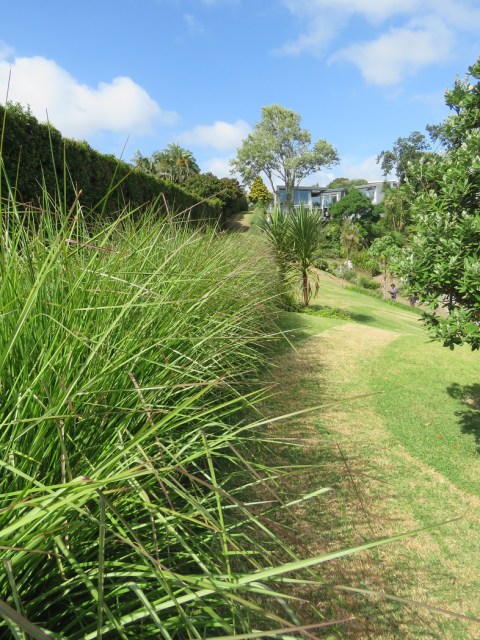
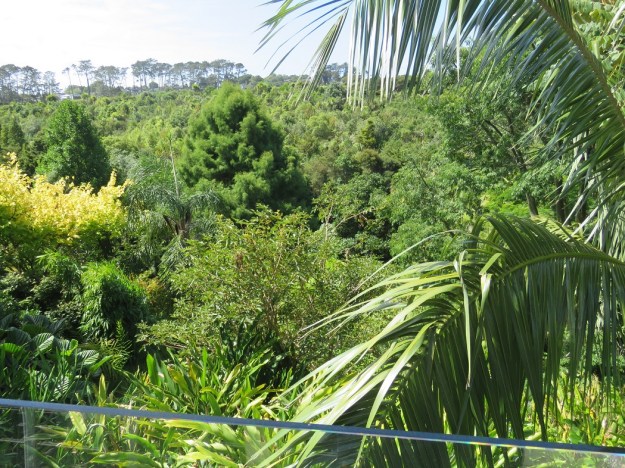
 Added to that, the row of houses have maximised what was once more or less wasteland that runs along the base of the properties. You wouldn’t want to go swimming or paddling in this water (I am guessing most of it is stormwater, supplemented by springs), but it is a delightful, sheltered common space at the end of the gardens.
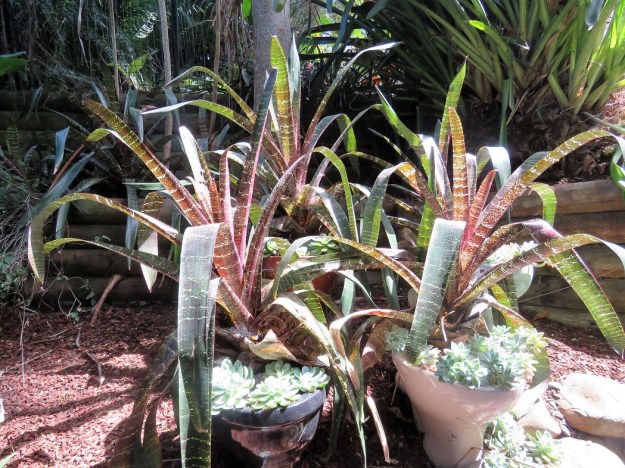 The light was too bright and the shadows too deep to do justice to this cluster of bromeliads but I particularly noted it because it was a counterpoint to the vibrant and bright use of bromeliads mentioned in the first post of these two. This was restrained and understated but maybe more charming for that.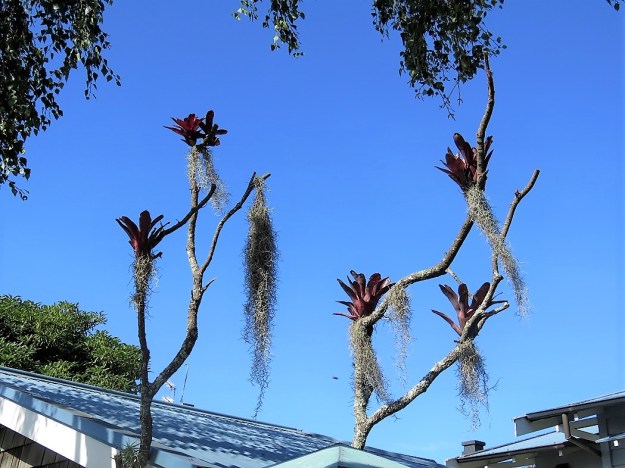
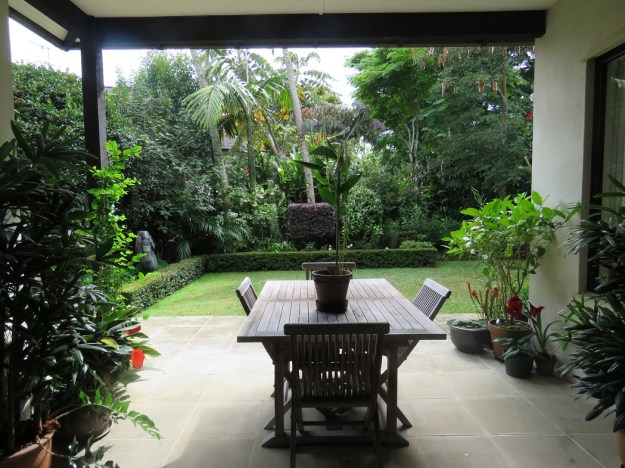
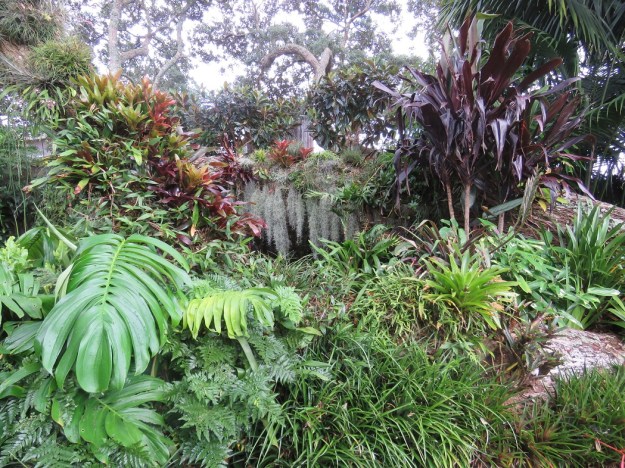
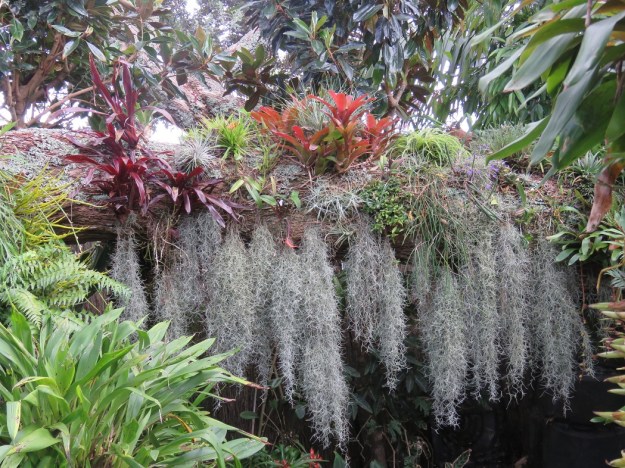 Despite its small size, good architectural design has given it total privacy and a good garden design has given it a sense of containment without being cramped. The level of refinement and detail is exquisite. The foliage is layer upon layer of detail without looking cluttered and the level of plant interest is extremely high. Wherever I looked, there was more fine detail to be uncovered with just the right amount of exotica. It takes a skilled eye and sure hand to be able to achieve that level of detail without it looking confused.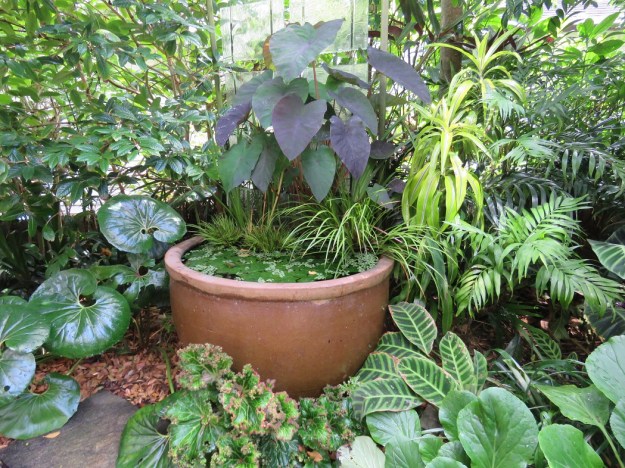
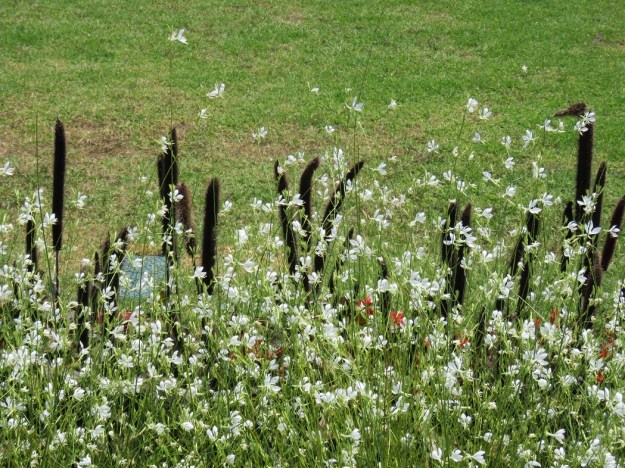 Ha! This strip of waving gaura with Pennisetum glaucum immediately in front of the entry was pretty much as good as it got when it came to summer perennials. There are major works underway putting in a new sealed route through the gardens and when I say road, I mean something that resembles a fairly major highway. It is going straight through the area of summer perennials so there was no summer display that I could find. It is the first time that Auckland Bot Gardens have ever let me down and I did feel a mite tetchy that I had driven all the way out to Mangere on a thoroughly disappointing visit.
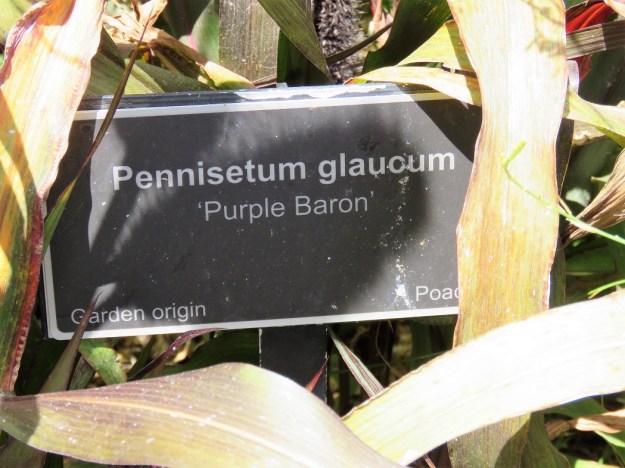 But look at the lovely seed heads on the pennisetum. I thought I needed this plant until I looked at the foliage. Pennisetums are classified as grasses and many have fine foliage. However, Pennisetum glaucum is actually millet, grown commercially for its grain harvest, though these named cultivars with purple foliage have been selected as decorative garden annuals rather than grain production. The foliage is closer to maize than a grass and while it may be possible to keep it lush and dark in a well cultivated and irrigated garden border, grown in harsher conditions, the foliage didn’t have a whole lot to recommend it. The seed heads did, though, especially in conjunction with the airy, waving gaura. In the interests of accuracy, I should perhaps add that there was a row of red bedding begonias in the front but I carefully framed my photo to cut them out. I am not a bedding begonia fan.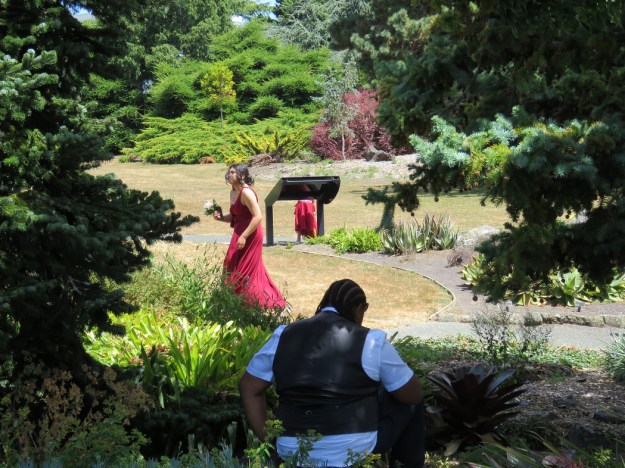
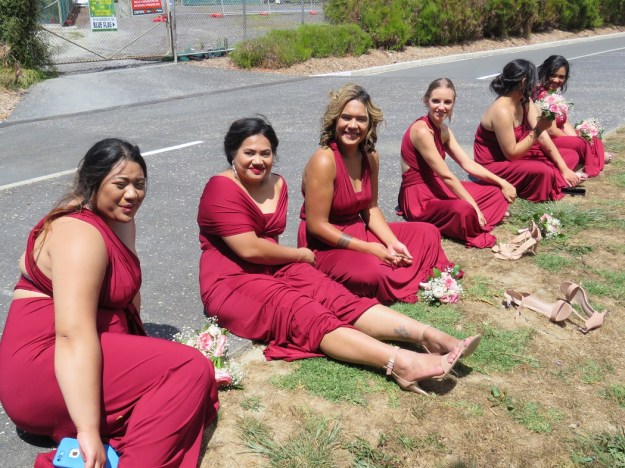 Other than that pretty scene, it was the waiting bridesmaids that most took my fancy. It was a hot afternoon and they must have found their stiletto heels a little taxing for prolonged standing around. I assume they were waiting for the bride but I didn’t quiz them. Now I think about it, I only saw a very large wedding party (there were pretty flower girls, another couple of bridesmaids and a fairly large cluster of well-turned-out young men standing in the shade as well) but no wedding guests. I was more concerned about the missing bride but now I wonder where the guests for this large wedding were hiding out. This will remain a mystery.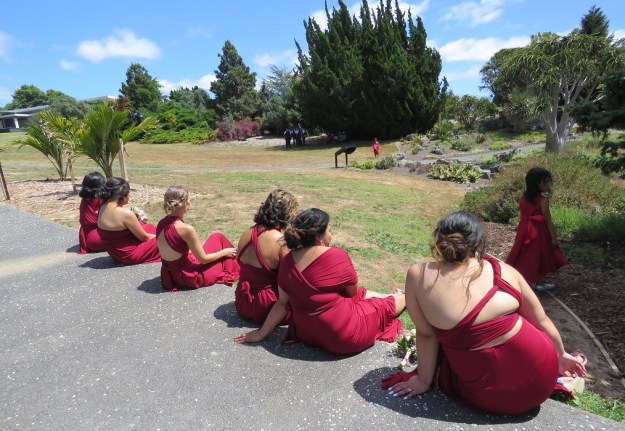



 Tikorangi The Jury Garden