
On our last day in London, we headed off to see the urban renewal project in Kings Cross. Our second daughter had lived in the area for some of her four year London sojourn so I had visited her there, in an ex-council flat. Inner city, gritty urban is how I would have described it a decade ago and I am sure large tracts of it still are. But the greening of Kings Cross has transformed the area to give it a people-friendly heart.
We have no expertise at all in urban landscape architecture and precious little in public horticulture so I make no pretence at doing anything other than trying to convey impressions of the humanising of a former industrial area.
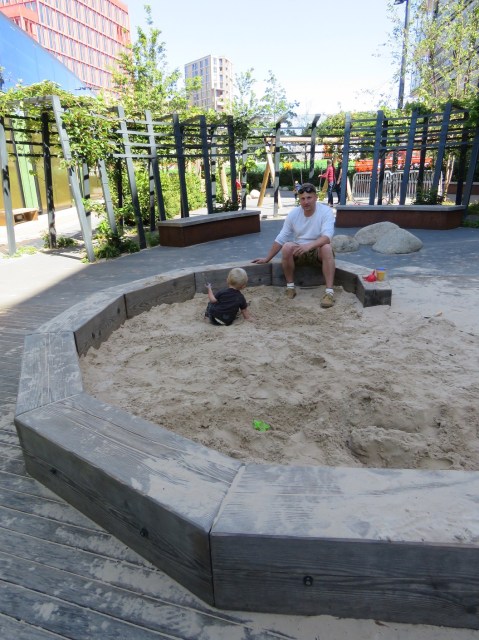
A sandpit in Handyside Gardens
Upon entering a small precinct named Handyside Gardens, what did we see? A sandpit! A sandpit designed to be used by children. I asked the dad’s permission before photographing him with his little boy in the sand. Sure it is surrounded by tall buildings so shade must be an issue, but that is the nature of inner city living. This was an area that had been designed to give a series of intimate spaces with lots of different seating areas. Leading out from the sandpit was a rill or small canal of flowing water which looked clean and inviting for children to play in. Indeed some of the sand had made its way into the rill. “Wait til you see the fountain,” said the father in the sandpit.
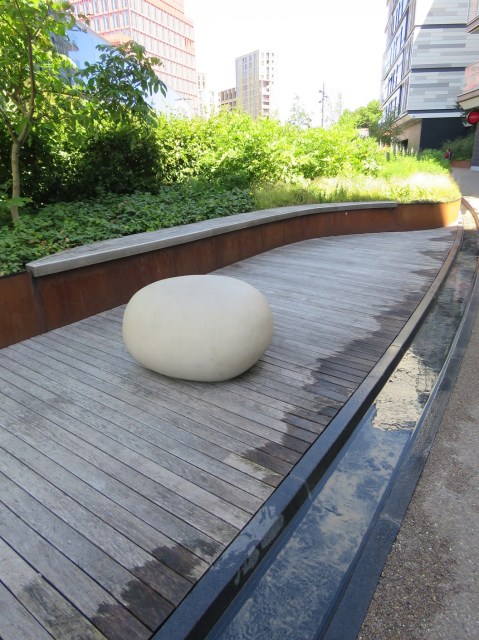
And a rill, or canal
We wandered our way along, noting all the different seating areas and planting that was not out of the usual School Of Bedding Plants and Floral Clocks. These plantings are the work of Dan Pearson whom I have mentioned before although his involvement in the entire project goes well beyond just the planting plans. It is therefore no surprise that there was a mix of material which shows that pretty seasonal plantings are possible even when the brief includes functionalism and practicality. There were plenty of scented plants though a high mortality rate on recently planted trachelospermum jasminoides suggested that somebody may have planted out a whole lot of nursery stock that had been grown under cover and not hardened off.
 As we walked along, we saw a few sodden children in their togs (bathing suits) and towels walking towards us. We rounded the corner and there, truly, was an amazing sight. The fountain in Granary Square. It was large and safe for playing. The seating around was occupied by parents watching their children as the water danced in sequences, sometimes stopping altogether for a brief moment, sometimes shooting high and then in waves across the area. It was magnificent. And safe fun. An urban beach, of sorts. Our kids would have stripped off and been in that water like a shot when they were young. It wasn’t exactly tropical on the day we were there but clearly kids still love water play. At night it lights up – 1000 different points of water and light.
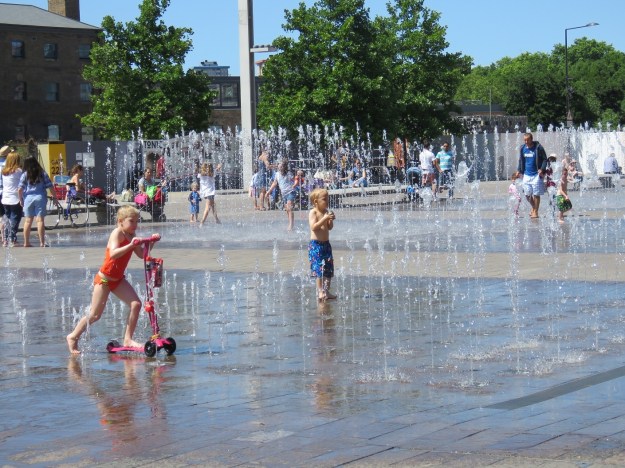
The fountain installation in Granary Square was fantastic
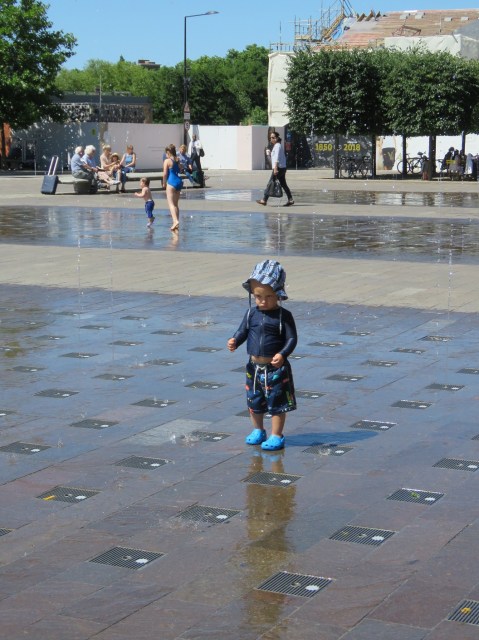
A lull in the water
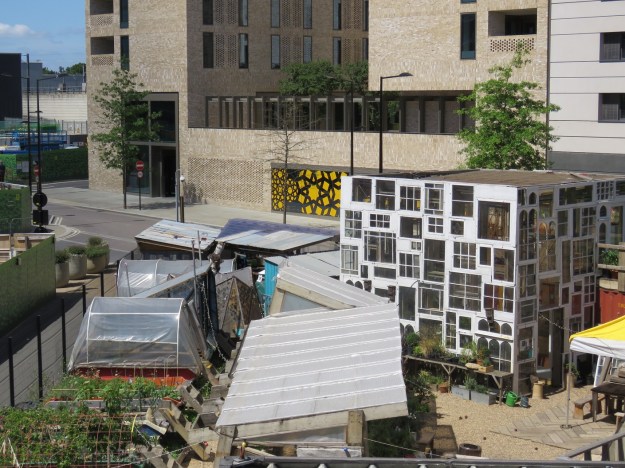
The skip garden. Look at that magnificent glasshouse made form recycled window frames on the right.
Further on we found the skip garden, a movable community garden supported by students at the Bartlett School of Architecture. Unfortunately the skip garden café was closed on the day so we couldn’t try the locally produced fare.
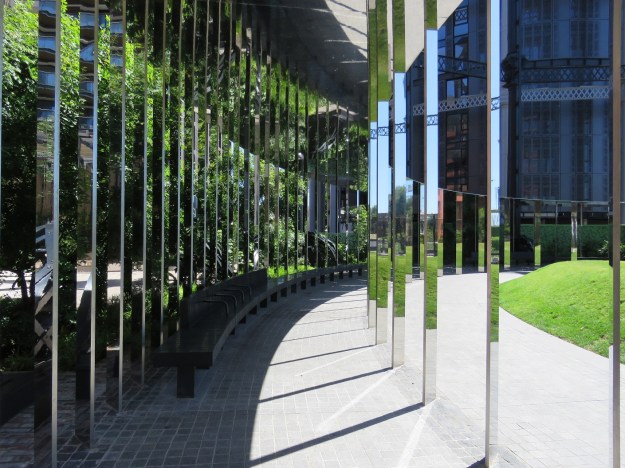 From there we wended our way round to the Gasholder Park, a major redevelopment utilising the old gas tanks for upmarket canal-side apartments and green space and gardens open to all. There is serious money going into this redevelopment around Kings Cross and plenty more information on line if you wish to look it up. The somewhat remarkable impression is that it is not just serious money to cater to the wealthy; it is serious planning to provide an enhanced living environment for all which seems unexpectedly inclusive in this day and age.
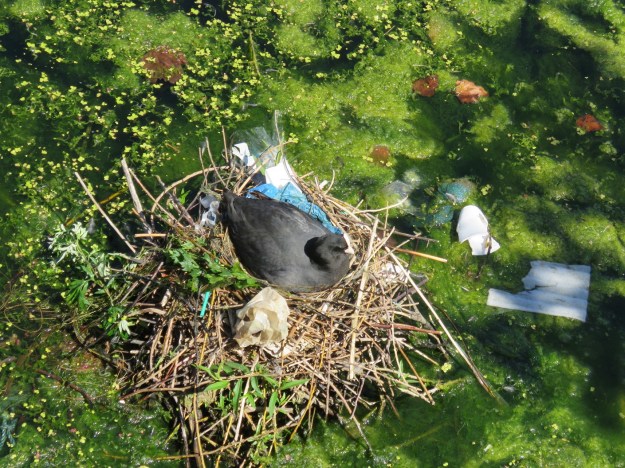
That is a floating nest and the background is green canal water
London has a major network of canals and Mark was shocked every time at the water quality and the rubbish. According to our London friends, ‘wild swimming’ is the rage. That is swimming in ponds, lakes, rivers and canals. We have plenty of issues with water quality in New Zealand, but all I can say is you would be a brave or drunk fool to want to swim in London canals. And you would not be wanting to enter those cesspools with any open wounds or even scratches. Maybe there will come a day when the city canals get cleaned up and no longer used as a receptacle for rubbish. Then the birds may not line their nests with plastic waste.
There was lots more to see around the Kings Cross area but it was time for the flights home. For those who have never done it, this involves around 25 hours flying to New Zealand. It is usually done as two long haul legs of a bit over 12 hours each via Asia (or the USA if you are unlucky) or 7 hours and 18 hours via Dubai or one of the other Arabic emirates. It is not fun.
There is an album of additional photos posed on our garden Facebook page for those who may wish to see more.
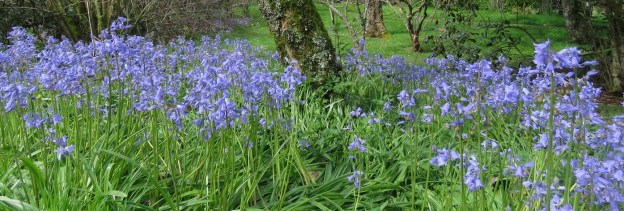
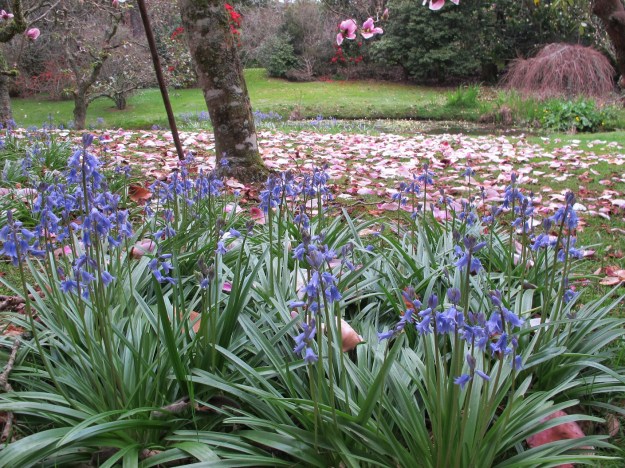 There is something wildly romantic about a proper bluebell wood. I have never forgotten being entranced by the haze of blue through woodlands near Castle Douglas in Scotland and that was more than two decades ago. Those particular bluebells and woodland trees are native to the area but this does not stop many of us trying to replicate the effect at home.
 It took UK writer Ken Thompson to demystify bluebell differences for me. The English Hyacinthoides non-scripta has sweetly scented, deep blue flowers on a droopy spike which means most hang to one side. Individual flowers are narrow tubes with reflexed tips. The Spanish H. hispanica is much stronger growing with an upright spike and flowers radiating all round. There is a greater range of colour from pale to dark blues and lilacs along with the pinks and whites. Individual flowers are bell-shaped and while the tips of the blooms flare out, they don’t reflex. They have little scent.
 A word about white or pink bluebells. While the English bluebell can occasionally throw a white mutant, given the rarity of H. non-scripta in this country, it seems likely that all colour variants we have are either Spanish or hybrids. The whites and pinks are charming mixed with the predominant blues, making a pretty scene. Isolate them out by colour on their own, and they become a novelty plant. Bluebells, by definition, should be mostly blue. A display of only pink bells would look awfully contrived for this simple flower while a mass of white bells might as well be onion weed, really. That is my opinion.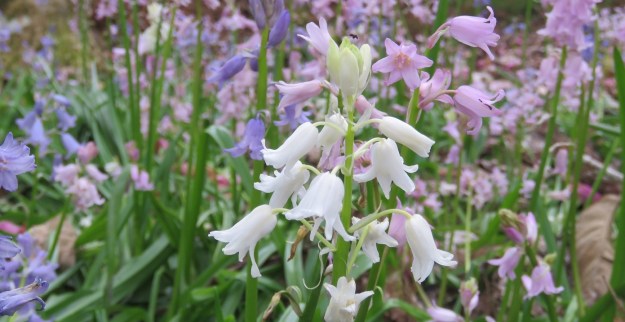

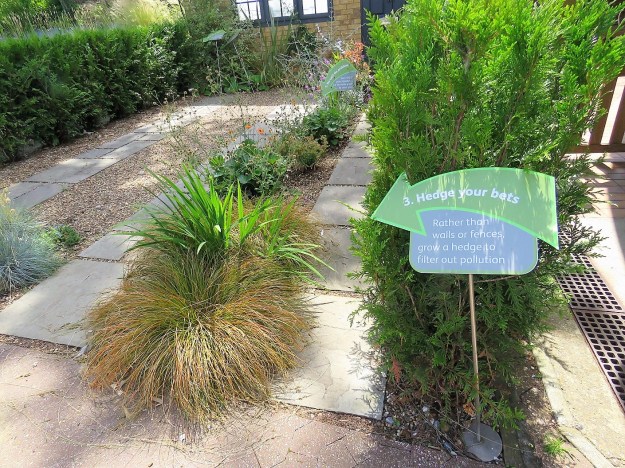
 The environmental benefits of growing plants are perhaps a harder concept to sell to people who don’t see anything wrong with living in concrete jungles. But we ignore the evidence of declining insect populations and the loss of biodiversity at our peril. Our planet is hitting crisis point, fuelled by human ignorance.
 It is not that the RHS are the only body leading public education in this area, but they are an influential one and all power to that.


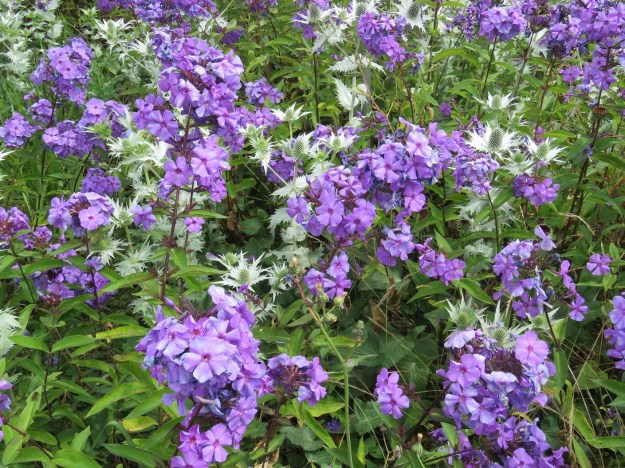


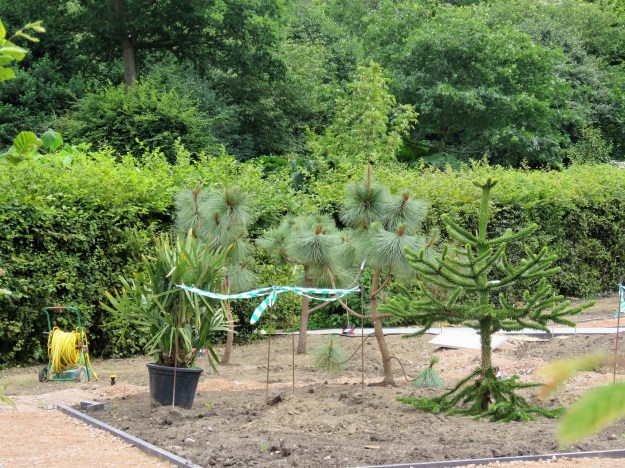 These friends had recently been to Great Dixter and expressed surprise at Christopher Lloyd’s dramatic ‘subtropical’ garden being taken out and seeing conifers going back in instead. It became a little clearer when we came across the Wisley project along similar lines. The conifers are being used as a framework for subtropical plantings. This is not a combination that would ever occur to a New Zealander but we will reserve all judgement until we see the finished product. Sometimes it is good to be surprised. Conifers are long overdue a revival and who knows? Maybe a new combination will launch a new fashion. Or maybe not.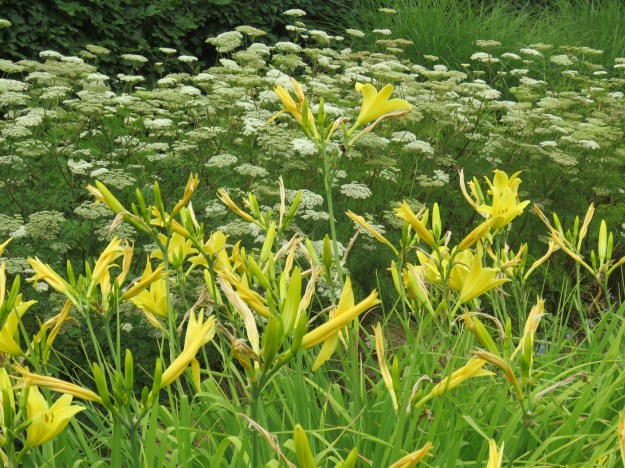
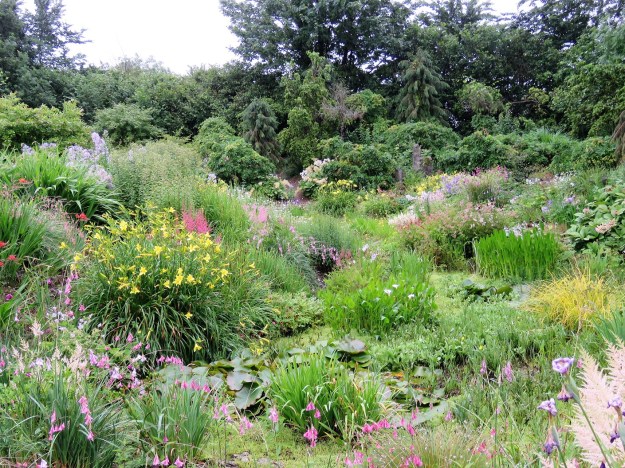
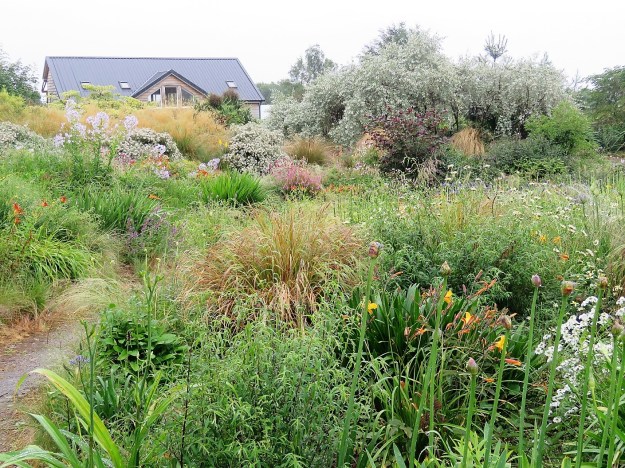 Keith and Ros Wiley had shut the garden for the past two years in order to start building their house and are still only open for very limited days but it is worth planning a trip around those days. It was interesting to see the way in which the building of the house gave a central heart to what is a private and very personal garden. But also, we knew we were looking at a situation where the owners’ energies had largely been going into the house in recent times. The garden hadn’t expanded physically into the remaining areas that had already been prepared when we visited in 2014. It will happen at some stage, I am sure. The existing plantings had filled out and softened in the intervening time.
 Tikorangi The Jury Garden