On dry land – Christmas in Canberra


We spent Christmas in Canberra. Why Canberra, you may wonder. Or you may not. We are one of those New Zealand families where all three of our children have headed off into the merry blue yonder and the daughter with our first and only grandchild lives there.

For those not in the know, Canberra in winter is very much colder than anything we ever get in Taranaki, but a dry cold. Canberra in summer is very much hotter, but a dry heat. I don’t think we had a daytime temperature that was below 30C on this visit and it only dropped a few degrees at night. It doesn’t make gardening easy, although roses are happier there and they can do corker lavender and other Mediterranean plants, along with their own natives.

Helichrysum growing as a wildflower

Adapting to growing a different range of plants and gardening in different ways is one aspect – though their conditions are just a more extreme version of Central Otago, parts of Canterbury and Hawkes Bay. The wildlife is more of a worry.We were staying in a house at the base of Mount Ainslie, a large nature park literally 15 minutes walk from the centre of the city. As she dropped us off, daughter commented that we should take care on the back terrace “because this is Redback Central”. That struck terror in us, especially as I recalled her saying previously that cane furniture is not suitable for Canberra because it was altogether too accommodating to redback spiders. We carefully brushed down the underside of the outdoor furniture before the seating of our posteriors thereon. We weren’t keen on the ants either, though the scarily large ants were harmless sugar ants. Or so we were told. It was the small ants that were the bite-y ones.

Snakes are also common in this inland area and we were a bit neurotic about the ornamental pond in overgrown grass beside the outdoor terrace. Snakes are apparently attracted to water in the dry summer months. Kangaroos graze on the adjacent reserve and the presence of fresh kanga poop on the driveways and paths each morning indicate they extend to the road verges at night. As there is a city ordinance that bans most front fences (though hedges are acceptable), this must be a challenge for front gardens. The abundant rabbit and possum population did not appear as damaging to gardens as we would expect here, though daughter was bitterly disappointed when a possum (a protected species in the homeland) took out her entire apricot crop in one night.

It was protection from the abundant and intrusive birdlife that saw the next door garden shrouded in white netting. The owners, Croatian migrants who escaped then-Yugoslavia in the 1960s for a better life in free Australia, were keen food producers growing many fruits and vegetables. It was an interesting visual effect, the shrouding of the garden, though you wouldn’t be able to expect a fruit crop in our humid conditions with the tree foliage compressed into tight domes.
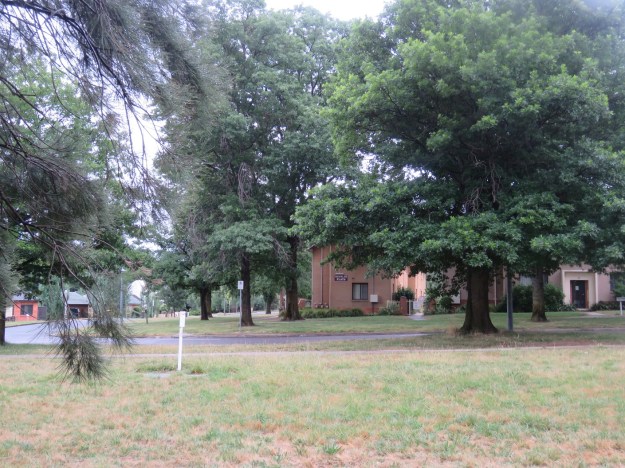
Streetscapes of Canberra
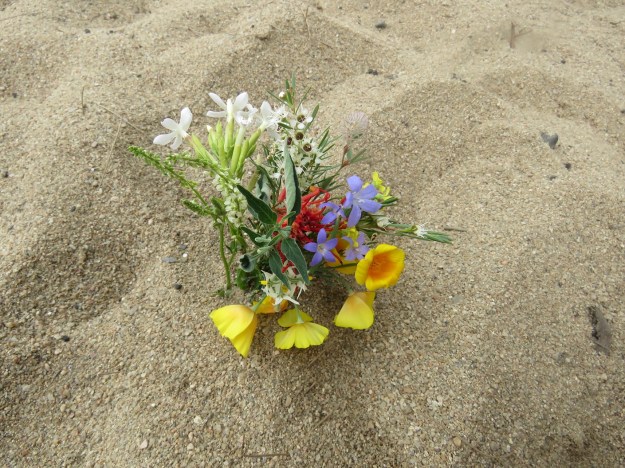
Mark’s little bouquet of wildflowers, gathered by a river

It wasn’t all hostile and locals presumably learn the  routine precautions that are necessary to protect their physical safety while gardening. We loved the dry grasslands and the wild flowers. The shimmering golden light is so very different to the bright, clear light we get at home in our landscape of verdant green and bright blue sky. Being able to take our baby grandson for his first river swims without worrying at all about water quality was a poignant experience for us as New Zealanders of this new millennium. The streetscapes of Canberra are all dominated by wide avenues, even in the suburbs, lined with very large trees. There was no evidence of clamouring locals wanting to take chainsaws to these specimens. Instead, everyone sought out the welcome shade to make walking in the heat of the day bearable.
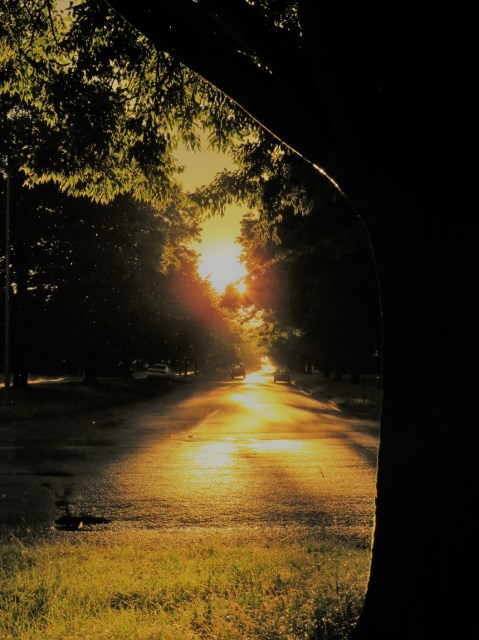
Golden light
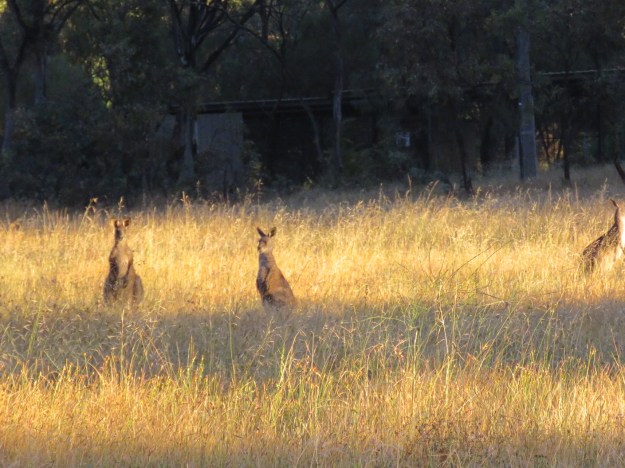
More golden light

In terms of domestic gardening, those who were irrigating heavily to enable a style of gardening imported from wetter climates were very obvious. This looks increasingly irresponsible in today’s world. Astro Turf seemed an option for some who wanted the effect of green lawns without the stigma of irrigation. We bought our daughter a book on American prairie gardens a few years ago and she is delighted with the effect of her little patch of perennials and grasses and waxes most enthusiastically about the feather reed grass – Calamagrostis acutiflora ‘Karl Foerster’’. This style of gardening has very low water requirements so is well suited to her conditions.

We flew home to our own garden which, even though we know it so well, looked unusually lush, well-furnished and, above all, green as green. We’d rather garden here than in a harsher climate and we have much to be grateful for in this country when it comes to the absence of poisonous fauna and large kangaroos.

First published in the March 2017 New Zealand Gardener and reprinted here with their permission. 

Poignancy – taking our baby grandson swimming in the Canberra rivers when this is no longer an option in too many of New Zealand’s polluted rivers

“It’s very personal”

frack-off-show-poster-5-26-march-opening-5-march-3-pm

I haven’t posted about the petrochemical development all around us for some time. It is not that it has gone away. No sirree, not at all. It became a situation where I had to change my personal coping strategies.  Being asked to contribute a piece of writing for the ‘Frack Off’ exhibition that opened yesterday was a poignant experience, focusing my thoughts on what has happened in the area I call home and the extent of the personal impact. Which is why I titled this piece:

It’s very personal 

I live in a place more beautiful than I ever dreamed possible. It is also a place that is now in the evacuation zones for two separate well sites and not so far from another dozen sites on this side of the river. Fracking and petrochemical development is very personal for me. I live with it day and night. Every day and every night.

From 2012 to 2014, I worked with others campaigning for better management of rampant petrochemical development, fighting to save what remains of pre-industrial Tikorangi, the area where I live. It nearly broke me.

My adult daughter sent me an iPod so I could listen to music and shut out the environmental noise when outdoors, as I am most days. How ironic that one of my favourite tracks was the original version of ‘Ring of Fire’ at a time when we often had only one quadrant of the night sky that was not lit up by gas flares.

Oddly, it was a single word – solastalgia* – that enabled me to refocus my life and to learn how to live with the changes beyond our garden boundary. Naming a condition is a remarkably powerful tool and the discovery of solastalgia made me realise I was not over-reacting or going mad. I was in grief, desolated even.

I circled the wagons and looked inwards. Moving is not an option for us. The family roots go very deep here, back to 1870. Quite simply, this is our place to stand.

Petrochem is a sunset industry exploiting a finite resource. I hope I live long enough to see the day the companies exit Tikorangi. But if I am not alive, others will be resident in this place where I currently live. They will see the return of dark nights, unlit by the burning of gas flares and high intensity site lighting. They will listen to the return of silence – the absence of huge volumes of heavy transport, generators priming up to frack, the underlying roar of the gas flare, the sound of a drilling rig, the frequent helicopters and all the clamour that accompanies the fossil fuel industry.

Beyond the boundaries of our property, Tikorangi has changed forever, despite our efforts from 2012. The raising and strengthening of the roads for heavy transport has removed any vestige of usable road verge. The many installations above ground may be removed – the well sites and the pumping stations with their hostile security fencing, maybe even the high-tension pylons and lines. But the network of pipelines below ground, crisscrossing almost every local road and at times running the length of the road beneath the seal, will presumably remain.

None of us can know the long term impact of frequent fracking and deep well reinjection. Will the contaminants find their way closer to the surface? We have to hope that the companies and regulators are correct when they claim it is safe but this is recent technology and the bottom line is that nobody knows.  

In many ways my world has grown smaller. I used to look beyond those circled wagons to the wider community. I learned that in order to survive, I had to narrow my focus. At least this little area where I stand, ringed by trees, can endure.  

Solastalgia It is the ‘lived experience’ of negative environmental change. It is the homesickness you have when you are still at home. It is that feeling you have when your sense of place is under attack.” (Glenn Albrecht, philosopher).

Our Tikorangi corner of the exhibition

Our Tikorangi corner of the exhibition

I feel honoured to have been invited to contribute to this exhibition – awed even, to be in the company of such New Zealand literary luminaries as Elizabeth Smither and David Hill, let alone the visual artists. But our Tikorangi corner was haunting for me, for we are on the front line.

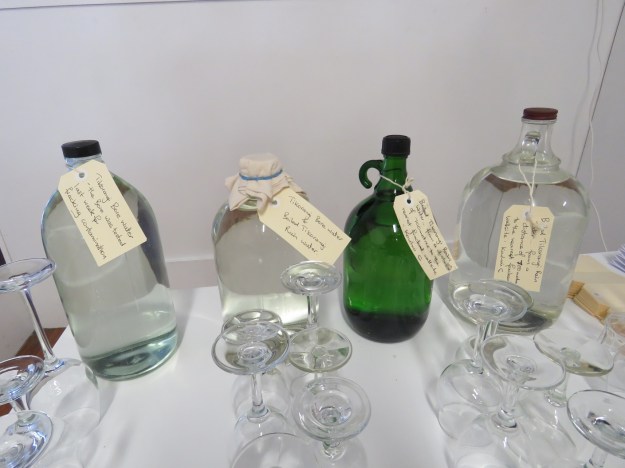
What can I say? That is our tap water to the left.

What can I say? That is our tap water to the left.

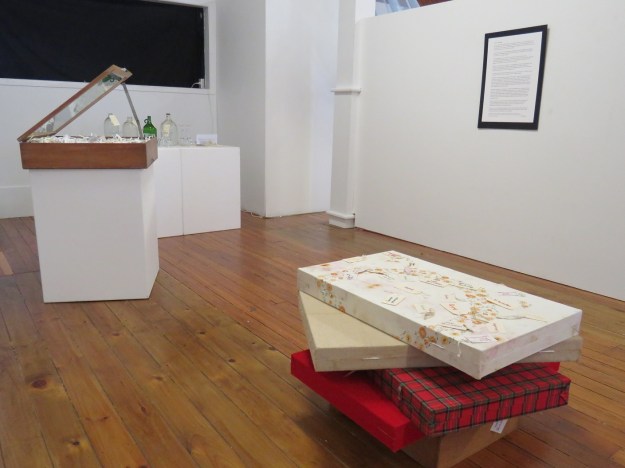
Fiona Clark is both a good friend and a neighbour. She is best known for her photography and has an exhibition opening later in April with American artist, Martha Rosler, at Raven Row in London. For ‘Frack Off’ she chose to go with an installation rather then photography and video.

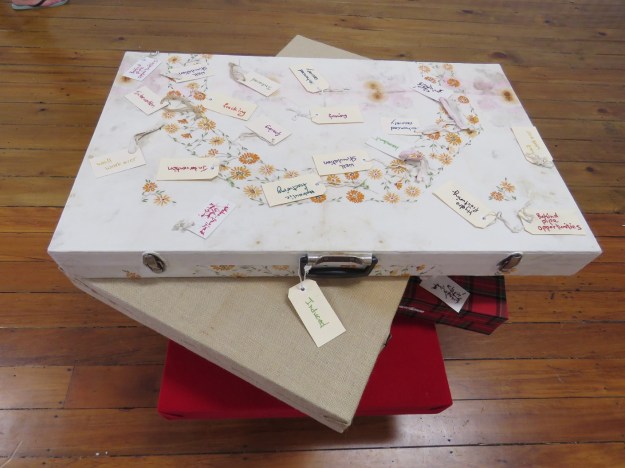
img_4224img_4225

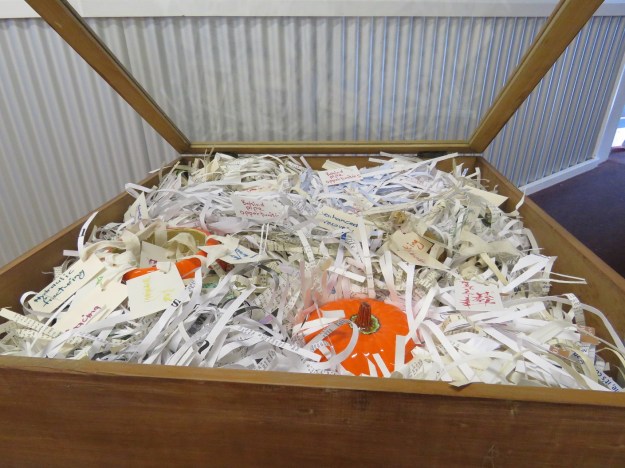
img_4226

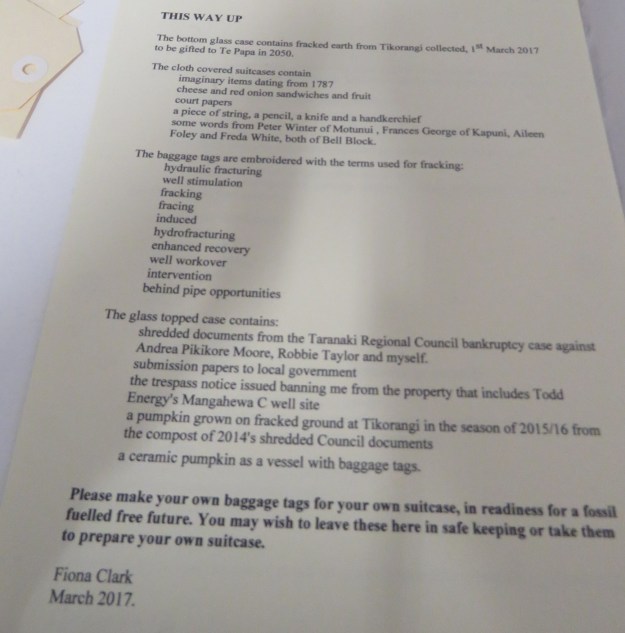
I add Fiona’s words, for those who wish to understand the significance of her display cases.

img_4229

Oh the irony, the irony, to walk out of the Frack Off exhibition and there, all along the main street of New Plymouth are flags and banners welcoming the upcoming petroleum conference. img_4232

Not MY New Plymouth. That is all I can say.

‘Frack Off’ has been curated by Graham Kirk whose own work is the Muppet poster. The exhibition is open until March 26 at the J D Reid Gallery at 33a Devon Street West which is down the bottom of the dip where the Huatoki Stream is piped beneath the the city, near the intersection with Brougham Street. 

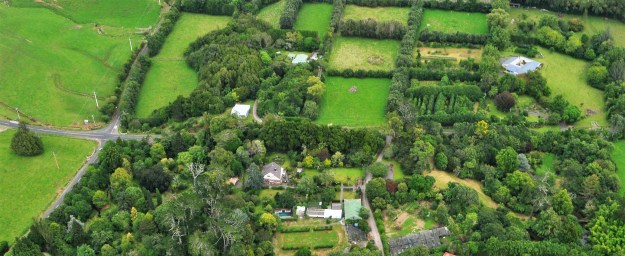
From the air – then and now

img_4207

When we moved in to the family home after the death of Mark’s father in 1997, there were a number of surprises. Some were more welcome than others but the two large format, aerial photos were particularly interesting. As far as we can make out, they must date back to around 1953, soon after the house was built and as Felix and Mimosa were at the height of activity, laying out the garden. The concrete in front of the house is still very new and white, the rockery has been constructed and some of low, stone walls are in place. It does not appear as if the sunken garden has been built yet and nothing has happened behind the house.

Running across the middle of the photograph, the avenue of rimu trees – one of our most outstanding features now – is still quite small and some of the much faster growing Pinus radiata trees are still standing at the right hand end of the rimus. Both the rimus and the pines dated back to the first Jury who moved onto the land in the early 1870s. By that date, the original tawa bush had already been cleared in this area.

dsc_0170

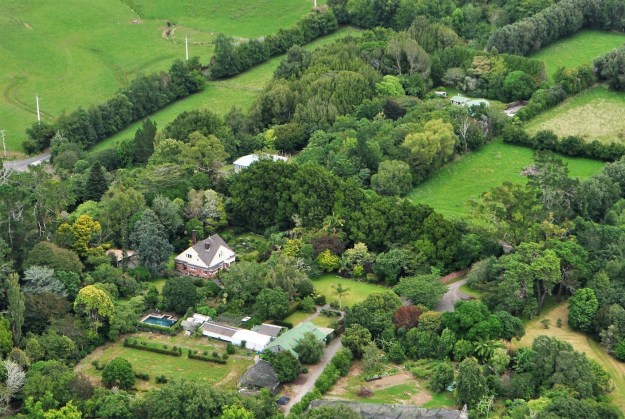
Looking down from above is not a view we see often but last week we had that opportunity.

dsc_0142-2

In the intervening years, the driveway has been relocated, additional buildings and a swimming pool have been added – and a whole lot more planting, although most of the original trees remain. The road runs left to right through the centre of this photo but is now screened by trees.

img_4204

This second photograph was probably of more interest to us than it ever was to Mark’s parents, Felix and Mimosa, because we bought the property in the foreground in 1994 – giving us both sides of the road. The house is shown centre right with the much smaller rimu trees running left to right and a large cluster of puriri trees to the right of the house. Many of these we had to fell because they were in such poor condition in the late 1990s.  No planting has yet taken place in the area we refer to as the park with one notable exception – the significant kauri tree which was the first plant Felix put in.

img_4111

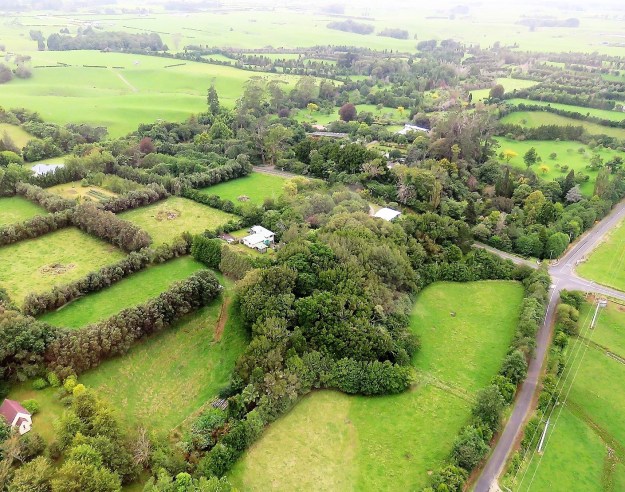
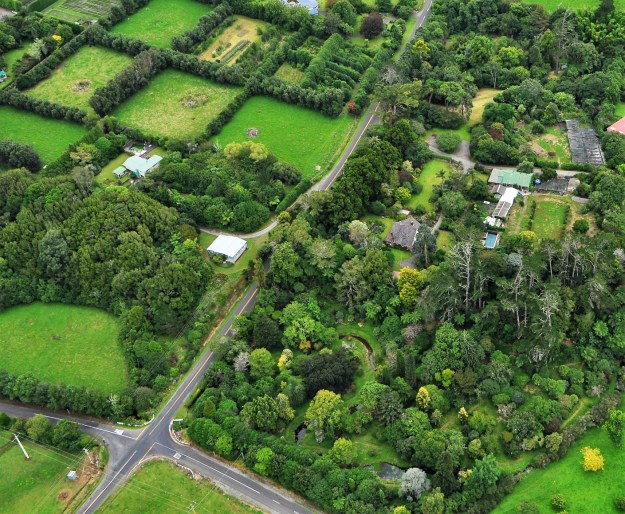
And a similar view from last week. The little church on the left belongs to the neighbour’s but the heavily planted areas on both sides of the road are mostly ours. Mark always regrets that a previous owner of the foreground property (the one we bought in 1994) felt the need to take out all the land contours on the lower paddocks that border the road. Mark would have preferred to work with the better drainage and more interesting  contours that were original.

dsc_0166

What struck both of us from the air, was just how tree-d the place now looks. This was a surprise to us because we work hard to keep a sense of openness at ground level so the effect in the garden is more park than woodland.

All we need now is a friendly person with a drone so we can get the late winter, early spring photos which show the deciduous magnolias and the michelias in full bloom. We have many of both, in the gardens on the right hand side of the photo and in all the wind breaks and plantings on the more utility left hand side of the road. In the meantime, we will continue to beaver away at ground level.

A boy and his tent

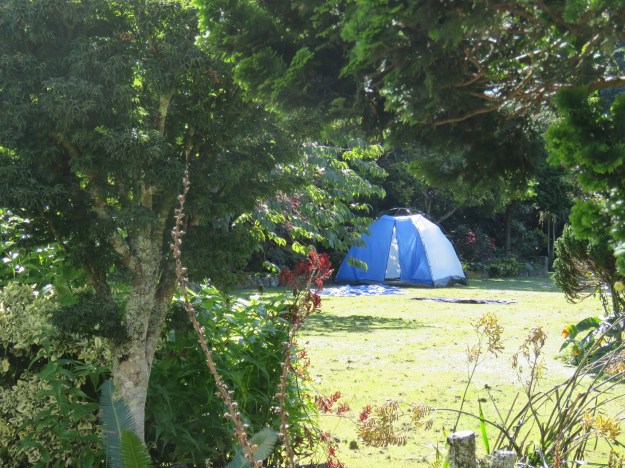
img_4071It was one of those moments of parental delight to put up the little tent on the lawn recently. I needed to check that it was still complete. Our boy was due back in the country and he needed a tent for a music festival in Auckland last weekend, before he and his partner were to travel southwards home. It was exciting enough to be seeing them after a two-and-a-half-year break while they have been living in Amsterdam but that little tent brought back so many memories.
When our children were young, we used to take them camping every summer, travelling around different parts of the country. While we used a one-roomed family tent, small dome tents also featured. We would often pitch the little tent on the lawn outside our bedroom window at home so the kids could play in it and bravely sleep outdoors if they wished. Our boy took it to new levels.

Reluctant to concede the family camping holiday was over one year, he pitched the tent himself on the lawn and moved out to it for a couple of weeks. The next year, he spent longer in the tent and each subsequent year, tent-time stretched further. Seven months, I think was the record. He was not allowed to pitch it until the annual garden festival was over – it was our busiest garden visitor week of the year – so it would go up the first week in November. By the time he was about 11, he was out in that tent through until the autumn rains set in – somewhere around May.

Don’t be thinking his bedroom was awful or even that he had to share it with a sibling. There was nothing wrong with his room in the house. He just liked sleeping outside. He would have his evening drink of Milo (a malted chocolate drink that is a family ritual here), bedtime stories on the sofa, brush his teeth and head out the door with his torch. In the morning, I would open the back door and call to him that it was time to get up for school.

Every four days or so, he was expected to move the tent so the grass beneath it did not die. I would wash his sleeping bag every few weeks and make sure that there was a supply of batteries for his torch. It was his summer dwelling.

From time to time we had to buy a new little dome tent. They are not designed for constant use and will degrade over time in the sun. But for a cheap product, they seemed to last remarkably well and brought him great delight. And despite being stored in the back shed for the intervening years, the last one was still water tight and complete for the festival last weekend.

Our children are adults now and all three of them live overseas so it becomes even more special when one of them comes home for a visit and a lifetime of memories flood back.

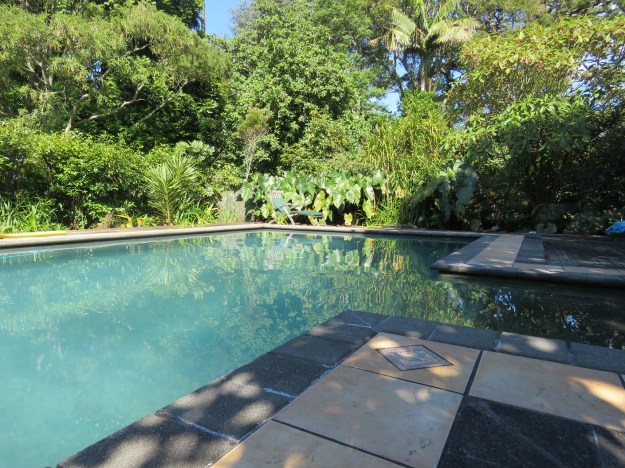
img_4065On the bright side, given that Theo and his partner departed from a Northern European winter under two weeks ago, our miserable summer perked up no end for them this week. They have spent much time in the pool and even I took my first swim of the summer on February 20 (we usually start swimming in December). Summer may be very late this year and will be extremely short as a result. The entire garlic crop succumbed to rust and the rock melon and water melon crops have failed to mature in the cooler, wet weather. But a week of warm, sunny, swimming weather gives a lift to the spirits.
A garden of grasses. Mostly.

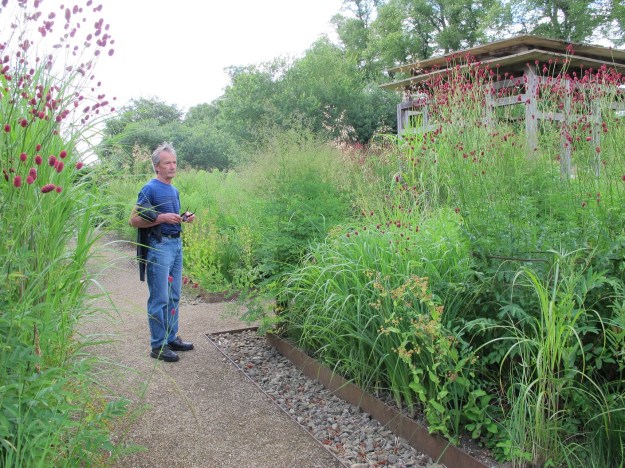
The grass garden at Bury Court

The grass garden at Bury Court

It is interesting to reflect on gardens over time. Sometimes a garden that makes you go ‘wow’ on the day is not the one that endures in the memory. In fact, not wanting to be too dismissive, but it is a rare garden that stays in the memory for long after a single visit.

That is Mark, not the owner, at Bury Court

That is Mark, not the owner, at Bury Court

The grass garden at Bury Court has endured for me. So much so, in fact, that it has inspired me to start a grass garden here.  Bury Court’s grass garden was by leading UK designer, Christopher Bradley-Hole but credit must also go to the garden owner, John Coke, whom we didn’t meet but had certainly stamped his mark on the other areas of the garden which were early Piet Oudolf. It is not that I want to recreate that grass garden which was full of soft, waving, tall grasses in informal plantings but contained within a sharp-edged, rectilinear design with a charming Japanese-influenced summer house at its centre. I am just using it as inspiration.

Anybody who has looked at gardens in the UK and Northern Europe over the past decade or maybe nearing two, will have seen the extensive use of grasses in perennial plantings. It is variously described as ‘prairie planting’, ‘New Perennials’, ‘naturalistic gardening’, ‘Sheffield School style’, ‘Oudolf- inspired’ and, no doubt, other terms as well. The bottom line is that it is the integration of grasses with flowering perennials in various styles and combinations and it has yet to catch on in New Zealand. Towards the end of our last trip in 2014, we started counting the ratios and it was common to see 3:1 – three flowering perennials to one grass. The Bury Court grass garden was 1:8 – that is one flowering perennial to eight grasses. The effect was very different and the movement of the tall grasses a delight.

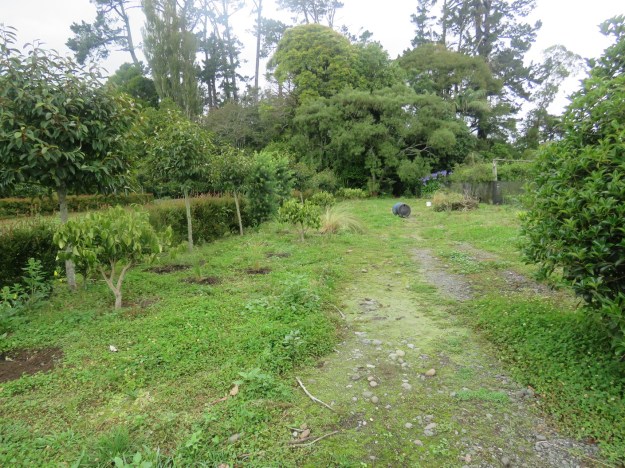
A blank canvas of about 250 square metres (I paced it out)

A blank canvas of about 250 square metres (I paced it out)

I have been incubating ideas for the past three years. In an old garden, it is rare for us to be in a position to start a new area from scratch but that opportunity has arisen. Somewhere over 250 square metres of empty space in full sun with good drainage, in fact, that I can get down on for my grass garden. But we need that amount of space for we envisage B I G grasses waving in the breeze and when each plant will take up probably a square metre, that chews up the space. We have enough highly detailed garden here already, so we are looking at bigger canvas garden pictures with lower maintenance. That is the plan, anyway.

Stipa gigantea, with phlomis, at Wisley. Lovely ethereal seed heads but unproven in our conditions

Stipa gigantea, with phlomis, at Wisley. Lovely ethereal seed heads but unproven in our conditions

Our native toetoe, or cortaderia

Our native toetoe, or cortaderia

We have been given some plants of Stipa gigantea, beloved by UK gardeners. It remains to be seen if it will perform in our conditions, but I have put the first nine plants out. Also our native toetoe (which used to be a cortaderia but has now been reclassified as an austroderia) which will grow here and is our native version of the pampas grass often used overseas. Pampas (Cortaderia selloana) is on the totally banned list where we live, be it pink or creamy pampas. I have a very large miscanthus that I will relocate and divide in winter and a few other different grasses we have gathered up over the years but never found a suitable spot for. In using some of our native grasses and the Australian lomandra, there is an immediate difference to what we have looked at overseas. For our grasses are evergreen and theirs are generally deciduous. That is a big difference. Deciduous grasses give a fresh new look every spring whereas evergreen grasses hold their dead leaves so they don’t look as pristine but they are present all year round.

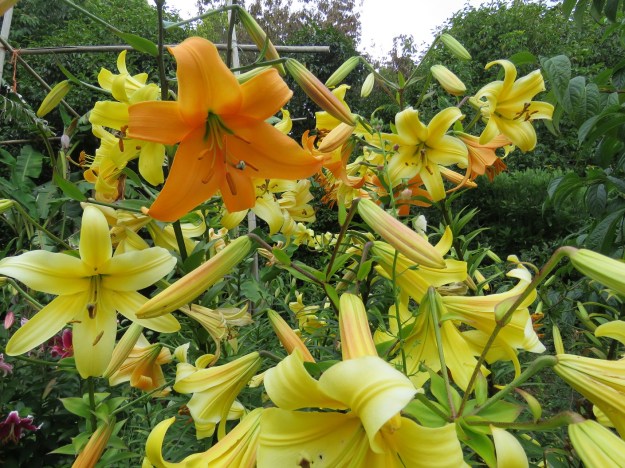
Aurelian lilies in abundance here

Aurelian lilies in abundance here

In terms of flowers, it will be a restrained palette. Mark has raised a lot of Aurelian lilies (clear, bright yellows and few in orange) that flower in early January and are desperate for a forever home in the garden. They will be number one, planted in groups of five. I have no idea how many there are out in his vegetable garden waiting to be lifted – maybe 80 flowering sized bulbs or so?

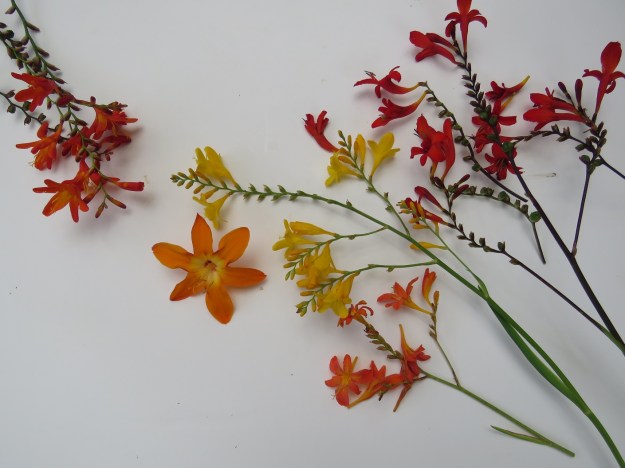
Crocosmia - from left: the roadside weed known as montbretia which is way to invasive to introduce to the garden, a spectacular large orange form that unfortunately does not increase quickly at all, yellow and orange forms and red 'Lucifer' for the new garden

Crocosmia – from left: the roadside weed known as montbretia which is way too invasive to introduce to the garden, a spectacular large orange form that unfortunately does not increase quickly at all, yellow and orange forms and red ‘Lucifer’ for the new garden

For mid summer, the crocosmias can add spots of colour and I may use the pure red and pure yellow tigridias too. We have a giant, autumn flowering yellow salvia that towers over 2 metres high so needs big space. I think that will fit in. Self-seeding, towering fennel (I like fennel flower and seed heads), a tall, creamy yellow alstromeria and that might be it for the initial plantings. The grasses are to be the prime focus in this new area.

Fennel, seen as a roadside weed here but I think it will fit well in the grass garden

Fennel, seen as a roadside weed here but I think it will fit well in the grass garden

Being gardeners, not designers, we are working from gut instinct and experience, not a formal plan. We are debating about whether to turn it into a gravel garden by using fine gravel as both mulch and path surface but that is a bit further down the track. We happen to have a small mountain, almost a mountain range, even, of fine gravel that would be suitable if we decide that is a good idea.

It is not instant gardening. Because it is dependent on plants, not hard landscape features, it will take time to fill in and mature. But that is in the nature of long term gardening – gradual evolution rather than instant gratification.

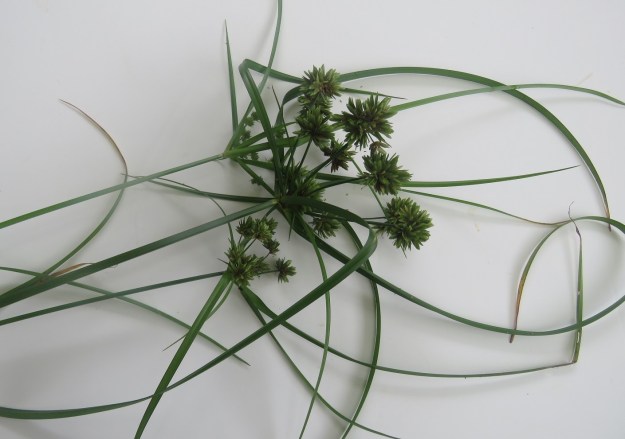
And a weedy carex - at least we think it is a carex, that we are hand digging to remove from both the new garden and the park. Decorative seed heads but way too badly behaved and invasive

And a weedy carex – at least we think it is a carex, that we are hand digging to remove from both the new garden and the park. Decorative seed heads but way too badly behaved and invasive

Postscript: A Facebook follower says of that weedy carex above: “Eek, that weed is a Cyperus eragrostis ( I think) type of sedge.” We are in complete agreement that it is a menace.