For the sake of the birds

I love cats. But when our last cat was in her twilight years, Mark commented that he did not want another. I felt a twinge of sadness, resentment even. But I knew he was right and these days I make do with the cats of the internet.
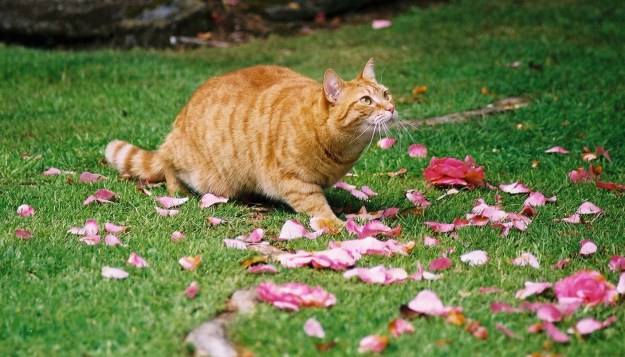
The late Buffy

The late Buffy

In our years together, we have had a succession of furry felines. Every one was both loved and ginger, male or female. To me, all cats should be ginger. Buffy, our final cat, was named by the children for the vampire slayer. She took her name seriously and slayed not vampires, but rodents, probably skinks, birds in abundance and she gave no quarter to visitors who thought they might stroke her without permission or – horrors – move her from a chair that they might sit there instead. Buffy met the world on her terms. And she was a killer.
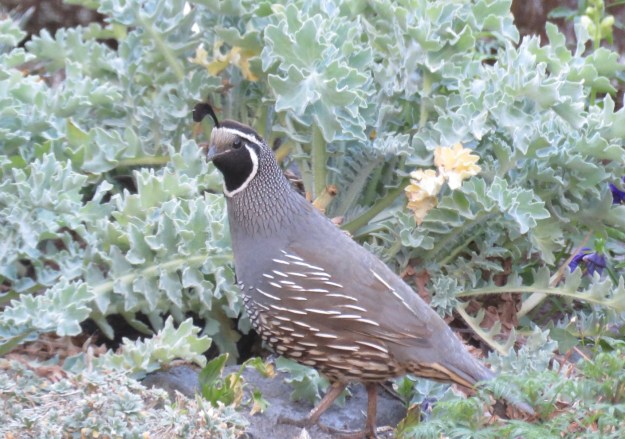
If we still had a cat, we would not have the ground-dwelling quail

If we still had a cat, we would not have the ground-dwelling quail

I believe Gareth Morgan when he says all cats are roaming killers, contrary to what their owners think. The hidden cameras prove him right. Urban cats may not achieve the same tally of bird kill but that is likely to be because of a lesser population of birds. We live rurally with no domestic cats in residence nearby. Mark maintains an ongoing rodent control programme, particularly against rats, and is on constant alert for other predators, including feral cats. We can never be predator free, but vigilance keeps the incidence lower than the norm.
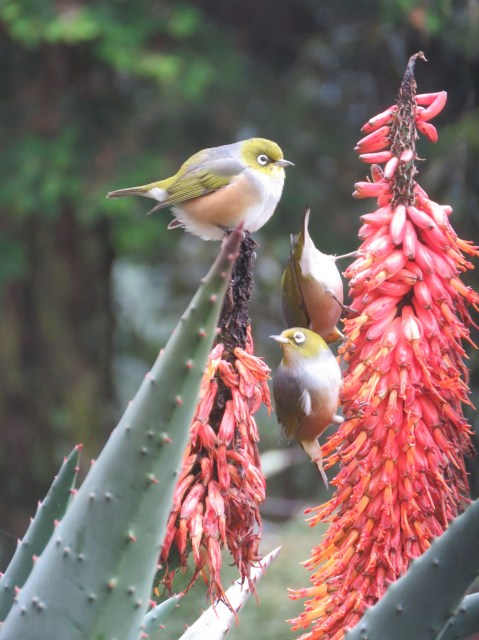
Waxeyes feeding from aloe

Waxeyes feeding from aloe

The rewards lie in the bird population. Everybody I know claims their garden is ‘full of birdsong’ and we are fortunate that there is a certain base-level bird population throughout most of the country. A friend who recently moved from a very large, cat-free country garden to a leafy town suburb commented how much she missed the birdsong. I bet if you asked her neighbours, they would be shocked and think this a gross misrepresentation. But the difference between that base-level population and an environment that is truly rich in bird numbers and variety is huge.  These days, our garden feels so alive. 
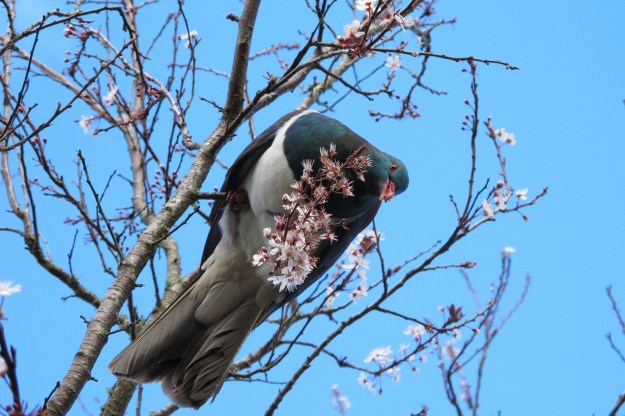
Our beautiful but lumbering native pigeon - the kereru

Our beautiful but lumbering native pigeon – the kereru

We have never set out to feed the birds. But on a property which is heavily planted in both natives and exotics with many different varieties, particularly flowering ones, across 25 acres, there is a succession of food all year round.

We have seen the kaka again recently so it appears to be resident in the area

We have seen the kaka again recently so it appears to be resident in the area

It is not that we have much in the way of rare birds, although the arrival of a kaka for two months in late winter was a thrill and we are on the feeding flight path of native falcons (karearea).  Mostly it is about the tui which we count by the score, the kereru that are permanent residents here, korimako (bellbirds), ruru (moreporks) at night, piwakawaka (fantails), white-faced herons, silvereyes, pukeko, shining cuckoos in season and all the formerly common birds of our bush and grasslands. Then are the introduced varieties. It is one of the delightful introductions that we know we would miss entirely if we had a cat. The Californian quail spend a lot of the time on the ground and nest at ground level so are extremely vulnerable to predation. These are charming additions to the garden, a gentle presence all the time. We do not eat them.
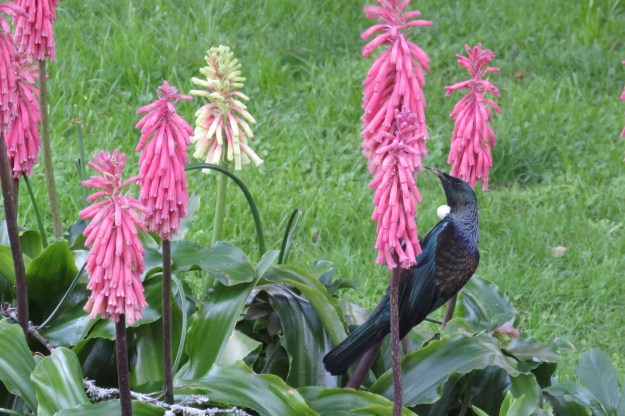
Tui feeding from veltheimia

Tui feeding from veltheimia

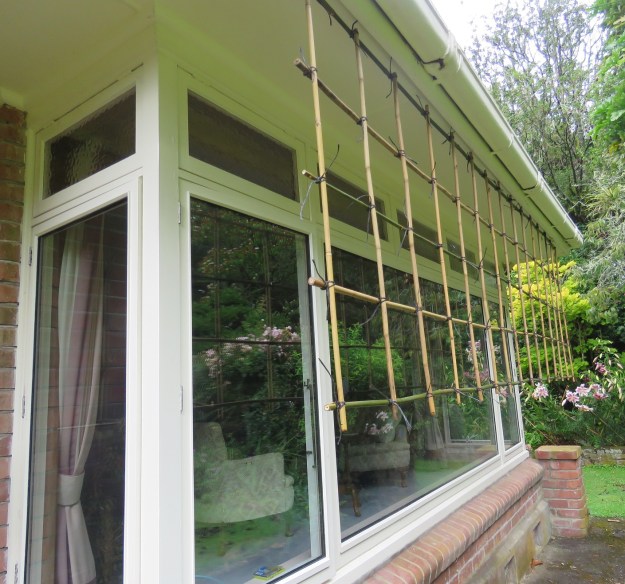
The one grief for us is the incidence of bird-strike on our windows, exacerbated by double glazing which turned the windows almost mirror-like. Because the reflection is all of sky and trees, too many birds think they can fly through. Window decals do not work. Believe me, I tried. A young kereru still died when it flew straight into one. Mark constructed an open bamboo grid that he suspended from the eaves in front of our very large picture window which claimed too many birds. It does not impede the view from indoors and we can still open the windows. Upstairs was more problematic because we lack eaves. Reluctantly – and I say reluctantly because we like the views – we have hung sheer curtains in the two worst affected rooms. These work – Mark has seen a young kereru take avoiding action when it registered the visual barrier.
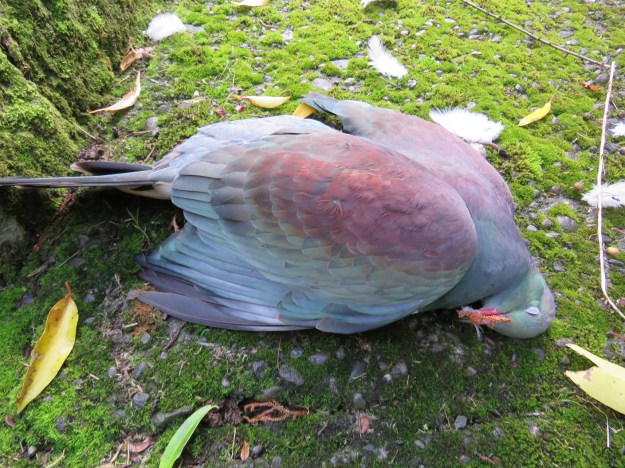
The grief of window-kill kereru
The grief of window-kill kereru

One solution to window-kill

One solution to window-kill

We place a high value on creating a sound eco system and the increasing bird population tells us we are succeeding. It is not just the birdsong. It is the movement, the interaction between the birds (we witness many a battle), the charm of different nests, even the falling feathers – all enrich our lives well above and beyond just having a garden. If the trade-off for us is forgoing the character and pleasure of a resident cat, then so be it. We would rather have the birds.

First published in the February issue of New Zealand Gardener and reprinted here with their permission. 
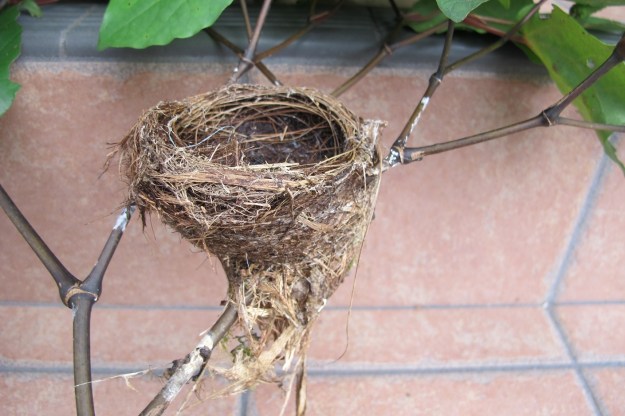
Fantail nest

Fantail nest

Weeding the stream. Again. An ongoing task.

“Believe me, my young friend, there is nothing – absolutely nothing – half so much worth doing as simply messing about in boats.”

Kenneth Grahame, The Wind in the Willows

I misremembered. I felt sure there was a Wind in the Willows quote about messing about in the muddy waters of a stream but I was wrong. Of course they were messing about in a boat, not mud. When I went searching, there were many other charming quotes from the same book which are gently affirming in a world seemingly gone mad, but I found another escape this week.
img_3982I have been weeding the stream. Yes, hand weeding the stream. I see it is five years since I last got down and dirty in the water, although Mark and Lloyd do a certain amount of ongoing maintenance with the long handled rake. I find it easier to climb right in and scoop by hand or sometimes with a rake. It is very muddy and Mark laughs when I stagger back up from the park but I am way too vain (or self conscious, maybe) to immortalise this by taking a selfie of Muddy Me.
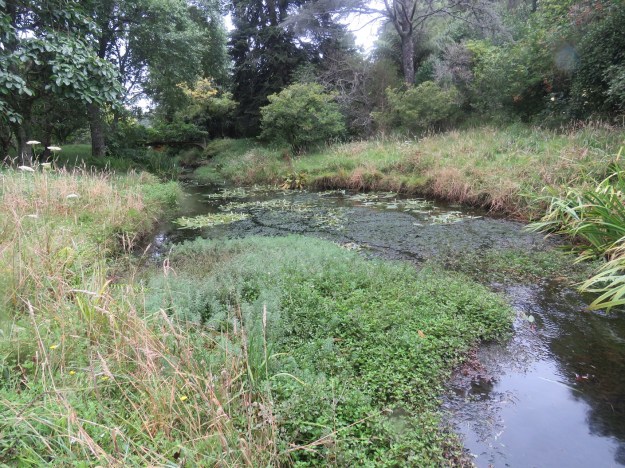
There are both eels and fish in the stream – small fish, mostly mud fish – and I find it deeply unnerving when something smooth and slippery brushes past my bare legs. I wouldn’t be quite so anxious were it not for Mark’s recent encounter with an eel. He was reaching into the water to pull out some blockage when an eel mistook his hand for something else and latched on. There was blood, quite a lot of blood and all of it was Mark’s. Eels are renowned for their backward facing teeth so it is not easy to dislodge them, though I think both the eel and Mark got such a fright that everything went flying. I console myself with the thought that eels are not known for aggressive attacks and it would be bad luck for one to follow up with me so soon after. Just in case, I wear both shoes and gloves as a precaution. I am hoping one will not attack my knees, calves or thighs.  Still, as I reviewed one cleaned area of the stream a few hours later, I was disquieted to see an eel gently swimming along the somewhat bare expanse. But it was a small one and I will not be intimidated.

Clockwise from top left: crocosmia, oxygen weed, wretched Cape Pond Weed, blanket weed and tradescantia

Clockwise from top left: crocosmia, oxygen weed, wretched Cape Pond Weed, blanket weed and tradescantia

But the weeds! We get up close and personal with the weeds that are carried down to us from properties further upstream but the major flood in 2015 has caused us a few more problems than before. Crocosmia, often referred to as montbretia but technically crocosmia x crocosmiiflora, have pretty summer flowers but the huge flood carried the corms far and wide and we are now working on restricting its spread. There is simply too much of it for us to be able to eradicate it and we would get reinfested during the next flood event.

Eradication, however, is the aim with the dreaded Wandering Jew (Tradescantia fluminensis). Mark has spent two decades battling this on our properties but still we get new outbreaks washed down to us. The problem is that every piece that is broken off is capable of growing and it is truly rampant once established. Both the tradescantia and the crocosmia grow alongside the water, rather than in it.

The goal is also to eradicate the oxygen weed and the Cape Pond Weed (Aponogetum distachyum). Mark has succeeded once in eradicating oxygen weed so he was most disappointed when he saw a larger form of it getting established on our place. His theory is that it comes from people emptying their little aquariums into fresh water ways, presumably because they do not wish to euthanise their goldfish and can’t find anyone to give them too. Don’t. Please don’t ever do this. Not only do we not need or want free range goldfish in our waterways, the oxygen weed becomes a choking blanket in slow moving fresh water. We have spent countless hours pulling it out but unless we get every bit, it will grow again. Ditto the Cape Pond Weed, about which I have written several times in the past.

What I call the blanket weed – a mass of very fine filaments – is here to stay but we try to keep it from getting too solid and impeding the flow of water. It is at least easy to rake out. Besides, the aquatic life needs some cover.

We are not perfect. Although we try and dead head our waterside irises and primulas, some of those may have washed downstream. I did at least go to a lot of effort to get rid of the noxious flag iris beside and in the water when we realised what an environmental hazard it is in this country.

In the meantime, there are worse ways to spend a pleasant, mild day than poddling about in the water. Our adult son is returning home from overseas next week and plans to stay for a few weeks. He spent many childhood hours playing with his mates in the ponds and the stream  – boogie boarding up and down and playing bike jumping games into the water. I am wondering at what stage I might suggest to him that it would be a huge help to his Aged Parents if he could turn his attention to scooping or raking the weeds from the deepest sections of the ponds which are beyond my reach. We shall see.

We have lowered the water level to enable major weed removal over the next week or two

We have lowered the water level to enable major weed removal over the next week or two

Garden diary February 5, 2017 – all about flowers this week

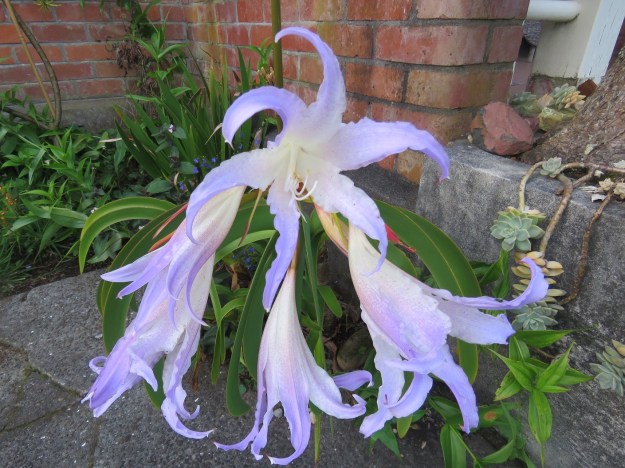
The exquisite Worsleya procera after all the rain

The exquisite Worsleya procera after all the rain

I shall ignore the weather, bar noting that we had over 100ml of rain on Thursday night and while we get some sunny days, this is not summer as we know it. As we enter February, we may just have to accept that full-on summer is bypassing us this year. In the meantime, large parts of the country are in drought.

At least the beautiful worsleya didn’t mind the torrential rain. Maybe it is used to heavy spray, given its natural habitat beside waterfalls in Brazil. W. procera now flowers every year for us – though rarely more than two flower spikes despite the fact we have more than two bulbs – but it never fails to wow us. This really is a most exotic bulb in a particularly unusual blue shade, though neither easy to source nor grow. Ours never set seed because they are all the same clone. It is always extremely slow to set offshoots from the bulb.

Not a Hippeastrum aulicum

Not Hippeastrum aulicum

...despite the label

…despite the label

While on bulbs, I shall be a little unkind and post this photo from my visit to Auckland Botanic Gardens last week. Hippeastrum aulicum? Ahem, I think not. For they are red and flower in August and September. This patch looks mighty like belladonnas to me.

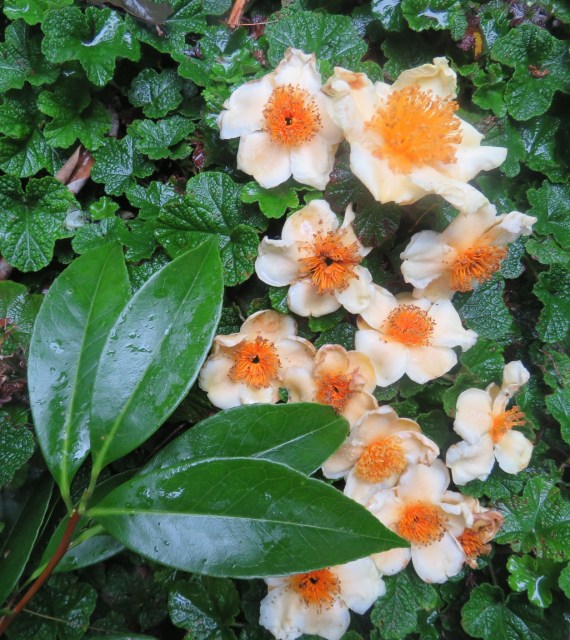
Not a camellia - a tutcheria, we think

Not a camellia – a tutcheria, we think

We went to visit a friend this week for a stroll around his garden – he is very strong on hydrangeas that go way beyond the commercial mop-top macrophylla types. But, while charmed by these, it was the yellow ‘camellia’ that excited us. Here, we thought, was an interesting summer-flowering yellow camellia that was far more sun tolerant than the yellow species we grow and that we had spent some time looking at in China last year. Ignore the background foliage which is the dreaded Rubus pentalobus (though not out of control in this shady spot). I just used it as a carpet to arrange the fallen blooms upon, with a leaf of the plant to the left. It certainly looked like a camellia in flower form, bud shape and texture and it was from a recent interesting plant collection in Asia.

I was about to email photographs to an Australia expert on yellow camellias for an identification when Mark saved us great embarrassment. Sometimes he surprises me with his knowledge, as when he came in and said he thought it was a tutcheria, not a camellia. It took a while to find the right spelling to enable a net search (he is better on names than he is on spelling) and it appears to be Tutcheria championii syn spectabilis and is found in woodlands of Hong Kong. Yes it looks like a camellia bloom and the habit of growth is similar but, like the gordonia, it is simply one of those related plants in the theaceae family which includes all camellias.

img_3969

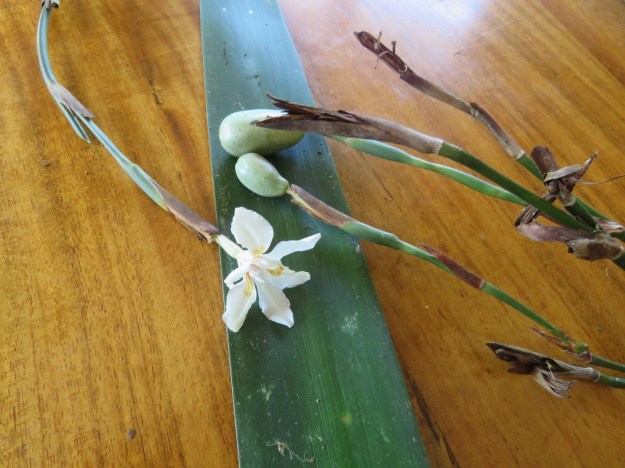
Probably Dietes butcheriana

Probably Dietes butcheriana

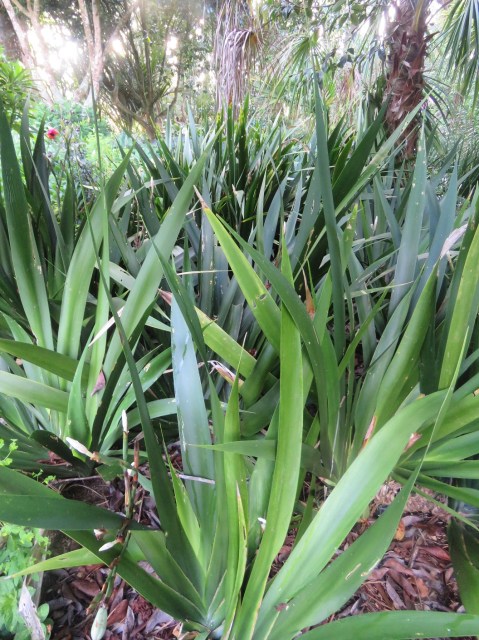
Another plant mystery was solved when we managed to get what we think is the right species name on this dietes. After finding our neomarica was not a dietes, I wasn’t entirely sure whether Mark was right that this was one, either. The foliage is more spectacular than the flowers, which are rather small in comparison and not at all showy. But it appears it is the lesser known Dietes butcheriana that has made itself completely at home in a shaded area of the garden.

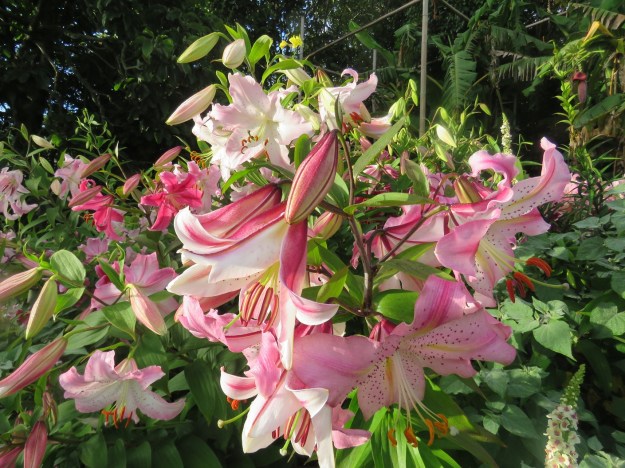
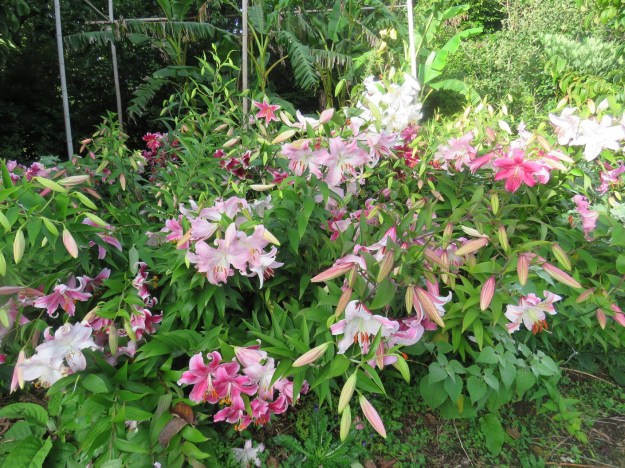
img_3976It is auratum lily season here and we have quite a few of these. I managed to get around staking the garden plants, in anticipation of the UK tour ten days ago – though they failed to flower on cue this summer. I don’t like to pick the flowers from the garden but… out in one of Mark’s vegetable patches, we have a large number of auratum lilies of many hues which Mark has hybridised and raised from seed in preparation for a new garden under construction. This has taken longer than anticipated so the lily patch has expanded and I can cut these to my heart’s content to bring indoors or give away.

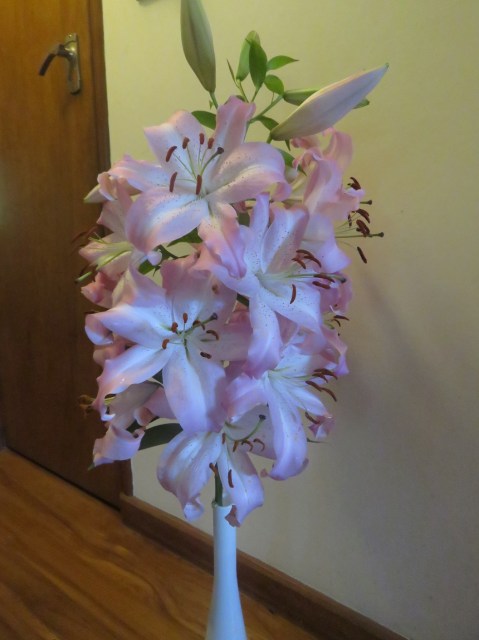
Just a one-off auratum seedling

Just a one-off auratum seedling

This soft pink specimen is decidedly over the top. With 20 separate blooms, the flower spike is much too heavy to ever make a good garden plant and indeed it looked a bit gross out in the lily patch. But it looks splendid cut and put in a vase. You may notice the outward facing blooms. Florists prefer upward facing blooms and many of the auratums offered for sale are upward facing. Felix and now Mark started breeding for outward facing blooms because these make much better garden plants. They are hardier to weather conditions, do not gather debris and suffer less from pollen staining when grown in open conditions. Like many of Mark’s efforts, these are not oriented to commercial production, just to get better plants for our own garden. But oh we do get such a lot of delight from these summer flowers.

The lily patch in the vegetable garden

The lily patch in the vegetable garden

Garden diary, January 31, 2017. Radio, geckos, summer flowers and a tour in the rain.

img_20170129_064707A quick trip to Auckland at the weekend saw me rushing hither and yon but also enabled a face to face conversation with Tony Murrell in the studio at Radio Live. Usually we do these by phone. It is at the unseemly hour of 6.30am each Sunday morning so I had to rise even earlier to get to the studio. These conversations are remarkably complex for the early hour but both Tony and I are enjoying them enormously. Last Sunday it was partly about taking inspiration from other people’s gardens and not falling into the trap of thinking that recreating these ideas at home means using their blueprint, often from another climate, another country and another time. The link is here if you want to listen – it is about 25 minutes of solid gardening discussion.
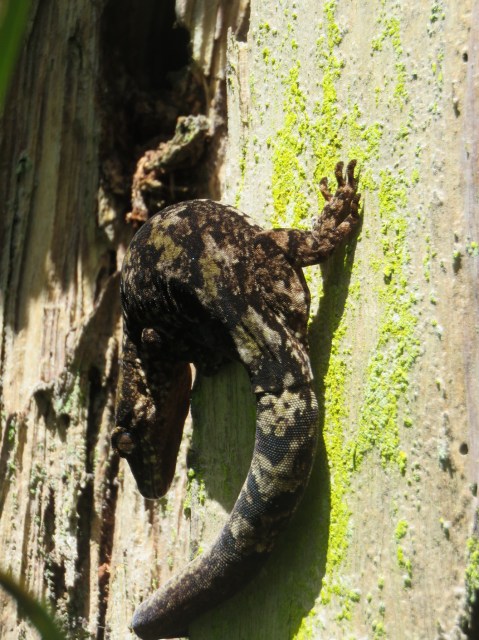
img_3767We did not see Glenys, our resident gecko, last year so were thrilled to spot her again last week. But this one is not Glenys. It is considerably smaller so our best guess is that she is the daughter of Glenys. Whether the mother is still around and we just haven’t spotted her remains unknown but having a smaller specimen this year suggests we now have a breeding population. Why do I use the female gender? Because those more knowledgeable about herpetology tell us that this is the behaviour of pregnant geckos, incubating their young. These reptiles can disappear in a flash if they are spooked so it takes quiet movements to sneak up to see. The safe haven appears to be in the fissures of the tree, beneath the bark.

img_3770The UK gardening tour I mentioned last week has done been and gorn. It rained, steadily, when they arrived which was disappointing but we moved them all indoors for tea and cakes and the rain stopped a few minutes into the walk around the garden. While hosting these tours takes a bit of work and a surprisingly large amount of mental energy, the visitors often repay the efforts in more than money.  Being able to share the garden with appreciative visitors who have a fairly high degree of knowledge themselves – albeit with an entirely different range of plants – is what it is all about really. We don’t garden on this scale just for ourselves and it can be extremely affirming to share it with a group like this one. I have to report that the lilies in the garden did not flower as hoped but we have enough lilies planted “out the back” as we say for me to pick an impressive display for vases indoors and they did not go unnoticed.

img_3900img_3902Also putting on the very best display we have ever seen here is Tecomanthe venusta.  Other plants here may be more floriferous. Indeed there are some years that T. venusta doesn’t actually flower at all, but it is lovely when it does.
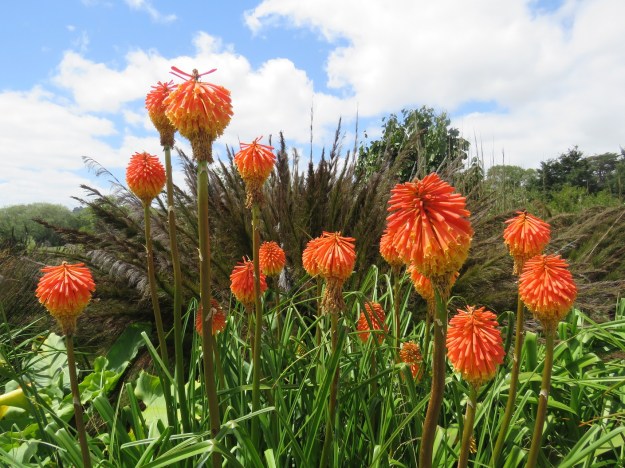
img_3784Finally, a few snapshots of summer flowers I liked this weekend. I called in to Joy Plants to check out their perennials and the kniphofia in the gardens were looking marvellous.

img_3780


There are times we get distinctly sniffy about both agapanthus and red hot pokers in this country but look at this scene – it was simple but lovely.

img_3811

Auckland Botanic Gardens have some excellent, large scale perennial plantings which are well worth a visit at this time of the year. This yellow achillea with a compact, very dark foliaged dahlia which is opening yellow flowers was a striking combination.

Fingers crossed here for some more sun this week and it really would be awfully nice if the temperature rose a few degrees more so we were in the mid twenties, rather than barely breaking into the early twenties.

A melon mystery solved at the Otara markets

We are big melon fans here, though keener on rock melons than water melons. Every summer, Mark goes to a great deal of effort to grow melons and it is either feast or famine – a complete glut of rock melons or next to none – because they need a lot of summer heat to develop and then sweeten before the autumn rains and cooler night temperatures.  But the melons which are often included as part of airline meals on long haul flights were, both of us thought, a terrible disappointment, being served unripe. Not so!

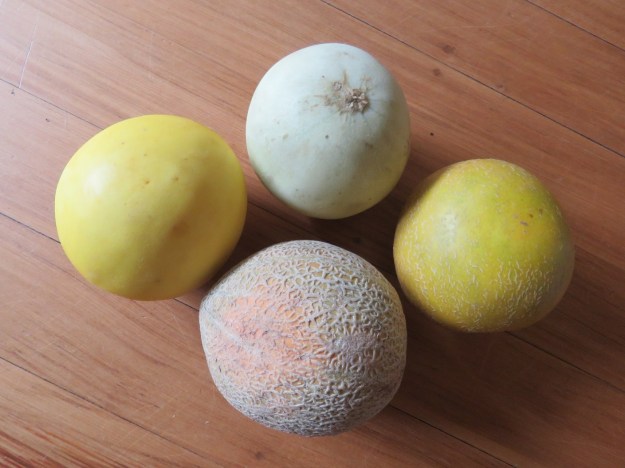
Clockwise from the centre top, bought as honeydew, Galia, rock and Twist melons

Clockwise from the centre top, bought as honeydew, Galia, rock and Twist melons

At the Otara markets, I found a stand of melons which seemed a snip at a dollar each. I had never seen Galia and Twist melons before. The vendor explained to me that that these were firm fleshed variants on the rock and honey dew melons and he specifically mentioned the supply for airline meals. The Galia is a crisp version of the honeydew (green fleshed) while the Twist melon is the crisp version of the standard orange-fleshed rock melon. Crisp melons are varietal, quite possibly bred and selected specifically for markets where soft-textured melons are not easy to handle. So now you know.

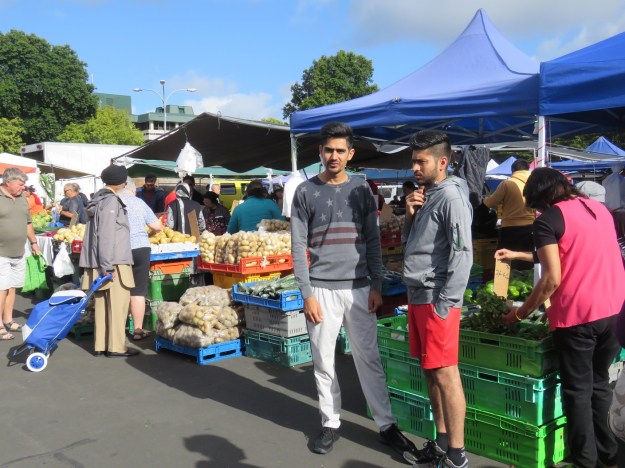
img_3788The Otara Markets in South Auckland are held each Saturday morning. Because I come from rural New Zealand, I find the mix of cultures, different styles and colour fascinating. We don’t see much of this in Taranaki and New Plymouth. We also pay a great deal more for our fruit and vegetables and have a way more limited range from which to choose.

Selling quick-maturing Asian greens from the carpark Selling quick maturing Asian greens from the carpark. 

img_3792Preaching with a loud sound system but no visible congregation or audience.

A spot of faith healing going on beside the carpark, A spot of faith healing being carried out beside the carpark.
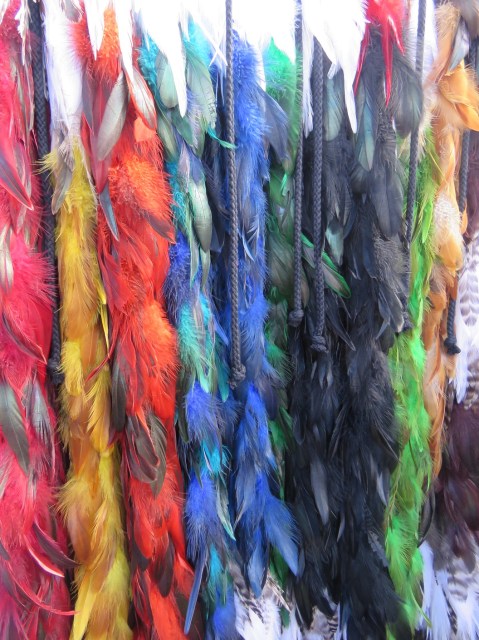
Colourful korowai - traditional Maori cloaks - made with dyed feathers
Colourful korowai – traditional Maori cloaks – made with dyed feathers

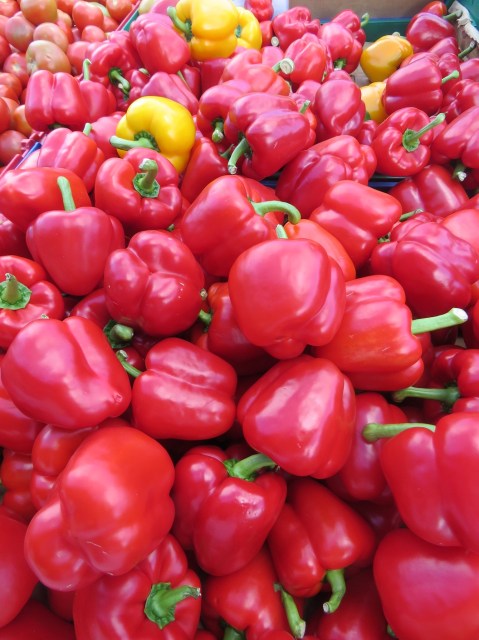
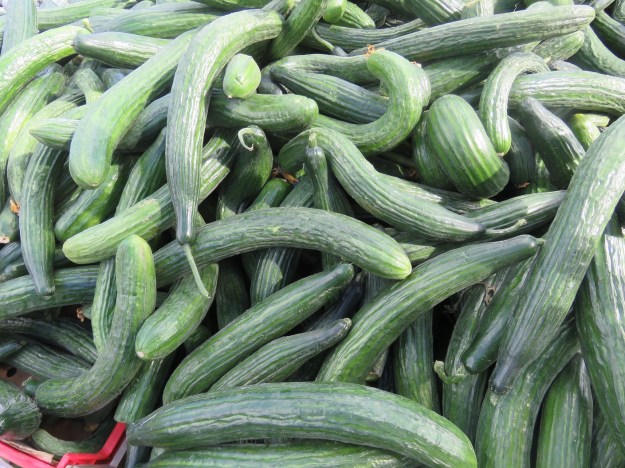
img_3796There is something so visually appealing about piles of fresh garden vegetables being sold on market stalls.
img_3800

img_3797

img_3798