
I illustrate this column with a few photos of gardens that have struck a particular chord, enduring in my memory long past the experience of visiting them. What they have in common is a strong identity and sense of place.
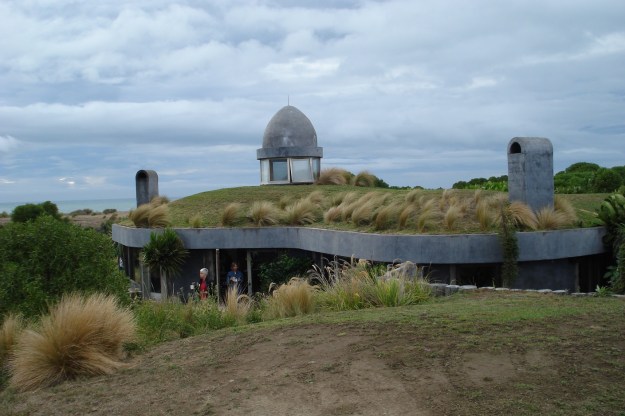
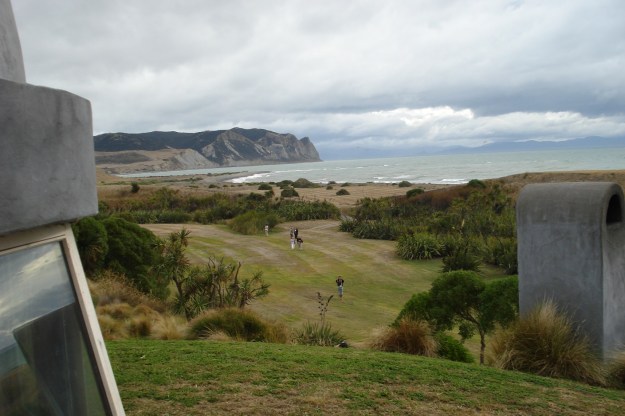
I apologise for the fact that I can not recall the name of the creator of this very interesting house and garden landscape south of Blenheim but I understand he has since died. I have never forgotten this remarkable place
What is it that lifts a garden – a good garden – above other good gardens? I have seen that special character described with various terms over the years, including having ‘soul’ or ‘the wow factor’. Or, more pretentiously perhaps, possessing ‘genius loci’. I wrote about genius loci in a sharp column seven years ago.
Ladies and gentlemen gardeners, it now appears that the current term is that the garden has ‘a sense of place’. It is one that appeals to me more than the soul or wow factor descriptors because it is less subjective.
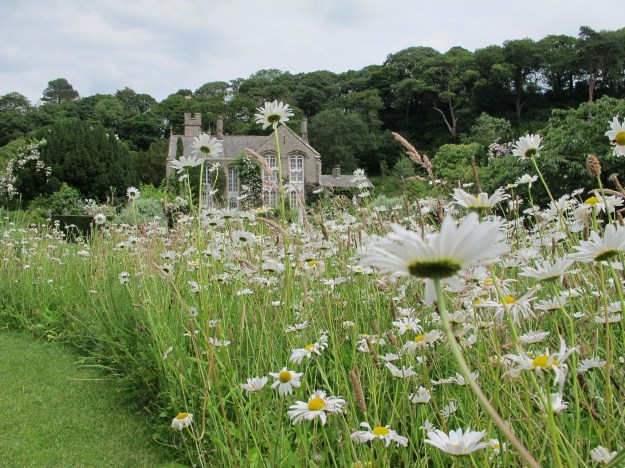
Gresgarth Hall near Lancaster in the UK
I came across the term twice this week, both from UK media. The first instance was a survey on the Thinking Gardens website, being carried out Janna Schreier. Searching for a more rigorous measure than the loose use of the descriptor ‘soul’, she defined ‘a sense of place’ as being one ‘with a distinctive character which fosters emotional engagement’. Her survey then listed possible attributes of that and asked the participant to rank each on a five-point scale. These were:
- Uniqueness
- Strong identity
- Fit with surroundings
- Thought provoking
- Harmonious design
- Brings back memories
- Personal to the owner.
I would point you to the survey but it finished yesterday. In a subsequent exchange of emails, I commented that plantsmanship was missing from that list but was critical for us here when it came to top-level appreciation of a garden. I rank plantsmanship* as being of equal importance to harmonious design. But from that list, I probably ranked strong identity, personal to the owner and maybe uniqueness as most important. Though uniqueness is very hard to define – pretty much every gardener I have ever met who rates themselves thinks their own garden is both unique and original, though too few are. In my opinion.
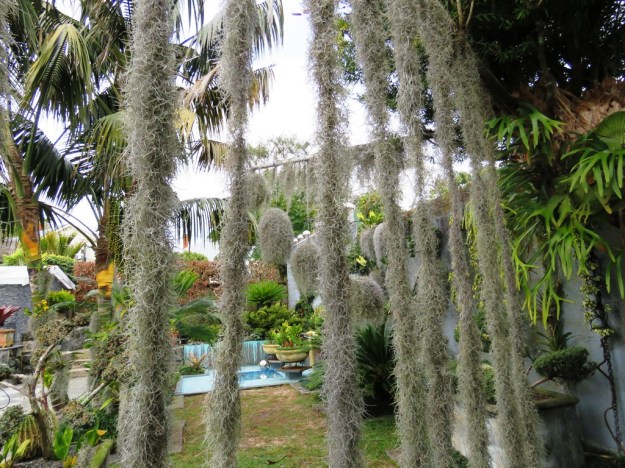
Grahame Dawson’s small, urban, industrial chic garden in Auckland challenged my preconceived notion that such plots of land must, by definition lack genius loci
Two days later I saw a tweet from Dan Pearson*, the UK landscaper for whom I carry a bit of fan-girl torch.
Another inspiring day talking gardens with Troy at Sissinghurst. Sure progress with their project to key the gardens sense of place.

Could anywhere have a stronger sense of place than New Plymouth cemetery?

Aha! I thought. A sense of place is it, then. And I like that term. It is much more encompassing than just ‘genius loci’. Oddly, we have our own word in New Zealand. Our country is gently taking on more Maori words into our language, particularly when there is no word for word translation that captures the complexity of the Maori concept. The word is tūrangawaewae, about which Te Ara, the Encyclopaedia of New Zealand says:
“Tūrangawaewae is one of the most well-known and powerful Māori concepts. Literally tūranga (standing place), waewae (feet), it is often translated as ‘a place to stand’. Tūrangawaewae are places where we feel especially empowered and connected. They are our foundation, our place in the world, our home.”
I recently described our garden as ‘our place to stand’. Must have been a bit prescient there? Though a “place to stand” is more about the personal experience of the garden-maker than the “sense of place” which is the experience of the fortunate garden visitor. Certainly there is something special that sets apart some gardens over others, that makes a few gardens particularly memorable. I am happy to consider that above design, context, plant content and maintenance, that special quality that sets them apart is indeed that they have a clear sense of place.
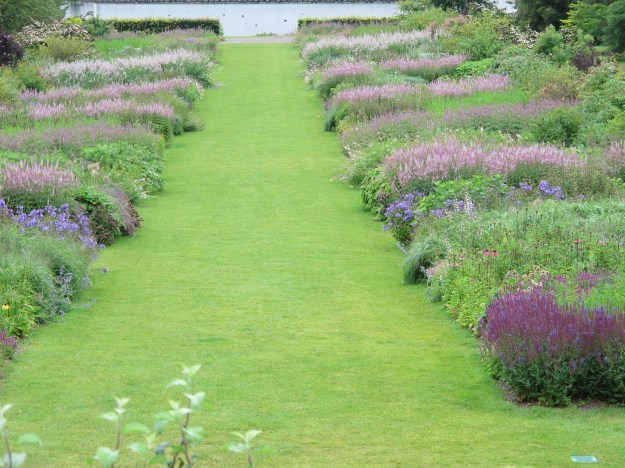
I have not often seen that special quality of a sense of place in public gardens but the Oudolf borders at Wisley are a notable exception
Footnotes:
*I continue to stick with Mark’s off the cuff definition of plantsmanship, even while I hesitate over the gender reference in the word: “The ability to use different plants in creative ways in the right environment and to feature unusual plants.”
*I subscribe to Dan Pearson’s weekly blog – Dig Delve. It is a gentle insight into plants and the very personal garden he is building with his partner, Huw Morgan. There is no big-noting, self-promotion or even that faux modesty that is now favoured by many writers. Rather, it is quiet and modest, an insight into creating a garden from scratch that focuses on eco-systems, sustainability and soft-edged naturalism. I find it most refreshing and calming in this day and age when so much of gardening appears to be about whizzy-bang instant results to impress.

I had a special affection for Te Popo garden when it was in the hands of Lorri and Bruce Ellis and I now see that response as inextricably tied up with that strong sense of place that they created.
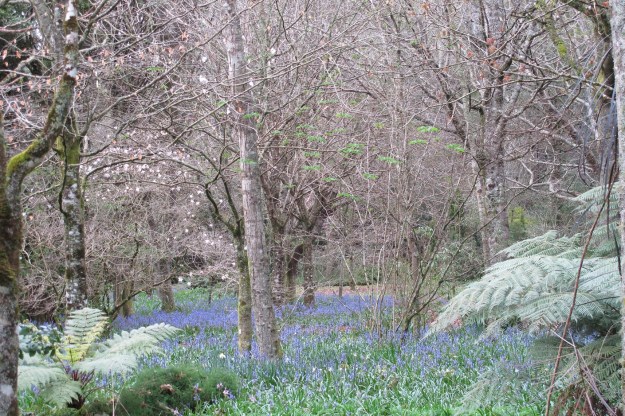
Te Popo again in Central Taranaki

Bury Court in the UK – much more than just beautiful buildings and an early Oudolf garden. A garden I wish to return to soon.
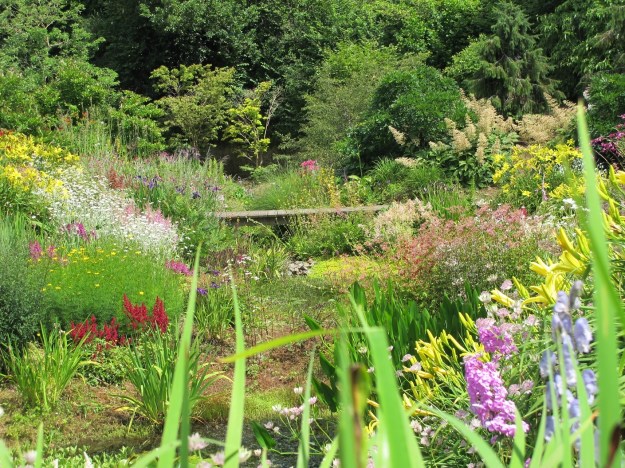
Wildside in Devon – a very strong sense of place is one of the defining features
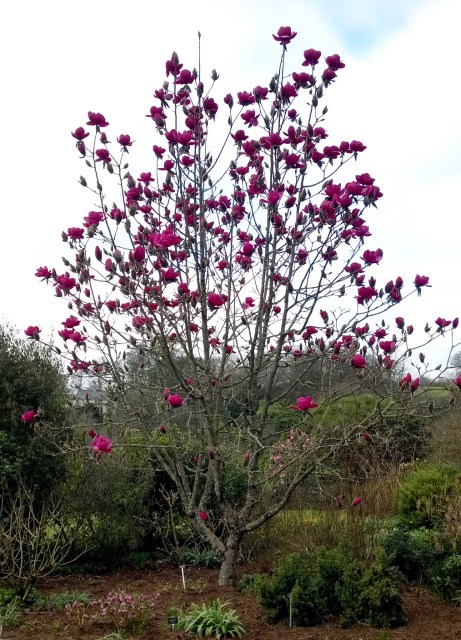 We are generally accustomed to seeing Jury plants growing in different parts of the world, though sometimes it generates a special thrill. A UK friend sent this photo of Magnolia Felix Jury in bloom at The Garden House in Devon last week. We had seen this particular tree growing strongly several years ago but it was summer, so in leaf, not bloom.
 Even I found it touching to see Mark’s delight at the specimen of Magnolia Felix Jury growing a few doors up from where our daughter lives in Canberra. He felt it was like having a touch of Tikorangi in her street. Canberra is not exactly Magnolia Central so if ‘Felix Jury’ blooms as well there as at The Garden House, it will be a showstopper. The house owners were a tad surprised when I knocked on their door to ask if I could take photos and explained why. They also had Mark’s Fairy Magnolia Blush growing to the immediate left of the umbrella. Nothing illustrates the stark difference in climate to here more than an astroturf lawn.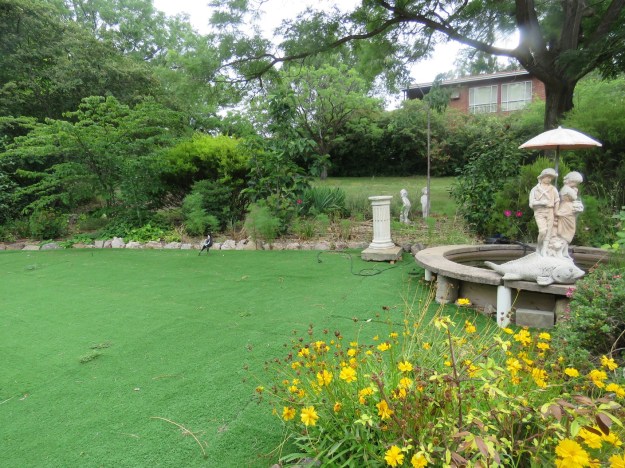
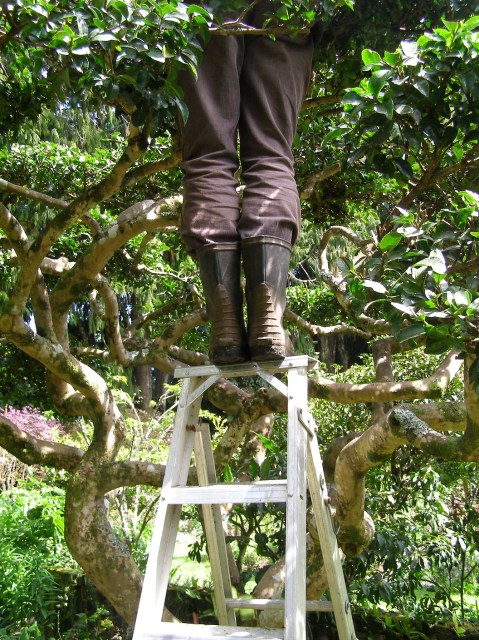
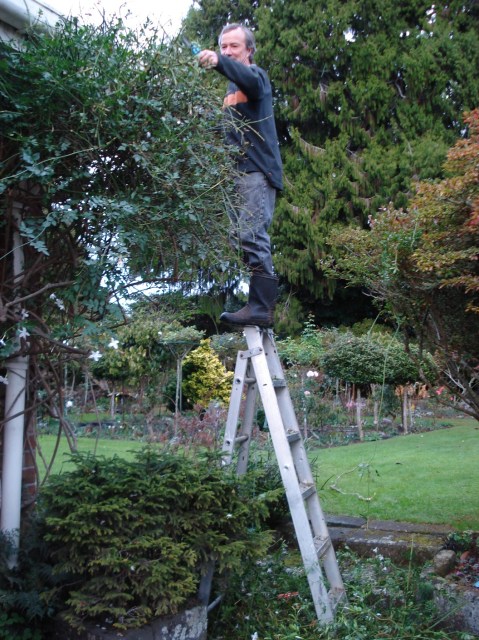 Mark, being an agile and wiry man with very good balance, has given me the most alarming photos of how not to use ladders. Do not try this at home. He would like a disclaimer added that he is not stupid. He only does this with the ladder in a stable position and with something firm to hand that he can grab should anything go awry. Never with the chainsaw. He is extremely mindful of safety and caution with the chainsaw when mistakes can be fatal.
 Because ladders play such a role in our lives, we were pretty interested in this permanent ladder structure seen attached to a tree in a tourist park in Jinghong, near China’s southern border. Presumably this tree is climbed regularly to warrant the construction of a ladder, although the reason why was not clear to us at the time. It can’t be that good for the long term health of the tree to have the wooden pegs bored into its trunk but at least they are not nails.
 We spent Christmas in Canberra. Why Canberra, you may wonder. Or you may not. We are one of those New Zealand families where all three of our children have headed off into the merry blue yonder and the daughter with our first and only grandchild lives there.
 It was protection from the abundant and intrusive birdlife that saw the next door garden shrouded in white netting. The owners, Croatian migrants who escaped then-Yugoslavia in the 1960s for a better life in free Australia, were keen food producers growing many fruits and vegetables. It was an interesting visual effect, the shrouding of the garden, though you wouldn’t be able to expect a fruit crop in our humid conditions with the tree foliage compressed into tight domes.



 Tikorangi The Jury Garden