Magnolia delight

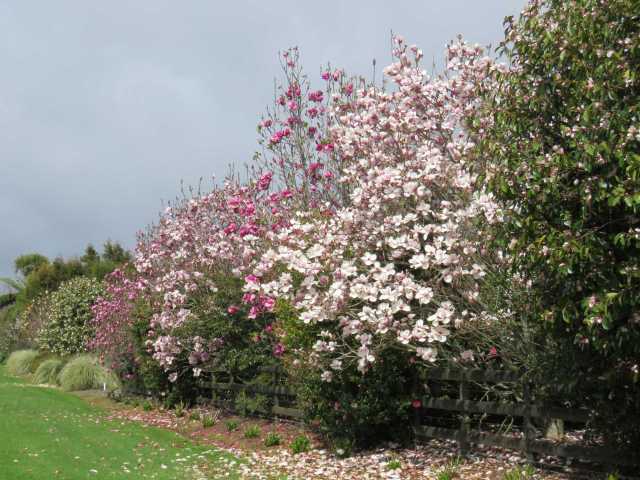
The roadside. On the far left is Honey Tulip and there is a Black Tulip also there that is not visible. Fairy Magnolia Cream, Serene, Iolanthe, Felix Jury, Athene and Fairy Magnolia Blush.

I see it was twelve years ago that I wrote about generous gardeners. Not those who readily share plants but those who plant up areas for other’s enjoyment. I remembered that article this week because of a beautiful stretch of roadside on the outskirts of our small town that I drive by almost every time I leave our property. It is a spectacular row of magnolias that goes from strength to strength every year. It edges grass paddocks where the owners graze a few stock.
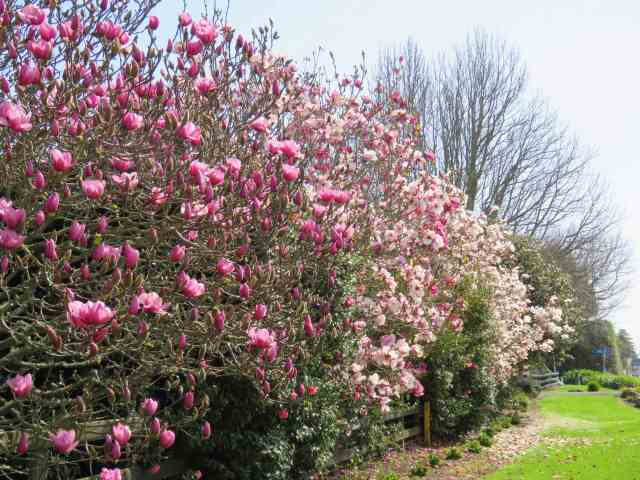
Looking back from halfway along the row

The thing about this row of magnolias is that its purpose is to delight passers-by. The owners, Pat and Brian, can’t see it from their house which is on the adjacent section. Pat, in particular, is a keen gardener and they keep a detailed and heavily ornamented garden around the house but the row of magnolias is for the benefit of passing traffic, be it in vehicles or on foot.

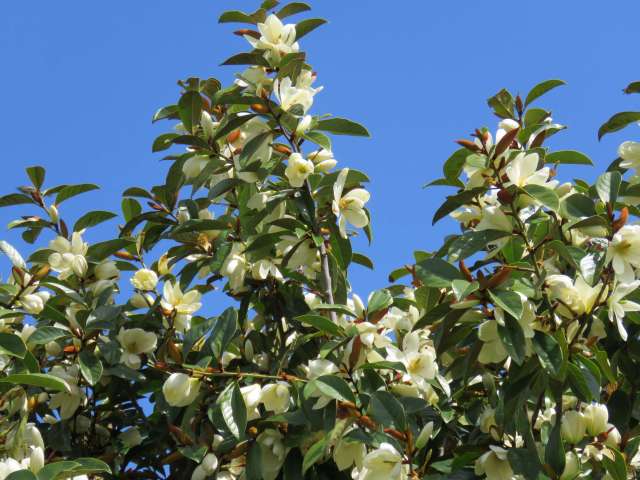
Magnolia Athene
Fairy Magnolia Cream

I called in yesterday to ask their permission to share the photos and, with their usual generous spirit, they said ‘any time. Our garden is your garden’. I had thought I might ask Pat if I could photograph her but it was a rushed visit and I didn’t want to embarrass her. She commented that she thought the magnolias were better this year than ever before and many people are admiring them. “I tell everybody they are Abbie’s magnolias.”
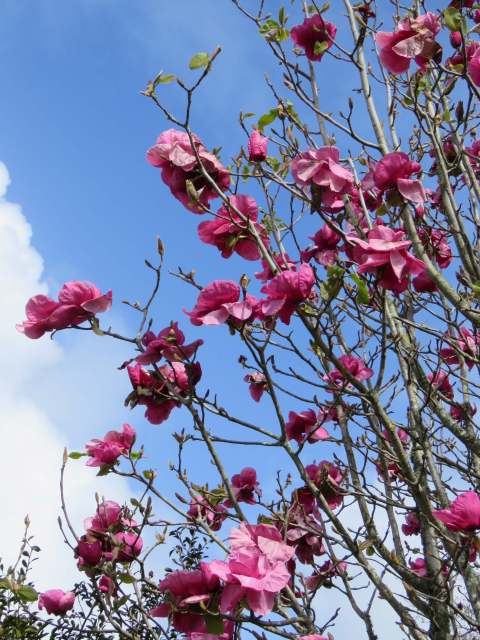
Magnolia Felix Jury just finishing flowering in Pat and Brian’s roadside row

We have had this conversation before. What you have to understand is that this row of magnolias is not far off being a complete collection of Jury magnolias. In vain, do I tell her that they are Felix and Mark’s plants. In Pat’s mind, they are mine.
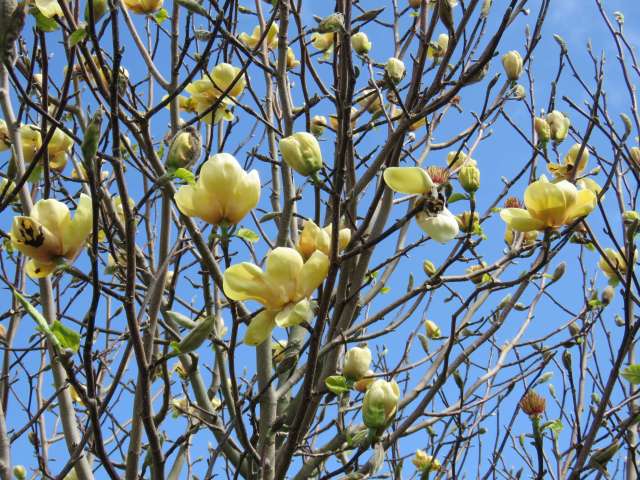
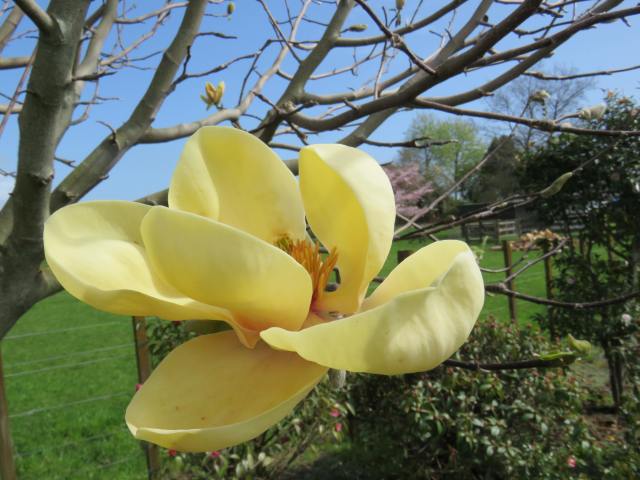
I do remember giving Pat this plant of Honey Tulip
Honey Tulip – Mark’s only yellow on the market. So far.

She remembers me giving her most of the plants. I remember giving her one and may have given her a few more but she was a very good customer of ours in the days when we used to retail plants. I have always admired Pat’s eye for a good plant. She lacks any curiosity about plants, rarely remembers names, won’t grow bulbs because they are untidy when they finish flowering but she has a good eye and picks out plants she likes solely on their appearance. She has a garden with plants like Camellia yuhsienensis, Rhododendron veitchianum and other choice varieties tucked in with garden centre utility options and plants she has picked up on special. I find her approach to gardening refreshingly honest and unpretentious while also being very capable.

Pat’s plant of Rhododendron veitchianum. It wasn’t until I got up close to it that I realised the striking colour contrast was cineraria.

What makes these magnolias interesting to us is that Pat and Brian garden very differently to how we do. The magnolias are planted in the open, exposed to pretty much every wind that blows. They are not mulched and the ground around them is kept bare. They are not trimmed or clipped. I would guess that they were well fertilised when getting established but are now left to their own devices. In those exposed, open conditions,  they are performing better than many of the ones we have here in our own garden which is sheltered from most winds.


Serene is one of Felix Jury’s lesser known hybrids but worthy of more attention. A later season magnolia, it is very lovely.

Wind is a big issue in this country of long thin islands set amidst vast oceans. Wind hardiness is a big factor in the selection of magnolias in our breeding programme. Petals that are of a softer, thinner texture and flower forms that are looser in structure fall apart when it blows hard. We see it every year on some of the magnolias here – particularly M. sprengeri ‘Diva’, M. sargentiana var. robusta and even the stellatas (star magnolias) and their hybrids. We have seen spectacular displays on some of these and similar magnolias in less windy countries – memorably in the Dandenongs in Australia and in the north of Italy. We don’t have that leeway here. So, it is interesting to see the Jury magnolias in very open conditions, still putting up mass displays of blooms that are largely untroubled by the many storm fronts that pass over in our early spring time.
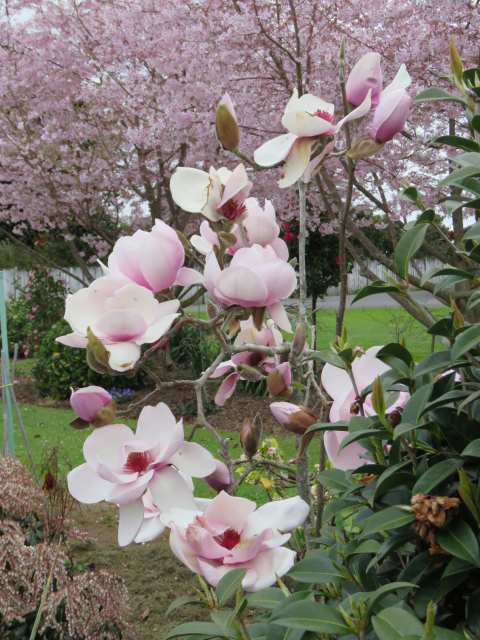
A small plant of Magnolia Iolanthe with many OTT blooms

A few doors down from Pat and Brian’s home is a house with this little Magnolia ‘Iolanthe’ in bloom – showy enough for me to stop the car and photograph from the roadside. The plant can only have been in the ground two or three years and I haven’t noticed it in flower before, although there is a young plant of ‘Felix Jury’ a few metres away in the same garden that catches my eye when in flower, every time I drive past. But look at ‘Iolanthe’ strutting her stuff! I counted around 30 blooms and opening buds on this very small plant.

Magnolia Iolanthe

I am a big fan of front gardens and roadside plantings. They make the world a better place for us all, or at least for those of us who notice them.

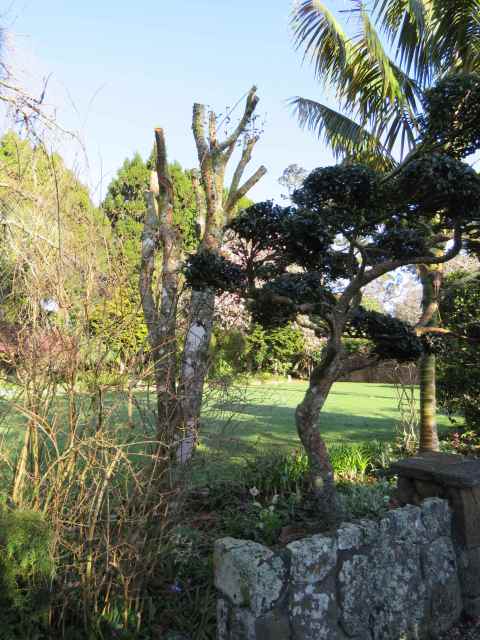
STILL pruning…

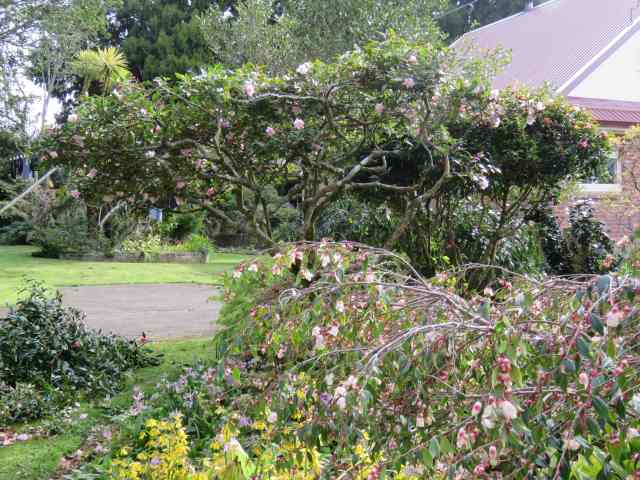
It is an experience shared by most gardeners. I will just get this (smallish) job done and then go on to something else. And that smallish job expands from a few hours to days or even weeks. So it is with trimming camellias, about which I wrote last week. I am still doing it.

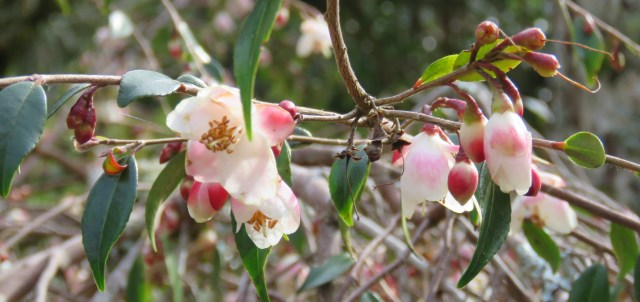
A rare sight these days – good flowers on Jury’s Pearl.

We don’t trim a lot of camellias, I thought to myself. And then I added them up. Excluding the camellia hedges – and there is a fair distance of those – I reached about 40 that get individual attention every year. That is not a lot compared to the number of camellias we have which must be several hundred, but it is still quite time consuming. Some we trim to be feature plants; some we trim to freeze them in size.

A relatively dry winter has meant we have had a better show this year. It doesn’t resemble the mass displays we used to get before the devastation wrought by camellia petal blight but there have been some pretty blooms. Most of our larger flowered camellias are retained as shelter, screening, wind breaks or their attractive form, certainly not for floral display because that is but a memory and the larger flowered types get hammered by petal blight. It means more work to ensure that in key spots in the garden, we have to make that attractive green form visually effective in order to justify keeping them. We have a strong preference for the small flowered varieties which do still put on a good show. And autumn flowering sasanquas, of course but they are long finished.

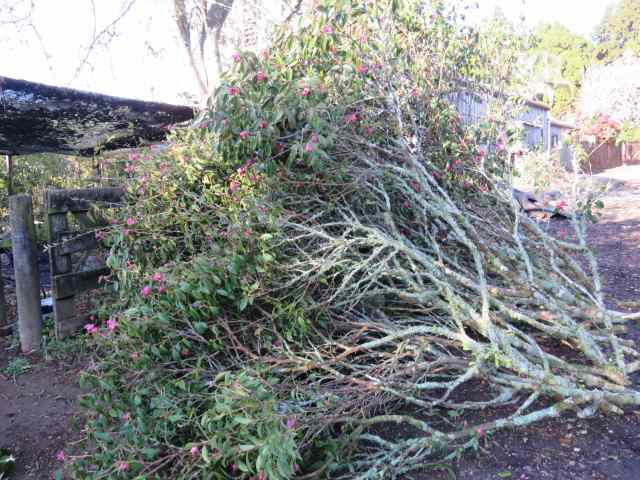
Fairy Wand has been reduced to a skeleton and we may drop it lower yet. We try and keep a good framework when we are cutting camellias very hard, not cutting off at ground level.
That is A LOT of Fairy Wand piled up to be mulched

Camellia ‘Fairy Wand’ started life as a miniature back in the days when miniature only applied to the flower size and not, as most people assumed, growth habit. Bred by Os Blumhardt in Whangarei, Mark planted it, ‘Gay Baby’ and ‘Tiny Star’, also from the same breeder, beside our driveway. After about 40 years, they were all about six metres tall and in a decidedly leggy state, with wayward branches being cut off to keep the driveway clear. We stagger our extreme pruning here. ‘Tiny Star’ was cut back two years and is now a bushy little column shape about two metres tall. This week was ‘Fairy Wand’s’ turn for drastic treatment. ‘Gay Baby’ will be done at some stage in the next two years, when ‘Fairy Wand’ has rejuvenated. We don’t want a row of three massacred plants. It took Zach all of an hour to cut back the Fairy and about the same length of time for Lloyd to mulch it up for wood chip.

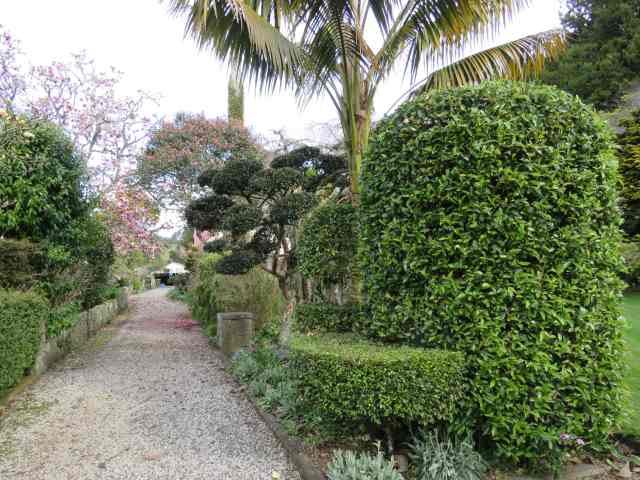
Taking Fairy Wand down behind gives this tableau of clipped camellias a whole lot more impact, especially the cloud-pruned sasanqua Elfin Rose. We are now thinking of dropping Fairy Wand behind even lower so it stays below the cloud pruning.

As an aside, it is possible to rejuvenate most michelias in the same manner. You do need to start with plants that are growing strongly because if they aren’t, the shock may kill them but we have, upon occasion, cut michelias as ruthlessly to promote bushy fresh growth.

Itty Bit in the centre after being reduced in size by about 40%

While Zach may only have taken an hour on ‘Fairy Wand’, I have spent many hours on others and that is because we want the form and shape on a healthy plant. I probably removed about 40% of ‘Itty Bit’ to reach this stage.

Camellia Hakuhan-kujaku – a shadow of its former self

It took me ages to get ‘Hakuhan-kujaku’, the peacock camellia, to this state. I took out at least 60% of it and it looks a whole lot better for the time spent. Shapely, not hacked or massacred.

Camellia minutiflora front right, Itty Bit behind

Little C. minutiflora is one of my absolute favourites, though hard to get photographs that do it justice so you will just have to take my word that it is a little charmer. It is a more recent planting so I probably only took 25% off it. At least it will only be a tidy-up trim for the next few years until there is so much congested growth and crossed branches that it is time to spend hours laboriously picking over every branch again.

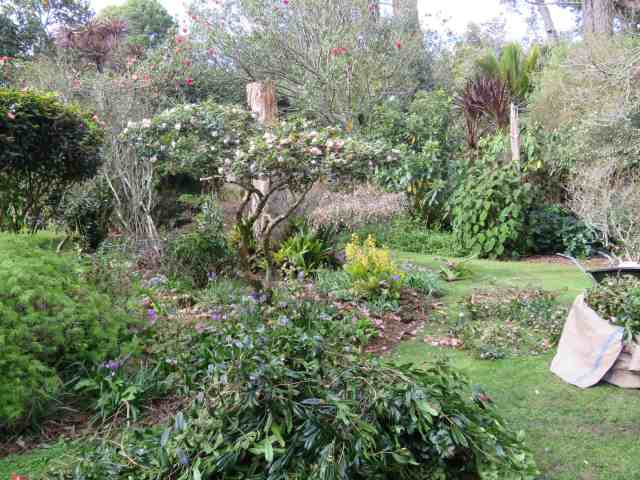
My secateurs and pruning saw are my best friends at the moment. If you are wondering where to start on this type of pruning, I start by looking at the plant from every angle. Because we are trying to keep the plants from getting tall and leggy, I first take out growths on top that are going straight up instead of bushing out sideways. Then I work around the perimeter, reducing the spread, always trimming growth flush to the branch or trunk. Then I get into the middle and take out crossing branches. Finally, I get underneath and trim from below, making sure there is cover across the top while taking out surplus growths and branches below. I spend a lot of time looking and tracing where main branches go. This is why it takes time.

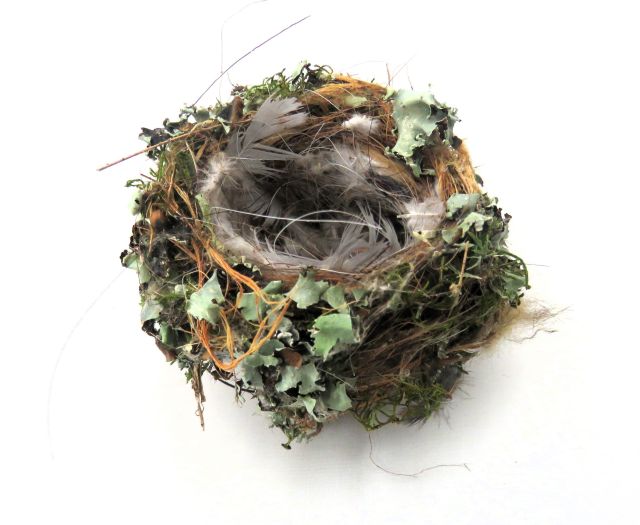
Look! Just look at this exquisite little chaffinch nest lined in soft feathers. Must the chaffinches start all over again because we humans destroyed their nest? Disclaimer – this one was blown down in a storm.

At this time of the year, I remember the warning from friend and colleague, Glyn Church. Pruning needs to be finished very soon on taller trees and shrubs. The birds are nest building and will be laying eggs. Unless you are okay with destroying days of hard work by individual birds and killing off their young, time is of the essence.

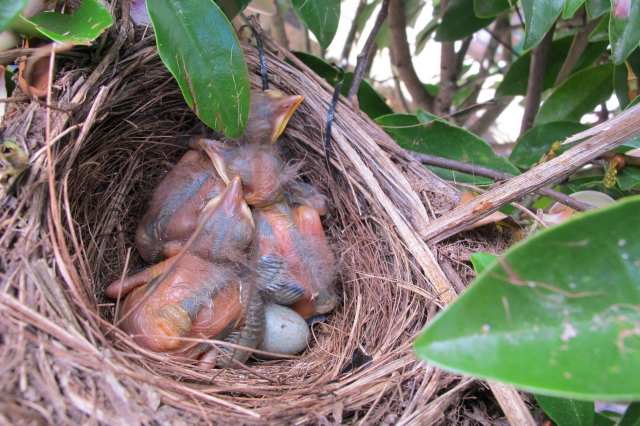
They are just common, pesky blackbirds but it still does not feel right to kill them for human convenience or by human carelessness.
A tui nest.

Spring panic, camellia pruning and a good ladder – a very good ladder

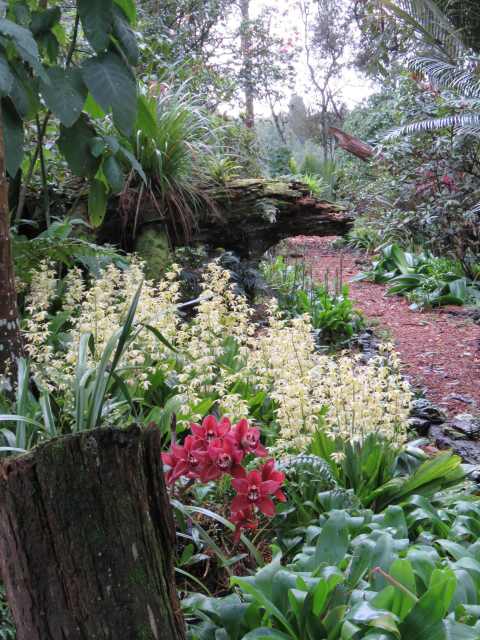
The Hippeastrum aulicums are coming into flower and the calanthe orchids are in full bloom.

As we hurtle into the full flush of spring, after a remarkably calm and mild winter, not only is the weather breaking up but I can feel the old sense of rising panic. The weather is entirely to be expected. Mark calls it ‘the magnolia storms’ on account of them always hitting during magnolia season – the confluence of cold fronts from the South Pole and warm fronts from Australia and the Pacific Ocean, I believe.

The sense of panic is more personal. I am the last of the generations who came through an education system where everything depended on the final examinations. There was no internal assessment. I was particularly good at exams which was just as well because I was never very diligent during the year. The arrival of spring meant I had to focus and cram in preparation, which I did. My last two years in school and then five years in tertiary education were marked by deep anxiety and stress in spring and exams generally finished towards the end. It was not my favourite season.

Some plants just get better with age and some do not. A magnolia should be amongst those that do get better and Magnolia Iolanthe fits that brief, even after 70 years.

I had barely recovered from repetitive stress dreams that dogged me well into mature adulthood when we inflicted springtime stress on ourselves in a different form. Many years of opening for the Taranaki Garden Festival meant that the advent of spring signalled the time the pressure came on to make sure every corner of the garden was up to opening standard. In a garden the size of ours, that was a big task that took planning, personal deadlines and a lot of hard work that wasn’t always fun.

The exams are a very long way in the past and we no longer open for the garden festival. Any stress these days is entirely self-inflicted but I still felt the old anxiety rising as I walked around the garden this week.  The onset of spring has been so rapid this year, that I found myself worrying that if I was distracted or forgot to look for a few days, I could miss something entirely. I had to speak sternly to myself, pointing out that this is what we garden for and that I need to take the time to breathe, to look and to enjoy. I listened to my own advice and truly, the seasonal sights are a joy to experience and yes, I do have the time these days to appreciate them. Every day, another plant will open in bloom to add to the floral tapestry already on display.

I have almost finished pruning the camellias that need it and I pondered the thought that two skills which are under-rated in gardening are pruning and staking. It is awfully obvious when they are done badly and doing them well can seem to take quite a bit of time.

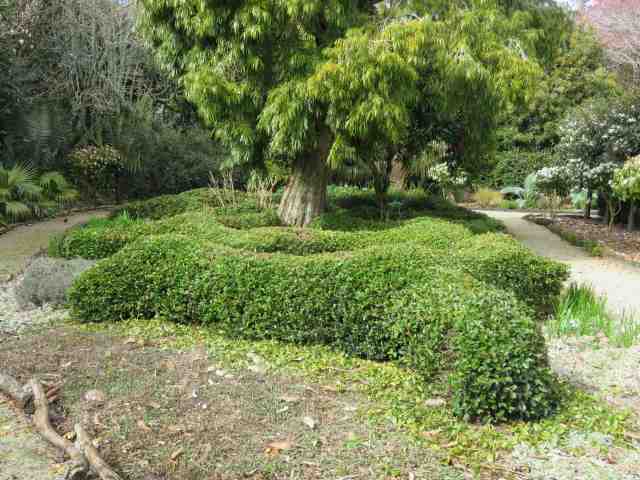
The undulating hedge in the Wave Garden – cut with an electric hedge trimmer.

We use a variety of pruning techniques on the camellias, depending on the situation. If we are doing a full rejuvenation, it is easy. We just cut off to a good framework and then practise patience for two years while the plant recovers and makes bushy, fresh growth. Camellia hedges are done with the electric hedge trimmer. Mark did the Wave Garden hedges and I spent probably as long going through afterwards with secateurs to tidy up wayward branches and bits that were still out of place.

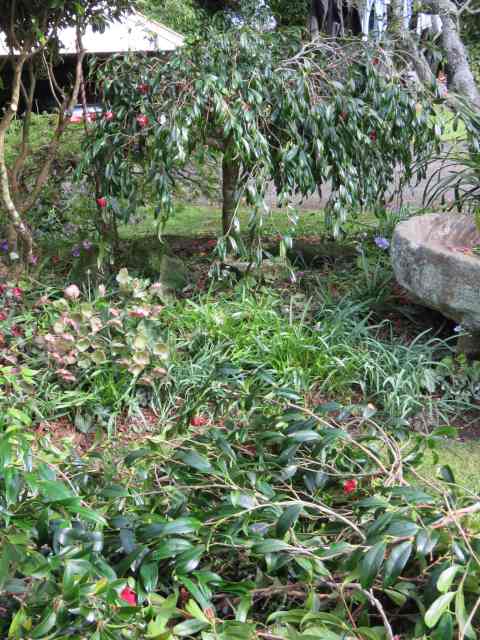
Camellia Tiny Star was cut back pretty much to bare wood two years ago after getting way too tall and leggy. This is two years of regrowth.

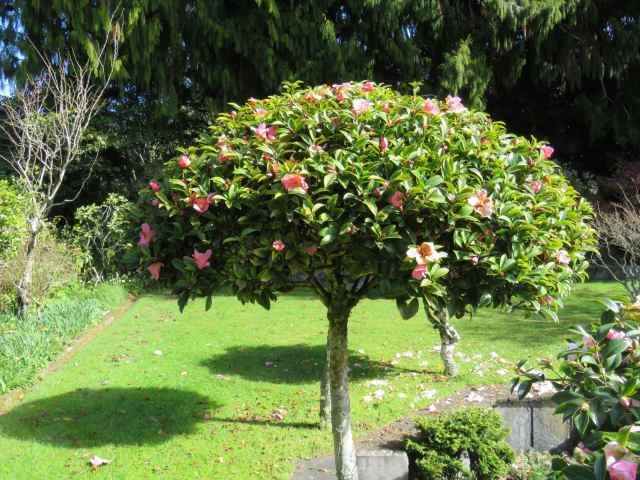
It was the four umbrella camellias surrounding the sunken garden that have taken the most time. These are top-worked, so grafted about a metre off the ground. They are a seedling from Mark’s breeding programme that we never sold but Mark has always referred to as Pink Poppet. For years, he has kept them in shape with the hedge clippers. When I say years, I have no idea how long. Maybe fifteen or so? They had become very dense and full of debris and dead twigs. I decided they needed a good clean out and thinning.

Untouched as yet.
Spot the difference? These are two down the other end of the sunken garden that have just had hours of attention and you can see in the wool bale how much has been removed.

I may not have started, had I realised how long it would take. The first one took me around four hours. I did speed up but even so the last one would have been two and a half hours and I could have spent longer and done a more thorough job. At the end of it, I had removed at least a third of the bulk and they did not look any different. But that is the whole point and the reason why it took so long. I didn’t want them to look any different, I wanted them to be able to breathe, to shed spent blooms and leaves and to get rid of the growing issue with black mould on some of the foliage. Invisible pruning. I am hoping they may last another decade.

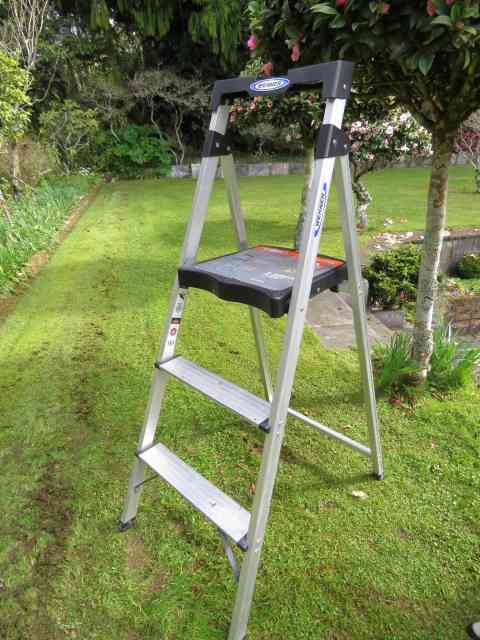
Behold my ladder. In an establishment with many ladders (about eight different ones), this one is mine, all mine. I bought it to use in the house. We have a higher ceiling stud than modern houses and I couldn’t reach the top cupboards from the kitchen step ladder. So it lives in the broom cupboard in the house but I also use it in the garden. It is so lightweight, I can lift it with a single finger. It is very stable with a platform for comfortable standing, rather than a narrow step at the top. There is even a handy top shelf for small tools. I can’t recommend it highly enough for anyone who needs a convenient ladder for outdoor or indoor use. Lloyd was so impressed when I let him use it indoors for a task that he said he was going to get one for his home. For New Zealand readers, I bought it at Mitre 10 Mega and it wasn’t hugely expensive – a bit over $100, from memory. It is worth every cent.

Gardening in the ruins

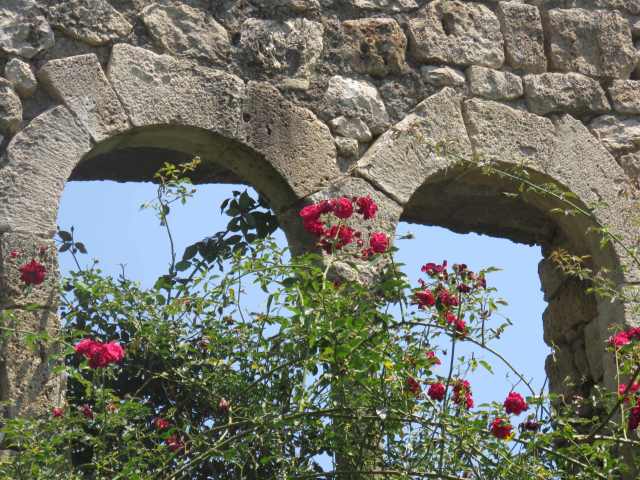
Not Christchurch. The Garden of Ninfa in Italy.

Poor old Christchurch cathedral is back in the news. Badly damaged in the devastating earthquakes of 2010 and 2011, its future again hangs in the balance as money for the restoration has dried up, with substantial shortfall of $89 million – at current prices but likely to rise.

In the 1880s on the left and in 2001 on the right. Photo credits Wiki Commons.

Christchurch’s Anglican cathedral is a key building in the heart of the central city square. Built in the neo-Gothic style in the years between 1864 and 1904, it immediately became an iconic image of that city.

A haunting image taken 30 minutes after the 2011 earthquake (Wiki Commons)

I have no personal opinion on the right or best option for the future of the badly damaged building. I can understand the desire for restoration from some parties. Christchurch lost so much of its history as a result of the earthquakes and this is one of its most significant, historic buildings. Its flamboyance harks back to earlier times before the stodgy utilitarianism of most modern structures.  On the other hand, I can see the point of view of the Anglican church, that their focus is on caring for the living, not preserving architectural history at huge expense financially. The post-earthquake reconstruction required throughout much of the city was incredibly expensive, stretching both government and local body resources and those financial resources have now dried up. While historic buildings are important, the reconstruction of sewage pipes, water and power takes precedence, followed by the need for new homes for the many displaced people.

I visited Christchurch in 2013 and saw some of the damage first hand, but just from a domestic, suburban point of view. The inner city remained largely closed off. The sheer scale of destruction was hard to comprehend. My well-travelled Christchurch gardening friend and I had discussions about how the cathedral could be made safe, preserved as a ruin and gardened. We had both seen similar scenarios in Europe. But we knew our idea was romantic fantasy at the time.

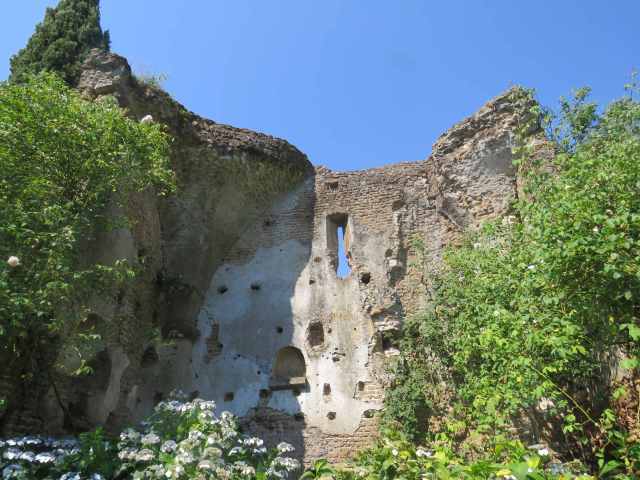
Ninfa, again. Built around a larger village than Torrecchia shown further down the page.
Ninfa again.

For the rest of the country, the earthquakes are already just a memory – but Christchurch is left with a ruined cathedral in the heart of the city, a constant reminder of what happened, now with no solution in sight.

Of the possible options for the cathedral, the current situation of stopping restoration mid-flight seems the worst possible one. Fully restored, the city square would have been returned to its pre-quake status. Demolition would have given the option of replacing the old cathedral with a new building in an exciting, contemporary architectural style marking the new era. Of course, it might also have led to the building of a utilitarian monstrosity of no architectural merit at all but public opinion may have had some sway on a replacement. But to be left with a ruined cathedral, shut off from the public and surrounded by the detritus of a building project sitting in limbo just seems like a continuing reminder of the destructive earthquakes with nothing positive in sight.

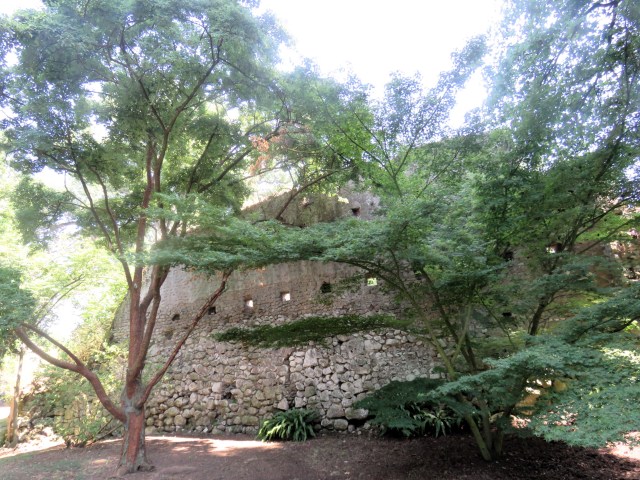
Torrecchia Vecchia in Italy, built around the ruins of a village
Torrecchia Vecchia again

Maybe those discussion my friend and I had back in 2013 are not so far-fetched at all. It had me delving back through my photo files for images of gardening amongst ruins. I am still a bit sad that Covid cancelled our 2020 trip when we planned to get to Lowther Castle in East Cumbria. We knew Dan Pearson, a UK designer whose work we admire greatly, had an ongoing project creating gardens around a ruin. I can’t find photos I can download without breaching copyright but it is worth clicking through this link to get a view of that project which looks both grand and romantic. I would love to have seen it in person.

Britain and Europe are littered with ruins. I have never forgotten a garden we visited, overlooking Lake Stresa in Italy. At the top of the garden were stone ruins – a Roman fort, no less. As in Ancient Roman. Christchurch cathedral doesn’t have that antiquity – but neither does Lowther Castle.

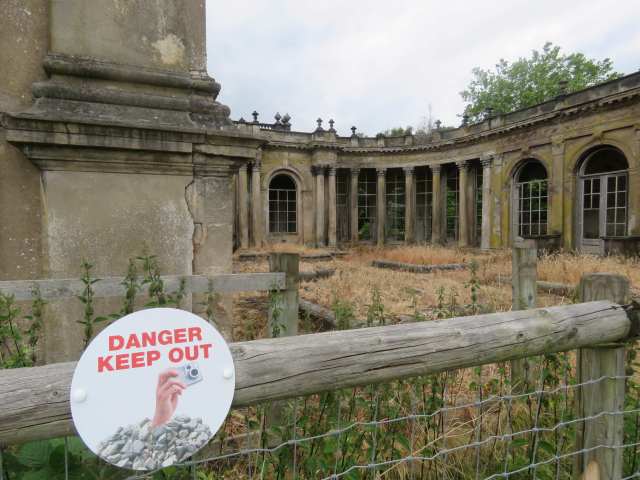
Ruins of the former grand house at Trentham near Stoke-on-Trent in the UK. It was all barricaded when we visited in 2017 but I am sure I read that there were plans to make the ruins safe and then extend the gardens into that area.

If it is still a roped-off building site in ten years time, or if hope dies of raising the funds to complete the restoration, maybe, just maybe, memorialising the site with a garden in the ruins will be an idea whose time has come in this country, too. It took 40 years to build, so I guess the 13 years it has been an unsafe, dangerous building may have a while to run yet.

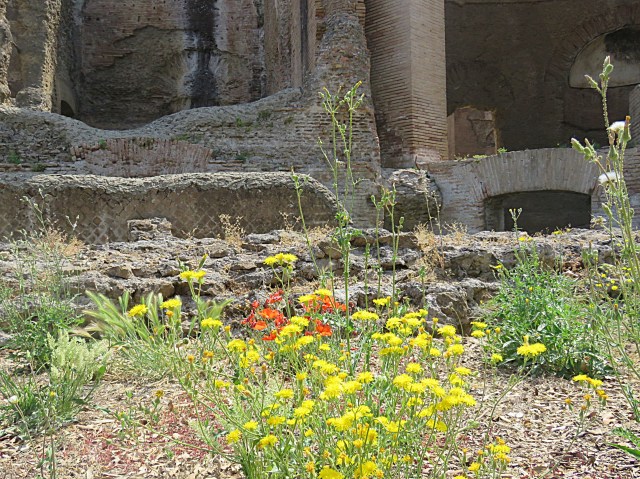
The Palatine in Rome – more gently controlled serendipity than active gardening
Villa Ariadne in Tivoli, near Rome. All serendipity here on a huge site of ruins but no less charming for that.

A postscript comment from Christchurch gardener, artist and garden writer, Robyn Kilty: It’s tragic Abbie! I have been to Ninfa too, and wondered if the Italian solution would work for Christchurch! Remembering that Ninfa is a much larger area- a village – with a most picturesque stream running through it, whereas the Square in Christchurch is an urban built up area with no stream, not much history, and surrounded by hard grey concrete. There is a small grassed area nearby, which is completely out of scale, but still, a Memorial garden of some sort would be preferable to the nothingness and the ugly temporary scaffolding that is meant to prop up what is left of the ruin. This seems destined to be the fate of the centre of Christchurch ad infinitum.

The trouble is that there has been and still is, such indecision around the whole sad situation – groups for and against restoration and at the time of the earthquake, a bishop from Canada with no vision and no cultural links to Christchurch, yet representing the Anglican community who appeared to hold all the power. She was in favour of demolishing the ruin and replacing it with a beach!!

As the current work to make the ruin safe has progressed, it is uncovering more and more structural damage that is more extensive and deep-seated than originally thought, so that sadly the cost of continuing to restore the Cathedral has become prohibitive, and with costs rising all the time, it is beyond the Anglican community and now the government. Even if it had been financially achievable, the feeling is that pouring more millions of dollars into restoration would still only result in a kind of ‘fake’ cathedral, where modern construction methods and materials could never replace the 19th century original anyway.

While some type of memorial garden amongst the ruins seems to be a solution, could it ever be like Ninfa, or even Lowther Castle, as our ruins are just a sort of small, out of scale aberration in the centre of the Square in Christchurch, surrounded by concrete. Imagine orange and yellow African marigolds gracing the centre of Christchurch where a cathedral once stood. Or perhaps that would be fitting after all, as we are told that the Christchurch Cathedral was mediocre in design anyway compared to grander Cathedrals in Europe and not worthy of restoration. Oh dear – why did our Victorian city fathers build their dream of an english city with a mediocre english cathedral at it’s core – on a far flung earthquake prone swamp??

Sorry, I’ve not left this comment on your Comments page, but that doesn’t seem to work for me – probably because I don’t press the right buttons.

I would make three points in reply to Robyn:

  1. It is all in the scale. Yes the cathedral site is one building, not an entire village but that is a design and scale issue, not a concept problem.
  2. Given the track record of the cathedral in earthquakes, maybe a rethink is needed. “Earthquakes have repeatedly damaged the building (mostly the spire): in 1881, 1888, 1901, 1922, and 2010. The February 2011 Christchurch earthquake destroyed the spire and the upper portion of the tower, and severely damaged the rest of the building.” (Wikipedia)
  3. Not African marigolds! Nevair! And preferably not tulips either, but that is personal taste.

Early spring gold

A selection of the earliest flowering narcissi – we like variety

What a delight are the dainty narcissi. I see I started photographing them in in mid July so we have had a month of pleasure so far and plenty more to come. When it comes to magnolia flowers, we lean to the bigger is better way of thinking but the narcissi are different. Small and dainty, thank you.

In the Court Garden

The big daffodils flower later and we don’t have many of those. In fact, we have none of the large-bloomed, modern hybrids which are what dominate the commercial bulb catalogues. They just don’t fit our garden style. Also, because they are later flowering, they get hammered by the narcissi fly and with their long stems and heavy heads, they flop over as garden plants in heavy spring rains.

Down in the park. Those backswept petals are a feature of cyclamineus narcissi but they are by no means all as backswept as these specimens that look particularly startled.

We once went to the National Daffodil Show when, for some unknown reason, it was staged in the War Memorial Hall of our nearest small town. It was amazing but the only dwarf varieties on show took up about one square metre while the rest of the hall was packed with impressive displays of show blooms and there was a clear preference for what we sniffily refer to as ‘novelties’ but devotees would describe as ‘breeding breakthroughs’. Those split coronas (the trumpet part in the middle) that look squashed don’t do anything for me and I am unconvinced by the colour break to pastel, salmon pink. But that is a matter of personal taste and life would be dull if we all liked the same thing.

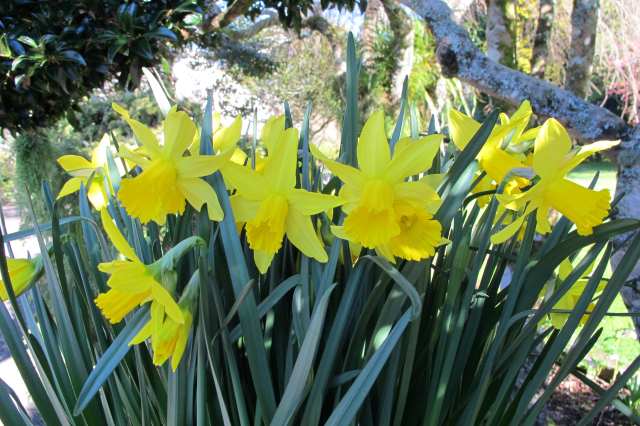
Against a tree trunk in our entrance area

Mark and his father before him gathered up all the dwarf varieties they could find at a time when there were more available than seem to be around these days. So we have a reasonable representation of named varieties like ‘Tête-à-tête’ (more commonly written as Tete a Tete, without the French accents these days), ‘Beryl’, ‘Jetfire’, bulbocodiums (hooped petticoats) in both bright yellow and lemon (Bulbocodium citrinus), ‘Thalia’ and others. But we wanted more and we wanted them sooner than we could get by lifting and dividing existing clumps, which is why both Felix and Mark started raising seed.

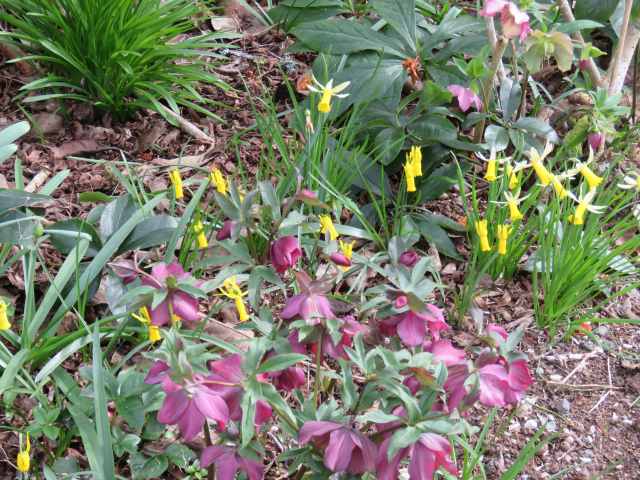
In the hellebore border beside the drive

It is the back story of our garden, really. We could not afford to garden on the scale we do if we had to buy in all the plants. A lot of what we have across most of the genus we grow are unnamed seedlings that have been raised on site. In most cases, those seedlings are the result of controlled crosses rather than random, self-sown seedlings. A controlled cross is selecting two good parents and taking the pollen from one to fertilise the other, marking the flower stem and watching until the seed is ripe enough to gather. It is quite a bit more faffing around than just collecting random seed that has set but it ensures a higher percentage of good progeny.

That is a Felix Jury hybrid which he named Twilight which may still be available in NZ. Naturalised on our bulb hillside in the park.

If you want to start in a smaller way, you can just gather seed but, with narcissi, you need to sow it in a seed tray, look after it and pot on the seedlings when they are large enough, growing them on – usually in small pots – until they are large enough to plant out. From seed to flowering size takes about three years which may seem a long time to some who are used to more instant results but we are patient gardeners here.

If you are wondering where to start, Peeping Tom is a very early season, larger variety that is fantastically reliable and prolific. It and Twilight in the preceding photo are the strongest growers and form the backbone of many of our larger plantings.

The classification of narcissi is a complicated business and there are many different species and groups. In our climate, we have most success with the cyclamineus types, often characterised by swept back petals. The other advantage of keeping to dwarfer varieties is that their foliage is smaller and finer so they die off more gracefully, rather than the spent foliage flopping down and smothering everything around them.
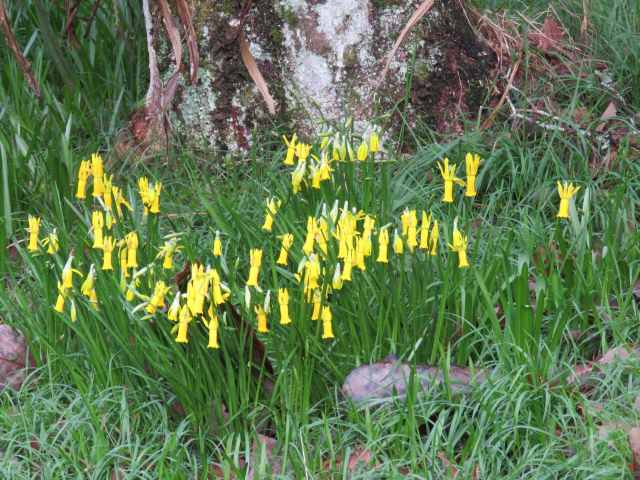
Mid August is a very pretty time for us. The early magnolias are magnificent and the dainty narcissi scattered all around the place are such a good contrast in scale, colour and detail. We have figured we can never have too many little narcissi and are continuing to spread them further afield from cultivated areas, to extending the bulb meadows and tucked in wherever we think they can grow undisturbed that they may emerge and delight during their weeks to shine their golden light in early spring.

I laughed at myself when I found this photo of Jetfire from nine years ago. I was clearly having a flight of fantasy as I photographed flowers set against our stainless steel splashback, lit by the spotlights on the rangehood.