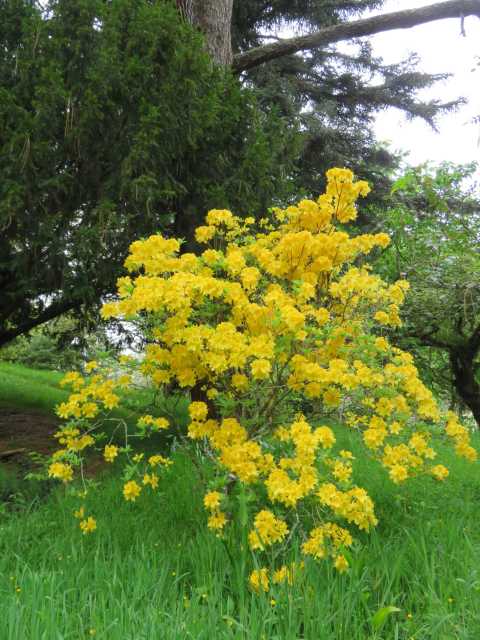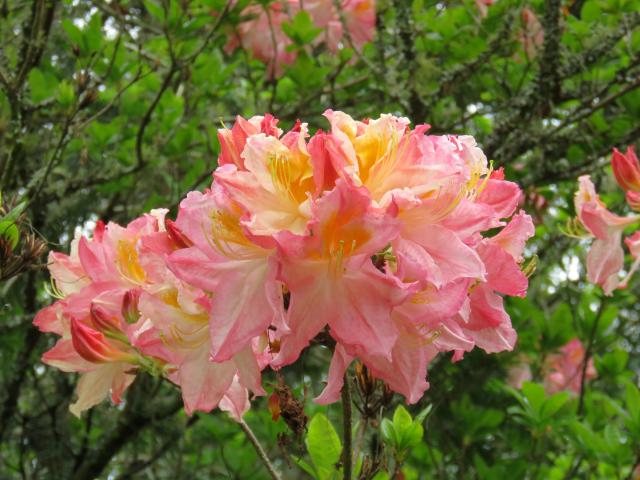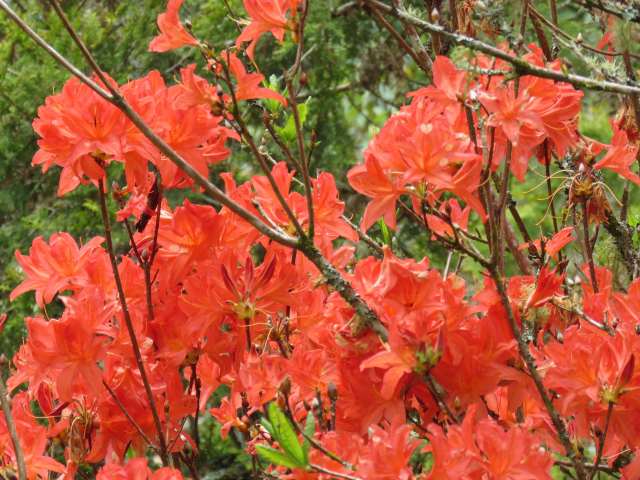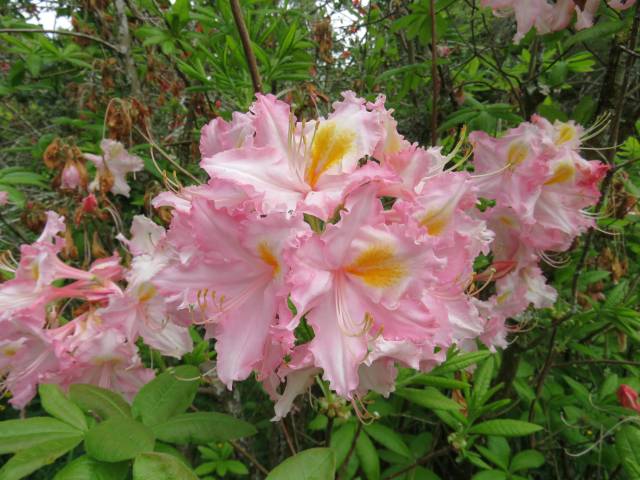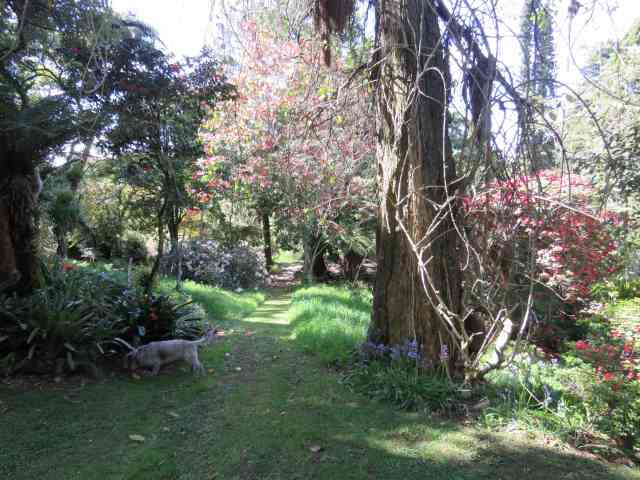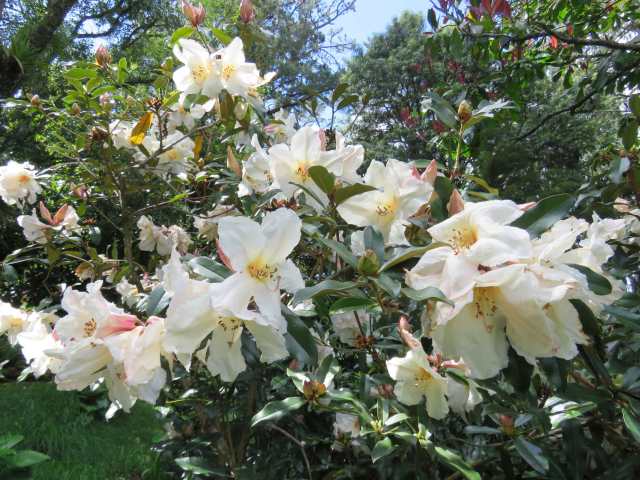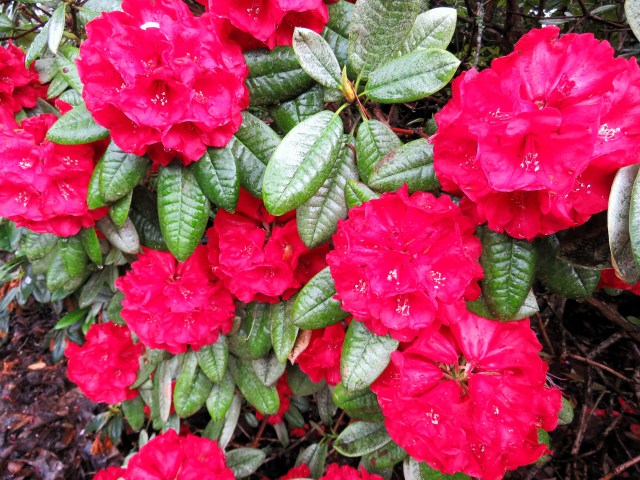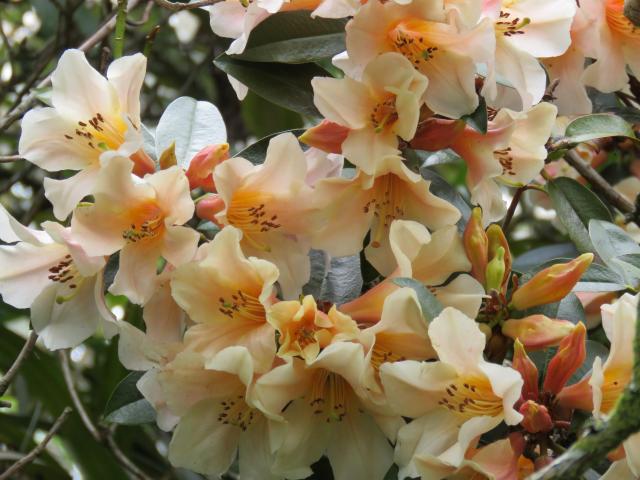
Early spring gold

A selection of the earliest flowering narcissi – we like variety

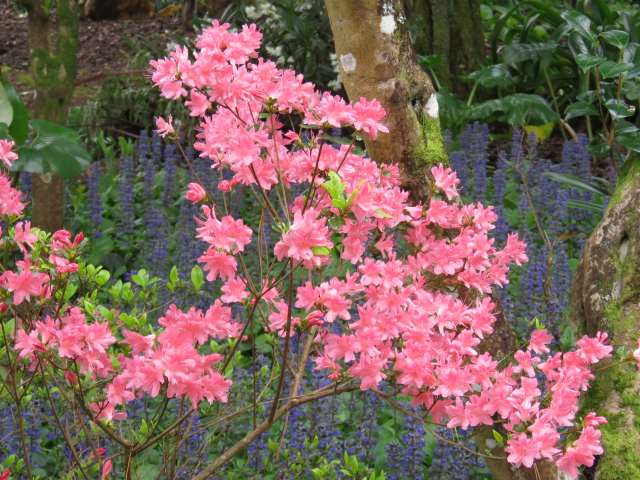
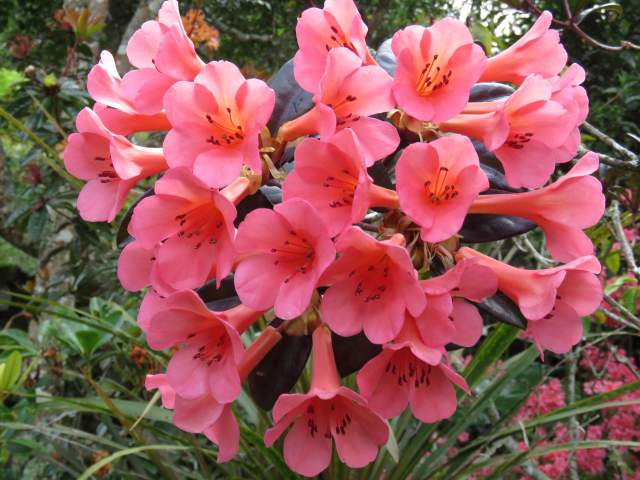
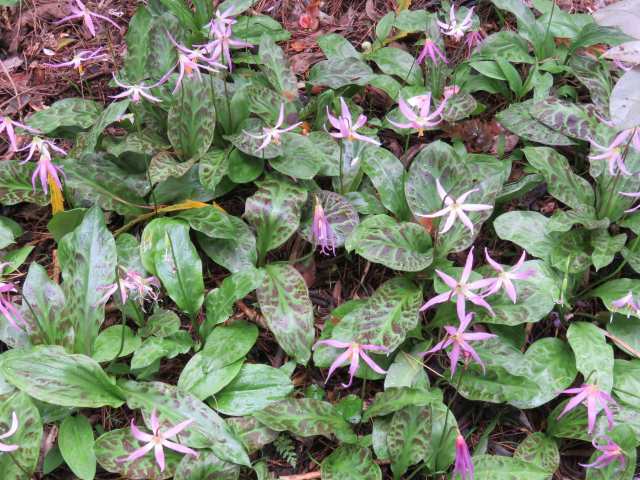
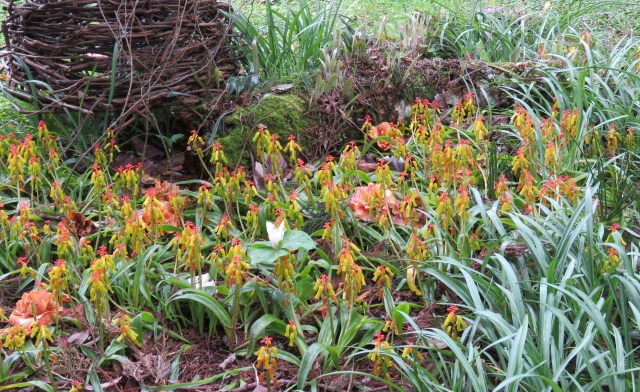
What a delight are the dainty narcissi. I see I started photographing them in in mid July so we have had a month of pleasure so far and plenty more to come. When it comes to magnolia flowers, we lean to the bigger is better way of thinking but the narcissi are different. Small and dainty, thank you.

In the Court Garden

The big daffodils flower later and we don’t have many of those. In fact, we have none of the large-bloomed, modern hybrids which are what dominate the commercial bulb catalogues. They just don’t fit our garden style. Also, because they are later flowering, they get hammered by the narcissi fly and with their long stems and heavy heads, they flop over as garden plants in heavy spring rains.

Down in the park. Those backswept petals are a feature of cyclamineus narcissi but they are by no means all as backswept as these specimens that look particularly startled.

We once went to the National Daffodil Show when, for some unknown reason, it was staged in the War Memorial Hall of our nearest small town. It was amazing but the only dwarf varieties on show took up about one square metre while the rest of the hall was packed with impressive displays of show blooms and there was a clear preference for what we sniffily refer to as ‘novelties’ but devotees would describe as ‘breeding breakthroughs’. Those split coronas (the trumpet part in the middle) that look squashed don’t do anything for me and I am unconvinced by the colour break to pastel, salmon pink. But that is a matter of personal taste and life would be dull if we all liked the same thing.

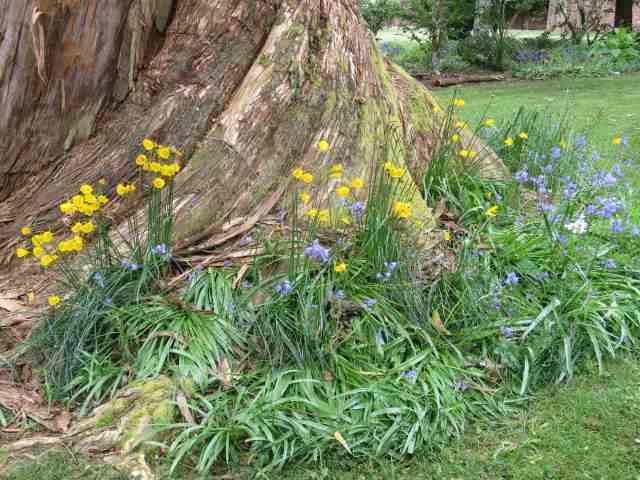
Against a tree trunk in our entrance area

Mark and his father before him gathered up all the dwarf varieties they could find at a time when there were more available than seem to be around these days. So we have a reasonable representation of named varieties like ‘Tête-à-tête’ (more commonly written as Tete a Tete, without the French accents these days), ‘Beryl’, ‘Jetfire’, bulbocodiums (hooped petticoats) in both bright yellow and lemon (Bulbocodium citrinus), ‘Thalia’ and others. But we wanted more and we wanted them sooner than we could get by lifting and dividing existing clumps, which is why both Felix and Mark started raising seed.

In the hellebore border beside the drive

It is the back story of our garden, really. We could not afford to garden on the scale we do if we had to buy in all the plants. A lot of what we have across most of the genus we grow are unnamed seedlings that have been raised on site. In most cases, those seedlings are the result of controlled crosses rather than random, self-sown seedlings. A controlled cross is selecting two good parents and taking the pollen from one to fertilise the other, marking the flower stem and watching until the seed is ripe enough to gather. It is quite a bit more faffing around than just collecting random seed that has set but it ensures a higher percentage of good progeny.

That is a Felix Jury hybrid which he named Twilight which may still be available in NZ. Naturalised on our bulb hillside in the park.

If you want to start in a smaller way, you can just gather seed but, with narcissi, you need to sow it in a seed tray, look after it and pot on the seedlings when they are large enough, growing them on – usually in small pots – until they are large enough to plant out. From seed to flowering size takes about three years which may seem a long time to some who are used to more instant results but we are patient gardeners here.

If you are wondering where to start, Peeping Tom is a very early season, larger variety that is fantastically reliable and prolific. It and Twilight in the preceding photo are the strongest growers and form the backbone of many of our larger plantings.

The classification of narcissi is a complicated business and there are many different species and groups. In our climate, we have most success with the cyclamineus types, often characterised by swept back petals. The other advantage of keeping to dwarfer varieties is that their foliage is smaller and finer so they die off more gracefully, rather than the spent foliage flopping down and smothering everything around them.

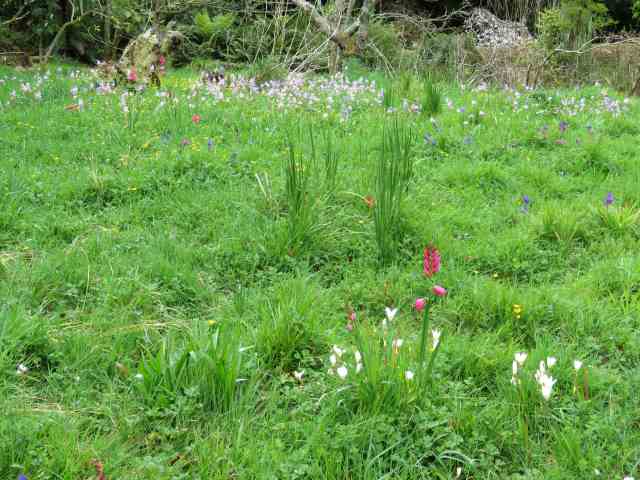
Mid August is a very pretty time for us. The early magnolias are magnificent and the dainty narcissi scattered all around the place are such a good contrast in scale, colour and detail. We have figured we can never have too many little narcissi and are continuing to spread them further afield from cultivated areas, to extending the bulb meadows and tucked in wherever we think they can grow undisturbed that they may emerge and delight during their weeks to shine their golden light in early spring.

I laughed at myself when I found this photo of Jetfire from nine years ago. I was clearly having a flight of fantasy as I photographed flowers set against our stainless steel splashback, lit by the spotlights on the rangehood.

The Magnoliafication

The Magnoliafication – we made it up. A bit like The Rapture, perhaps, but with its roots firmly in the soil, showier and more socialist in concept so not, in fact, like The Rapture at all. It was the process by which we distributed our surplus nursery stock free of charge in our local town of Waitara.

Every plant nursery ends up with surplus stock, seconds and rejects. We had less than many nurseries, being smaller and focused on producing high-end products. But we still had them – lines we had over-produced and plants that did not make the quality grade and it seemed such a waste to burn or compost them. We had the occasional sale but when you are targeting the upper end of the market, sales are something of a betrayal of loyal customers who have already bought a plant at full price. We preferred to give the plants away.

Magnolia Vulcan as a street tree, but not planted by the Council

In the early days, Mark gave a lot of surplus magnolias and rhododendrons to local farmers in the hopes of beautifying the countryside and we still see some of those around the area. We also see properties which have since changed hands and new owners have come in and chainsawed out established trees with no awareness of what they are removing, but such is life. A few experiences made us feel we were being taken somewhat for granted so we stopped giving them to farmers. Instead, we had an arrangement with a charity shop on the main street of Waitara that they would collect plants when we had them and put them out on their front pavement for people to collect free. It worked well. Everything was taken and some of it at least would be planted.

There were a lot of Vulcans in flower around the town

A lot of what went down for collection were magnolias – some with inadequate root systems which would have needed nursing to recover, or misshapen plants which should have grown well, if a slightly odd shape. And a lot of those reject magnolias were ‘Felix Jury’ which took us a while to learn how to grow straight and tall. We also had a contract grower producing an export crop of the magnolias for us and his standards were not as high as ours so too many were unable to be exported. They went down to our magnolia distribution system outside the charity shop.

At the time, Mark quipped about the magnoliafication of Waitara.

Waitara has a lot of magnolias all coming into bloom. By no means did they all come from us, either as purchases or as freebies. When the powerhouse nursery, Duncan and Davies, was in full production on the other side of Waitara, it was a significant employer of locals as seasonal labour and it was also renowned for its huge end-of-season sales. There were also a number of other nurseries around, also producing magnolias and employing locals and some of the trees will have come from those sources.

The irony is that magnolias are generally seen as a high-end, prestige plant and Waitara can be described in many ways but elite is not one of them. Its post-colonial history has made it the poor relative in the district, at the low end of every socio-economic indicator. But it can sure grow magnolias well and I think it likely has more magnolias per capita than similar small towns.

I only drove around about 8 or 10 short streets this week, photographing magnolias from the roadside. I belong to a Facebook page which is mainly comprised of mad, keen magnoliaphiles in the more northerly parts of Europe. Most of the photographs they post are close-ups of blooms on small plants, often growing in challenging climatic conditions. I thought they would be interested to see them used more widely as a mainstream ornamental plant, planted by non-gardeners and gardeners alike. They were indeed surprised to see them in this context.

Three Magnolia Felix planted in a row

Given how many reject Magnolia ‘Felix’ we sent down, I was delighted when I found five planted in two gardens a couple of doors apart which were the right age and size to be from those. One had two trees planted side by side and the other house had three planted close together on their side boundary. I don’t know that they were our free ones, but given the high price tag on the premium product from both us and local garden centres we supplied, it seems unlikely that non-gardeners would go out and buy two or three at the same time.

I now plan to drive more extensively around the back streets of Waitara, playing ‘spot the magnolia’.

Finally, a wry observation about human nature. Friday was free plant day at the op shop, when we had plants to send down. One Thursday afternoon, two women drove in here in a modern car. They hadn’t come to buy plants, they had come hoping to get first dibs on picking over the free plants ready to go down to Waitara the next day. At the time we had a lovely, local man called Danny working here. He intercepted them and I hope they felt some shame at his incredulous response as he told them that was not how it worked. The nerve of some people.

This sight will not be seen again until July next year

Waitara has a splendid tree of the pink Magnolia campbellii which is one of my seasonal markers for the start of the magnolia season. It has finished flowering already but here is a photo I prepared earlier, which some of you may recognise. The tree did not come from us; it is likely it was a Duncan and Davies plant.  

A travesty, I say. A travesty of pruning on this magnolia on the main street but I wanted to give the poor specimen an award for bravery in flowering on.

Odd crops

Hakeke at the top with white oyster mushroom below

We are timid eaters of assorted mushrooms and fungi in this country, having been raised with a healthy fear of death cap mushrooms which look so innocent and edible. Generally we have a choice of brown Portobello mushrooms or white button mushrooms at the supermarket, so I leapt at the chance to try fresh oyster mushrooms when I saw them at the local farmers’ market.

We were a bit underwhelmed, which was disappointing. More textural than tasty, one might say. I decided to taste test the remaining ones beside the flabby brown fungus that grows freely around here and which played a very significant role in the early colonisation of Taranaki, where we live.

I am not sure that I have unravelled the complicated nomenclature of this flabby brown fungus. Mark has always known it as ‘woodear fungus’ but that is wrong. I couldn’t commit the original Maori name to my memory – hakekakeka – but it seems that is now synonymous with hakeke, which I can remember easily. It belongs to the Auricularia group, and it may be correctly identified as A. cornea but that seems to be interchanged freely with A. polytricha, which it probably shouldn’t. They are not synonymous. Anyway, it is common here and safe to eat. If you want to.

Mark found me some hakeke from the garden for my flavour experiment. I sliced both that and the oyster mushrooms into thin strips and cooked them in butter with a touch of olive oil (to stop the butter from burning) and some finely diced garlic, using separate frypans.

The verdict? Compared to the hakeke, the oyster mushroom was flavourful but it was the garlic butter that was the tastiest by a long shot. The hakeke is purely textural. The only use I could see for it in times when food is plentiful, is fried until it is crisp and then used as a garnish on, say, fried rice. I don’t think I will be adding it to our diet on a regular basis, even though we can gather it for free.
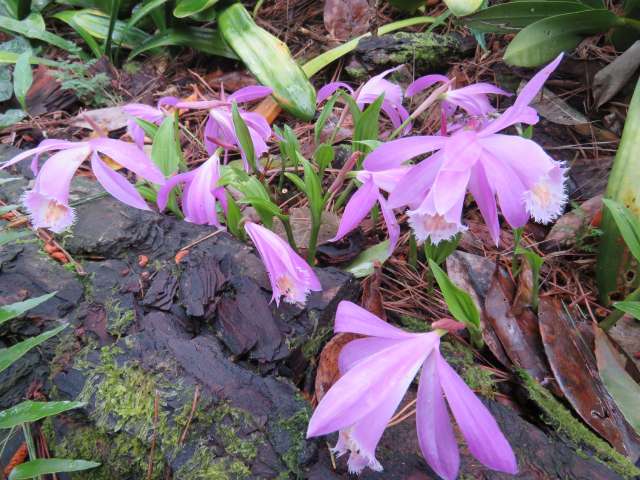
Wasabi in flower beneath the orange trees. With self-sown forget-me-nots.

We were given a small division of a wasabi plant last year. Despite the internet saying it was difficult to grow, we hit on ideal spot (fertile soil with overhead cover from a couple of orange trees) and the clump has grown. I could see some evidence of the swollen tubers that are the part that is grated to eat so I dug it up, only to find I was being a bit optimistic. It seems it is a two or three year crop in our conditions, to get big enough tubers to grate. We now have seven divisions, five replanted and two shared with others. 

You can see the tuberous parts forming which are the edible parts but I didn’t want to sacrifice too much of the plant by harvesting too early

Interestingly, I doubt that I have eaten genuine wasabi before. Outside of Japan, most of what is sold as wasabi paste is in fact horseradish, mustard and green food colouring. I did grate one little bit to try but it was too small a volume to detect subtle differences in quality and taste. It tasted wasabi-ish. I am sure that in time, freshly grated wasabi will lift my summer sushi to a new level.

Salted limes. In the past, I have done them whole but quartering them makes no difference and more fit to a jar.

In the kitchen, I am curing a jar of salted limes. I have been doing these for years to use in cooking, particularly in Middle Eastern and southern European dishes. They also add flavour when cooking grains like wheat, be it freekeh or bulgar, quinoa, rice or couscous. I dropped couscous when I realised how processed it is, but if you eat it, I can recommend adding a finely chopped salted lemon or lime to give it flavour. Limes and lemons are interchangeable when it comes to salting; I just use limes as they turn yellow because we have more and they are a better size if I am salting them whole, rather than quartered as here. The brine is so strong that they last up to a year in the fridge.

Fermented artichokes – I just looked up several recipes on line and worked out the general drift rather than keeping to one. Delicious raw in salads – and more digestible.

Salt also plays a role in fermenting foods. I have just completed a small jar of fermented Jerusalem artichokes and the reason to ferment this crop is that the process breaks down the inulin to a more easily digested form. It is the inulin that is responsible for this crop oft being referred to as  fartichokes. Fermenting means that you can eat, sweet, crispy artichokes without the unpleasant after effects. I like the taste of artichokes and they are heavy croppers for minimal to no effort but my stomach did not like them at all. Hence the fermentation. I did a big jar last year but we didn’t eat them fast enough and they don’t store as well as salted lemons. When some questionable moulds formed, I threw out the rest but I think we will get through the smaller jar.

Huhu grubs – reputed to taste a little like peanut butter

I have my limits. I know that huhu grubs, as we know them, were eaten in earlier times but I could not bring myself to gather these, even when I discovered a plentiful supply in a rotting stump. Huhu are a long horned beetle endemic to this country. We were often faced with a plate of cooked insects in the elaborate meals we were served in China and I did try a few. I think it is a cultural thing and it would take me a while to get over my gag reflex and to normalise eating insects, even while I know that they could be a valuable protein source and more environmentally sustainable than animal farming. If I am going to eat insects, I would rather start with them in a more anonymous form – cricket flour, perhaps – rather than launching straight into foraging at home and putting live, squirming bugs into a hot frying pan. I fed them to the birds.

The food we were served in China often included a plate of insects.

The legacy of Magnolia ‘Lanarth’ and modest Magnolia liliiflora ‘Nigra’

Not the best photo but I can assure you it was the best sight on its day – looking through trees to ‘Lanarth’ in the distance

As I paused to admire the glorious purple of Magnolia ‘Lanarth’ through the trees, the thought occurred to me that the vast majority of the red magnolias raised and released around the world since the mid 1980s have descended from this particular tree down by the stream in our park. Some are several generations down the line but they trace their genes back to our tree.

Our plant of Magnolia campbelllii var mollicomata ‘Lanarth’

Botanically, our Magnolia ‘Lanarth’ is the form distributed by leading UK nursery, Hilliers, back in the 1960s, Magnolia campbellii var. mollicomata ‘Lanarth’. Felix Jury imported it at considerable expense and thank goodness he did.

Magnolia liliiflora Nigra – red but otherwise unremarkable
and the shrubby tree of M liliiflora Nigra at about 60 years of age. It flowers later in the season so we think must have been the mother of the red hybrids, not the pollen donor.

To be fair, it wasn’t just ‘Lanarth’ that launched the platform for new generations of red magnolias. The plant of Magnolia liliiflora ‘Nigra’ in the garden border behind our house was the other parent, almost certainly the seed-setter. In the heady world of magnolias, liliiflora is not a showstopper. Our plant is more sturdy shrub than tree, the blooms are not large, typical liliiflora form which is not showy and the flower colour has none of the rich glow that magnolias can have. But it is red both inside and outside on the petals. Mark tells me we are reputed to have a particularly good form of liliiflora ‘Nigra’ in this country in terms of its solid red bloom without the inner petal being white.

Breeders and enthusiasts around the world had been trying to create good red magnolias before, like the optimistically named ‘Chyverton Red’,  ‘Pickard’s Ruby’ and ‘Pickard’s Garnet’. We have one example here but I only have one tiny photo of it and I have just found out that the name we have on it is wrong. I will have to take more notice of it when it flowers this year and try and work out what it is, only out of curiosity because it is not remarkable.  

Felix looked at his plant of ‘Lanarth’ and wondered if he could get a good-sized, red campbellii-type flower. He had already done his other breeding to reach ‘Iolanthe’, ‘Milky Way’, ‘Athene’ and the other four Felix Jury cultivars. And so he created ‘Vulcan’, a breakthrough in its day. ‘Lanarth’ contributed the flower size and form, solid colour inside and out but also the translucence, tree form and scent. M. liliiflora ‘Nigra’ contributed solid colour, smaller tree stature and, importantly, red.
Magnolia ‘Vulcan’ this morning

We first released ‘Vulcan’ in 1989, in that wonderfully under-stated way of that era. I don’t think we sent any plant material overseas at the time but bits of it soon winged their way around the world and the rest, as they say, is history. ‘Vulcan’ is not without its flaws. It flowers too early for frosty areas (as does ‘Lanarth’); it only achieves its density and purity of colour in warmer climates and even then tends to fade out to murky purple as the season progresses. But for its time, it was a breakthrough. It was the only plant we ever released that we could track its flowering from north to south of the country by the telephone calls we received. Even today, 35 years on, it is a showstopper at its best. I had two young tradeswomen painters in a couple of weeks ago and one of them asked me about the ‘black magnolia’ as she spotted the first buds opening, declaring she had never seen anything like it before.

Our mailorder catalogue from 1989

Felix didn’t go any further with breeding magnolias after ‘Vulcan’ but encouraged Mark in turn. And it was Mark who created the next generation which included ‘Black Tulip’ and ‘Felix Jury’.  Other NZ breeders followed suit – notably Vance Hooper and Ian Baldick.

It seems that ‘Black Tulip’ and Felix Jury’ have become two of the more significant breeder parents around the world. I see many, many red seedlings on international magnolia pages and they are clearly descended from those early red hybrids here.

Magnolia ‘Vulcan’

Felix named one red magnolia, Mark has named and released three but there is a fourth in the pipeline. We are hoping it will be ready for release internationally next year or maybe 2026. We describe it as a ‘Vulcan’ upgrade. It flowers a little later and has an exceptionally long blooming season and is a different hue of red, without a tendency to the purple undertones inherited from ‘Lanarth’. Solid colour and cup and saucer form which is our preference – it stands out here as good and we have high hopes for it across a range of climates. I won’t share photos until we have a release date.

Magnolia campbelli var mollicomata ‘Lanarth’

The new selection also traces its origin to the lovely ‘Lanarth’ in our park. That ‘Lanarth’ originated from a seed collection by plant hunter, George Forrest, in 1924 in southeastern China, near the Burmese border. Only three seed germinated back in the UK and this one was the best, named for the garden where it was raised in Cornwall. Those are quite long odds for what turned out to be such a significant plant.

While we may only have named and released four red magnolias from the Garden of Jury, with one more to come, we have many, many magnolias on the property that come from the same breeding lines. This lovely one that won’t be selected for release is another seedling from the batch that gave both ‘Black Tulip’ and ‘Felix Jury’.

In praise of the humble tamarillo

A seedling tamarillo that appeared in the Wild North Garden

The unsung hero of our winter salads is tamarillo. We eat salads most days all year round and finding mixed contents in the depths of winter can be problematic. Mark is Chief Salad Maker here and he is a good forager. Perish the thought that we buy salad ingredients, especially out of season salad ingredients like tomatoes and cucumber. Winter salad staples include random foraged greens (from chickweed to amaranth leaves to juvenile beet foliage), avocado, bean sprouts, finely diced onions, citrus and… tamarillo.

Tamarillo*** are what the oldies amongst us may remember as tree tomatoes, a South American fruit renamed by in this country by a fruit marketing board, just as we renamed kiwifruit from China. Botanically, it is Solanum betaceum and the solanum tells you it is in the same family as tomatoes and potatoes, which means it is frost tender. This is not a plant for everybody, but for those who can grow one, it is worth it, fruiting as it does through the depths of winter.

If you buy one to plant, it should fruit for you within two years. Ours are self-sown seedlings so we really are foraging.

Stewing skinned tamarillos to make jelly

In my childhood, I think I was probably served them as dessert, stewed with a fairly large amount of added sugar. As a young adult, I encountered my mother-in-law’s winter salad standby of finely sliced onion, sliced raw tamarillo and a sprinkling of brown sugar. We have done away with the sugar now for salads. When we gather a surplus, I blanch them to remove the skins and then stew them before sieving them to remove the pips, adding gelatine and a small amount of sugar to turn them into a fresh fruit jelly. The usual way of eating them is to blanch them by pouring boiling water over to remove the skin and stem, slicing them and sprinkling them with sugar. I prefer them jellied to have with my breakfast muesli. They are very much a feature of our winter diet – both savoury and sweet.

The red form is way better known than the orange or yellow but we lean to a preference for the orange.

We are currently eating from two of three volunteer plants. In the depths of the Wild North Garden is a seedling that was presumably spread by a bird pooing on the wing. It is a red one, which is by far the most common form. On the wilder margins of the summer gardens, we have another two plants, one of which is an orange form which is milder and slightly sweeter to taste. Mark prefers to use the orange one for his dinner salad assemblages.

Red, orange and what we think is the result of the potato pysillid.

The third plant is a red which cropped brilliantly for a couple of years. Last year it surprised us with just as many fruit but they were tiny and this year they have remained tiny. We were puzzled why but now think it may have been affected by the dreaded potato psyllid which is a recent pest in this country that is cutting a swathe through commercial solanum crops.

Tamarillos are not long-lived plants but they are easy to root from cutting or raise from seed if you don’t want to buy one from the garden centre. We never spray or prune ours. They are not the world’s most exciting or delicious fruit but we have found them to be one of the most useful – trouble-free and adaptable at a time of the year when options are limited by winter.

The orange seedling starts out red but turns orange as the fruit ripens and ages to yellow

*** The name tamarillo is specific to Aotearoa New Zealand. This fruit is grown in mild to subtropical areas around the world and has many different common names, depending on which country they are in.