
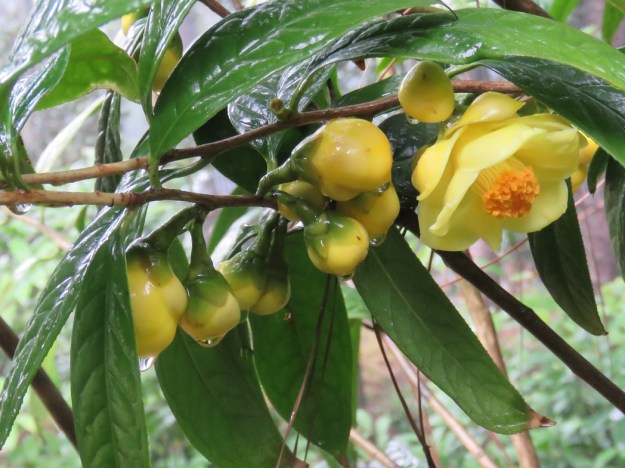
It was raining at Foshan Institute of Forestry Science where they have extensive plantings of yellow species, mainly C. nitidissima. It is thought that the flowers face downwards and are nestled beneath the foliage to protect them from the heavy raindrops they would receive in their forest habitat.

There was a fine specimen of C. nitidissima in the Confucian temple gardens in Dali. The heavy textured buds look more like hanging fruit than emerging flowers. Our plant at Tikorangi has never bloomed this freely.
While we talk about yellow camellias, in China they refer to golden camellias, often in tones of reverence and awe.

Camellia Jury’s Yellow on the honours table at the national camellia show in Dali
By the time Mark Jury (yes, my Mark) started breeding camellias, his renowned camellia-breeding uncle, Les Jury, was quite elderly and happy to share his experience and goals. It seems remarkable that 45 years after he first registered ‘Jury’s Yellow’, it is still widely grown and sold and we even saw it on the honours table at the National Camellia Show in China in February. ‘Gwenneth Morey’ and ‘Brushfield’s Yellow’ are Australian camellias of that era also heading down the yellow camellia path, but it seems that Les’s version is the one with staying power.
None of these breeders of the 1960s and 70s had access to yellow species. They would not even have known of their existence, but always there is that quest to extend the colour range. Les explained to Mark that he thought it might be possible to get the golden stamens to bleed colour into the petaloids (the tiny petals that comprise the centre of an anemone-formed camellia). It worked. These early three yellows all have pale lemon coloured centres with the outer circles of petals remaining white. They were colour breaks in their time but they all originated from white japonicas. The trouble was that there really was nowhere else to go from there, in breeding terms, to try and intensify the yellow.
Enter the yellow species. Even I can remember the waves of excitement in the camellia world when C. chrysantha became available. Suddenly it appeared that there would be a huge range of new directions in camellias. Don’t hold your breath. It ain’t that easy and it is not for want of trying. After maybe fifty years and probably hundreds of thousands of crosses, there haven’t been many encouraging results out of China. Japanese breeders have been very active without many results and we have never heard of anything coming from other international breeders.

The Best in Show award went to a yellow hybrid
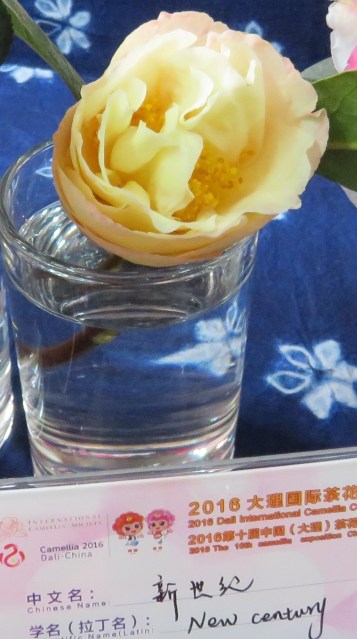
‘New Century’ shows good colour but it was not possible to tell if the bloom opens more than this specimen in the show
True, the Best in Show award at the Chinese nationals went to a fine yellow hybrid and there was another promising yellow coloured bloom called ‘New Century’ on the table. But those are cut flowers looked at in isolation. There are many other factors to be taken into account to determine garden worthiness. We also saw a few other results from breeding programmes – one flushed palest yellow with pink on the outer petals. It was a hybrid but not of great note. Others just seemed to throw to the japonica parentage. Kunming camellia breeder, Shen Yunguang, said that she was crossing the yellows with a white japonica – the latter will be to get greater size and floriferous characteristics – but the yellow species do not appear to be keen to cross with other types.
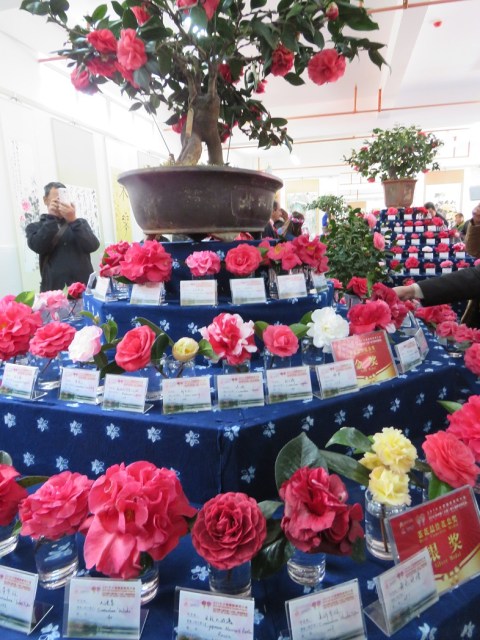
The Chinese national camellia show was staged in a temple in the heart of Dali Old Town. The yellow cultivars stood out amongst the more usual pinks, reds and whites
If it is possible to get a range of good yellow hybrids, the Chinese will do it but I doubt that it is imminent. What about orange ones? Can the next generation look forward to yellow camellias being crossed with red ones, to give a new colour altogether? International yellow camellia expert, Dr George Orel is pretty sure it can’t happen because of the incompatible genetic codes between the yellows and the reds. I am sure it is not for want of trying but the yellows are notoriously difficult in hybridising.
I asked Mark if he saw breeding potential in the new species that are still being discovered. He shrugged his shoulders and said, from his point of view, no. They are tropical, too tropical for New Zealand. He is also realistic enough to know that if the Chinese and major international breeders from other countries have found them hugely difficult to cross with other camellias, it will be a fluke if a minor breeder in another part of the world comes up with something worthwhile. It is just as well he doesn’t want the newly discovered species because with our closed borders, bringing in a new species of anything is devilishly expensive and difficult.

Camellia nitidissima (or chrysantha) – the one good flowering we have had on our plant in 2011
Chrysantha or nitidissima?
The most common yellow species in the west and, I understand, the one widely used for flower tea in China was originally distributed under the name of Camellia chrysantha. It is now more usually named as C. nitidissima syn chrysantha – in other words, you can use either name but nitidissima has precedence. We bought it from Neville Haydon at Camellia Haven as soon as it became available. It has handsome bullate foliage – heavily veined and textured leaves – but in all the years since we have had it, I think it has only flowered well once. It wasn’t helped by a pear tree falling upon it but it has reached quite a large size and is now at least 20 years old, if not more. The other yellow species we have here have never bloomed. This is not to say that they won’t bloom in other parts of the country, at least further north.
Collectors’ plants vs good garden plants
The yellow species are what I would call collectors’ plants – really interesting to have and exciting when they flower. But good garden plants? Not so much. All the species I saw had small flowers and not that many of them at any one time. The flowers usually face downwards and are on the underside of the branches. They are also quite picky about growing conditions and many were sparse in foliage. A good garden plant is a reliable performer that will delight your average home gardener and, with camellias, that means a reasonably long season of mass blooming. This is why there is so much interest in creating good hybrids. If you want to grow any of the yellow species, remember that these are understory plants of the forest, growing in humus-rich soils. They need overhead shade but also sufficient light to enable them to set flower buds.
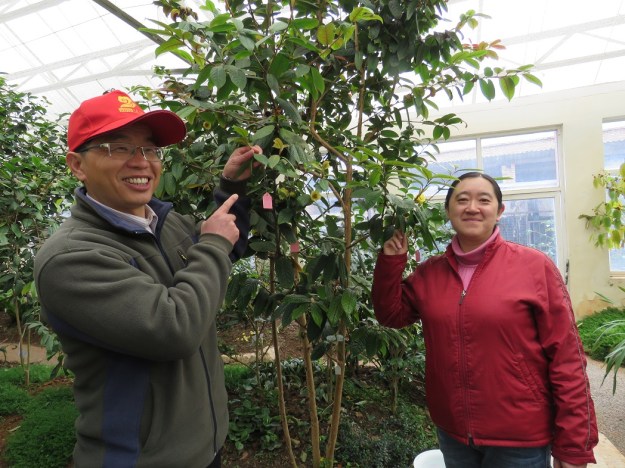
Shen Yunguang is responsible for managing the covered house that contains the yellow camellia species at Kunming Botanic Gardens, where it is too cold to grow them outdoors. While it appears more usual to use the yellow species as the pollen donor, she is also trying to cross using them as seed setter. The hanging pink labels mark her crosses. To the left is Professor Wang Zhonglang from Kunming Botanical Institute

C. chuongtsoensis (photo by Tony Barnes)

C. longzhouensis (photo by Tony Barnes)

C. impressinervis (photo by Tony Barnes)
Camellia nitidissima was first described and named in 1948. In 1960, a wild population was found growing near the southern border of China with Vietnam and it was named C. chrysantha (hence the two names). It wasn’t until the 1980s that the west realised there was a yellow camellia species and it remains the only one commercially available in any significant numbers.
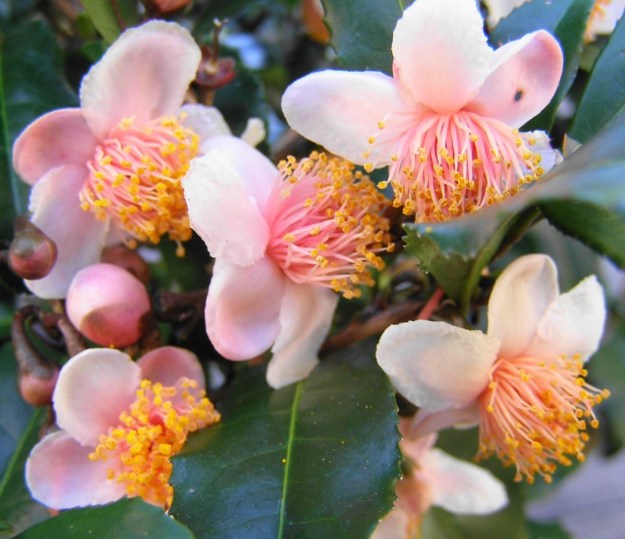
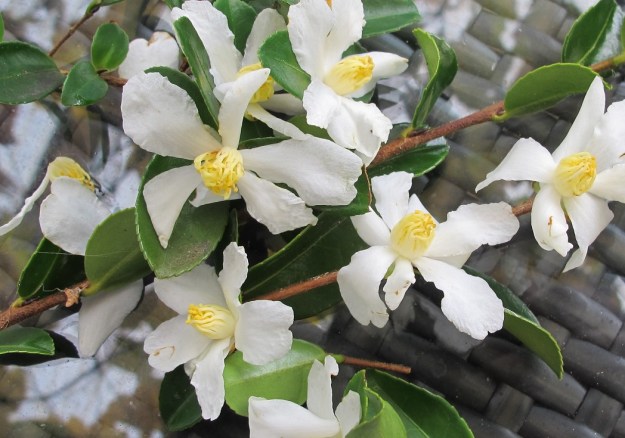
However, since the 1980s, there has been an explosion of interest in yellow species and modern day plant explorers are continuing to find new ones, particularly in Vietnam. It is a fluid situation. There appear to be anything between 28 and 60 different yellow species. It is likely that some will be reclassified as variants on existing species while new ones will continue to be identified. There are at least six notable public collections of yellow camellias in Chinese institutions. I visited the one at Kunming Botanic Gardens where they are grown under cover. We also saw extensive outdoor plantings in Foshan near Guangzhou. The differences in flower form between species are not great to the untrained eye. All appear to have small blooms around 4cm across, usually semi double (two rows of petals) with a large boss of golden stamens in the centre. The heavy substance of the petals is remarkable, making them look waxed and solid.

Tea made from the golden flowers was served to us on a number of occasions and is very pretty

Drying the flowers and buds for tea in Foshan
When we talk about new species being discovered, we should remind ourselves that this is being discovered by botanists. Local residents will have known about these plants throughout history. Tea made from the golden camellia flowers is widely served on ceremonial occasions and is now a commercial venture. It seems unlikely it only dates back to the 1980s.
What does golden camellia tea taste like, you may wonder. Subtle, is all I can say. Beautiful to look at, with a subtle floral aroma and taste.
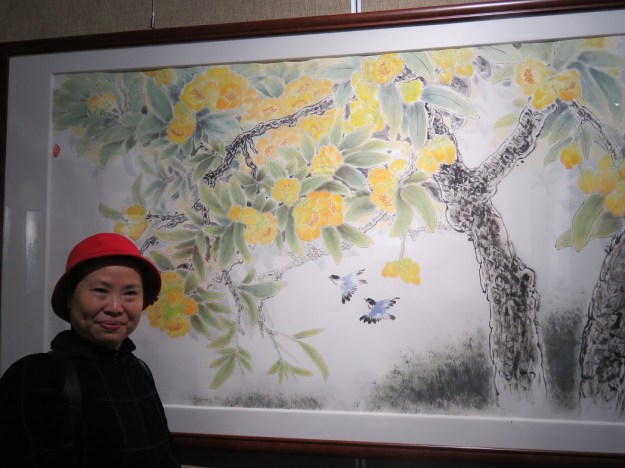
Artist Xinger Li with her lovely painting titled (in English) ‘Chinese Camellia with Dense Dew”
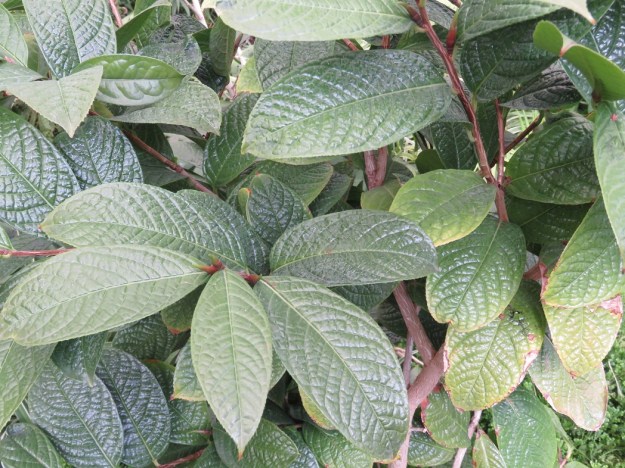
The foliage on C. impressinervis, as on C. nitidissima and some of the other species, is heavily veined and textured (called bullate)
First published in New Zealand Gardener and reprinted here with their permission.
Stop press: one of our other yellow species in the garden here has set flower buds for the first time, after maybe fifteen or twenty years. We will be watching it closely and now we just have to try and unravel which species it is. The label has long since gone.

 First published in the June issue of NZ Gardener and reprinted here with their permission.



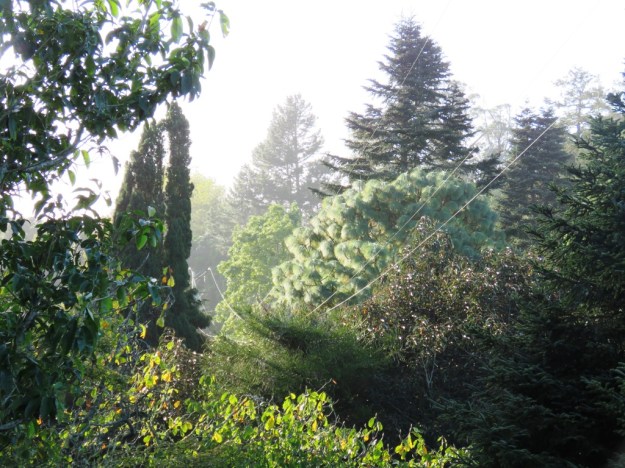
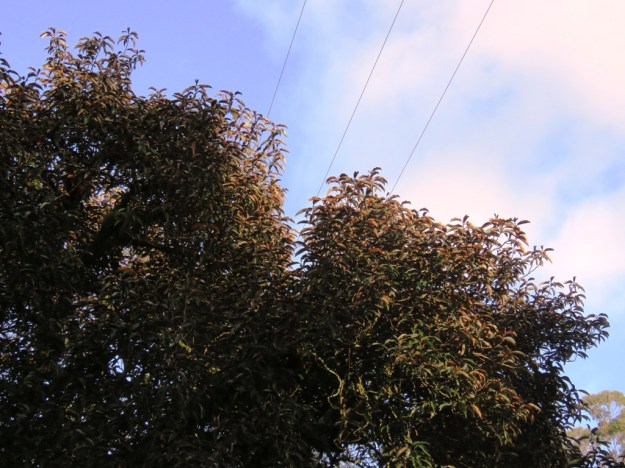
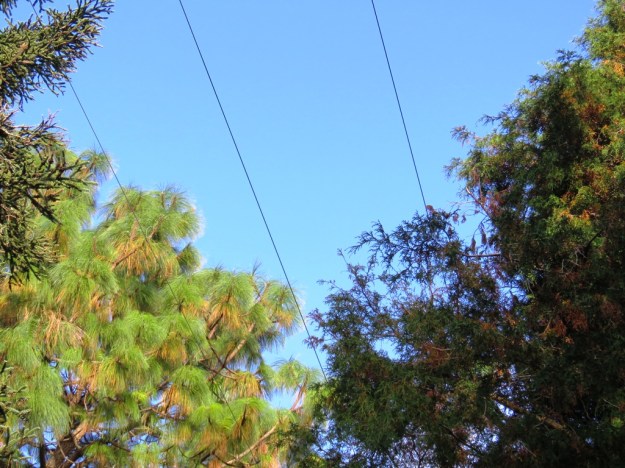
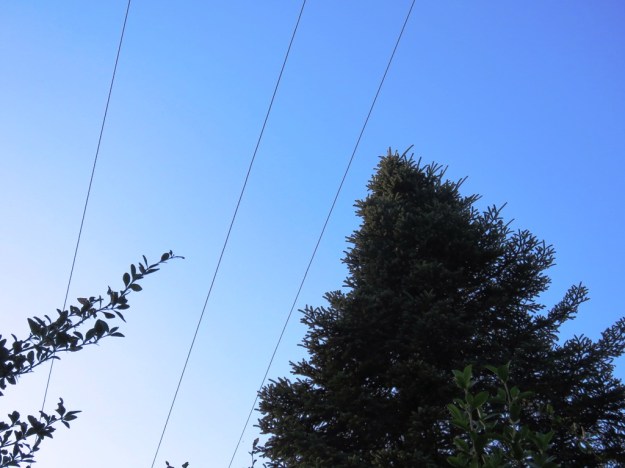 But no more. Yesterday the lines were removed as part of an upgrade on that particular section. We could not be more delighted. And relieved. At least some of the trees should now be free to grow to their maximum size and maturity long past our lifetime.
 Tikorangi The Jury Garden