

One of the You-Me series of hydrangeas
What would a Tikorangi summer be without hydrangeas? They are one of the easiest and showiest of summer flowering plants here. Much of that is due to summer rain. We are blessed with both high sunshine hours (higher than Auckland, I like to point out) but also regular rainfall and hydrangeas do best in moist conditions.
We have the usual macrophylla mop tops which often feature in older gardens, with their big heads of blue or white. These we use more as background plants but hydrangeas are a large family and there are many more interesting variations than often realized.

Hydrangea quercifolia ‘Snowflake’
Most hydrangeas hail from Asia, particularly Japan, Korea and China but the oak leaf species, H. quercifolia, is a toughie from USA. The double form of this plant, ‘Snowflake’, is particularly showy. The abundant flower heads hang like cones, with each bloom forming multiple layers of petals down the stem. While it opens white, over time it ages through shades of soft green and antique pink before drying on the bush to a buff colour. It can look as if they are made from paper or silk and the flowers last right through the summer season into winter.

Hydrangea serrata ‘Preziosa’ changes flower colour through the season
We looked at a vast collection of H. serrata in an English garden and were very taken with the more refined appearance of this branch of the family. We have had the serrata hybrid “Preziosa” in our garden for many years. It starts flowering in November, coming out lime green, ageing through cream to white before turning pink and then red by the end of the season, often showing a range of colours on the same bush at any one time. The serratas are generally colour stable, unlike many macrophyllas. I want more serratas when I find the right spaces, particularly the daintier lace-caps.
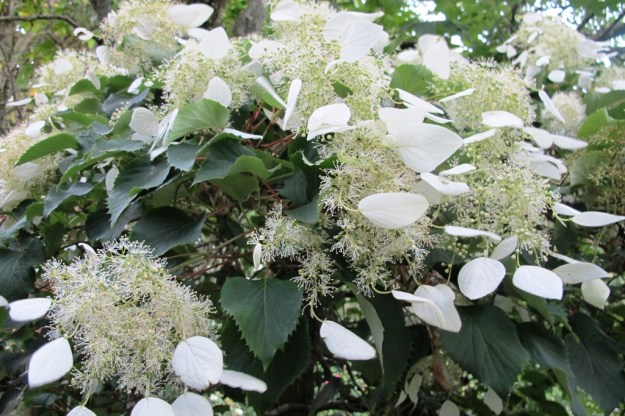
We prefer Schizophragma hydrangeoides to the climbing Hydrangea petiolaris
When it comes to climbers, we favour the close hydrangea relative, Schizophragma hydrangeoides, over the more common climbing Hydrangea petiolaris. We have them in pink and white and they dance in the breeze with a lightness that petiolaris lacks, as well as flowering more profusely in warmer climates. Give them something to climb up and they will stick themselves to it.

Hydrangea ‘Immaculata’ – a top performing compact, white macrophylla
If you are a fan of macrophyllas, I can vouch for the top performance of “Immaculata” which is a compact growing bush with beautiful white mop top blooms. I am also extremely impressed by the new You-Me series that has come from a Japanese breeder. We have four different ones and they have names like “Forever” and “Eternity” and I lost the names so I don’t know which is which. But they are all very good with compact habit and such lovely flowers – semi-double lace-caps in the prettiest shades.
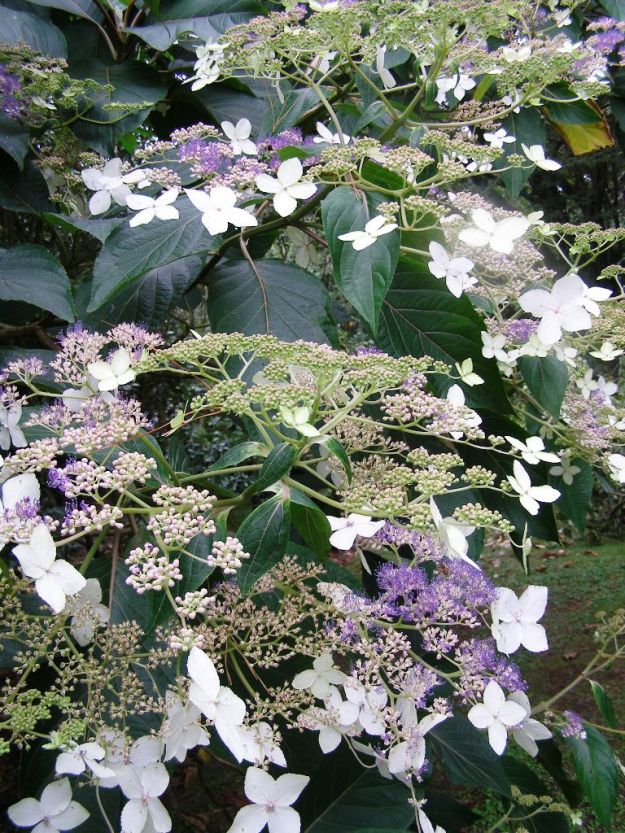
The magnificent tree hydrangea, probably a form of H. aspera
The season will close out for us with the huge, unusual, evergreen tree hydrangea that I see is now classified as belonging to the H. aspera (syn. villosa) group and sometimes given the cultivar name “Monkey Bridge”. At over five metres tall, it is large. It is also brittle so needs protection from wind. And somewhat frost tender. This is not a plant for everybody. But those huge lace-cap flower heads in early autumn are showstoppers and the flowering season lasts for a long time. Each flower head can measure up to half a metre across with colouring in subtle antique shades. I love it.
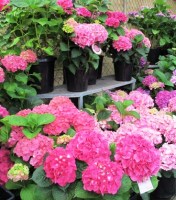 A word on the thorny matter of turning hydrangeas blue or pink… why bother? Gardening should be about working with nature, not trying to outwit it. In Taranaki, our hydrangeas are largely blue, very blue – the sort of blue that folk with pink hydrangeas envy. Yet I found myself charmed by the pink hydrangea display in a Canberra garden centre.
It is many of the macrophyllas that have colour determined by soil conditions. In acid soils (where rhododendrons thrive) they are blue, in alkaline soils they are more likely to be pink. It is actually to do with the available aluminium, an element that is usually strong in acid soils and absent from alkaline ones. Surely it is better to live with what we have and just admire the alternatives elsewhere?
The good news is that in a time of declining specialist, mail order nurseries, you can still source many of the less common hydrangea varieties as well as good selections of more usual types. Woodleigh Nursery was originally set up by Taranaki plantsman, hydrangea expert and personal friend, Glyn Church but is now in the capable hands of Janica and Quin Amoor. Their website is good and easy to use.
Hydrangeas are invaluable plants for easy-care summer gardens where there is enough moisture in the soils and, ideally, semi-shade. An annual winter prune tidies them up and gives larger blooms but you don’t even have to do that if you don’t want to.
First published in the February issue of New Zealand Gardener and reprinted here with their permission.

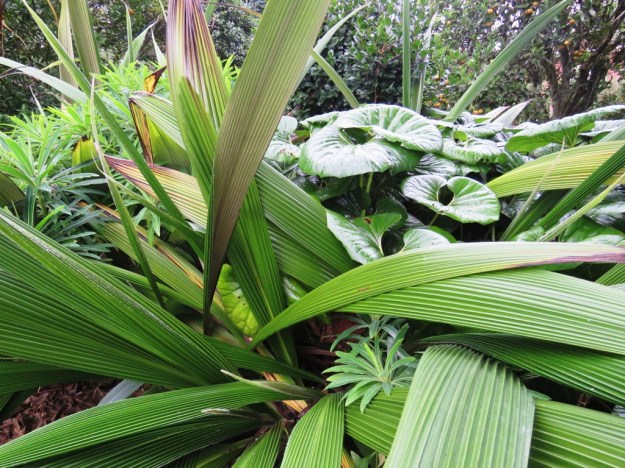
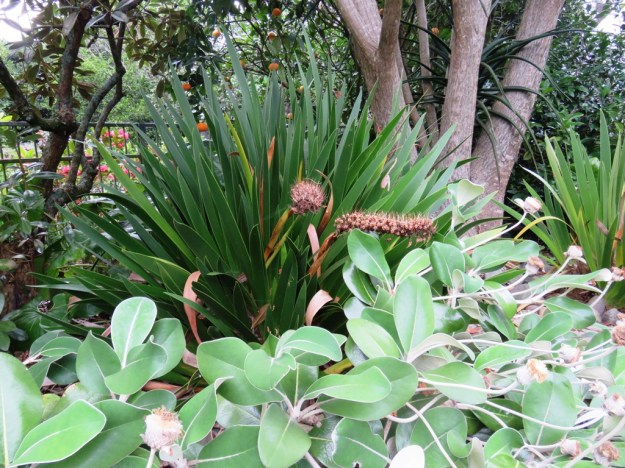
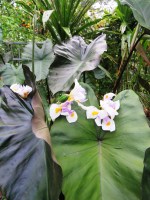 It is the next ten square metres or so where I have gone for a block planting. It was a mish-mash. No longer. I chose to use two common plants – the pretty but tough Dietes grandiflora and black taro. At least we know it as black taro but I am not sure if it is a colocasia (in which case it may be ‘Black Magic’) or an alocasia. It looks very new and raw at this stage, but I expect it to be a pleasing combination with plenty of pretty flowers next summer and good foliage interest. And low maintenance, without looking like a supermarket carpark.
 And for those of you who don’t follow the


 Tikorangi The Jury Garden