Tikorangi notes: hellebores (again), fallen tree (another one), the daffodil show and Heart of Darkness

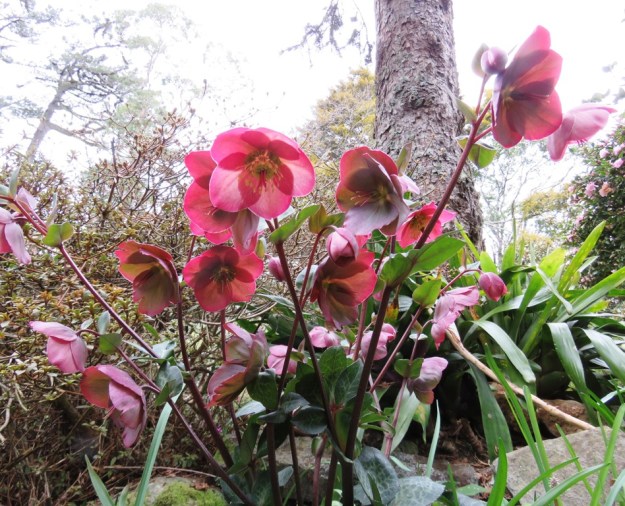
Hellebore Anna's Pink

Hellebore Anna’s Pink

In the garden, I have been slogging my way along the hellebore border removing pretty well all the old plants and replacing them with Mark’s hybrids which he has been cultivating in the nursery. I mentioned how much the border has gone back in an earlier post. What is interesting is how many clumps I am digging up which have only one or two leaves but below ground is a chunky mat of dormant eyes. I say dormant, not blind, because it appears that if these were divided up and put into good conditions, most eyes would sprout into a fresh plant. It must be what happens to hellebores over time and this border has not had a major rework in 30 years.

A multitude of dormant growing tips on hellebores with only a leaf or two showing above

A multitude of dormant growing points on hellebores with only a leaf or two showing above

I watched a debate on a UK gardening site about whether hellebore seedlings are worth saving and, as an aside, references to never digging and dividing anything. Hmmm… all I can say from our experience is that self-sown Helleborus orientalis seedlings are not worth keeping. There are huge numbers of them, for these are promiscuous plants, and the vast majority will revert to murky colours. I am deadheading as I replant and will continue to deadhead hellebores because we don’t want the seedlings. The chances of a brilliant self-sown seedling are remote whereas controlled crosses are hugely more successful. Mark has been working to get strains which hold their flowers up high and are sometimes outward facing which obviously improves the display.

As an aside, it appears that the new releases from the UK – Anna’s Red and Anna’s Pink – are both sterile which is to their credit. Not only do the blooms last longer, but this eliminates the need to deadhead and weed out seedlings. They are worth buying.

When it comes to digging and dividing perennials, I would comment that you can only get so far if you refuse to dig and divide. Over time the thugs take over and eventually you get to a point where even they start to go back. Feeding alone is not enough. It is the below ground root competition that takes its toll. You can go a decade or two without digging and dividing anything, depending on the plants you are using, but the treasures are likely to have given up the ghost by then. There will come a time when you will look around and think “this used to look so much better”. We think about ten years is all we can expect of the hellebore border before it will need major work again but an easy-care nine years is good.

IMG_4575The latest natural garden feature arrived last week as the dead Pinus radiata we refer to as Glenys’s tree snapped off, fortunately leaving the lower few metres intact so we hope Glenys the Gecko will remain in residence. As is our practice, we will clean up the paths and damage but leave the body of the trunk in situ and garden around it.
IMG_4579I am pretty sure that the next tree in the row is developing a bigger lean and will likely fall sooner rather than later, but Mark is unconvinced. I like to remind him that I was right last time and those were smaller, younger trees. This leaning tower of Pinus radiata is probably 45 metres tall so we have to wait for nature to take its course.
IMG_4792We went to the North Island daffodil show last Saturday. There is a larger album of photos posted on our Garden Facebook page. There is no denying that our personal tastes lie with the less celebrated dwarf and miniature varieties which I have been systematically photographing this season. We are all about garden varieties, not show blooms. But like any genus of show blooms, the breeding directions are unveiled in a major display – lots of split coronas, colour combinations and pinks still coming through.

I decided we should be sourcing the dwarf hybrid named ‘Rapture’, the white N. cantabricus (which looks very similar to a bulbocodium) and I really would like some N. poeticus even if we have to go to poeticus hybrids. But, I was as much delighted by the whole event. The stalls! The competitions! I think these were the result of the involvement of the local branch of the horticultural society. Truly, I did not realise that the craft of crocheting edges to pictorial tea towels is not only alive and well, but also a competitive activity.
IMG_4790Nothing to do with gardening, but I still have a strong mental image of an acquaintance many years ago, earnestly crocheting aqua coloured edges to white face cloths. “I think it is nice for guests to have special face cloths,” she said with a high degree of self-satisfaction. I looked around her home – a large and cavernous turn-of-last-century villa which had been cut in pieces and relocated but not restored. The walls were scrim, the facilities and decor still more or less original. It was truly grim. And I thought to myself, you poor woman. You think guests won’t notice the surrounds if they have new face cloths? It was all so evocative of Kurtz in Joseph Conrad’s ‘Heart of Darkness’, where the rituals of civilisation are all that keeps the chaotic universe at bay and without those, what is left is “the horror, the horror”. It had the makings of a short story, but instead I became a garden writer.

Next Tikorangi Notes may bring you an insight into the lost art of waxing camellias which, I have only recently found, is not a lost art at all but almost certainly sits alongside pictorial tea towels with hand crocheted edges.
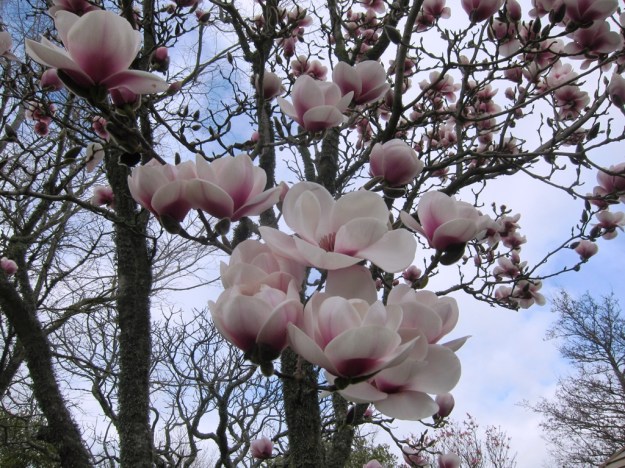
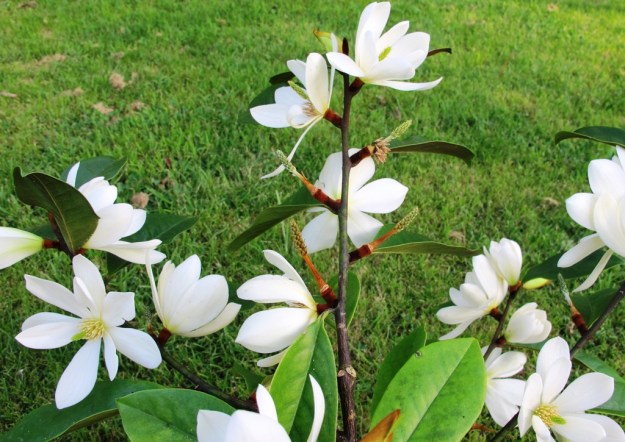
And because we are at Peak Magnolia, here is Milky Way
And because we are at Peak Magnolia, here is Milky Way
Petal Pushers – the Jury Michelias


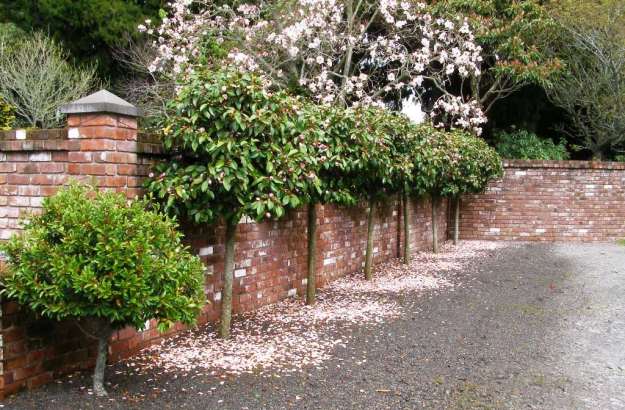
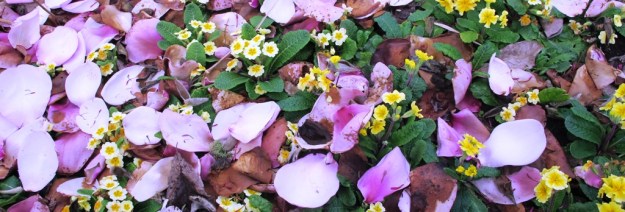
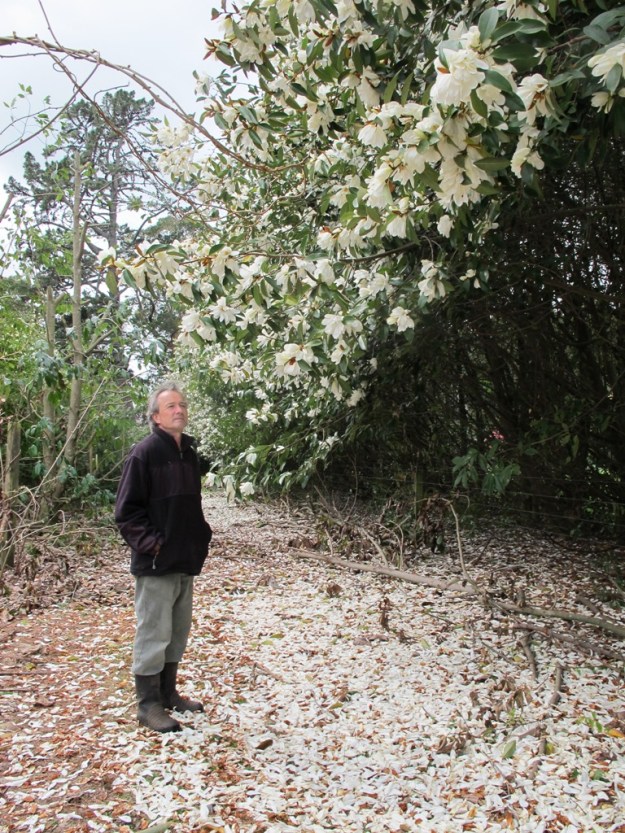
Mark Jury standing on a carpet of fallen scented petals, surveying one of his early shelter belts planted with michelia hybrids

Mark Jury standing on a carpet of fallen scented petals, surveying an early shelter belts planted with michelia hybrids

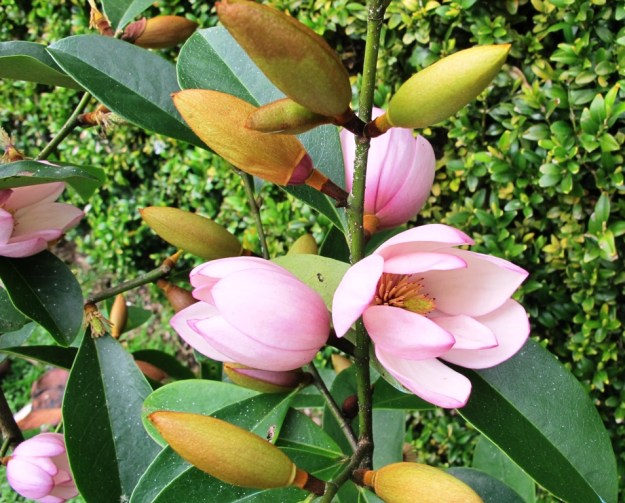
All michelias are magnolias but not all magnolias are michelias. We have always known them as very close relatives to magnolias but they sat in a group of their own. Now there has been some international reassignment after DNA testing and they have become magnolias, which has led to some confusing name changes. In common usage, they are still often referred to michelias and we are a bit betwixt and between on names.

Until very recent times, there weren’t many different michelias in New Zealand. Doltsopa (the best known cultivar being named ‘Silver Cloud’) and figo (common name of port wine magnolia) have been here for a while. It was an early cross between these two by the late Oswald Blumhardt that gave us ‘Mixed Up Miss’ and ‘Bubbles’.

Interest started to grow when yunnanensis was brought in some twenty years ago. It has spawned a gazillion named selections because it sets seed readily, but just to confuse you, it is now correctly referred to as Magnolia laevifolia. There are a few other species which are not widely available, including maudiae, and some obscure ones that are of interest to collectors only. But our borders closed to new introductions so there are a number of recent discoveries in Asia that we don’t have here. Yes, new plants are still being discovered in this world of ours but we can only look at them from afar with our bio-security rules.

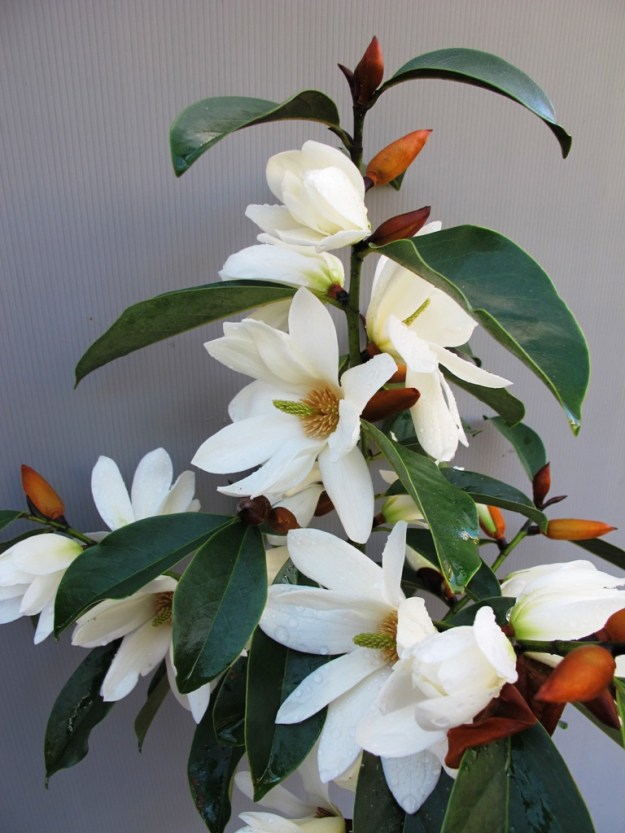
Fairy Magnolia White

Fairy Magnolia White

Mark started hybridising them here back in the 1990s. He figured there was room to improve on them as garden plants. Figo’s flowers are a bit insignificant and the foliage tends to go yellow in full sun. ‘Silver Cloud’ has a wonderful fragrance but the flowers are very floppy and lack good form. It also grows too large for many town gardens and it can defoliate – dropping all its leaves – after flowering. Laevifola (yunnanensis) can defoliate too, in spring conditions which are wet and cold. These are evergreen plants so defoliation is not a great look. ‘Bubbles’ and ‘Mixed Up Miss’ look great as juvenile plants but are pretty ordinary when they get bigger and older. Mark could see possibilities.

September and October are exciting months for us as the michelias bloom. We live and breathe michelias and magnolias at this time of the year. There are six hundred new michelia seedlings ready to flower this spring alone, part of a long term breeding programme. Out of the thousands he has raised, only three have been named and released so far.

Fairy Magnolia Blush

Fairy Magnolia Blush

There is a long way to go yet but some directions are emerging. Despite the vast majority of michelias being basically white, he has reached reds, purples and deep pinks and is working on deepening the pale yellows to get stronger colour. Along the way there are an awful lot of murky colour combinations that get the chop. There is a big range of flower form, foliage and growth habits. Perfume can be an issue when two of the most fragrant species spawn offspring with no scent at all. Bringing together all the different elements to get a new plant is an absorbing and time consuming occupation.

Along the way we have also learned that michelias are very tolerant of cutting and clipping and sprout again from bare wood. The row of lollipop Fairy Magnolia Blush at our entrance has been clipped and shaped over ten years now and we can keep it to the size we want by trimming just twice a year. They make excellent hedges and some of our roadside shelter belts are a feast of flower and fragrance at this time.

The sustainable wood lot

The sustainable wood lot

Regrowth

Regrowth

An unexpected bonus has been the sustainable woodlot. Because we heat our large house entirely with wood, we burn through a prodigious amount every winter. Mark had been thinking along the lines of establishing a sustainable woodlot for the future that we could harvest on a rotational basis. I even sourced a book on the very topic. But lo, he realised a few years ago that his reject michelia seedlings already filled that very niche, doing dual duty as winter feed for our very small herd of beefies that we keep to eat the paddock grass. I say very small herd – there are only four at the moment. Cut off close to the base, the plants soon shoot away again with long straight whips that could be used as poles or left to grow for firewood. Mark drags the branches into an adjacent paddock where the cattle enthusiastically eat the foliage. He then gathers the remaining trunks to cut up for next season’s firewood. It seems a good multi-purpose use of a plant breeding programme.

Fairy Magnolia Cream

Fairy Magnolia Cream

Mark’s three michelia selections to date are sold under the Fairy Magnolia brand and are widely available in New Zealand garden centres and in some overseas countries. Blush is a soft pink, Cream is very fragrant and grows in a similar, compact manner to Blush. White is a larger grower and the first in the season to flower. Mark has always seen it as a garden-friendly alternative to “Silver Cloud” with good fragrance and beautiful flower form.

First published in the September issue of NZ Gardener and reprinted here with their permission.

Lollipop Fairy Magnolia Blush at our entranceway. The smaller michelia to the left is an unnamed figo hybrid with masses of creamy yellow flowers.

Lollipop Fairy Magnolia Blush at our entranceway. The smaller michelia to the left is an unnamed figo hybrid with masses of creamy yellow flowers.

Pink and yellow. Together.

Bright yellow kowhai and cerise campanulata cherry at Auckland Botanic

Bright yellow kowhai and cerise campanulata cherry at Auckland Botanic

Two of the three plants on my most-disliked list are pink and yellow combinations. The first was a nasty spirea we saw in the UK several years ago. It was clearly a recent release as it was everywhere – a murky pink flower with yellow foliage. The second was a variegated oleander spotted in Spain, sporting the same colour combination but the foliage was a yellow variegation which may add yet another layer to the colour crime. The third is Rhododendron ‘President Roosevelt’ which also sports similarly freakish, variegated yellow foliage but it is more red-toned than murky pink. We are not fans of variegated foliage here, as a general rule.

Pink and yellow in Beth Chatto's garden

Pink and yellow in Beth Chatto’s garden

In that magical garden that Beth Chatto has created, I did notice on our last visit that she quite often combined pink and yellow in combinations that would worry me in my own garden. So when I saw a bright campanulata cherry in full bloom at Auckland Botanic Gardens last week with a strong yellow kowhai planted in front, my reaction was to do a double-take. It is just not a colour combination that pleases me. As an aside, I did notice that the feeding tui much preferred the campanulata to the kowhai – which is to say that there were none in the kowhai but a whole mob coming and going in the campanulata. I take this as proof that tui lack political correctness and fail to appreciate that they are letting the side down by preferring the import to the native plant.

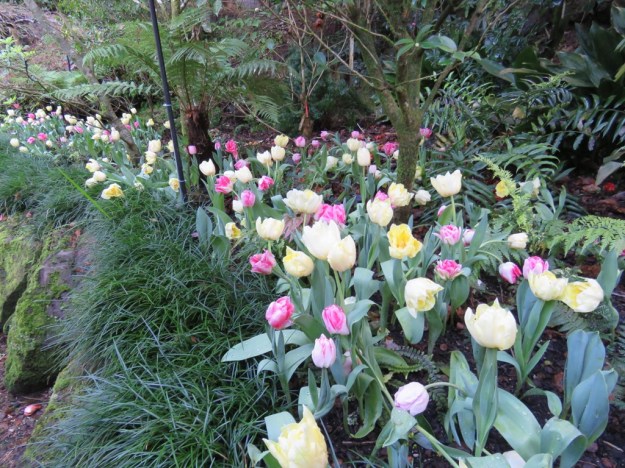
Pastel hued tulips at Eden Gardens

Pastel hued tulips at Eden Gardens

Pink vireya but with pastel yellow tulips

Pink vireya but with pastel yellow tulips

Because I was already thinking about that pink and yellow combo, the plantings at Eden Gardens immediately grabbed my attention. And there, the pink and yellow pleased me and I am sure that is because they were pastel and the pinks were clean hues. It is the combination of either cerise pinks, purplish pinks or muted Paris pink with bright yellow that worries me most, I decided. It is not that it should be avoided at all costs (unless it is yellow variegated foliage with murky pink flowers!), but that it fails more often than it works. A pale yellow is much easier to combine. Bright golden yellow needs more care – unless it is a narcissus. Vibrant orange needs even more caution.
Magnolia Felix Jury with colour-toned tulips at Eden Gardens

Magnolia Felix Jury with colour-toned tulips at Eden Gardens


It was Peak Tulip at Eden Gardens. I have planted some tulips this year, but nothing on the scale of Eden. It is the inner conservationist conservative in me. My instincts are too frugal to be willing to buy in fresh bulbs each year, treating them like annuals to be discarded after blooming. I don’t even plant annuals. I expect my tulips to earn their keep and return each year, gently multiplying. This is, apparently, too optimistic for tulips, although I planted them deep in the soil with hope. I enquired at Eden Gardens and was told they start again with fresh bulbs each season which is why they were so showy. Away from pink and yellow, the colour-toned planting beneath Magnolia Felix Jury as one enters the garden was restrained and impeccable though it lacked the zing that can be achieved with more adventurous colour combinations.
001 (6)

Garden lore – three hedging ideas for 2015

“My garden sweet, enclosed with walles strong,

Embanked with benches to sytt and take my rest:

The knots so enknotted, it cannot be exprest,

With arbors and alyes so pleasant and so dulce.”

George Cavendish (1499 – 1561).

IMG_4441

How to punctuate the end of hedge with panache and style in 2015.

I was taken to see the gardens at The Kelliher Estate on Puketutu Island in Auckland last week. When we say island, it is connected by a causeway. No ferry crossings were required. The gardens have been undergoing a major renovation in the last few years. There is a difference between a restoration and a renovation. The former attempts to recreate the gardens as they were in their glory days. In our climate with rampant growth and a heavy dependence of woody trees and shrubs, restorations are somewhat ill-conceived, in my opinion.

Renovations are a reinterpretation of a garden and in public gardens can range from pedestrian to insensitive, from ego-driven (the modern gardener determined to ‘make his or her mark’) to compromise by committee. Occasionally they are carried out with genuinely creative flair and there were indubitably elements of this showing in the gardens at the Kelliher Estate.

IMG_4438

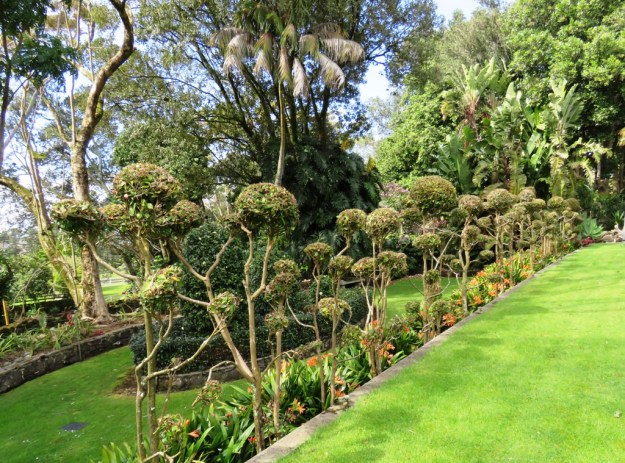
I was simply delighted by the reworking of the formerly overgrown lilly pilly hedge at the entrance – cloud pruned. With panache. I am no expert on lilly pilly. In fact it is more akin a yawning gap in my knowledge, especially as there are a number of plants which carry this common name. But I am guessing that this particular lilly pilly was the Australian myrtle also known as Syzygium smithii syn Acmena smithii (see footnote). If you are going to try something like this at home, take your time. You can’t rush the process of finding the natural shape of each individual plant. And trim flush to the stem. Nothing looks worse than nubbly elbows poking out all over the place where you have lopped off branches.

IMG_4467

Finally the wave hedging is a device I have seen in UK and Europe but not in this country before. It echoes the natural shapes of the landscape but gives some form without the regimented and straitjacketed predictability of the usual flat topped, formal hedge.

The one key element to remember if you decide to get more adventurous with your own hedges is to ensure that they will tolerate hard pruning and resprout from bare wood if you are going to reshape. Not all hedging plants do and conifers can be particularly touchy.

Postscript: Social media can be very helpful. The following more knowledgeable comment on lilly pillies was made on the garden Facebook page by Andrew from Twining Valley Nurseries
“You’re not wrong with the naming of Lilly Pilly. I’ve been to garden centres and seen the same plant labeled with three different names!
The correct taxonomic names for the 3 most commonly grown Lilly Pilly’s in NZ are-

Waterhousia floribunda (Old name: Eugenia ventenatti or Syzygium floribundum) Common name: weeping Lilly Pilly
Syzygium australe (Old name: Eugenia australis) Common name: brush cherry or Australian rose apple and is the most common.
Acmena smithii (Old name: Eugenia smithii) Common name: Lilly Pilly (or weed!)”

Thanks Andrew.

Do we take the award for the prettiest roadsides this week?

Looking along Tikorangi Road

Looking along Tikorangi Road

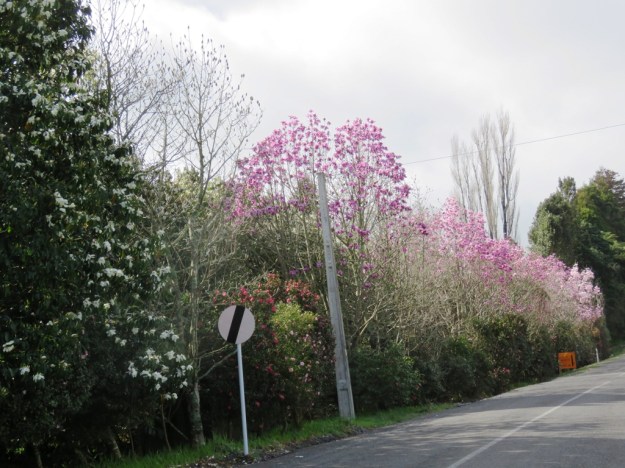
I was mooching around down at our corner yesterday afternoon. It being Sunday, there was little traffic but there are plenty of magnolias in bloom. With the large white michelias alongside, scent lies heavy in the air. Most of the roadside plantings are seedlings from Mark’s breeding programmes. He is always looking for space to site good plants and all our boundaries are ringed with flowering trees. Every year, the display gets more spectacular.

You will just have to imagine the fragrance from all that bloom

You will just have to imagine the fragrance from all that bloom

IMG_4154Generally speaking, people talk to us about our boundaries full of flower and scent because they really like them. Indeed we often hear vehicles slowing down to get a better view at this time of year.

So I admit I am still scarred by the local resident who accused us last year of causing a traffic hazard with our overgrowth and ‘debris’. In terms of insults, this just might go down in our history as the worst ever levelled at us. I get that some folk will drive past without even noticing. Indeed, yesterday as I was on the road with my camera, a truck driver stopped to ask me if I was photographing the undermining of the corner by the recent flood. It has still not been repaired nine weeks on but we don’t mind because it means the heavy traffic is a lot slower and more careful when it comes to turning that corner.  He looked a little surprised when I said no, I was photographing our trees.

IMG_4159

But to want to see this planting removed as an alleged traffic hazard? That I find simply beyond comprehension. Goodness, even our little herd of beef cattle show more appreciation of our planting efforts than that local farmer. Maybe in time, I will get over the shock of his comments.

Looking back up Otaraoa Road

Looking back up Otaraoa Road