
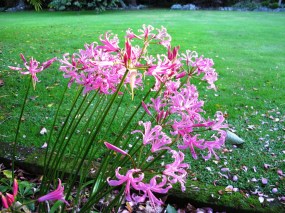
Nerine bowdenii on May 11

And a month later on June 11
Without a camera, I may never have tracked the flowering time of Nerine bowdenii. It is a species and we have valued it for being the last of the season to flower without being too excited by it. But a MONTH at least in full bloom through autumnal storms and wind – that is an astoundingly long time for a bulb that only puts up one flower head, as opposed to successional flowering down the stem. We are now thinking we will use it more widely beneath deciduous trees where we had been relying on belladonnas. The latter flowers early in autumn when the leaves are still on the trees and the blooms don’t last anywhere near as long. Fortunately, N. bowdenii multiplies up extremely well and is probably the easiest of the nerines we grow.
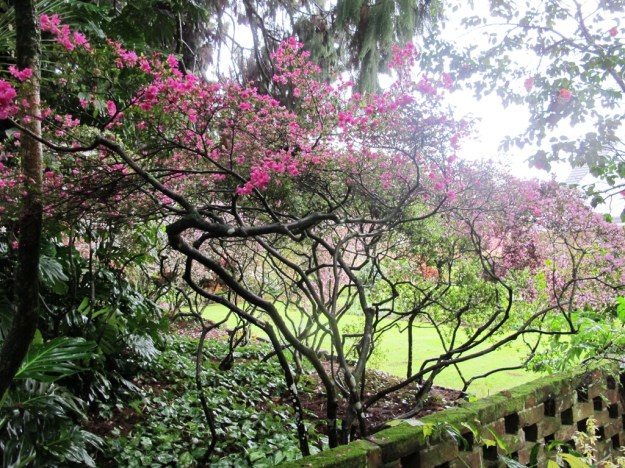
The Kurume azaleas, underplanted with Cyclamen hederafolium
I have been cleaning out the azaleas. Oh how easily those words trip off the tongue but I tell you, doing the first of two blocks is probably 20 or 30 hours work. It must be a sign of the leisured pace of my life at the moment that I can spend that amount of time on one task. Years ago, we limbed up these tiny leaved Kurumes to make the most of their interesting form and to enable us to look through them. Sculpting them, we call it. It is more common to clip and mound them, keeping them much lower to the ground. These ones are planted on the margins of our enormous rimu trees and they catch a fair amount of litter falling from above. They also shoot from the base and we try and rub off those new shoots before they get large. But once every five or ten years, a major clean out of the dead wood and the canopy makes a major difference. It just takes time. A lot of time. I am reminded of something we once heard Christopher Lloyd say (it must have been on the telly because I can’t find it in print): “People are always looking for low maintenance and easy care gardens. Personally I am of the view that if you love what you are doing, higher maintenance is more interesting.”

I lack a photo of passionfruit at the purple stage of ripening
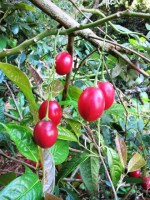
But at least I have red tamarillos on file
On the home harvest front, we are now experimenting with homemade juices. Not using the mechanised juicing machine that we inherited from our daughter when she left to live overseas. She assured us it made good carrot juice but we have not had a surplus of carrots yet. Mostly I use it for grape juice or melon juice. It takes a prodigious quantity of fruit for a pretty small liquid yield but then so do the fresh squeezed orange juices we often make – 5 or sometimes 6 fruit per glass. No, it was the surplus of passionfruit and upcoming tamarillos that were worrying me and I didn’t want a juicing system that ground up the seeds. Mark scooped a bucket of passionfruit out. The quantity immediately reduced to medium sized basin. I added some water and brought it to the boil with a little sweetener because the fruit was rather too tart. Do not laugh. It was only because I had agave nectar in the cupboard (bought when I was test cooking a recipe book sent for review) that I used it as a sugar substitute. I simmered the fruit for a short while before straining it off. The original bucket of fruit yielded just a litre of juice. Liquid gold. We will savour it, diluting it 50% with soda water in lieu of our weekday homeopathic gins.
What, you may ask, is a homeopathic gin? Here, it is lime and soda served in a nice glass which holds the memory of gin. When we decided, in a burst of wholesome living, to manage alcohol consumption by not drinking from Monday to Thursday, we realised that it was in part the ritual of sitting down together with a drink before dinner that we enjoyed. Hence the homeopathic gins. The logical extension of wholesome living seems to be the shunning of synthetic lime juice in plastic bottles, replacing it with our own fruit juices. Virtue expires on Friday evenings, I admit.
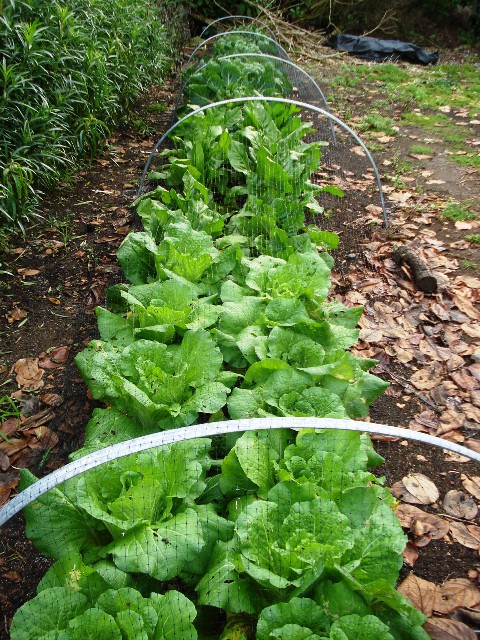

Blame the quail
Mark has been busy in his vegetable gardens. He has now resorted to covering all the brassicas and leafy greens as well as all seedlings, in order to protect the crops from birds. He blames the cute resident quail for attacking the Brussel sprouts but there are plenty of candidates. It may just be that the quail, being predominantly ground birds, are the most visible. The strawberries are planted for spring and the garlic is already above ground.

Lovely in bloom, huge, but what is it?
Finally, if any reader can give us the name of this enormous perennial, we would be most appreciative. It is of similar stature to a tree dahlia – about 4m x 4m – so taking up a lot of space. Currently it is smothered in white daisies and has survived a frost but cold weather can cut it to ground. It is very late in the season for what is presumably an autumn flowering perennial. We will enjoy while we can, but we would like somebody to remind us of its name.
Postscript: That didn’t take long. A reader has identified this as Montanoa bipinnatifida which I see is commonly known as the Mexican tree daisy, a member of the asteraceae family. No wonder we were struggling to come up with a name – I don’t think either of us have ever heard it before. And it is not a perennial but a shrub. It must be that ours gets cut back so often by the winter chill that it resembles a huge perennial rather than a shrub.
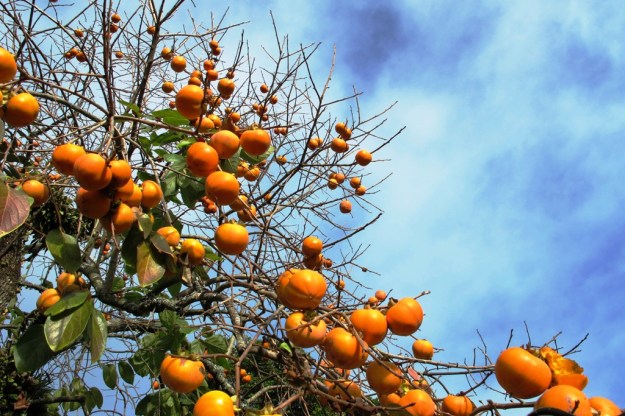 Persimmons. These are a glorious sight in autumn but more decorative than useful here. Ours is an old astringent variety – mouth-puckeringly so until it is super ripe and then I really only like the jelly-like centre segments. We don’t eat many of them. I tried buying the fruit of the non-astringent recent introductions, which can be eaten at the crisp stage like an apple. I was a little underwhelmed – I preferred apples.
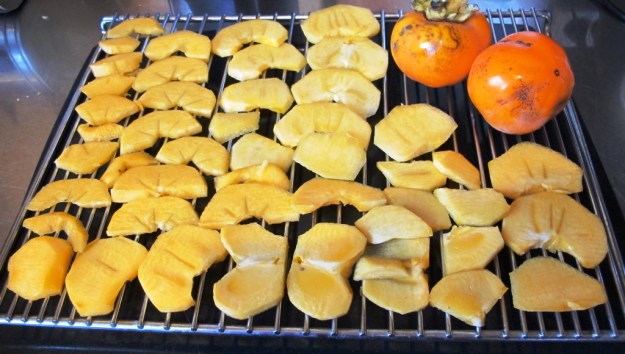 I recently read that persimmon fruit dry well and even the astringent types can be picked before fully ripe, sliced and dried and they will lose their astringency. Truly, we were very sceptical. But it works. It really does. The first batch I sliced, skin and all, and dried on a rack over our woodburner. It was a bit hot for them and the skin was a little tough. This second batch I used a sharp knife to remove the skin – which wasn’t difficult – and then sliced and put in the oven on fan bake at a very low temperature for several hours. They aren’t fully dried so I will store them in small packages in the deep freeze lest they go mouldy in our humid climate.
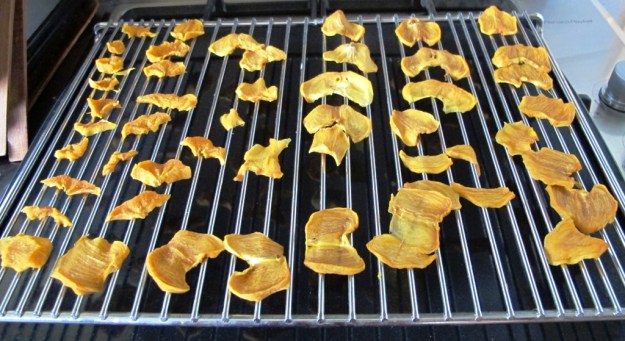 If you like dried fruit or eat muesli, they will make an excellent addition. I plan on using them as a substitute for dried apricots. They don’t taste the same but they will fill the same role. As with any dried food, they shrivel away to very little. I doubt that my forays into dried persimmons are going to make much of an inroad to our total crop – I won’t be drying hundreds of them and there is a large crop on the tree. But we are always interested in adding variety to our diet and dried persimmons take little effort to utilise a crop that we would otherwise waste.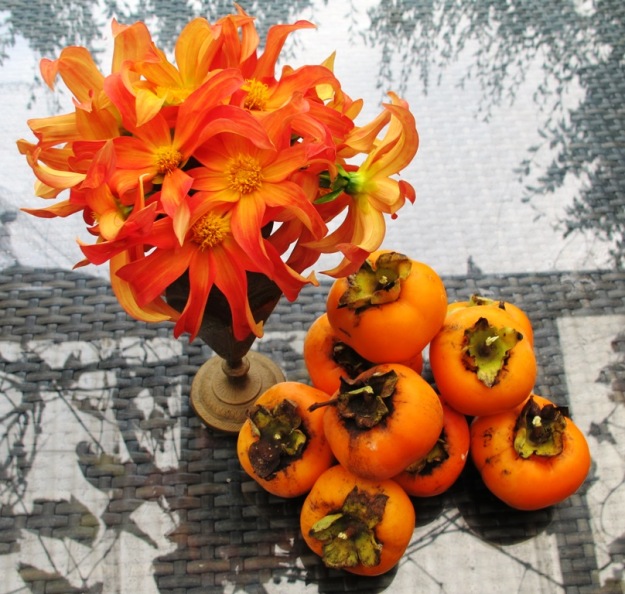
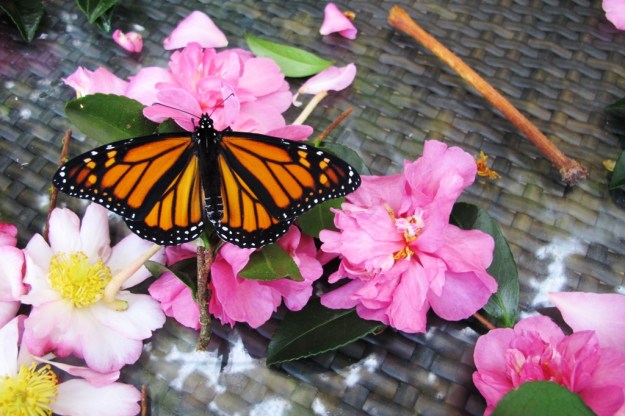
 It being autumn, ‘tis the season of sasanqua camellias here. Ever since camellia petal blight arrived to wreak havoc on the later flowering japonicas, we have been a great deal more appreciative of the sasanquas. What they lack in flower form, they make up in performance.


 It is a somewhat gloomy grey and damp day here today, brightened by a knock at the door. There stood a woman, slightly abashed. She had read a piece I wrote recently about
 Tikorangi The Jury Garden