

The genie is well and truly out of the bottle. Flaring on Mangahewa E site down the road. Photo: Fiona Clark
Never. Sign. Anything. No matter how careful you think you are being, you are signing away all your rights including future rights to things you may not even know are in the picture. We have signed two consents and have been badly burned on both. Ours is not an isolated story.
If you don’t sign, they will go ahead anyway if they possibly can. But at least you haven’t signed away what few rights you may have.
Being nice to a petrochemical company does not mean you will get a better deal. Better deals go to those who are the hardest negotiators. It is likely the reason why a petrochemical company insists you sign confidentiality agreements is because they do not want you comparing notes with your neighbours where you may well find they have negotiated a much better deal than you have. By way of example, when it comes to payments to farmers for the installation of gas pipelines across their land, a reliable source has told me he has seen agreements where the daily rate is four times higher than the base rate that is initially offered and accepted by most farmers.

Some may be grateful for a hamper containing Bluebird salt and vinegar chips and housebrand Pam’s Christmas mincemeat tarts
Some people go all out for whatever compensation or sweeteners they can get – and sweeteners come in many forms starting with modest Christmas hampers. A few refuse to touch anything. Most will take the sweeteners but, because compensation is rarely offered, they are too polite to demand it. We have never been offered or asked for compensation. In the past we have accepted some minor sweeteners. Whether you want to go all out for whatever you can get, whether you want to accept, maybe even be grateful to the company for sweeteners or whether you prefer the chilly moral high ground of refusing all such offers is entirely personal choice.

Save your home baking for friends and family
Keep records including notes of all interactions. Never delete emails. File all paperwork. Keep diary notes. You never know when you might need to refer to them. Do not make the mistake of assuming your emails to your *friendly* petrochemical company criticising Council will remain with that company. You may find them in your Official Information Act pack from Council, showing that the company has forwarded them on to the Council. I have.
When a company approaches you for your signed consent, never assume you are being told the truth, the whole truth and nothing but the truth. What you are told is likely to be well short of the whole truth. It will be best case scenario for you – but not the company whose best case scenario is very different. And nobody checks what they have told you to get your signature so if, in time, it proves to be inadequate or inaccurate, you have no recourse whatsoever. Because in signing, you signed away your rights.
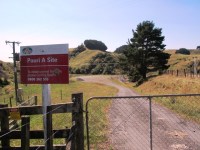
The way things used to be
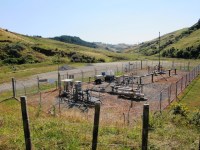
“Just a single well. Probably.”
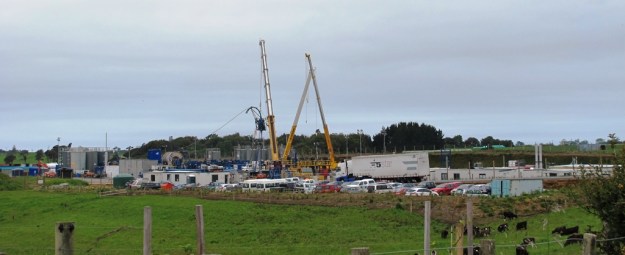
Or it could be a behemoth of a modern site
If a company leads you to believe that it will just be a little site – “you will hardly know we are there” one company is reported as saying – do not make the mistake of thinking you will get a little old-style site with a few pipes coming out of the ground and no noise or disruption. Modern sites are different, as evidenced by this behemoth of a site down the road from us and the even larger one on the farm next door. Check what they tell you against their applications for consent. Sometimes they are different. There is a big difference between “we are just going to drill one well” and their application for the full suite of eight wells plus production facilities, as one local family found.
Do not make the mistake of thinking that it will all be over when the holes are drilled. Oh no sirree. Not necessarily. Not at all. There is much ongoing work that will be done and with a big site, you can expect that frequent work to continue, we now find, for the lifetime of the site. But they won’t tell you that when they get you to sign.
Once in on a site, there is the potential for activities to escalate. Because of course they are already there so each small – or indeed large – increase in activity is just another building block on top what they have already laid. After all, in this industry it is impossible to plan ahead with any certainty and of course it is their right to escalate activities. They have invested all this money (for the good of the people, you understand, for private profit is never mentioned) and you signed away your rights back at the start.
Be prepared for the oft-repeated sneer from shallow thinking dumbos: “Well you drive a car, don’t you? You want us to go back to horse and cart? Hahaha.” This has nothing to do with fuelling our cars, even less so when it is gas, as it is in Tikorangi. Suitable replies may be: “I drink milk but I don’t think dirty dairying is okay,” or “I own a gun but it doesn’t mean I believe in war.” Glib, but parallel arguments. Derisory comments come from those who are either benefitting personally from petrochemical development or those who have no idea whatever how bad it can be for the residents living alongside the development.
Don’t expect your local councils to keep you informed. While they may and do have a great deal to do with the petrochemical companies and Their Processes allow them to assist the companies to repeatedly massage their resource consent applications until they fit the clipboard check list, these very same processes do not include keeping the most affected residents and ratepayers informed. At least not until the final decision has been made and it is too late for you to raise any concerns.
No matter how sympathetic some elected councillors may be, they cannot help you. The power base at local body bureaucracy level rests with the paid senior staff. The role of elected councillors is to be the public fall guys for staff actions and decisions and the sooner some new councillors realise this, the happier the organisation will be.
The Councils will assume that everything in the consent applications is complete and correct on the part of the companies and approve it accordingly. There is too little due diligence that I have seen. When you find out after the application has been signed off that it may not have been full and correct, it becomes a matter of personal pride for Council staff to defend their decisions. Catch 22 but no matter, the winners will be the companies.
You are on your own. There is nobody tasked with protecting the residents’ interests. You are just a small fry to be squishied as the Councils and the companies work “to get things right moving forward”.
Stress. Be prepared for considerable stress over a long period of time. I have heard the ongoing anxiety over company plans blamed for marriage breakups amongst residents. Who knows if this is the case, but I do know that the stress is protracted, genuine and very personal. And that stress is all your very own stress so if you feel your anxiety levels rising, you may need to look for help. It can take a year or two from when a company first comes a-knockin’ at your door to get all the consents in place and start the activity. They may drill one hole and then go away. But their consents are commonly for eight holes and they can come back repeatedly over the next two decades – longer for the earlier consents which don’t have an expiry date at all – and drill again. And again. Then they may apply for a variation to the consent to add more activity on the site. That stress ebbs and flows but it doesn’t go away and none of the official processes recognise the stress placed on residents. It drives some residents out but when moving is not an option, you just have to batten down the hatches and cope.
For all these reasons above, trying to work “within the system” is pretty much doomed to failure for the individual. Oh you may have some small victories to keep you happy along the way, but when it comes to the important issues that really matter, the system ensures that the powerful voices triumph.
Coming up soon: Toxic Transport and other delights from the Tikorangi Gaslands.


 In the garden it is still all about lilies. Big, blowsy, over the top auratum lilies. I am not picking the ones in the garden but in a small area of Mark’s new vegetable garden is a congested block of his seedling auratums, raised in anticipation of our new summer garden. There I can pick by the armful and oh, how I love these extravagant blooms. Auratums are a strong argument for the vigilant border control we have in this country. We do not, repeat NOT, need the lily beetle here. It is a nasty critter that takes up residence on auratum lilies and covers itself in its own excrement. We have seen it in the UK where it is an unwelcome arrival which has all but destroyed the auratum display in some areas.

 Following my final photo feature for the Waikato Times on the topic of

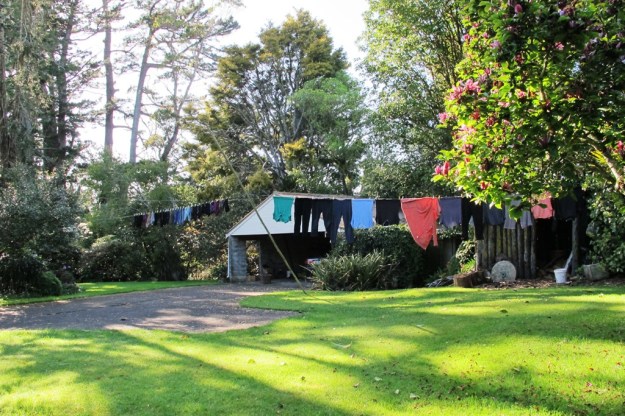 1) This is my own washing line, dating back, I assume, to when the house was built in 1950. I like the giant bamboo prop we use to hold it up. I think it is what Kevin McLeod of Grand Designs would call “honest” or maybe “unpretentious”. Old fashioned, certainly, it offers excellent drying but you do need space and you have to walk up and down it rather than standing in one spot to peg and unpeg.
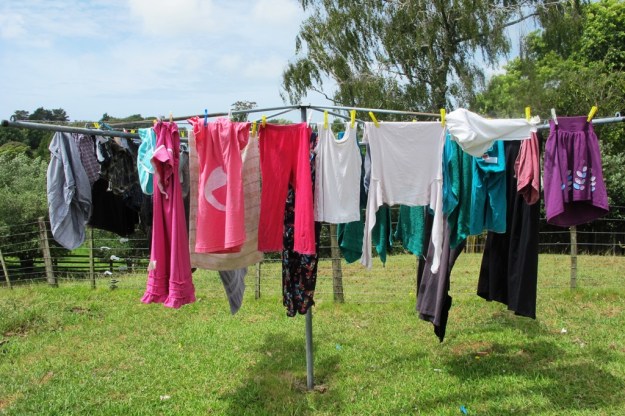 2) The rotary clothesline, often referred to as the Hill’s Hoist, is an Australasian phenomenon which features heavily in suburban backyards of both Australia and New Zealand. There is no doubt it is practical but it also lacks any aesthetic at all. Is there a sadder sight than a barren backyard with nowt but a weed infested area of broken concrete and a Hill’s Hoist washing line?
 3) Presumably in an attempt to hide the heavy visual presence of the Hill’s Hoist, there seems to be strong interest in wall-mounted lines which can often folded down discreetly when not in use. I would guess this one was advertised as having 20 metres of line space (10 wires by 2 metres each) but it isn’t really 20 metres of usable space and it won’t hold large sheets without folding them in on themselves. It lacks the air circulation of the first two options so will not offer such efficient drying but the wide eaves give some protection from rain.
 4) For property-proud people, the service areas needed for a household may be screened. Here the washing lines join the Sky dish, heat pump units, and probably the wheelie bins and recycling bins. The trade off is the reduction in sunshine hours on the shaded side of the house as well as reducing the air movement which dries washing more quickly. I have seen this done in a small garden but the screening was much closer to the washing line which created more shade and reduced air movement even further. Keep some distance if you can.
 5) As a D.I.Y. compromise, I photographed this fixed line which is free standing in full sun but softened by the frames at either end which are wreathed in a flowering climber – one of the solanum family but I am not sure which one. Paving beneath gives reflected heat and keeps fallen items cleaner. This is the best example I found for a town section where the owner wanted a more discreet but still efficient washing line. It also took the award for the prettiest clothes line I found.
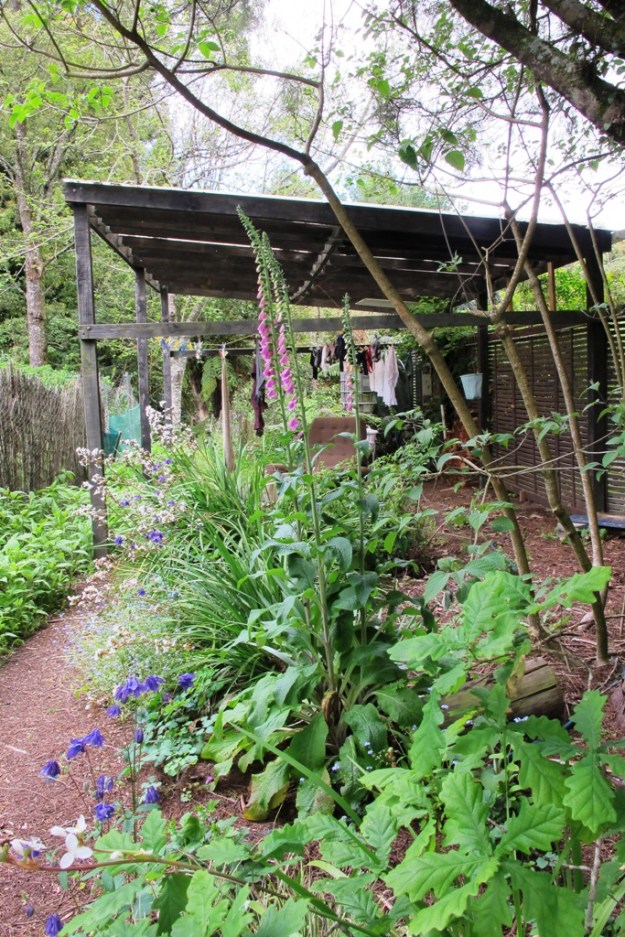 6) I spotted this line on a large country property where winters can be a little cold and bleak. It is under cover but the roof is high. It incorporates screening from view without sacrificing air movement. It is on a property with accommodation units and the owner told me there was sufficient line space to hang all the washing from the four units. She loved her washing line and, where space allows, it struck me as remarkably practical.
  It is time for me to bid farewell to Waikato readers. This will be my last garden page. The new-look garden page will be rolled out next Saturday but I will not be part of it. I have really enjoyed writing for this publication over the past 3 ½ years and would like to thank readers for reading it. Thank you also to those of you who have emailed and even written proper letters and cards.
 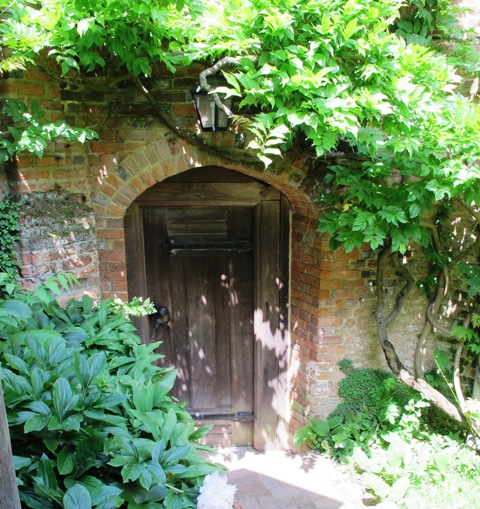 “I shall stop being queer,” he said, “if I go to the garden. There is Magic in there – good Magic, you know, Mary, I am sure there is.”
 Tikorangi The Jury Garden