
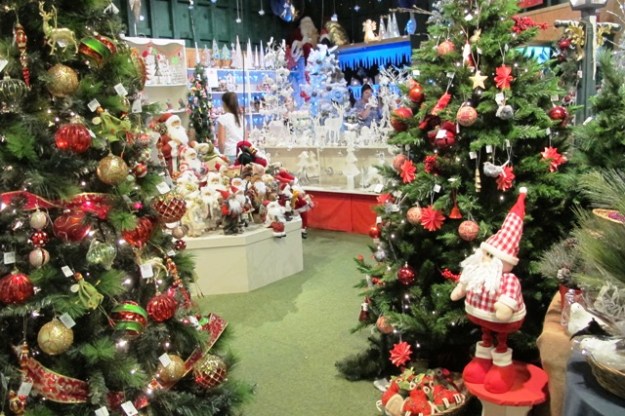
 1) I have not made a great study of artificial Christmas trees but from what I can see, there is a vast range and both quality and price are equally variable. They are not as easy to customise as a living tree (or a dying tree, to be precise, if you have one without roots). There is a certain danger of ending up with one that looks similar to a shopping centre tree, especially if you opt for decorations that are restrained and unified as is favoured by many designers. For many, much of the charm of the traditional tree lies in the mishmash of family decorations passed down the decades.

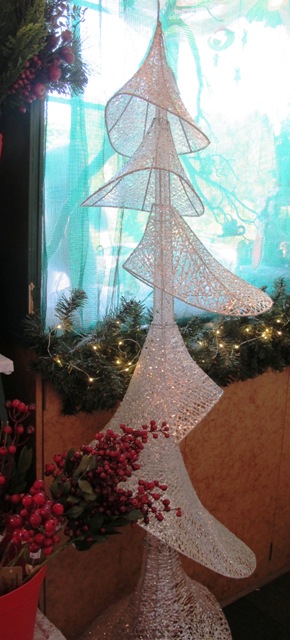
2) Where space is limited – I am thinking of small urban apartments or similar shoe-box living – I was very taken by this tall, narrow tree which I spotted in Trade Aid. It comes with built-in star and could be stored easily at the back of a wardrobe for the other 49 weeks of the year. Add a string of lights and a few small angels and birds, and you have an instant feel of festive cheer amplified by the knowledge that your purchase is supporting fair trade. The spiral tree that looks as if it is a variant on stacked sunhats was in a specialist Christmas store and has a somewhat sophisticated ambience for the minimalist decor.
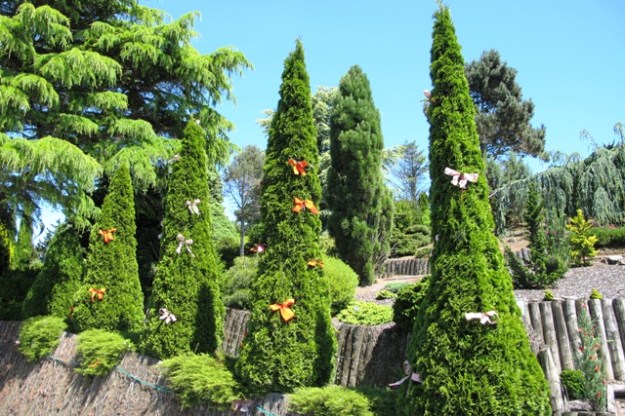
 3) If you have a suitable tree outdoors, decorating it with expendable decorations can be a festive greeting to be shared with passers-by. These are thujas. Norfolk Island pines look magnificent with a star on the top if you can work out how to reach their elevated heights. I have seen it done, though I am not sure how one would manage without a cherry picker or a tree-climbing monkey in the family. But folk are sufficiently enterprising to festoon their houses in Christmas lights (and pay the power bill) so no doubt there are some quite capable of decorating trees outside.
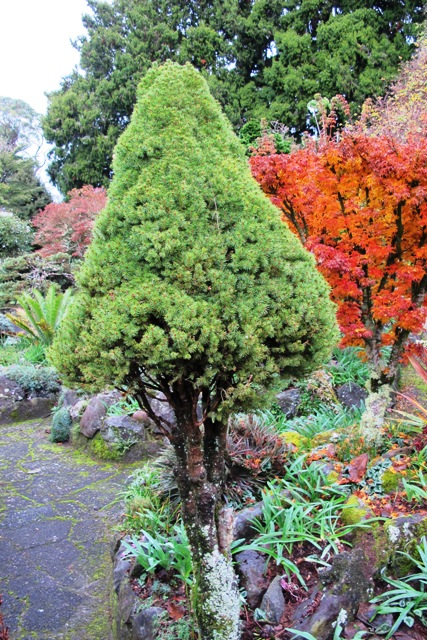 4) Our cute little Picea albertiana conica died. I have wondered about shaking all the dead foliage out of it and recycling it for the next few years as a skeleton Christmas tree. It is the perfect size and shape and could be stored in a shed. However, I recall one year using a large yet shapely dead branch which I spray-painted white. The children were young at the time but they were distinctly underwhelmed by their mother’s creativity and just wanted a proper Christmas tree such as other families had.
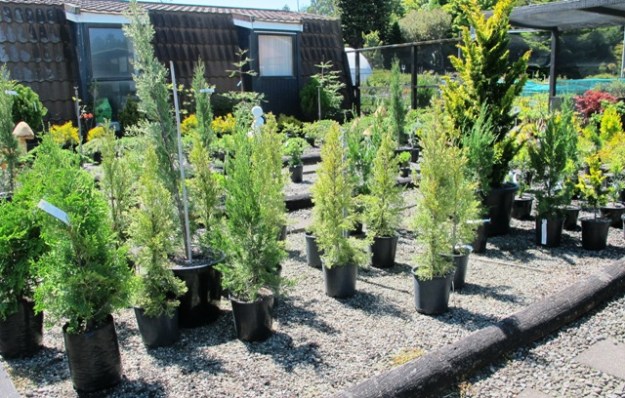 5) If you want a living tree, you need to set your sights small and choose a dwarf if you are intending to keep it alive for several years. Conifers have relatively large root systems and will not thrive on benign neglect when kept in a pot long term. However the very small growing varieties can be kept for many years with just the usual care that container plants require. They get more characterful with age, though not necessarily a whole lot larger.
 6) At the risk of repeating myself from previous years, I offer up our two variations. Both use a handy, permanent, metal frame I was given. The toe-toe tree was spectacular but a one-season wonder. It had a unique Pacifica vibe which was a nice cross-cultural connection given the European history of the Christmas tree (16th century Germany). The woven grapevine version is durable, makes no mess and is very easy to decorate.
First published in the Waikato Times and reprinted here with their permission.
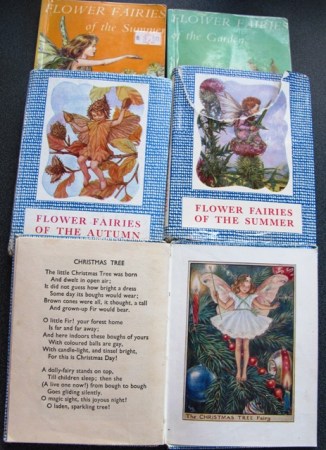
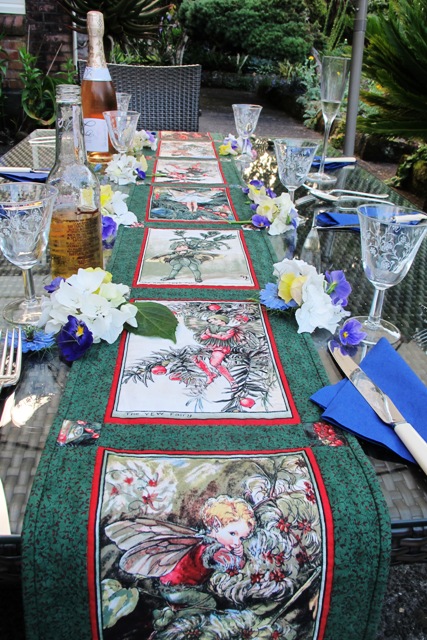 Garden lore: A Flower Fairy Christmas
 This is what our corner of Otaraoa and Tikorangi Roads used to look like in the mid 1990s. The havoc on the left hand side is the result of major work Mark carried out to reduce flooding through our park and to return some of the stream to its original bed. His tidy grandfather had straightened up the stream to run along the boundary back around the early 1900s.
 A year or two later and our children are getting off the school bus on what was a quiet country road. Note the trees on the right hand side.
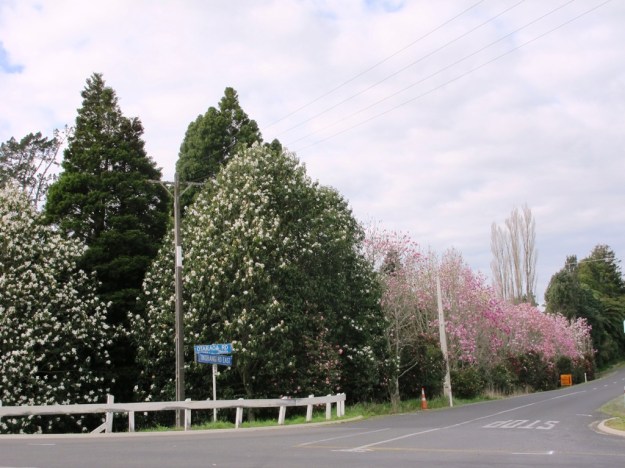 This is what our side of the road looks like now. The trees have grown up and many people tell us how much they enjoy the flowering.
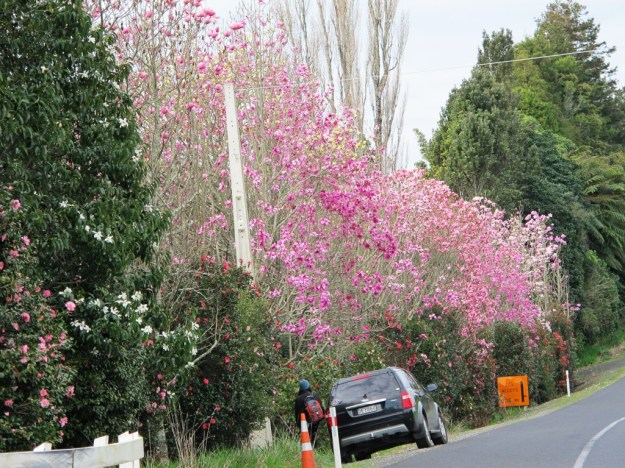 But we now have the petrochemical industry all round us and down this formerly quiet little country lane is the huge Mangahewa C site with its eight gas wells, single men’s camp and much additional activity. The road has been strengthened and widened for their heavy transport, all done in such a way as it is now impossible to walk along the verge. It is sometimes referred to as “loss of rural amenity”. Children can no longer walk safely to and from school bus stops, cycling is not safe, forget horse riding. It is pretty difficult to find a safe position to stand clear when the heavy transport thunders by. Meantime, across the intersection, the other side of Tikorangi Road – largely unused by the petrochemical industry – has remained unchanged over the past 20 years. It is a stark contrast.
 And on the right hand side of the road where there used to be trees, there is now a green wasteland dominated by the designated high tension power lines that Todd Energy, a petrochemical company, deemed necessary for their operations. Sadly, petrochemical development is now given precedence over rural amenity, local residents or the preservation of the environment. This is our world of 2014. During the day we listen to the heavy transport. At night, our formerly pitch black sky is often lit by gas flares in one or more quadrants. On an otherwise quiet Sunday morning today, I could hear the distant noise from Mangahewa E site. Every night we go to sleep to a low drone from one of the plants and we are not even sure which one it is any longer because there are four possible sources for the noise. But under the Resource Management Act, we are told by our councils that “effects are less than minor” and we are not, therefore, an affected party.
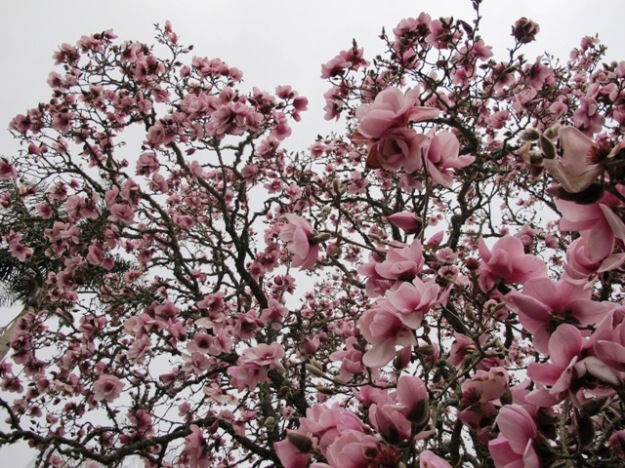

 Tikorangi The Jury Garden