
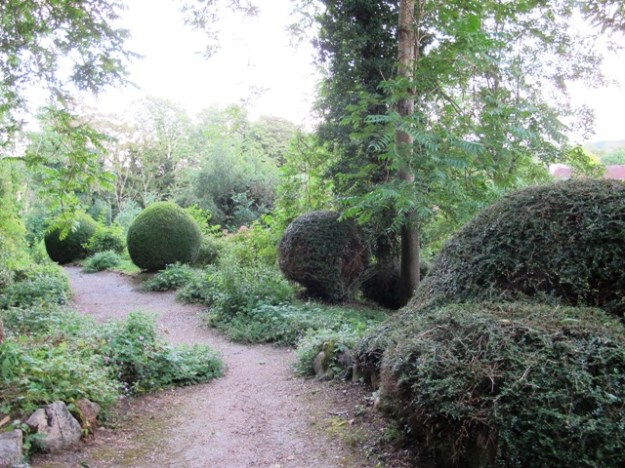
In an otherwise undistinguished garden in Giverny village, these clipped hummocks gave real impact.
Formal gardens will often have pretty much everything clipped. If you have ever been to many Italian gardens, you may have noted the inclination to clip everything – at times to within an inch of its life. It photographs well. In fact we have often found that the photograph can be better than the real thing when you get to see it.
The modern New Zealand garden is characterised by clipped hedging, often carried out with military precision whether 30cm or 200 cm high.
But if you don’t want a formal garden or clipped hedging, there is a middle path. Punctuation marks.

Clipped accent plants give form in this garden which has predominantly loose herbaceous plantings and grassy meadows. Pettifers near Stratford on Avon.
It is a technique that you can transfer to many situations. At its simplest level, a tightly clipped shrub gives a focal point of order in a casual or chaotic environment. If your garden looks an unkempt mess, try it. You may be surprised at how a formal shape can make the disorganised areas alongside look as if they are intentional.
A sequence of clipped punctuation points gives coherence or visual order to an otherwise disorganised space. Sometimes it is a deliberate design feature, other times it may be closer to an act of trickery by a laissez faire gardener.
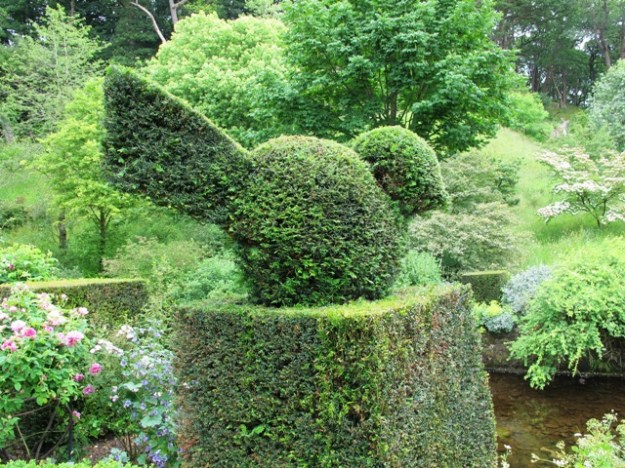
While the topiary bird at Gresgarth may be beyond the amateur, the sharp lines give contrast to the informal plantings and design.
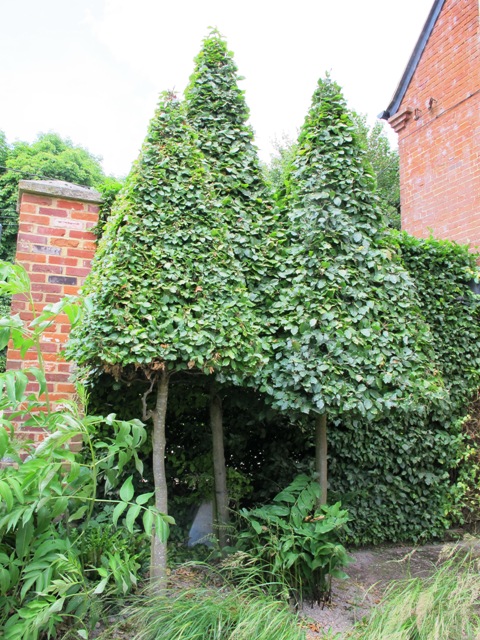
Pyramids on stilts give an accent point, a breathing space between two very different gardens at Bury Court.
I have also seen small groupings of clipped shrubs used as a breathing space, a quiet linking device between two very busy but different areas of a garden.
Various shrubs can be clipped effectively. There are the tried and true hedging plants of buxus, lonicera and teucrium. Yew is a classic clipping candidate.

Often referred to as “pudding trees”, these Chamaecyparis give structure in the otherwise informal cottage garden made by Margery Fish at East Lambrook Manor
Camellias clip well. If you can cope with the prickles, so do hollies. Choysia ternata takes clipping. Evergreen azaleas take clipping and shaping well. So indeed do our native totara and matai. Some conifers can be clipped, some cannot. The mark of one that does not take clipping is a failure to sprout afresh from bare wood (in other words, where you have cut below the external leaf cover). It can be terribly blotchy and twiggy on conifers, if not terminal. Do some research first before you try this on your prized specimen.
The more you clip, the denser the new growth becomes so the tighter shape you get as a result. But if you are considering a first hard clip to establish a shape, do it right now. This very weekend is good. That is because at the end of the day, most plants are on the cusp of breaking into fresh spring growth (spot my political allusion). The aim is to clip before that happens, stimulating the plant to make fresh new growths at the point where you have cut it back. You will generally have to follow up with a tidy-up trim of long new growths a bit further down the season, but the first clip is the most radical shaping. Once established, you can often get away with just once a year.
Or clip on special occasions when you want your garden to look sharp, cared for or creative.
First published in the Waikato Times and reprinted here with their permission.


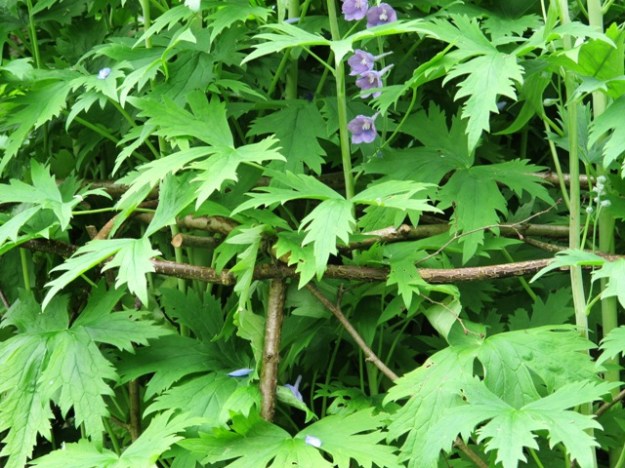 Delphiniums are usually problematic. Rather than staking each flower spike individually, having a clump of them enables them to be retained invisibly. If natural fibre string is used for any ties required, the entire structure is fully biodegradable. This type of support is probably the most time consuming to construct. Whether it takes longer than to stake each flower stem individually, tying it with synthetic stretch tie to a plastic cane is debatable however.
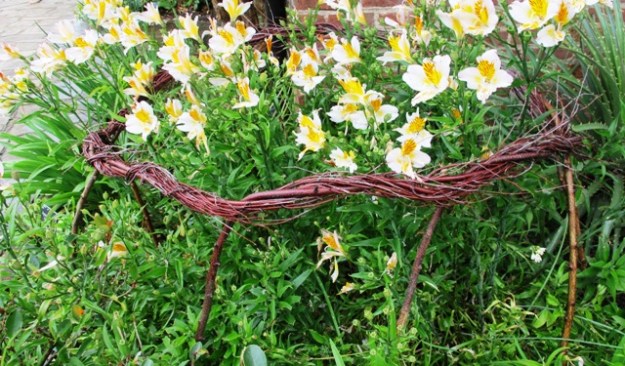 Alstromerias are inclined to fall apart in our climate with rapid growth rates and often torrential downpours. Here the weaving approach has been used, adapted from its traditional use in rural fences and hedges. Stems of willow have been pushed into the ground at regular intervals and then bent and woven, side growths and all, at the desired height. If you are using a material like willow which can root easily, you need to either treat the ends (boiling water should do it if you are shunning herbicides) or keep an eye out for the support starting to grow.
 In this case, wire mesh has been laid at about 30cm above the ground to support the plant, a tall thalictrum, as it grows. While neither invisible nor attractive, the plant growth will fill out and hide it as the season progresses. If you want to try a natural alternative, tying bamboo lengths together in a grid will work. We have used a vertical bamboo grid to give an unobtrusive frame for a seasonal climbing plant –
 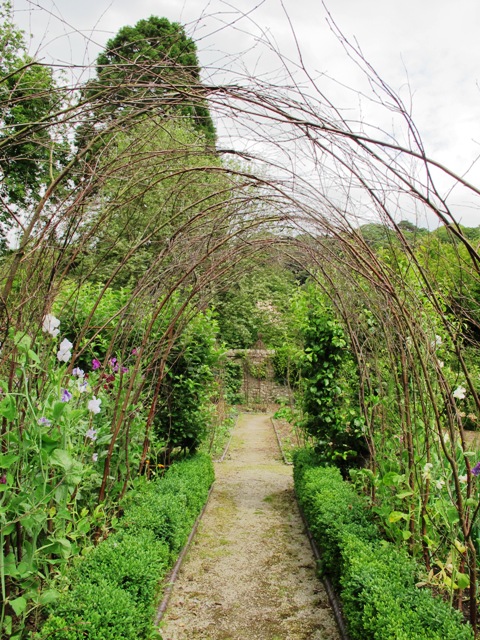 It depends on what visual effect you want in your garden, but the use of natural materials to create a seasonal growing frame is as efficient while more environmentally friendly than tanalised timber, plastic or metal. It is just not as permanent but this may not be a requirement for some gardeners, certainly when it comes to annual crops such as sweet peas. The natural alternative will usually age more gracefully.
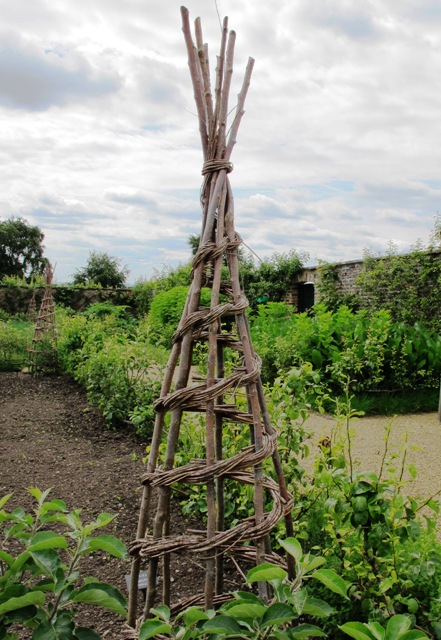 We make
 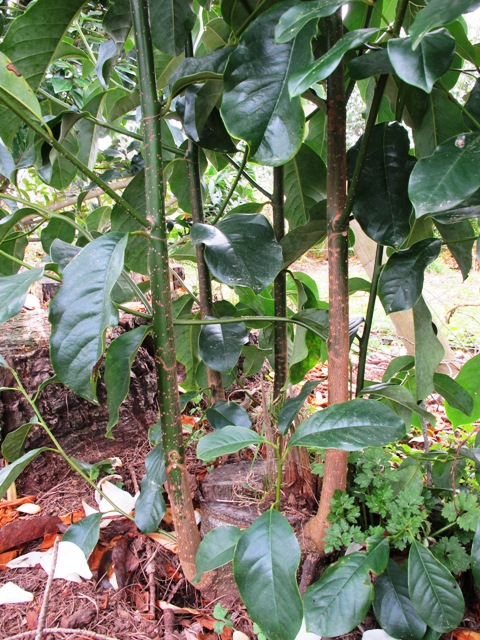 If you have the space, coppicing plants is the traditional means of ensuring an ongoing supply of fresh, green wood. We are very impressed at the coppicing potential of michelias here. Others coppice cornus already and hazel is the traditional English material. However, most gardens will have some suitable material available for gathering – grapevine, bamboo, willow, phebalium, wisteria canes – the choices are many. The growth needs to be flexible for weaving, more rigid if it is to be pushed into the ground, twiggy if it is to form a natural support for bushy plants – one material will not fit all situations.
 Tikorangi The Jury Garden